CPT code 21011: Excision of soft tissue tumor of the face
CPT code 21011: Official descriptor and procedure overview CPT code 21011, as pu...

Last Updated: Oct 8, 2026
CPT Code 30420 is the billing code for rhinoplasty, primary; including major septal repair. It covers a procedure that reshapes the nose while correcting a structural deformity of the septum.
That septal work has to be substantial enough to count as integral to the rhinoplasty. It is what separates 30420 from CPT 30400 (limited tip work) and CPT 30410 (complete rhinoplasty, no major septal repair).
Most payers treat 30420 as cosmetic by default, so payment rests on documented functional impairment and, in many plans, prior authorization.
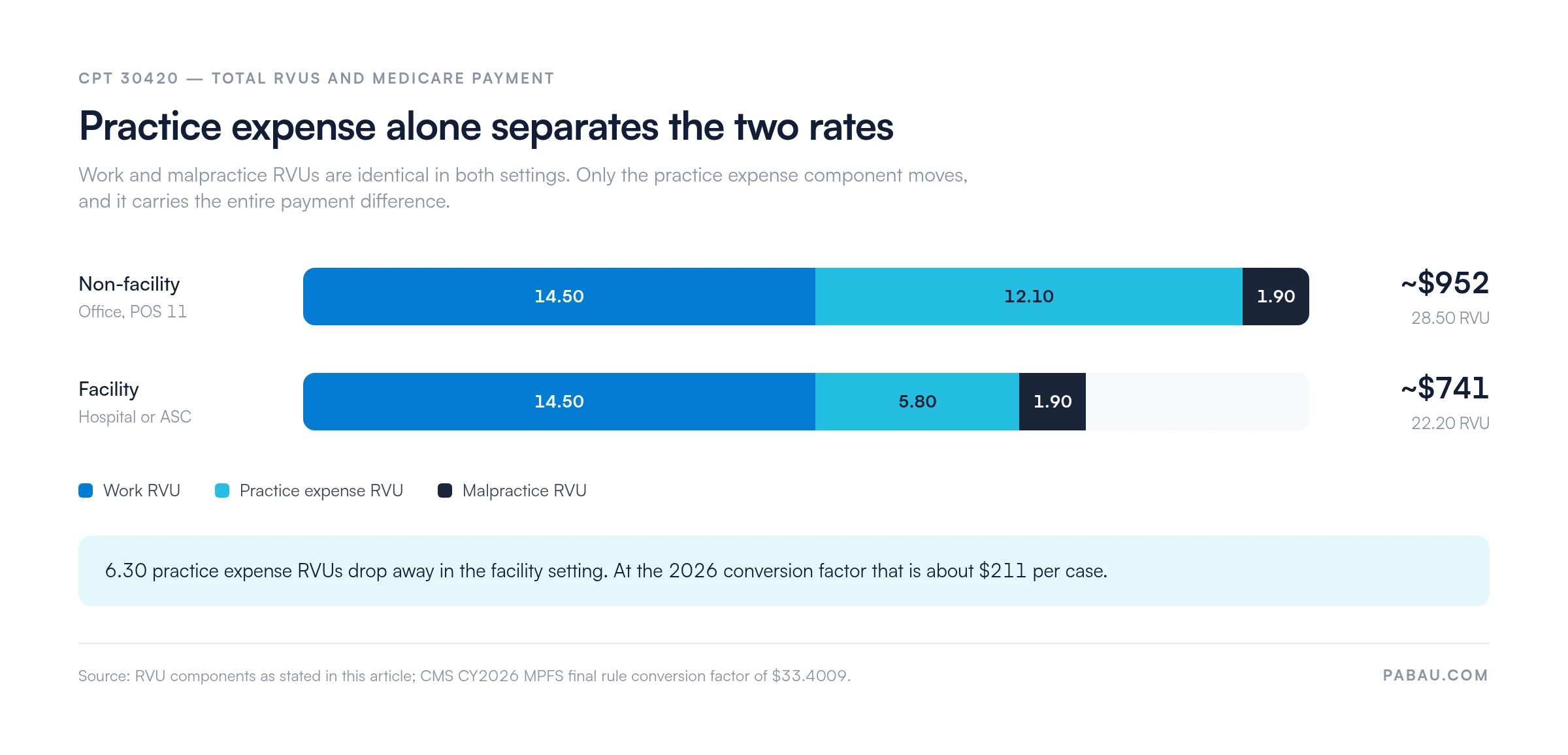
National Medicare payment runs about $952 in a non-facility setting and about $741 in a facility. The sections below cover the RVU breakdown, modifiers, supporting ICD-10 codes, NCCI bundling rules, and the most common denial reasons.

CPT Code 30420 describes rhinoplasty, primary including major septal repair, which separates it from 30400 and 30410.
Medicare covers 30420 only when the record documents functional impairment, such as nasal obstruction from a deviated septum.
At the CY2026 conversion factor, national Medicare payment runs about $952 non-facility and about $741 facility.
The leading denial reasons are missing prior authorization, cosmetic-only ICD-10 coding, and incorrect unbundling with CPT 30520.
Practice management software like Pabau carries built-in CPT and ICD-10 catalogs and files claims through the Claim.MD clearinghouse.
CPT Code 30420 describes rhinoplasty, primary; including major septal repair. The American Medical Association places it in the Surgery section, under Repair Procedures on the Nose (CPT range 30400-30630).
“Primary” means the patient has not previously undergone rhinoplasty on the same anatomical site. “Major septal repair” means substantial reconstruction of the nasal septum as an integral part of the rhinoplasty, not a minor adjustment.
Clinically, 30420 fits a patient who has both an aesthetic nasal deformity and a functionally significant septal deviation. Neither CPT 30400 nor CPT 30410 covers septal work of that extent.
The correction goes well beyond the incidental repositioning that accompanies a routine rhinoplasty. Spreader grafts, caudal septal repositioning, and resection of large bony or cartilaginous spurs are the typical techniques.
Medicare reimburses CPT Code 30420 under the Medicare Physician Fee Schedule (MPFS) when medical necessity is documented.
The rates below are national averages, taken before geographic adjustment through the Geographic Practice Cost Index (GPCI). Payment varies by locality. High-cost urban areas typically pay 15% to 30% above the national average, and rural localities often pay below it. Verify current rates with the CMS Physician Fee Schedule lookup tool.
The Medicare payment formula is total RVU multiplied by the conversion factor, then adjusted by GPCI. CMS set the CY2026 conversion factor at $33.4009 for clinicians who are not qualifying APM participants.
Qualifying participants are paid at $33.5675. The final rule was published on October 31, 2025 and took effect on January 1, 2026. The payment row below uses the $33.4009 rate.
Important: the RVU values above are approximations and should be confirmed against the CMS MPFS final rule for the applicable year. GPCI adjustments can shift total payment by 20% to 40% depending on locality. Pull current work, practice expense, and malpractice values from the CMS relative value files for your carrier.
The place of service code on the claim determines which rate applies. When CPT 30420 is performed in a physician’s office or a practice-owned surgical suite (place of service 11 or 24), the non-facility rate applies.
When it is performed at a hospital outpatient department or an independent ASC (place of service 22 or 19), the facility rate applies. The facility bills CMS separately for overhead, so the physician payment drops.
The difference is roughly $211 per case at national average rates. Every dollar of it sits in one RVU component.
Always confirm the place of service code matches the physical location where the procedure was performed. A mismatch between the claim’s POS code and the facility’s NPI type is a common audit trigger for rhinoplasty claims. It can also lead to overpayment recovery demands.
Modifiers for CPT Code 30420 clarify circumstances that change how the payer prices or processes the claim. Rhinoplasty is a midline procedure, so bilateral modifiers (RT, LT, -50) are clinically atypical.
Most payers deny them without supporting documentation. Modifier -22 for increased complexity applies most often, given the mix of cosmetic and functional work.
Modifier applicability is payer-specific. Not all payers follow CMS modifier rules, so check individual payer policies before filing. Modifier -50 (bilateral procedure) is clinically inappropriate for a midline nasal procedure under most circumstances. Applying it without clear anatomical justification risks a medical review or an audit flag.
Medical necessity for CPT Code 30420 rests on a functional diagnosis. The ICD-10-CM codes below establish that the patient has a structural nasal impairment affecting breathing or function.
Documentation has to support the specific diagnosis, because payers deny claims where the operative note and the diagnosis code disagree. Check the exact descriptor in the ICD-10-CM code index before you file, since several nasal codes sit close together.
Cosmetic-only diagnoses that will be denied: purely aesthetic diagnoses do not support payment. Take Q67.4 (other congenital deformities of skull, face and jaw). Filed without documentation of functional impairment, it is denied as a non-covered cosmetic service. The claim has to carry the functional component explicitly.
Medicare and most commercial payers draw a sharp line between functional rhinoplasty, which is covered, and cosmetic rhinoplasty, which is excluded. For CPT Code 30420 to be payable, the claim and the medical record have to agree.
Together they must show that the procedure addressed a structural impairment causing measurable functional deficits. Build those documentation requirements into pre-authorization and scheduling, rather than assembling records after a denial arrives.
According to First Coast Service Options (FCSO) Medicare review policy for rhinoplasty and related services, the following elements are required in the medical record:
Prior authorization requirements vary by payer and by plan. Some Medicare Advantage plans impose prior authorization requirements that traditional Medicare does not. Verify with each plan before the procedure is scheduled.
The National Correct Coding Initiative (NCCI) establishes which procedure codes may be billed together and which are automatically bundled.
NCCI edits change quarterly, so any statement about a specific code pairing should be checked against the current CMS NCCI tables before filing. The most common bundling conflict for 30420 is its relationship with CPT 30520 (septoplasty).
CPT 30520 is standalone septoplasty, a correction of the nasal septum with no rhinoplasty component. CPT 30420 already includes the septal repair as part of the rhinoplasty.
When a rhinoplasty and a septoplasty happen at the same session, one coding question decides the claim. Was the septal work separate from the rhinoplasty, or integral to it?
CPT 30420 and CPT 30520 are subject to NCCI bundling edits when billed together. The CMS procedure-to-procedure edit tables list the current code pairs each quarter. Whether a modifier can override the edit depends on how distinct the two procedures were.
The operative note has to document them separately and justify them as non-overlapping. Check your denial management workflows before appealing a bundling denial.
Selecting the right rhinoplasty CPT code depends on the extent of the procedure and on whether septal repair is performed. Choosing the wrong code from within the rhinoplasty family is one of the most frequent audit findings in ENT and plastic surgery billing.
HCPCS descriptor families behave the same way, and K0825 covers a group 2 heavy duty power wheelchair with a captain’s chair seat. A sling seat, or a weight band above 450 pounds, carries a separate code and a separate DMEPOS fee schedule allowance.
Most CPT 30420 denials trace back to five mistakes. Each one below carries the fix a practice can build into its pre-claim workflow, ahead of submission rather than after a rejection.
Run a quarterly audit of your 30420 claims using the denial reason codes on your clearinghouse remittance advice. Codes such as CO-97 and CO-4 point to bundling or modifier errors, and a coding review can correct those prospectively.
In most ENT and plastic surgery practices, a 30420 claim passes through three disconnected systems. The surgeon dictates the operative note in one place. A coder picks the diagnosis somewhere else. The claim then leaves through a separate portal, and the mismatch only surfaces when the remittance arrives.
Practice management software like Pabau keeps those steps in one patient record. The CPT and ICD-10 catalogs sit inside the chart, so the code a coder selects is attached to the operative note it came from. Eligibility checks run before the procedure is scheduled, which is where prior authorization problems are cheapest to fix.
Claims then go out through the Claim.MD clearinghouse, which reaches thousands of US payers, and remittance advice comes back into the same record. A denied 30420 appears next to the note that caused it. The appeal starts with the document the payer asked for, instead of a search through three systems.

Pabau connects ENT and plastic surgery practices to Claim.MD’s clearinghouse network. Clean claim submission, real-time eligibility checks, and ERA reconciliation all run from one platform.

CPT Code 30420 sits on the line between cosmetic and functional surgery, and payers price that ambiguity into every review. The work that decides whether the claim gets paid happens long before the patient reaches the operating room.
Build the functional documentation into pre-service scheduling, and re-check NCCI edits each quarter. Match the diagnosis code to the operative findings rather than to the patient’s complaint. Practices that hold that line see 30420 pay like any other major surgical code.
Documentation thorough enough to satisfy a payer does cost the surgeon time at the dictation stage. Structured operative templates absorb that cost once, rather than on every claim. Book a demo to see how Pabau runs surgical billing from pre-authorization through remittance.

Need a clearinghouse built into your billing workflow? Pabau’s Claim.MD clearinghouse guide explains how the integration supports thousands of US payers, ERA delivery, and clean claim rules.
Wondering how denial codes get resolved? Denial codes in medical billing covers CARC and RARC code interpretation and appeal strategies for common surgical claim rejections.
Want fewer surgical claims coming back? What a clean claim is sets out the fields, code pairings, and eligibility checks that decide whether a claim pays on first submission.
CPT Code 30420 is the billing code for rhinoplasty, primary; including major septal repair. It covers a procedure that reshapes the nose while performing substantial structural correction of the nasal septum. It sits under Repair Procedures on the Nose (CPT 30400-30630) in the AMA’s Surgery section.
National average Medicare payment runs about $952 at the non-facility rate and about $741 at the facility rate. Those figures apply total RVUs of roughly 28.50 and 22.20 to the CY2026 conversion factor of $33.4009. Payment varies by locality through GPCI adjustment. Verify exact figures against the current CMS Physician Fee Schedule before billing.
Modifier -22 (increased procedural services) applies most often, where documentation supports substantially elevated complexity. Modifier -51 (multiple procedures) may apply to secondary codes billed at the same session. Modifiers -RT, -LT and -50 are clinically atypical for this midline procedure and are payer-specific. Always check modifier rules against individual payer policies.
Yes, where documented functional impairment exists. Medicare and most commercial payers cover CPT 30420 when the record establishes nasal obstruction and measurable functional deficits. The record also has to show that conservative treatment failed. Purely cosmetic indications are excluded regardless of the CPT code billed.
Only where the septoplasty was performed as a distinct procedure from the rhinoplasty and documented separately in the operative note. NCCI bundling edits may apply, and a modifier may be required to override the edit. Check the current quarter’s NCCI tables before billing both codes at the same session.
The medical record needs a history of functional nasal impairment, physical examination findings, and pre-operative photographs. It also needs an operative report describing the extent of septal repair separately from the cosmetic reshaping. Add a prior authorization number where the payer requires one. Insufficient operative detail is the most common trigger for post-payment medical review.