



CCSD code G5100: Bypass of duodenum billing guide
CCSD code G5100 bills a bypass that leaves the duodenum in place CCSD code G5100...

Last Updated: Oct 16, 2026

CPT Code 29888 reports arthroscopically aided ACL repair or augmentation, with or without internal brace ligament augmentation, under the AMA’s Musculoskeletal Endoscopy/Arthroscopy section
The 2026 Medicare national average facility rate for CPT 29888 is about $889, and commercial payers typically pay 110-150% of that.
A 90-day global surgical period applies, so routine post-op E&M visits are bundled into the surgery. Billing one separately needs modifier 24 and an unrelated diagnosis.
Practice management software like Pabau flags NCCI edit conflicts and missing modifiers before submission, which cuts ACL arthroscopy denials.
CPT Code 29888 reports arthroscopically aided anterior cruciate ligament repair or augmentation, with or without internal brace ligament augmentation. It covers arthroscopic ACL work in the knee, including procedures that place an InternalBrace device. Open ACL repair is coded 27407 instead.
This reference covers the billing variables that decide whether a 29888 claim pays. That means the descriptor, 2026 Medicare rates, RVU components, modifiers, the ICD-10 crosswalk, NCCI edits, documentation, and the 90-day global period.
Missing laterality modifiers and NCCI conflicts with co-billed codes such as 29881 and 29882 cause most 29888 rejections. Those two sections carry the most detail.
CPT Code 29888 describes arthroscopically aided anterior cruciate ligament repair or augmentation with or without internal brace ligament augmentation. The American Medical Association (AMA), which maintains the CPT code set, places this code in the Musculoskeletal System chapter under Endoscopy/Arthroscopy (codes 29800-29999).
The procedure itself involves arthroscopic visualization of the knee joint to repair or augment a torn or insufficient anterior cruciate ligament. Key distinctions for coding:
Coders need both forms of the descriptor. Claim submission systems often truncate to the short description. Payer medical necessity reviews reference the long form.
“Repair” and “reconstruction” are not synonymous in CPT language, but 29888 covers both when the work is done arthroscopically. The approach decides the code, not the technique. That is why the operative note has to state the approach explicitly.
Internal brace ligament augmentation does not constitute a separate reportable service. If the surgeon places an InternalBrace device during the same session as 29888, no additional code is added. Payer-specific coverage policies for internal brace devices vary, so verify prior authorization requirements before surgery when applicable.
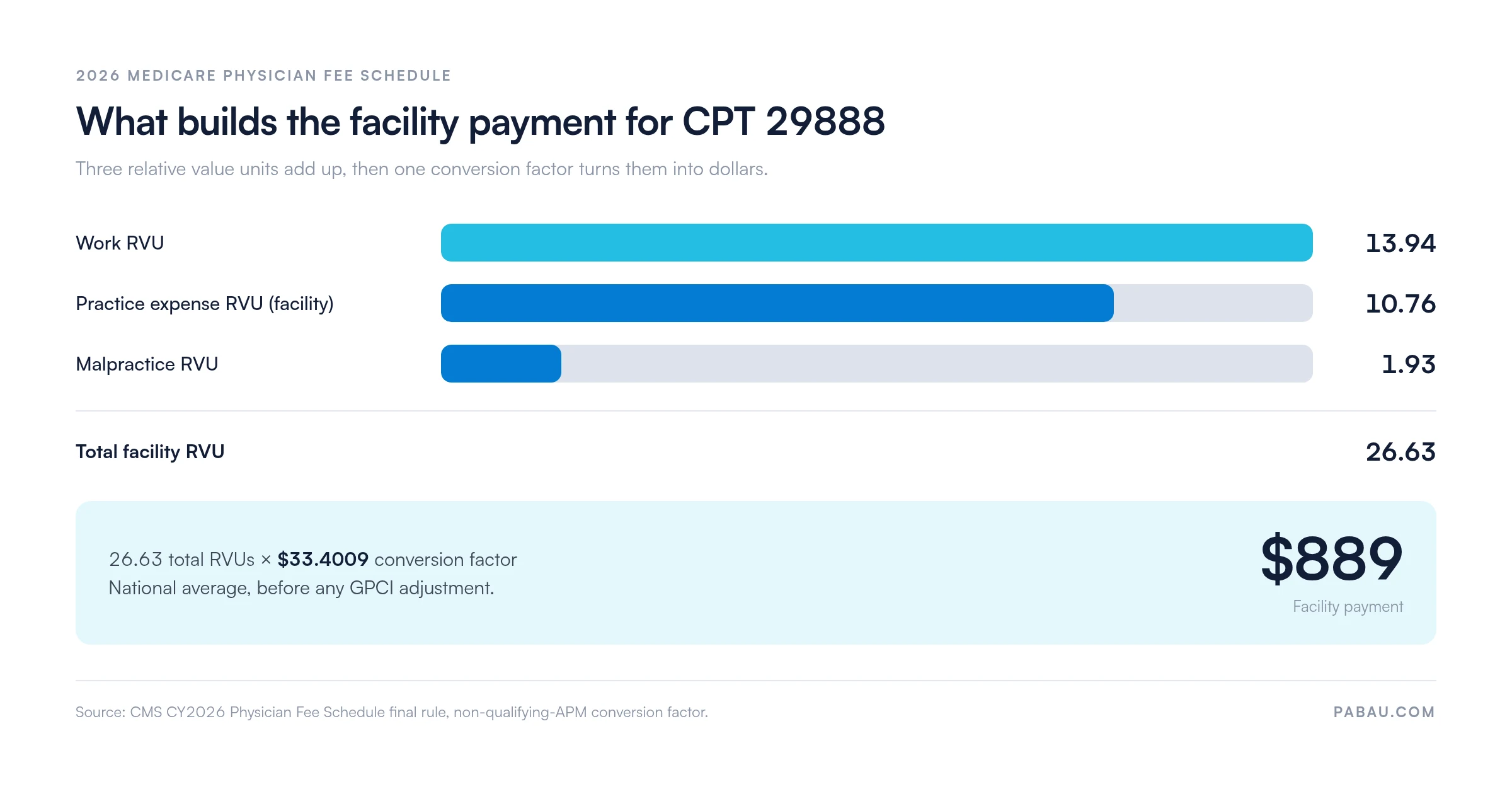
Medicare pays about $889 for CPT 29888 in a facility setting in 2026, before any locality adjustment. Rates are set annually through the CMS Physician Fee Schedule.
They differ by place of service and are adjusted for local cost factors through the Geographic Practice Cost Index (GPCI). The figures below are 2026 national averages, so verify your own locality in the PFS look-up tool.
The facility figure is a national average built from the RVU components below. Check your own locality against the CMS PFS look-up tool before using it in a contract discussion. Commercial payer rates are contractual and vary by region and negotiation history.
Converting RVUs to dollars takes one step. Multiply the total RVU value by the CMS conversion factor. The CY2026 final rule set that factor at $33.4009, or $33.5675 for clinicians in a qualifying alternative payment model. Work RVUs drive physician compensation benchmarks. Practice expense RVUs reflect overhead allocation.
Work RVUs are only just over half the total, so the facility payment tracks overhead almost as closely as it tracks physician effort. The chart below runs the arithmetic end to end.
Modifier selection is where most 29888 denials originate. A missing LT or RT is the most common avoidable rejection on this code. The table below covers every modifier billing staff should consider for it.
Always append LT or RT to every 29888 claim before submission. A missing laterality modifier is the fastest path to an administrative denial, and most payers will not process the claim without it. Build laterality into your claim template defaults so it cannot be omitted.
Pairing 29888 with a specific ICD-10-CM code is what establishes medical necessity. Unspecified codes trigger payer edits and raise denial risk, so pull the diagnosis straight from the operative report.
The ICD-10-CM code library carries the current descriptors if you need to confirm one. The M23.61x series is the primary diagnosis family for ACL pathology, and its final character specifies laterality.
Verify current ICD-10-CM codes against the CDC/NCHS ICD-10-CM web tool before each billing cycle. Codes are updated annually effective October 1; a code valid in FY2025 may be retired or revised in FY2026.
ACL arthroscopy frequently involves additional procedures on the same knee during the same operative session. Each co-billed code needs separate documentation establishing it as a distinct, medically necessary service. The table below shows which of those codes are separately reportable and which bundle into 29888.
CPT 29870 sits in that table as a bundled code rather than a billable one. Its separate procedure designation folds the diagnostic scope into any surgical knee arthroscopy performed in the same session.
The table lists 29882 for meniscus repair, which covers one compartment only. Repairing both the medial and lateral menisci in the same session is reported as 29883. That claim follows the same modifier 51 and separate documentation rules.
The Centers for Medicare and Medicaid Services (CMS) runs the National Correct Coding Initiative (NCCI). It governs the code pairs that cannot be billed together without a modifier override. For CPT 29888, the key NCCI rules are:
Adhesion release during the same ACL case needs the same check. A same-session lysis of adhesions is reported as 29884, which can be payable with modifier 51. Confirm the current NCCI pair before you bill both.
The separate procedure designation in a CPT descriptor reaches well beyond orthopedics. CPT 46600, diagnostic anoscopy, bundles into a larger endoscopy such as a colonoscopy when both happen in the same session.
Effective denial management workflows for orthopedic practices include a pre-submission NCCI check on every 29888 claim that includes a co-billed arthroscopy code. Current NCCI table files are available for download from CMS and update quarterly.
An ACL arthroscopy claim without a complete operative note is the most direct route to a medical necessity denial. Documentation must establish what was done, why it was medically necessary, and that the reported code matches the procedure performed. Each element below belongs in the operative report before the claim goes out.
Payer audits of high-value orthopedic claims are common. A complete operative note is the primary defense against a post-payment recoupment request.
Order documentation on equipment claims runs in the opposite direction, since it has to exist before the service rather than describe it afterward. The written order for HCPCS code K0816 must be signed and dated before delivery. A generic order reading “power wheelchair” fails the specificity test, because the code itself has to appear on it.
CPT 29888 carries a 90-day global surgical period. Medicare and most commercial payers therefore include routine post-operative care in the surgery payment for 90 days after the procedure. The table below shows what falls inside that package and what does not.
Denials on 29888 cluster around a predictable set of errors. Use the list below as a triage checklist for the rework queue, with the fix for each pattern.
Run a denial pattern audit on your last 90 days of 29888 claims before the next billing cycle. Categorize denials by reason code (CO-4, CO-97, CO-B15) and total the dollars attached to each pattern. Laterality misses and unbundling errors are usually the two largest categories, and both are fixable at the point of claim creation.
Orthopedic billing teams running high-volume ACL caseloads hit the same problem. Coding decisions get made while the note is written, then validated at claim submission, by which point the rework already exists.
Practice management software like Pabau closes that distance through its Claim.MD clearinghouse integration. NCCI edit conflicts and missing modifiers surface before the claim leaves the practice.
Pabau’s software that scrubs claims reaches thousands of US payers through Claim.MD. It supports CMS-1500 and 837P submission and runs real-time eligibility checks, so the practice confirms ACL coverage before the patient arrives.
Submitting clean claims on a code with a 90-day global period and several NCCI exposures takes that validation at the source.

Pabau’s Claim.MD integration validates CPT 29888 claims for NCCI edits, modifier gaps, and diagnosis specificity before submission. See how orthopedic billing teams use Pabau to reduce rework.

A 29888 claim rarely fails on the code itself. It fails on a missing LT or RT, or on an NCCI pair that needed a modifier. It also fails when the operative note never names the arthroscopic approach. Fix those three at the point of claim creation and the rework queue shrinks without an appeals push.
The trade-off is where the effort goes. Validating at submission costs a few seconds per claim. Chasing the same error after a denial costs a rework cycle, a resubmission, and 30 days of aging on a claim worth roughly $889. Book a demo to see how Pabau validates a 29888 claim before it reaches the payer.

Need to understand how clearinghouse claim validation works? Pabau’s Claim.MD clearinghouse guide explains how 837P electronic claims move from practice to payer and where validation occurs.
Looking for a denial prevention framework? Medical claims clearinghouse overview covers the role clearinghouses play in NCCI edit checks and claim scrubbing before Medicare adjudication.
Tracking electronic remittance for surgical codes? Electronic remittance advice (ERA) guide covers how 835 remittance files map denial reason codes back to specific claim lines for ACL and other orthopedic procedures.
CPT Code 29888 describes arthroscopically aided anterior cruciate ligament repair, augmentation, or reconstruction with or without internal brace ligament augmentation. It sits in the Musculoskeletal System Endoscopy/Arthroscopy section of the AMA CPT code set. It covers arthroscopic ACL procedures rather than open ones, including those that place an InternalBrace device.
CPT 29888 captures both when the work is arthroscopic. Repair means direct suture or anchor fixation of the native ligament, and reconstruction means graft-based replacement. The key coding distinction is approach: arthroscopic procedures use 29888, while open procedures use 27407. Internal brace augmentation does not change the CPT code regardless of technique.
The 2026 Medicare national average facility rate for CPT 29888 is approximately $889, based on 26.63 total facility RVUs and the $33.4009 conversion factor. ACL arthroscopy is a facility procedure, so the office rate rarely applies. Rates vary by locality through the Geographic Practice Cost Index (GPCI). Use the CMS Physician Fee Schedule look-up tool for your service area.
CPT 29888 carries a 90-day (090) global surgical period. Routine post-operative evaluation and management visits related to the ACL procedure sit inside the global package. They cannot be billed separately for 90 days after surgery. Unrelated E&M visits during this period require modifier 24 and documentation of a distinct medical problem.
Yes, both 29881 (meniscectomy) and 29882 (meniscus repair) can be reported with 29888 when performed as distinct, separately documented procedures during the same session. Apply modifier 51 to the secondary code and modifier 59 or XS if an NCCI edit exists. The operative report must document separate pathology and medical necessity for each code.
Diagnostic arthroscopy (29870) is always bundled into 29888 and cannot be separately billed. Chondroplasty (29877) is subject to NCCI edits in some quarterly table versions. Meniscectomy (29881) and meniscus repair (29882) have NCCI edit relationships with 29888 that permit unbundling. Apply modifier 59 or XS, and support it with distinct operative documentation. Verify the current NCCI table version before submission.
Yes. The CPT 29888 descriptor explicitly includes “with or without internal brace ligament augmentation.” When an InternalBrace device is used during arthroscopic ACL repair or augmentation, no additional CPT code is added. The descriptor update was made to clarify that internal brace use falls within the existing 29888 code, not a separate reportable service. Payer-specific coverage policies for the device itself may vary and should be verified prior to surgery.



