HCPCS Code G0163: Skilled nursing observation and assessment
What is HCPCS Code G0163? HCPCS Code G0163 is a deleted Level II code for skille...

Last Updated: Oct 15, 2026
46600 is the CPT code for anoscopy; diagnostic, with or without collection of specimen(s) by brushing or washing (separate procedure).
The code was last revised in 2015 and sits within the 46600-46615 Endoscopy Procedures on the Anus family. Its separate-procedure designation bundles it into a colonoscopy or sigmoidoscopy performed in the same session. Most 46600 claims therefore turn on modifier -59 and the documentation behind it.
Let Pabau's smart automation suggest the right codes, reduce claim denials, and keep your practice compliant—effortlessly.
Automate repetitive tasks and focus on what matters most—your patients.
Reduce coding errors and ensure compliance with the latest regulations.
Clean claims, fewer denials, and faster reimbursements.
Powerful insights and reporting to help your practice thrive.
HIPAA compliant SOC 2 certified GDPR-compliant Trusted by 4,000+ clinics worldwide

CPT code 46600 covers diagnostic anoscopy with or without specimen collection by brushing or washing, revised by the AMA in 2015
The ‘separate procedure’ designation means 46600 bundles into colonoscopy (45378) and sigmoidoscopy when performed in the same session
Modifier -59 unbundles 46600 from a same-day colonoscopy where the anoscopy is clinically distinct, and omitting it is the top denial cause
The 2026 Medicare allowable is approximately $129 non-facility and about $40 facility, unadjusted and varying by locality
Pabau submits 46600 claims online through Claim.MD and tracks eligibility and remittances, while your coder still owns the code and the modifier
CPT code 46600 describes a diagnostic anoscopy of the anal canal and distal rectum, with or without specimen collection by brushing or washing. It pays roughly $129 in the office and about $40 in a facility, and it bundles into a same-session colonoscopy. The table below lists the reference data coders need before submission.
The separate-procedure phrase in the descriptor decides how most 46600 claims are processed. Under CPT and Medicare rules, a separate procedure bundles into any bigger service at the same anatomical site. The two have to fall in the same session. That single phrase drives most 46600 denial cases.
CPT 46600 covers visual examination of the anal canal through a rigid or disposable anoscope. It also covers any specimen collection by brushing or washing performed during the same pass. No extra code is reported when specimen collection is the only add-on service.
Included services:
Explicit exclusions:
The distinction between 46600 and 46601 (HRA) trips up coders in colorectal and HIV-specialty practices. CPT 46601 requires high-resolution magnification equipment and carries its own Medicare coverage rules. Reporting 46600 when the clinician used a colposcope or other HRA equipment misstates the service.
A properly documented anoscopy note is the basis of a payable claim. Payers audit 46600 for medical necessity, and a thin procedure note is the fastest route to a denial or a post-payment recoupment.
The standard clinical steps, and the documentation element each one must generate, are:
A clean claim for 46600 requires a signed, dated procedure note. It has to be available to the payer when an audit request arrives. Templated notes that omit findings, or that copy text forward from a prior encounter, are a consistent audit target.
Modifiers control how payers process 46600 when it appears alongside other services on the same claim. Using the wrong modifier, or omitting one that is required, causes most denials on this code.
Modifier -59 deserves close attention. The NCCI policy manual permits unbundling 46600 from a same-day colonoscopy in limited cases. The record has to show a distinct indication, a distinct anatomical site, or a separate session. Appending -59 without that documentation is the error most likely to trigger a payer audit of your whole 46600 billing pattern.
Choosing the wrong code within the anoscopy family is a common upcoding or downcoding risk. The table below covers the full 46600-46615 range, so coders can select the right service level at charge entry.
If the clinician did more than look and collect a brush or wash specimen, 46600 is the wrong code. Check the operative note for interventional language before selecting 46600 over a more specific code in this family.
The National Correct Coding Initiative (NCCI) pairs 46600 as a component code with colonoscopy (CPT 45378) and the flexible sigmoidoscopy codes. When both are performed in the same session by the same provider, 46600 bundles into the larger procedure. Anal fistula surgery under CPT 46280 carries the same edit. Billing it separately then requires a valid modifier.
An anoscopy performed as part of the approach to CPT 46255 is integral to that hemorrhoidectomy. Separate payment requires a distinct diagnostic purpose, documented on its own, with modifier -59 appended.
NCCI edit pairs change quarterly. Check the current pairings on the CMS National Correct Coding Initiative page. Do that before applying modifier -59 to any claim carrying both 46600 and a colonoscopy code.
Run a monthly NCCI edit check against your 46600 claims before batch submission. Pull the prior month’s remittance and filter for CARC codes 97 and 234. Both indicate a bundling denial. More than two in a month points to a documentation or modifier training problem worth addressing before the pattern triggers a focused audit.
The 2026 Medicare Physician Fee Schedule allowable for CPT code 46600 varies by place of service and geographic locality. The figures below are national unadjusted rates. Your practice’s allowable will differ with the geographic practice cost index (GPCI) for your locality. Verify current rates with the CMS Physician Fee Schedule Look-Up Tool.
Practice expense accounts for almost all of the office payment, which is what makes place of service the single biggest variable on this code.
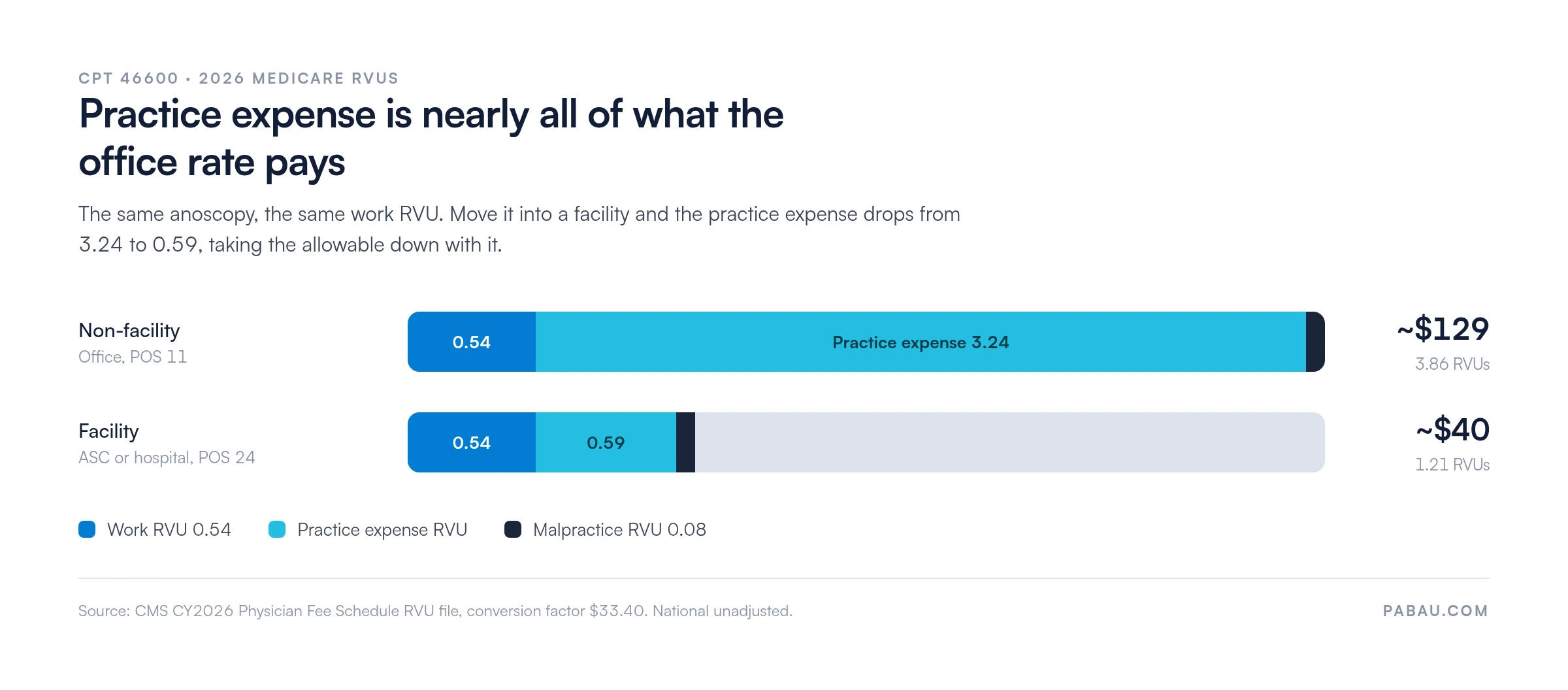
Commercial payer rates often fall between 110% and 180% of the Medicare allowable, though some managed care contracts pay below Medicare. The 46600 fee schedule is updated each January. Practice management software like Pabau submits 46600 claims online through Claim.MD, our US clearinghouse connection, then tracks eligibility responses and remittances against the same encounter.
Medical necessity for CPT code 46600 is confirmed by the ICD-10-CM diagnosis code paired with it. A mismatched or vague diagnosis is the third most common reason this code denies. The payer asks whether that diagnosis clinically justifies a diagnostic anoscopy. The codes below are the pairings most often accepted, based on AAPC coding guidance and routine clinical practice.
Select the most specific ICD-10 code the documentation supports. K64.9 is widely accepted, but it can trigger a medical necessity review at some payers. Where the note records a hemorrhoid grade, code from K64.0 through K64.3 instead.
Reading the denial codes that come back on these claims tells you whether the diagnosis or the modifier caused the problem. Both fail in the same place on the remittance, so the code on the line is what separates them.
Practices billing CPT code 46600 see a common set of denial patterns, and each one has a direct fix. Catching them is a charge-entry review job, done by a coder reading the operative note. Software adds the submission and tracking trail, so each denial lands against the claim it came from.
Tracking CARC codes on each remittance shows which of the six patterns above is driving the most write-off risk. A clearinghouse edit check before submission catches bundling conflicts while the claim can still be corrected.
A practice billing 46600 today usually works across three places. The coder picks the code in one system, the biller keys the claim into a payer portal, and the remittance arrives somewhere else. Sorting out a bundling denial then means opening all three.
Pabau holds the procedure note, the charge, and the claim on one patient record. Eligibility is checked before the visit, the claim goes out through Claim.MD, and the remittance posts back against the same encounter. Our medical claims management tools show where every 46600 claim sits without a second login.
Coding stays with your coder. Pabau does not pick the modifier, attach the diagnosis, or rule on an NCCI edit on your behalf. It gives the person doing that work the note, the charge history, and the denial trail in one place. A pattern then shows up in weeks rather than at the next audit.

Pabau submits 46600 claims through Claim.MD, tracks eligibility and remittances, and keeps the procedure note on the same record. See how practices using Pabau cut claim rework and close the payment loop faster.

CPT code 46600 is a simple procedure sitting inside a demanding billing system. The separate-procedure designation, the NCCI edits with colonoscopy, and the modifier rules make it one of the more denial-prone codes in the anorectal family.
Two checks catch most of the money on this code. Confirm the place of service on the encounter form, because the office and facility rates differ by roughly $89. Then confirm modifier -59 on any date where 45378 also appears. Book a demo to see how Pabau tracks a 46600 claim from charge entry through to remittance.

Need to understand how claims move from charge to payment? What is medical billing walks through the full billing cycle, from superbill creation to remittance posting.
Working through a denial on an anorectal claim? Medical claims clearinghouse guide explains how clearinghouse edits catch bundling conflicts before they reach the payer.
Want to see CPT billing rules for a different procedure category? Coaching CPT codes covers a separate code family with its own modifier and documentation rules.
CPT code 46600 is the billing code for diagnostic anoscopy. It covers visual examination of the anal canal, with or without collection of a specimen by brushing or washing. It is designated a separate procedure, meaning it bundles into larger endoscopic procedures when performed in the same session.
Mostly no. NCCI edits bundle 46600 into colonoscopy (CPT 45378) when both are performed in the same session. The exception is an anoscopy performed for a clinically distinct indication at a distinct anatomical site, documented separately, with modifier -59 appended to 46600. Without the modifier and supporting documentation, the claim will deny.
The CPT codes for hemorrhoidectomy depend on the technique and the number of hemorrhoid columns removed. CPT 46250 covers external hemorrhoidectomy of two or more columns or groups. CPT 46255 covers internal and external hemorrhoidectomy of a single column or group, and CPT 46260 covers two or more columns or groups. A single external column has no code of its own, so the unlisted code 46999 applies instead.
Yes, but only when the E/M service was for a separate and distinct clinical problem from the reason the anoscopy was performed. Modifier -25 must be appended to the E/M code, and the medical record must document the separate problem on its own. An E/M that addresses only the condition driving the anoscopy cannot be billed separately.