

CCSD code G5100: Bypass of duodenum billing guide
CCSD code G5100 bills a bypass that leaves the duodenum in place CCSD code G5100...

Last Updated: Oct 16, 2026
K0816 is the HCPCS Level II code for power wheelchair, group 1 standard, captains chair, patient weight capacity up to and including 300 pounds.
For DME suppliers and the practices that prescribe them, sequence is what gets paid. The face-to-face exam, the written order, and the authorization each have to land before delivery.
Let Pabau's smart automation suggest the right codes, reduce claim denials, and keep your practice compliant—effortlessly.
Automate repetitive tasks and focus on what matters most—your patients.
Reduce coding errors and ensure compliance with the latest regulations.
Clean claims, fewer denials, and faster reimbursements.
Powerful insights and reporting to help your practice thrive.
HIPAA compliant SOC 2 certified GDPR-compliant Trusted by 4,000+ clinics worldwide

HCPCS code K0816 covers a group 1 standard power wheelchair with a captains chair, for patients up to 300 pounds.
Prior authorization has to be approved before delivery, or the rental claims that follow are not payable.
CMS dropped the Certificate of Medical Necessity for power wheelchairs in 2005, so the exam notes and the written order carry the file.
Medicare pays K0816 as a capped rental, with 13 monthly payments before ownership passes to the patient.
The KX modifier attests that the file meets LCD criteria, so careless use invites overpayment recovery.
K0816 is the HCPCS Level II code for a power wheelchair, group 1 standard, captains chair. The patient weight capacity runs up to and including 300 pounds.
The Centers for Medicare and Medicaid Services (CMS) maintains it inside the DMEPOS code set. It describes a piece of equipment rather than a service, so it carries no physician work component.
Three descriptor elements decide whether K0816 fits. Group 1 means a standard, non-complex power base. The captains chair is a molded one-piece seat and back, rather than a sling or solid seat on a frame.
The 300-pound figure is the chair’s rated weight capacity. All three have to match the device that was dispensed.
Medicare Part B covers a K0816 power wheelchair when the patient cannot safely self-propel a manual chair at home.
Walking has to be limited enough that daily tasks there are out of reach. The home is the test. A patient who only needs the chair for shopping trips does not meet the standard.
The Local Coverage Determination (LCD) for Power Mobility Devices sets the criteria, and a covered claim usually has to document all of the following.
The face-to-face examination has to fall inside the window the LCD sets. Timeframes and covered diagnoses vary by Medicare Administrative Contractor (MAC).
Read the policy your patient’s MAC publishes rather than a national summary, because that is the policy your claim gets judged against.
Incomplete documentation denies more K0816 claims than wrong coding does. The file below is what a MAC auditor expects to find, and it has to exist before delivery rather than after.
One item no longer belongs in that file. CMS removed the Certificate of Medical Necessity requirement for power wheelchairs in 2005, and CMS Form 10125 is the CMN for external infusion pumps.
Suppliers still ask for it and prescribers still sign it, but it carries no weight on a K0816 claim.
Keep the home assessment notes and any therapist evaluation with the rest of the file. A claim that fails at the documentation stage takes far longer to recover than one caught during pre-billing review.
K0816 sits on the CMS prior authorization required list for DMEPOS, so an affirmative decision has to exist before delivery. Supplying the chair earlier puts the whole rental at risk, however complete the clinical file is.
Run eligibility first. Confirm the patient is enrolled in Medicare Part B, look for a secondary payer, and check what DME benefit has already been used. The request itself then follows six steps.
Medicare Advantage plans set their own rules, and they rarely match fee-for-service. State Medicaid programs often require authorization too, on their own portals and their own clocks. Check the plan before you assume the Medicare process applies.
Submit the authorization request the same day as the face-to-face exam. The notes and the written order both come out of that visit, so the file is already complete. Same-day submission starts the 10-business-day clock sooner, and it cuts the odds that the patient buys equipment while waiting.
Medicare pays K0816 as a capped rental. The supplier bills a monthly rental for 13 months, and ownership then passes to the patient. Maintenance and repairs bill under their own codes from that point on.
Each month follows the same path. The supplier submits the rental claim with the RR modifier and, where LCD criteria apply, KX. The MAC prices it against the DMEPOS fee schedule for that jurisdiction. Medicare pays 80% of the allowed amount once the deductible is met, and the patient owes the other 20%.
Payment comes back as an electronic remittance advice, the 835 file. It itemizes the allowed amount, the Medicare payment, the patient’s share, and any adjustment reason codes. Reconciling 13 of those against 13 rental months is where DME billers lose the most time.
Rates change every year and vary by jurisdiction, so a figure quoted here would be stale within months. Pull the current allowed amount from the CMS DMEPOS fee schedule or from the DME fee schedule your MAC publishes.
Diary a check at month 12 of every K0816 rental. Confirm that month 13 transfers ownership and that the patient is still using the chair. Check whether any repairs or accessories will need their own codes. Over-billed rental months are one of the most common DMEPOS audit findings, and they are easy to avoid.
Modifiers tell the MAC how to read the claim. Miss a required one and the claim denies. Add one you cannot support and you invite an audit.
KX deserves a closer look. Appending it tells Medicare that the supplier’s file already satisfies every LCD criterion.
If an audit finds otherwise, the consequences run past a denial. The MAC can recover what it paid, and a pattern of careless use can be referred for compliance review.
Most K0816 denials trace back to something a five-minute review would have caught. Work down this list before the claim leaves the building.
Competitive bidding used to add a supplier test on top of that list, and right now it does not. Round 2021 contracts expired on December 31, 2023, and CMS has not run a new round since. Any Medicare-enrolled supplier can therefore furnish K0816 in a former competitive bidding area.
CMS has signaled a next round for 2028, and standard power wheelchairs are reportedly outside it. Treat the current position as temporary and confirm it before you rely on it.
The power wheelchair range runs from K0813 to K0864. Codes K0800 through K0812 sit below it and describe power operated vehicles, which are scooters rather than wheelchairs. Within group 1, two descriptor elements do the work. The frame and the seat pick the code.
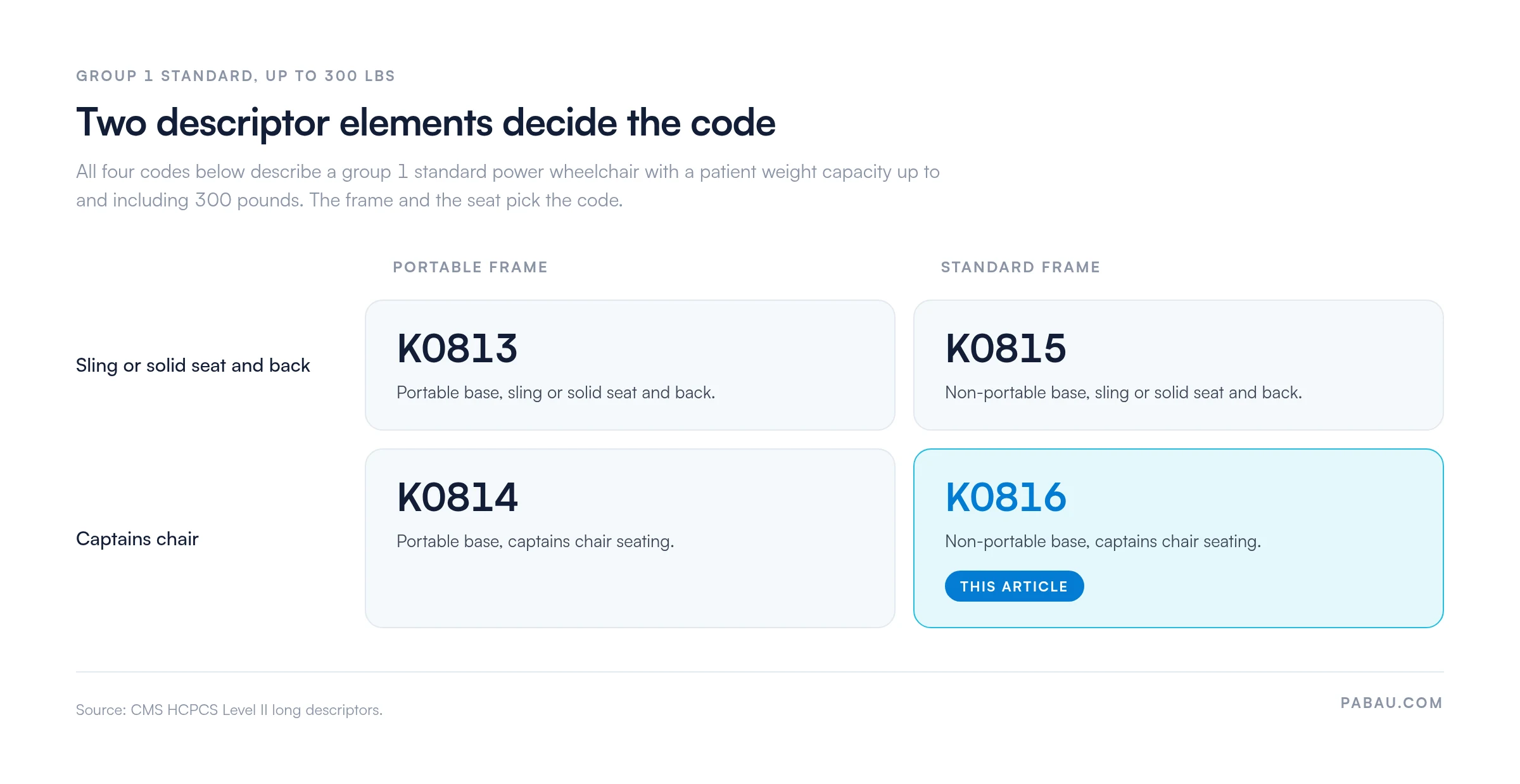
Weight capacity and power base group take over from there. The table below sets K0816 beside the codes billers confuse it with most often. For the rest of the range, the HCPCS code library lists the DME codes that come up most in outpatient billing.
Group classification is what pushes a chair out of K0816. A patient who needs group 2 driving controls takes a group 2 code even when the captains chair and the weight class both match.
Where the chair is a plain group 1 with a sling or solid seat instead, K0815 is the code. Confirm the long descriptor against the AAPC HCPCS lookup before you commit it to a claim.
Five patterns account for most of the denials on this code:
A K0816 file gets assembled in several places. The exam notes come from the prescriber, the home assessment from a therapist or the supplier, and the decision from the MAC. When those sit in separate systems, the missing item usually surfaces after the claim has already gone out.
Practice management software like Pabau keeps the clinical record and the claim in one system. The exam findings, the mobility assessment, and the signed order live on the patient record. Whoever prepares the claim reads the same file the prescriber wrote.
Pabau’s claims management software then pre-fills the CMS-1500 from that record and checks the required fields are complete before the claim can be sent. ICD-10-CM and HCPCS lookup libraries sit inside the claim form, so a code is a search away rather than a second browser tab.
In the US, claims route through Claim.MD for real-time eligibility checks, claim status tracking, and ERA posting. Across a 13-month rental, each remittance posts against the same patient record. The rental count stays visible to the person billing it.
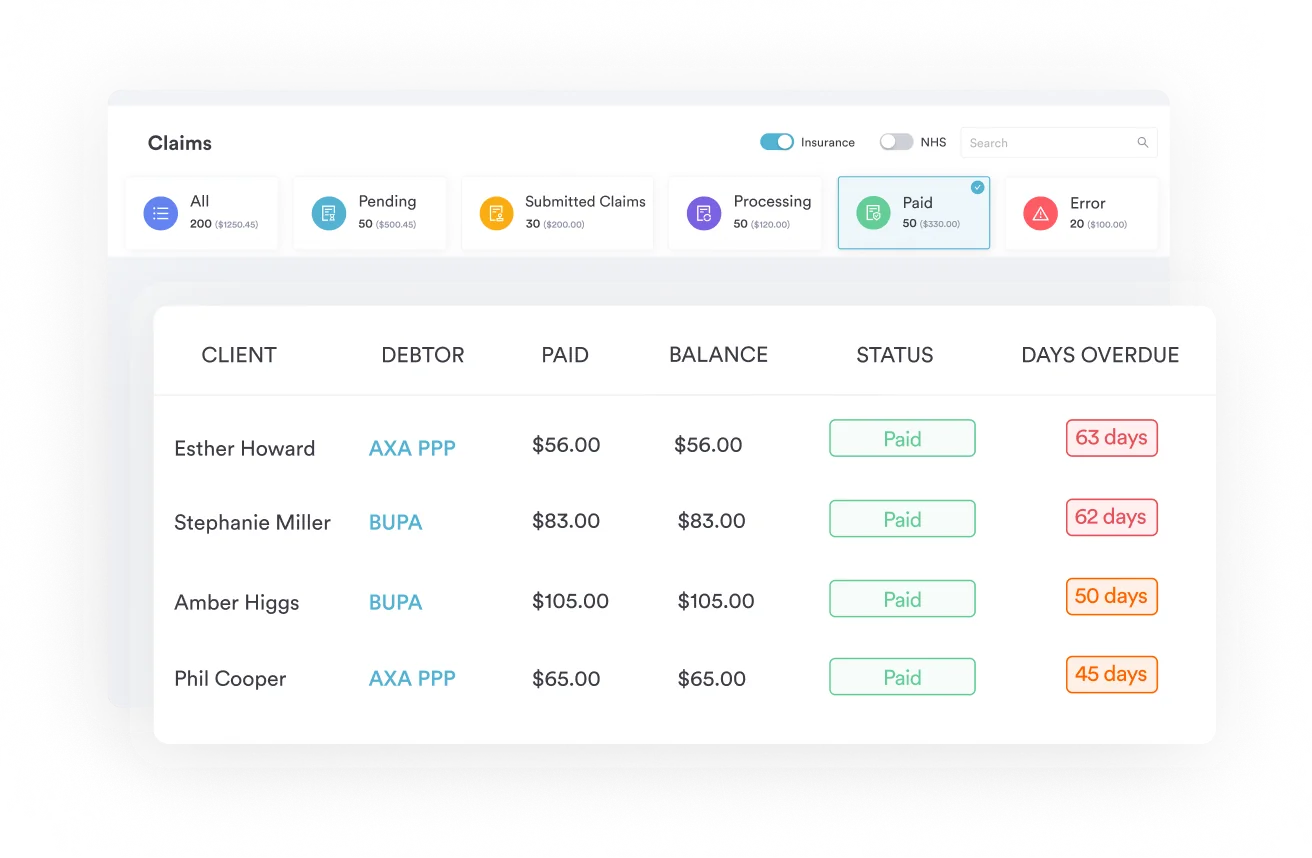

Pabau pre-fills the CMS-1500 from the patient record, checks the required fields before submission, and posts each remittance back against the same file. Your rental months and your documentation stay in step.

K0816 is a simple code attached to an unforgiving process. Matching the descriptor takes a minute. The sequence around it, from exam to authorization to 13 rental months, is where the money is won or lost.
Build the file before the chair moves and the rest is bookkeeping. Skip a step and you spend the next quarter appealing a claim you could have had paid first time. Treat documentation as the start of billing rather than the end of care.
Power mobility is one of the few areas where paperwork discipline pays better than volume. Book a demo to see how Pabau keeps the exam notes, the authorization, and the rental claims on one record.

Want to know what makes a claim complete before it reaches the payer? Clean claim fundamentals walks through the fields and checks that keep a first submission payable.
Need a framework for the payment cycle behind a 13-month rental? Revenue cycle management for healthcare practices covers the workflow from patient encounter through to posting.
Looking for the compliance standards behind DMEPOS documentation? Medical billing compliance outlines the audit readiness expected of suppliers and prescribing practices.
Working through a stack of non-affirmed DME claims? Denial management in healthcare sets out how to triage, correct, and resubmit without losing the appeal window.
Reconciling 13 remittances against 13 rental months? Electronic remittance advice explained breaks down the 835 file and the adjustment codes you meet on DME claims.
No. Medicare Part B covers a power wheelchair for use in the patient’s home. A skilled nursing facility is not a home for this purpose, so K0816 is not payable during a covered Part A stay.
Medicare applies a reasonable useful lifetime of five years to durable medical equipment. Before that, replacement is payable only for loss, theft, irreparable damage, or a documented change in the patient’s condition.
Yes. Options and accessories, such as elevating leg rests or an alternative drive control, carry their own HCPCS codes. Each one needs its own medical necessity documentation, and some also require prior authorization.
CMS publishes no fixed list. Your MAC’s local coverage article names the diagnoses it accepts. The diagnosis on the claim has to match the mobility limitation described in the exam notes.
No. Coverage turns on whether the patient needs power mobility inside the home, but the chair can be used anywhere. Use outside the home never substitutes for an in-home need in the documentation.
A power operated vehicle, or scooter, is billed under K0800 through K0812 and steered with a tiller. K0816 is a joystick-driven power wheelchair, and the LCD requires a scooter to be ruled out first.



