CPT code 63081: Vertebral corpectomy, cervical spine
CPT code 63081: official descriptor and procedure overview CPT code 63081 descri...

Last Updated: Oct 6, 2026
29884 is the CPT code for arthroscopy, knee, surgical; with lysis of adhesions, with or without manipulation (separate procedure). It covers the arthroscopic release of scar tissue inside the knee joint, whether or not the surgeon also manipulates the knee under anesthesia.
Because it is a separate procedure, 29884 is bundled when a more definitive knee arthroscopy, such as a meniscectomy, is performed in the same session. It carries a 90-day global surgical period.
Let Pabau's smart automation suggest the right codes, reduce claim denials, and keep your practice compliant—effortlessly.
Automate repetitive tasks and focus on what matters most—your patients.
Reduce coding errors and ensure compliance with the latest regulations.
Clean claims, fewer denials, and faster reimbursements.
Powerful insights and reporting to help your practice thrive.
HIPAA compliant SOC 2 certified GDPR-compliant Trusted by 4,000+ clinics worldwide

CPT Code 29884 covers knee arthroscopy with lysis of adhesions. Its ‘(separate procedure)’ label decides when it can be billed alongside other knee scope codes.
The code has a 90-day global surgical period, so routine post-op care is bundled into the surgical payment.
Cigna (via eviCore) and Centene IL Meridian require prior authorization for CPT 29884 from January 1, 2026, and WellSense from March 1, 2023.
CPT 29884 is bundled into same-session meniscectomy codes such as 29881 unless a separate compartment is documented and the NCCI edit allows a modifier.
Pabau, the practice management platform we build, checks claim details before submission and sends claims to thousands of US payers through Claim.MD.
CPT Code 29884 is a surgical arthroscopy code for releasing intra-articular adhesions in the knee, with or without manipulation under anesthesia. The American Medical Association classifies it as a “(separate procedure).”
The complete official descriptor reads: Arthroscopy, knee, surgical; with lysis of adhesions, with or without manipulation (separate procedure).
The code sits within the 298xx family of knee arthroscopy codes. Adhesions form after trauma, prior surgery, infection, or prolonged immobilization and restrict range of motion by binding the synovial lining, fat pad, and capsular tissue. The arthroscopic approach lets the surgeon visualize and release these structures under direct vision without an open incision.
Two elements of the descriptor need immediate clarification for coders working from operative notes. “With or without manipulation” means the code applies either way. The surgeon may manipulate the joint under anesthesia before or after arthroscopic lysis, or skip manipulation entirely. “Separate procedure” is the high-stakes parenthetical, addressed in detail below.
Coders need to match the operative note to the code. For CPT Code 29884, the intraoperative sequence typically includes these steps.
For medical necessity to hold at audit, the operative note must confirm that adhesions were seen on direct arthroscopic inspection. A pre-operative suspicion from imaging does not qualify.
The “(separate procedure)” parenthetical in CPT Code 29884 means the code counts as a component of more comprehensive knee arthroscopy procedures. It is not separately payable when performed as part of a more definitive procedure in the same operative session.
If the surgeon performs lysis of adhesions as the only knee arthroscopy that day, 29884 is billable on its own. Add a meniscectomy such as 29881, an ACL repair, or another definitive knee arthroscopy, and 29884 is bundled into it. The exception is lysis in a distinctly separate anatomical area, which Modifier 59 or Modifier XS can support when the documentation shows it.
National Correct Coding Initiative (NCCI) edits govern these combinations. The NCCI tables, updated quarterly by CMS, list column 1/column 2 edit pairs. Before submitting 29884 alongside any other knee arthroscopy code, check the current NCCI edit status for that specific pair.
Modifier 51 (multiple procedures) does not override an NCCI bundling edit. Only Modifier 59 or the X-modifiers (XS, XU, XE, XP) can do that, and only when the documentation supports a distinct service. The decision below shows how those rules play out on a single claim.
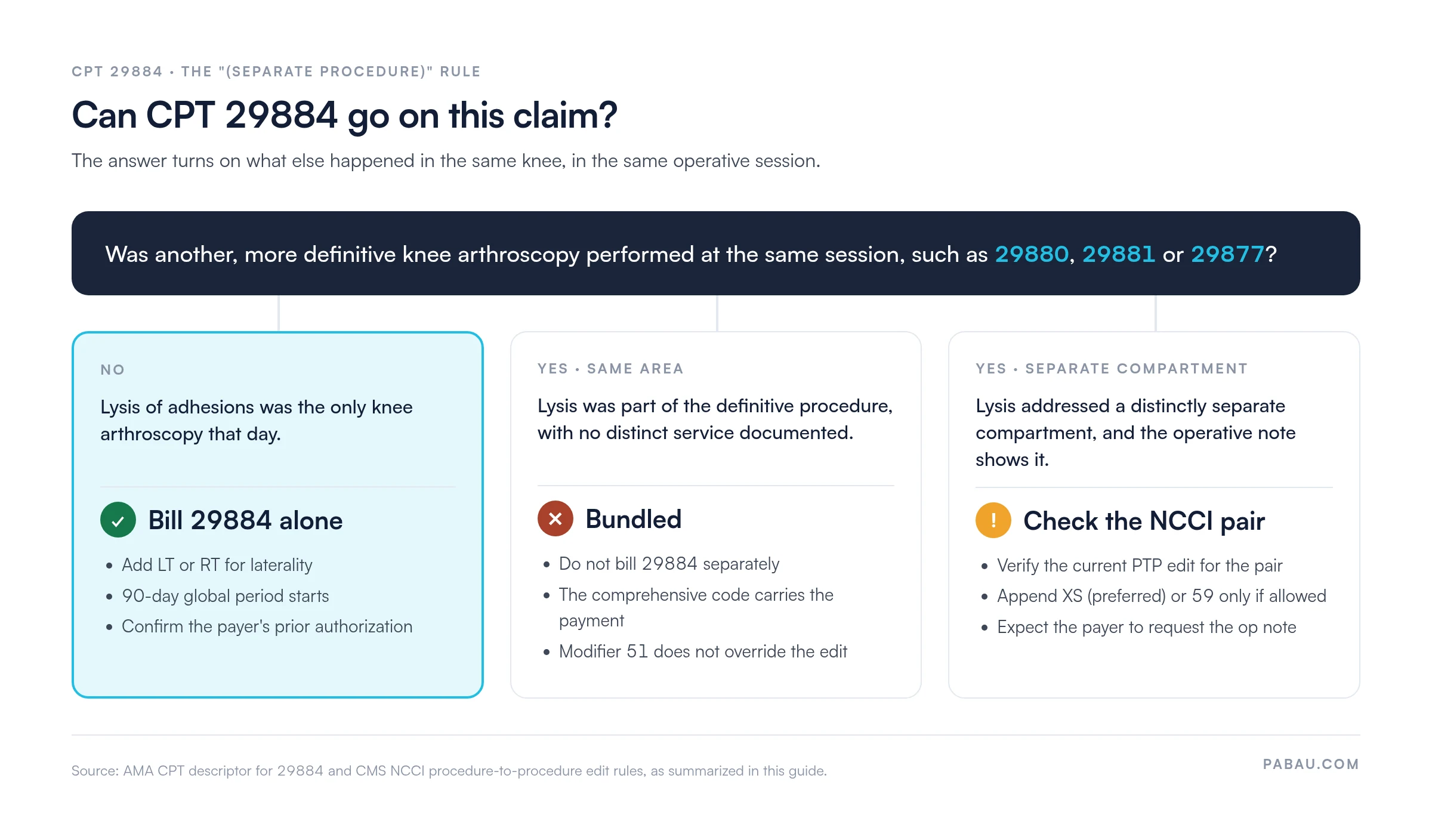
The most common coding error around CPT 29884 is billing it alongside a code it is bundled into, such as the cartilage debridement code 29877. This comparison table shows the key distinctions.
Always verify against the current NCCI Procedure-to-Procedure edit table at CMS before submitting any combination. Edits are updated quarterly and a pair that was payable in Q1 may be bundled in Q2.
Choosing the wrong modifier, or omitting one when it’s needed, is the fastest path to a denial on CPT Code 29884. The table below covers the modifiers coders encounter most often with this code.
Always confirm the current NCCI edit status before appending Modifier 59 or XS to override a bundle. A modifier that doesn’t match a valid NCCI modifier indicator creates compliance exposure as well as a billing error. Pull the current NCCI table directly from CMS rather than relying on prior-year guidance.
Reimbursement for CPT Code 29884 is set through the Medicare Physician Fee Schedule (MPFS), published annually by CMS. Rates vary by geographic locality and are adjusted by the conversion factor in effect for that year.
Verify the current payment amount with the CMS Physician Fee Schedule lookup tool for the specific MAC jurisdiction and site of service. The FastRVU 2026 RVU lookup also provides current work, PE, and MP RVU values by code and locality.
Key reimbursement reference points for CPT Code 29884 include the following structure.
Orthopedic and sports medicine practices using Pabau, the practice management platform we build, can submit CPT Code 29884 claims electronically through its Claim.MD integration. Claim.MD connects to thousands of US payers and runs real-time eligibility checks before the claim goes out.
CPT Code 29884 carries a 90-day global surgical package (indicator: 090) under Medicare’s global surgery rules. The payment covers pre-operative care from the day before surgery and the intraoperative work. It also covers all routine post-operative care for 90 days.
The global package bundles routine recovery office visits, suture removal, standard physical therapy coordination, and dressing changes. None of these is separately billable during the 90 days. Services that can be billed separately during the global period include the following.
The global period is central to revenue cycle management for orthopedic practices. Post-op visits billed inside the 90-day window are a frequent target of post-payment review.
Prior authorization requirements for CPT Code 29884 vary by payer and plan year. Three payers publish authorization requirements that include this code.
Medicare does not require prior authorization for CPT 29884 at the federal level, though Medicare Advantage plans may impose their own requirements. Always verify directly with the specific plan before scheduling.
A prior authorization request for CPT 29884 typically needs this clinical documentation.
Payers may also request pre-op flexion and extension measurements, plus the prior surgical history if this is a revision procedure.
Insufficient documentation is the root cause of most medical necessity denials on CPT Code 29884. The operative report and pre-operative office notes must collectively support four elements.
Claims management software that checks required fields before submission catches a missing authorization number before the payer does. Your clean claim rate for orthopedic procedures rises when missing documentation surfaces at billing instead of at denial.
Most denials on CPT Code 29884 are preventable. The table below maps the top denial scenarios to their corrective actions.
Tracking denial patterns by code is the fastest way to spot a systemic billing problem. A structured approach to denial management helps orthopedic billing teams log, categorize, and appeal denials, which shortens the time to resubmission.
Coding staff can also cross-reference medical billing denial codes to see which CARC reason code the payer applied and what it takes to overturn it.
Run a quarterly audit of all claims submitted with CPT Code 29884 alongside other knee arthroscopy codes. Sort by denial reason. A cluster of NCCI bundle denials signals that coders are applying 29884 as a companion code without checking the current edit table first. A quarterly check takes less than an hour and prevents a pattern from becoming an OIG audit trigger.
A knee arthroscopy claim often passes through three systems before it’s paid. The authorization number sits in a payer portal, the operative note sits in the EHR, and the claim leaves through a separate clearinghouse. Each handoff is a chance to drop the authorization number or the laterality modifier.
In Pabau’s claims management software, the insurer details live on the patient record, and each claim routes to the right payer automatically. Before submission, Pabau checks that details such as the membership number and authorization code are in place. The claim can’t be sent until they are.
US claims go out through Claim.MD, with real-time eligibility checks, claim status tracking, and ERA remittances posted back into Pabau. You get fewer 29884 denials for missing authorization, and every claim stays visible from pending to paid.

Pabau checks authorization details before a claim goes out and tracks it from pending to paid, so fewer orthopedic claims come back denied.

CPT 29884 is simple to code on its own and easy to lose money on beside another knee scope code. Before the claim goes out, check the same-session procedures against the current NCCI pair. Then confirm the operative note says the adhesions were seen on scope.
If the lysis sat in a separate compartment, document it and use XS. If it didn’t, let the comprehensive code carry the payment. Dropping that line item costs less than the appeal a wrongly unbundled claim triggers.
Book a demo to see how Pabau checks authorization details and tracks orthopedic claims from submission to payment.

Need to understand how claim rejections flow through your billing system? What is medical billing covers the end-to-end revenue cycle from charge capture to remittance posting.
Preparing for a payer audit or compliance review? Medical billing compliance outlines the documentation and coding standards that reduce audit risk for surgical procedures.
Want to understand how electronic remittance works after a claim pays or denies? Electronic remittance advice (ERA) explains how 835 files map payer responses back to individual line items on your claim.
CPT Code 29884 describes knee arthroscopy with lysis of adhesions, with or without manipulation under anesthesia. The AMA CPT code set designates it a “(separate procedure).” It applies when a surgeon arthroscopically releases adhesions that restrict knee range of motion, with or without joint manipulation.
Yes, CPT 29884 carries a “(separate procedure)” parenthetical, which means it is considered a component of more comprehensive knee arthroscopy procedures. It is billable alone when lysis of adhesions is the only knee arthroscopy performed. When a meniscectomy or ACL repair is performed at the same session, 29884 is typically bundled into that code. It can be billed separately only where the NCCI edit permits an appropriate modifier.
CPT 29881 covers knee arthroscopy with meniscectomy (medial or lateral), while CPT 29884 covers lysis of adhesions only. When both procedures are performed in the same session, 29884 is generally bundled into 29881 under NCCI edits. Modifier 59 or XS may allow separate billing only if the lysis addressed a separate compartment from the meniscectomy. The operative report must document that distinction clearly.
Medicare reimbursement for CPT 29884 is the current-year Physician Fee Schedule RVUs multiplied by the annual conversion factor. Geographic locality then adjusts the result. Rates change each January. Use the CMS MPFS lookup tool or a current-year RVU calculator to verify the exact non-facility and facility rates for your MAC jurisdiction before billing.
CPT 29884 carries a 90-day (090) global surgical period under Medicare. Routine post-operative care, including standard follow-up visits by the operating surgeon, is bundled into the procedure payment for 90 days. Separately payable services include treatment of unrelated conditions (Modifier 24) and complications requiring a return to the OR (Modifier 78). Physical therapy billed by a separate PT provider is also payable.
Prior authorization requirements depend on the payer. Cigna (via eviCore) and Centene IL Meridian list CPT 29884 on authorization lists effective January 1, 2026. WellSense lists it on a list effective March 1, 2023. Medicare fee-for-service does not require prior authorization for this code, but Medicare Advantage plans may. Always verify with the specific plan before scheduling.
No. CPT 29884 is specifically an arthroscopic knee procedure. Laparoscopic lysis of adhesions in the abdomen or pelvis uses different code families entirely (such as CPT 58660 for salpingo-ovariolysis). CPT 29884 applies only to intra-articular knee adhesions released arthroscopically.