

HCPCS code E0198: Water pressure pad billing guide
HCPCS code E0198 is a water pad for a standard mattress HCPCS code E0198 is the ...

Last Updated: Oct 13, 2026
29870 is the CPT code for arthroscopy, knee, diagnostic, with or without synovial biopsy (separate procedure).
It covers visualization and assessment of the knee joint, with no therapeutic work attached. Billing staff mix it up with CPT 29881, the meniscectomy code, because both procedures start the same way in the operating room. The moment the surgeon does any therapeutic work, the surgical code replaces 29870 on the claim.
Let Pabau's smart automation suggest the right codes, reduce claim denials, and keep your practice compliant—effortlessly.
Automate repetitive tasks and focus on what matters most—your patients.
Reduce coding errors and ensure compliance with the latest regulations.
Clean claims, fewer denials, and faster reimbursements.
Powerful insights and reporting to help your practice thrive.
HIPAA compliant SOC 2 certified GDPR-compliant Trusted by 4,000+ clinics worldwide

CPT code 29870 covers diagnostic knee arthroscopy with or without synovial biopsy, meaning visualization only, with no surgical work.
If the surgeon performs therapeutic work in the same session, the surgical code replaces 29870 and the two cannot be billed together.
Most commercial plans and Medicare Advantage plans require prior authorization, so document failed conservative treatment before you submit.
The diagnosis code has to sit on the payer’s coverage list, or the claim comes back denied for medical necessity.
A 90-day global period applies, so routine follow-up visits after the scope are not separately billable.
CPT code 29870 is the billing code for a diagnostic knee arthroscopy, with or without synovial biopsy. The American Medical Association defines it as “Arthroscopy, knee, diagnostic, with or without synovial biopsy (separate procedure).” Every part of that descriptor changes how the claim behaves.
The American Medical Association maintains the CPT code set and publishes updates each year. Check the descriptor annually, because the wording can be revised between code years even when the number stays the same.
Knowing where the 29870 fee stops prevents both undercoding and the unbundling errors that trigger NCCI edits. The table below separates what the code already pays for from what needs its own line.
That “separate procedure” flag is what bundles 29870 into any surgical knee arthroscopy code billed on the same date. Reporting both on one claim is an unbundling violation under CMS NCCI policy, so it carries compliance exposure as well as a denial.
The knee arthroscopy family runs from 29870 through 29889, and picking the wrong member is the most common billing error in orthopedic practices. These procedures share setup and patient positioning, so only the operative report separates them.
Below are the codes coders meet most often alongside 29870.
Use 29870 when the pre-operative plan is assessment and the operative report confirms that no surgical work took place. Use 29881 when meniscal tissue is excised from one compartment, medial or lateral, even if the surgeon only planned to look.
A loose body found and removed moves the claim to 29874 in the same way. The operative note then has to name the fragment and describe its removal, or the claim is denied.
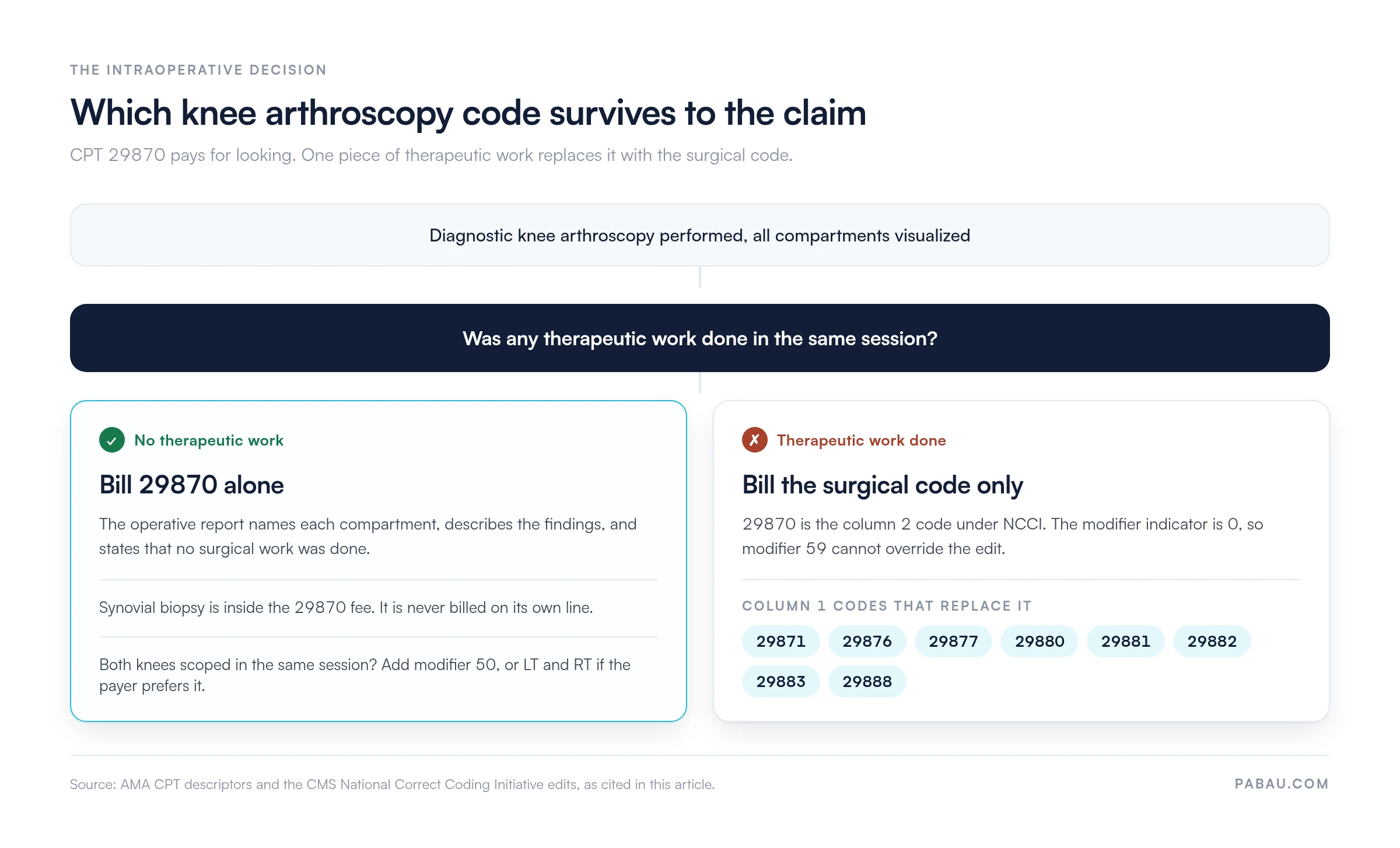
The surgical upgrade is where practices lose money. A surgeon scopes the knee to investigate pain, finds a torn meniscus, and debrides it on the same table visit. Only 29881 goes on the claim.
The diagnostic work is bundled into the surgical code by NCCI policy, so billing both on that date of service is an edit violation. The chart below follows that call from the first look through to the finished claim.
Medical necessity rests on the ICD-10 code you pair with 29870. Payers cross-reference the diagnosis against the procedure to judge whether the scope was warranted.
The pairings below turn up most often on diagnostic knee arthroscopy claims. Check each one against the full ICD-10-CM code list before you bill.
Treat these as examples, not as an approved list. Each payer’s Local Coverage Determination decides which diagnosis codes qualify, and CMS keeps the current ICD-10-CM code files those determinations draw from. Submitting a code the LCD does not list is the second most common denial reason on 29870 claims.
Medicare reimbursement for 29870 changes with the place of service, because the practice expense RVU shifts between facility and non-facility settings.
The code also carries a 90-day global period. Post-operative visits inside those 90 days sit within the surgical payment, so they are not billed again.
Dollar amounts move every year with the conversion factor update. Use the CMS Physician Fee Schedule lookup tool to confirm the current rate for your locality before you quote a figure to a patient.
Traditional Medicare does not require prior authorization for 29870. Medicare Advantage plans and most commercial payers do. Missing a required authorization produces a CO-4 denial, and the claim is then processed as though the service were never covered.
A clean authorization request has three parts. Document at least six weeks of failed conservative care, attach the MRI or X-ray, and state the clinical question the scope will answer. Approval rates climb when that last part is explicit, because reviewers look for a question rather than a list of symptoms.
Almost every 29870 denial traces back to the operative note. A thin report draws a denial on first submission, then fails retrospective review months later. Six elements need to be in it:
A report that covers all six also shortens the appeal cycle, because the reviewer finds each element without writing back for records.
Most 29870 denials fall into five buckets, and each one has a preventable cause. The table pairs the reason with the claim adjustment reason code you will see on the remittance.
The CMS National Correct Coding Initiative sets column 1 and column 2 edit pairs. CPT 29870 is the column 2 code whenever a surgical knee arthroscopy from the 29871 to 29889 range is reported as column 1.
A meniscus repair in both compartments, reported as 29883, sits inside that range. The diagnostic scope is bundled into that repair, so 29870 never gets its own line.
The modifier indicator on most of those pairs is “0”. That means modifier 59 and the X modifiers cannot override the edit. Diagnostic visualization counts as part of the surgical procedure, so no modifier makes it separately reportable.
Open knee procedures bundle the scope as well. A dislocating patella reconstruction with extensor realignment, coded 27422, includes the diagnostic arthroscopy, so 29870 stays off that claim.
NCCI tables update quarterly and pairs do change. Check the current quarter’s procedure-to-procedure edits, or the AAPC Codify tables, before you submit.
Modifier 50 applies when 29870 is performed on both knees in the same session, instead of two line items carrying LT and RT. Some payers prefer the LT and RT form, so confirm the preference before you submit.
Modifier 59 does not help here. It cannot unbundle 29870 from a surgical knee arthroscopy code, and using it to try is an audit flag. Modifier 22 can apply when the diagnostic scope involved unusually complex evaluation, though the operative note then has to explain the extra work.
Run your NCCI check against the current quarterly tables, not a copy saved six months ago. CMS updates edit pairs every quarter, and a pair that allowed a modifier last year may carry a 0 indicator today. Pull the live tables from CMS, or verify through your clearinghouse, before you submit any claim that pairs 29870 with another knee code.
A structured workflow catches most 29870 problems while they are still cheap to fix. These eight steps follow one claim from the pre-operative note through to the remittance.
Run this list once more before the claim leaves your practice.
Most of the checks above live in different places. The op note sits in the chart, the authorization in a payer portal, and the claim in a separate billing system. The same details end up retyped two or three times. Each retype is a chance for the code, the diagnosis or the authorization number to drift.
Practice management software like Pabau keeps them in one record. Its claims management software pre-fills the CMS-1500 straight from the patient record. The CPT code attached to the service lands on the charge line, and the ICD-10 slots draw from the recorded problem list.
Built-in ICD-10-CM and CPT lookup libraries sit behind a search icon, so a coder can check a descriptor without leaving the claim. Before the send button unlocks, Pabau confirms the fields a claim needs are complete, including membership and authorization numbers.
In the US, claims then route through Claim.MD, which handles real-time eligibility, claim status tracking and electronic remittance posting. So denials arrive in one queue instead of scattered across three payer portals. The person chasing them can see the whole record behind each one.
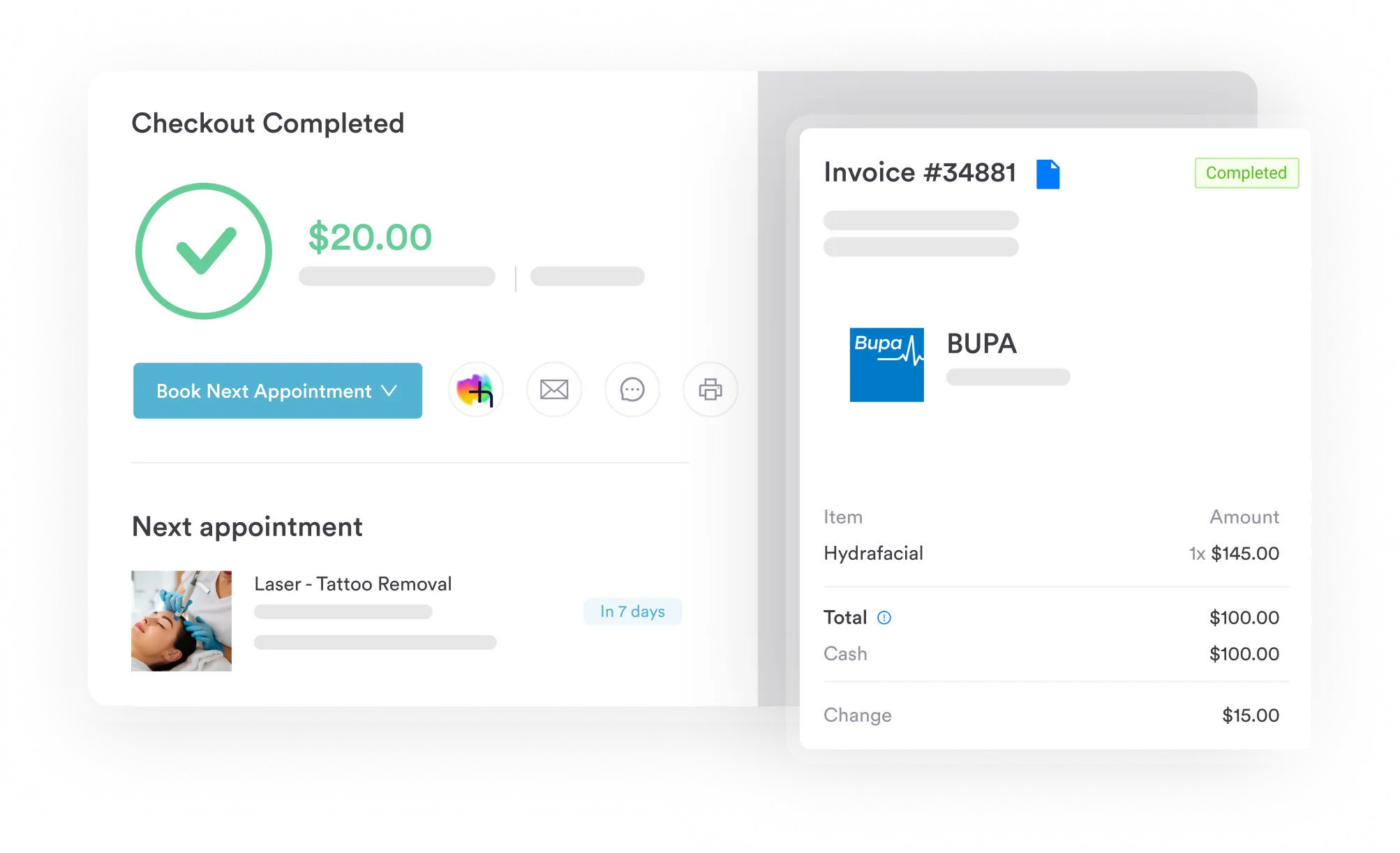

Pabau pre-fills claims from the patient record and validates the fields a payer needs. US claims route through Claim.MD, with real-time eligibility and remittance tracking.

CPT code 29870 describes a look at the knee, and only that. What the surgeon does after the first look settles which code reaches the claim, whatever the pre-operative plan said. Once a scope turns therapeutic, 29870 comes off and the surgical code stands alone.
The work that protects the payment happens before the claim is built. That means an authorization naming 29870 and a diagnosis code on the payer’s coverage list. It also means an operative note that states plainly what was, and was not, done in theater that day.
Keeping those three in one system removes most of the retyping behind preventable denials. Book a demo to see how Pabau builds an orthopedic claim from the patient record and tracks it through to the remittance.

List Item #1
List Item #2
Rarely. Because 29870 bundles into every surgical knee arthroscopy code, it is usually the only knee code on the claim. Modifier 51 applies when a second, unrelated procedure is reported in the same session. Many payers append it themselves, so check the payer rule before adding it by hand.
Only when that visit is the decision for surgery. The 90-day global period already covers the routine pre-operative evaluation. If the surgeon decides on the scope during that visit, append modifier 57 to the evaluation and management code. Document the decision in the note.
No, not when they relate to the arthroscopy, because postoperative care sits inside the global payment. A problem unrelated to the knee is reported with modifier 24 on the evaluation and management code. The note has to show clearly that the visit was unrelated to the scope.
Most diagnostic knee scopes happen in an ambulatory surgery center, place of service 24, or a hospital outpatient department, place of service 22. Both count as facility settings, so the facility practice expense RVUs apply. An office-based scope is rare and pays the higher non-facility rate.



