



CCSD code G5100: Bypass of duodenum billing guide
CCSD code G5100 bills a bypass that leaves the duodenum in place CCSD code G5100...

Last Updated: Oct 16, 2026

CPT Code 29877 describes arthroscopy of the knee with debridement or shaving of articular cartilage, also called chondroplasty, classified under the AMA’s Musculoskeletal System section.
Medicare may deny CPT 29877 for knee osteoarthritis without clearly documented medical necessity showing conservative treatment failure; payer policies vary significantly.
CPT 29877 shall not be reported with any other knee arthroscopy code (29866-29889) on the same knee. No modifier bypasses that edit.
HCPCS G0289 covers loose body removal or chondroplasty in a different compartment, but never alongside CPT 29880 or 29881 for chondroplasty.
Pabau’s claims management software supports clean claim submission for orthopedic CPT codes through its Claim.MD clearinghouse integration.
CPT Code 29877 is arthroscopy of the knee, surgical, with debridement or shaving of articular cartilage. Surgeons call the procedure chondroplasty. The code is payable only when it stands alone on that knee. NCCI bars it from every other knee arthroscopy code in the 29866-29889 range, and no modifier changes that. Coders who still append modifier 59 to force the pair through are building a denial into every claim.
This reference walks through the AMA description, 2026 Medicare rates, and the modifiers that apply to CPT 29877. It also covers the NCCI edits, the HCPCS G0289 alternative, ICD-10 pairings, the 90-day global period, and the denial patterns behind most rework.
CPT Code 29877 is a surgical arthroscopy of the knee that involves debridement or shaving of articular cartilage, a procedure also referred to as chondroplasty. The AMA maintains the code under the CPT code set within the Musculoskeletal System section, under the Endoscopy/Arthroscopy subsection.
The procedure involves inserting an arthroscope into the knee joint and using shaving or debridement instruments to smooth damaged or irregular articular cartilage surfaces. This differs from bone debridement and does not include meniscal work. Cartilage work that reaches bleeding subchondral bone through abrasion, drilling, or microfracture is coded as CPT code 29879 instead.
Surgical vs. diagnostic arthroscopy: CPT 29877 is a surgical code. A surgeon may begin a knee arthroscopy expecting only to look, then find damage that needs debridement. In that case the surgical code replaces the diagnostic arthroscopy code entirely. Diagnostic arthroscopy (CPT 29870) is bundled into all surgical knee arthroscopy codes and should not be billed separately on the same session.
Medicare reimbursement for CPT 29877 varies by geographic location (through the Geographic Practice Cost Index, or GPCI) and setting. The rates below reflect national averages from the CMS Medicare Physician Fee Schedule for 2026. Verify current rates against your MAC’s local fee schedule before billing.
CMS finalized two conversion factors for 2026. Qualifying APM participants are paid at $33.5675, and everyone else at $33.4009. The non-facility figure above uses the lower one. Verify your own rate through your Medicare Administrative Contractor (MAC), because the GPCI adjustment moves it in both directions.
Correct modifier selection on CPT 29877 claims affects both reimbursement and audit risk. The biggest error is reaching for modifier 59 or XS to pair 29877 with another knee arthroscopy code. Those edits carry modifier indicator 0, so the bypass never works on the same knee. Laterality modifiers, by contrast, are required by most payers and are often left off.
Medicare and most commercial payers prefer the X-modifiers over modifier 59 when a more specific choice exists. Neither one works on a 29877 edit carrying modifier indicator 0. Appending one anyway does not open the pair, and it does put the claim in front of an auditor. The operative report has to support whichever modifier you append.
CPT 29877 cannot be reported with other knee arthroscopy codes. Chapter IV, Section E of the CMS NCCI Policy Manual states the rule for the 29866-29889 range, naming 29874 specifically. That range includes 29883, the medial and lateral meniscus repair code, so chondroplasty in the same knee stays off the claim.
The live NCCI procedure-to-procedure table confirms it. Every active pairing of 29877 with a knee arthroscopy code carries modifier indicator 0, so no NCCI-associated modifier can bypass the edit, however the operative report is worded.
The 29877/29881 pair is still the most frequent denial in this family, but the fix isn’t a modifier: when a surgeon performs a meniscectomy and shaves cartilage in the same knee, 29881 alone describes the session.
Reporting 29877 next to it will be denied, and appending modifier 59 to force payment reads as unbundling on audit. See the medical billing denial codes reference for the CARC codes involved.
HCPCS G0289 is the add-on code Medicare created for extra arthroscopic work in a second compartment of the same knee. Its descriptor covers removal of a loose body or foreign body, or debridement and shaving of articular cartilage.
The work has to occur at the time of another surgical knee arthroscopy, in a different compartment of the same knee. It is the only route to payment for that additional work.
NCCI does carry a live edit pairing 29880 and 29881 with G0289, and that one has modifier indicator 1. A loose body pulled from a separate compartment supports the bypass. Chondroplasty does not, whichever compartment it was performed in.
Three routes cover almost every operative report in this family. The chart below shows which code carries the session, and where G0289 is available.
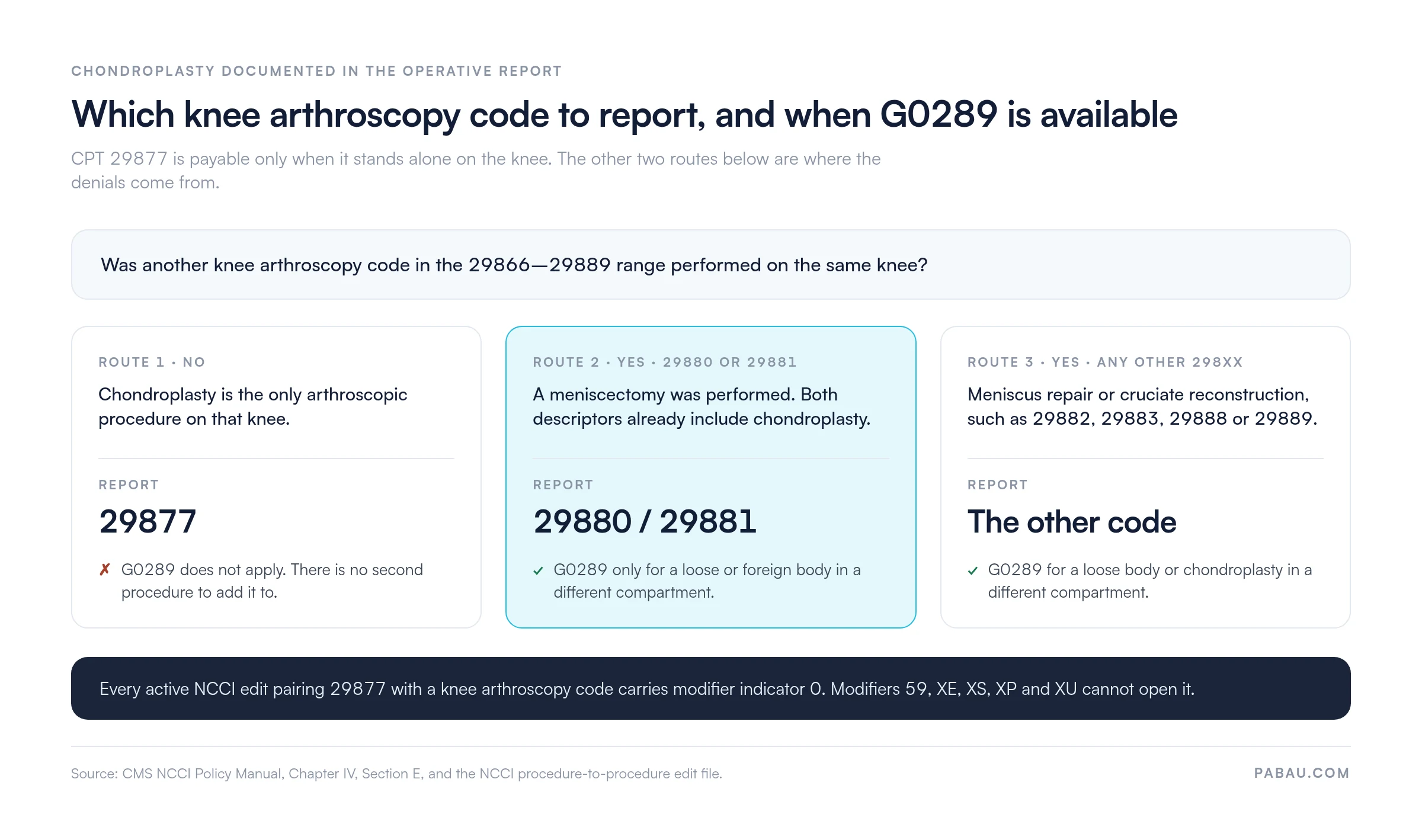
Check the modifier indicator column before you plan any override. Indicator 0 means the pair cannot be unbundled, indicator 1 means a documented modifier may work, and indicator 9 means the edit is deleted. Every active 29877 pairing with a knee arthroscopy code sits at 0. NCCI files refresh on January 1, April 1, July 1, and October 1.
CPT Code 29877 sits within a family of knee arthroscopy codes spanning 29870 through 29889. Correct code selection depends on exactly which procedures were performed during the operative session. Review the family every year, because descriptor revisions quietly move work from one code into another.
Confusing CPT 29877 with CPT 29881 is the most common coding error on knee arthroscopy claims, as the AAPC CPT code guidance confirms. The distinction matters clinically and financially. CPT 29881 reimburses at a higher rate and covers meniscal tissue removal. CPT 29877 covers articular cartilage surface work only. Since the 2012 descriptor revision, 29881 also absorbs any chondroplasty performed in the same session.
Medical necessity for CPT 29877 is a significant denial risk. Payer coverage policies for arthroscopic debridement vary widely. Some commercial payers follow Aetna’s Clinical Policy Bulletin 0673, which restricts coverage for debridement in knee osteoarthritis unless specific criteria are met. Medicare and most payers require evidence that conservative treatment has failed before approving surgical arthroscopy.
Documentation for CPT 29877 starts with the operative report. That report has to carry specific elements to support both the procedure selection and the medical necessity behind it.
Tie every procedure on the claim back to a named operative finding. That one habit cuts retrospective audit exposure further than any change to the report template.
Timing runs the other way on equipment lines. CMS put HCPCS code K0800 on its Required Prior Authorization List on April 13, 2022, so the supplier needs provisional affirmation before delivery. Retroactive approval is generally not available.
Pairing CPT 29877 with an appropriate ICD-10-CM diagnosis code is required for every claim. The diagnosis code must support the medical necessity of the debridement. Check the covered diagnosis list in your MAC’s Local Coverage Determination before you submit.
ICD-10-CM pairing does not guarantee coverage. Payer-specific Local Coverage Determinations (LCDs) and medical policies override general coding guidance. Always verify individual payer policy before submitting a claim for CPT 29877 in an osteoarthritis-only clinical scenario.
CPT 29877 carries a 90-day global surgery period under the Medicare Physician Fee Schedule, as is standard for major surgical arthroscopy procedures. Routine post-operative care during those 90 days is included in the base payment. Billing a separate E/M visit for routine follow-up will be denied.
Modifier 24 is a frequently overlooked billing opportunity. A patient may return during the 90-day global period for an unrelated condition. If the problem is not the knee and not tied to the operative procedure, the E/M visit can be billed with modifier 24 appended. The visit documentation must clearly support that the encounter was for a separate, unrelated problem.
Knee arthroscopy claims carry above-average audit exposure because the 298xx code family has historically shown upcoding patterns. OIG work plans have included arthroscopic procedure review in prior years, and high denial rates on CPT 29877 should prompt an internal coding audit. Effective denial management starts with identifying the root cause before resubmitting.
A compliance review of your CPT 29877 denials will show which of these errors turns up most often in your practice. Sorting 90 days of remittance advice by reason code takes an afternoon, and it usually names one dominant cause.
Review your last 90 days of CPT 29877 claims and sort by denial reason code. CARC 4 means the procedure code is inconsistent with the modifier used, or a required modifier is missing. CARC 97 means payment is already included in the allowance for another service. The first points at laterality, the second at bundling.
Orthopedic billing teams managing CPT 29877 claims deal with a code that sits at the intersection of bundling risk, medical necessity scrutiny, and modifier complexity. Manual workflows raise the odds that a claim ships with a missing modifier or an unsupported diagnosis code. An NCCI conflict that triggers an automatic denial is just as easy to miss.
Practice management software like Pabau supports cleaner claims management for surgical CPT codes including 29877. Its Claim.MD integration reaches thousands of US payers and processes CMS-1500 and 837P claims electronically. It returns electronic remittance advice, so billing staff can reconcile payments and spot denial patterns in one place.
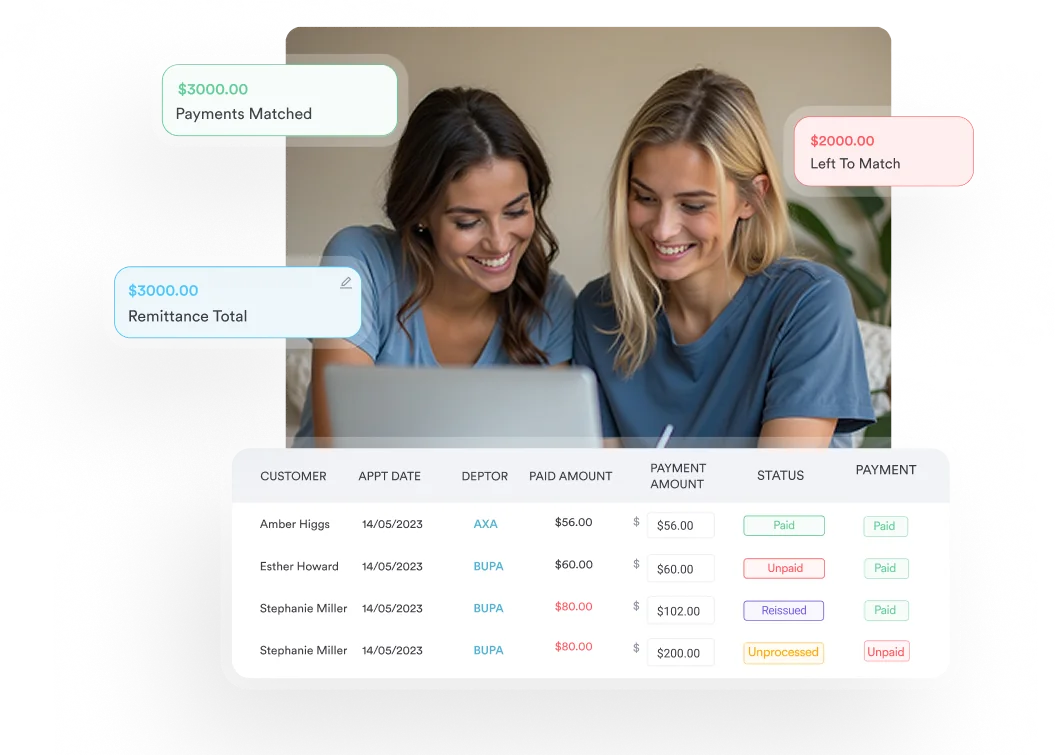
Built-in CPT and ICD-10 catalogs cut manual lookup time and the risk of mismatched code pairs. That matters most in orthopedic and multi-specialty practices running steady arthroscopy volume. Most of the efficiency comes from the whole chain, running from claim creation through ERA reconciliation. The submission step alone accounts for very little of it.

Pabau’s claims management software supports clean claim submission for knee arthroscopy codes through the Claim.MD clearinghouse. See how it keeps CPT 29877 claims moving.

CPT Code 29877 is a clean code when it stands alone, and a denial when it does not. NCCI bars it from every other knee arthroscopy code on the same knee, with modifier indicator 0 on every active pair.
Ask whether the more comprehensive code already describes the whole session. Then check whether G0289 covers any qualifying work in a second compartment. The operative report still has to name the compartment, the cartilage findings, and the failed conservative care behind the decision to operate.
Practices that check the modifier indicator before submission, pair 29877 with a supported ICD-10-CM diagnosis, and document the compartment will see fewer denials. To see how Pabau’s claims management tools handle CPT validation and clearinghouse submission for orthopedic procedures, book a demo with the team.

Need to understand how denial codes affect reimbursement? Denial management in healthcare breaks down CARC and RARC codes and how to resolve the most common claim rejections.
Want to verify 29877 claim submissions before they reach the payer? Clean claim submission covers the checklist every billing team should run before submitting surgical procedure claims.
Looking for a broader view of arthroscopy billing in your revenue cycle? Revenue cycle management explains how surgical claims fit into the full financial workflow from scheduling through payment posting.
Need the code that carries the session when a meniscectomy is also performed? CPT code 29881 is the meniscectomy code that absorbs chondroplasty in any compartment.
Billing extra arthroscopic work in a second compartment? HCPCS code G0289 sets out the compartment rules and the pairings that qualify.
CPT Code 29877 describes arthroscopy of the knee, surgical, with debridement or shaving of articular cartilage, a procedure also called chondroplasty. It covers smoothing of damaged articular cartilage surfaces using arthroscopic instruments and is classified under the Musculoskeletal System section of the AMA CPT code set.
The dependable modifiers on a CPT 29877 claim are RT and LT for laterality, plus modifier 22 for substantially increased work. Modifier 59 and the X-modifiers do not help here. Every active NCCI edit pairing 29877 with another knee arthroscopy code carries modifier indicator 0, so the bypass fails whatever the operative report says.
Coverage for CPT 29877 in knee osteoarthritis is not guaranteed. Payers including Aetna explicitly restrict coverage for arthroscopic debridement in OA without documented medical necessity showing conservative treatment failure. Medicare requires a specific cartilage pathology indication beyond a general OA diagnosis. Verify your MAC’s Local Coverage Determination before submitting.
G0289 covers removal of a loose body or foreign body, or chondroplasty, in a different compartment of the same knee during another surgical knee arthroscopy. With CPT 29880 or 29881 it is limited to loose body or foreign body removal, because those descriptors already include chondroplasty. It is never reportable for work in the same compartment as the other procedure.



