



CCSD code G5100: Bypass of duodenum billing guide
CCSD code G5100 bills a bypass that leaves the duodenum in place CCSD code G5100...

Last Updated: Oct 16, 2026
CPT code 29879 covers knee arthroscopy with abrasion arthroplasty, multiple drilling, or microfracture, with chondroplasty included where necessary.
Medicare pays about $623 nationally for the surgeon’s work, and that figure holds in a hospital, a surgery center, or an office. The code also carries a 90-day global period, so routine post-op visits are already paid for.
Several knee arthroscopy codes fold into 29879, and billing one alongside it triggers an automatic edit. The sections below cover the payment math, the modifiers, the bundling rules, and what to check before you submit.

CPT code 29879 covers knee arthroscopy with abrasion arthroplasty, multiple drilling, or microfracture, and chondroplasty is included where necessary.
Medicare pays roughly $623 nationally in 2026, with no split between facility and office settings, before geographic adjustment.
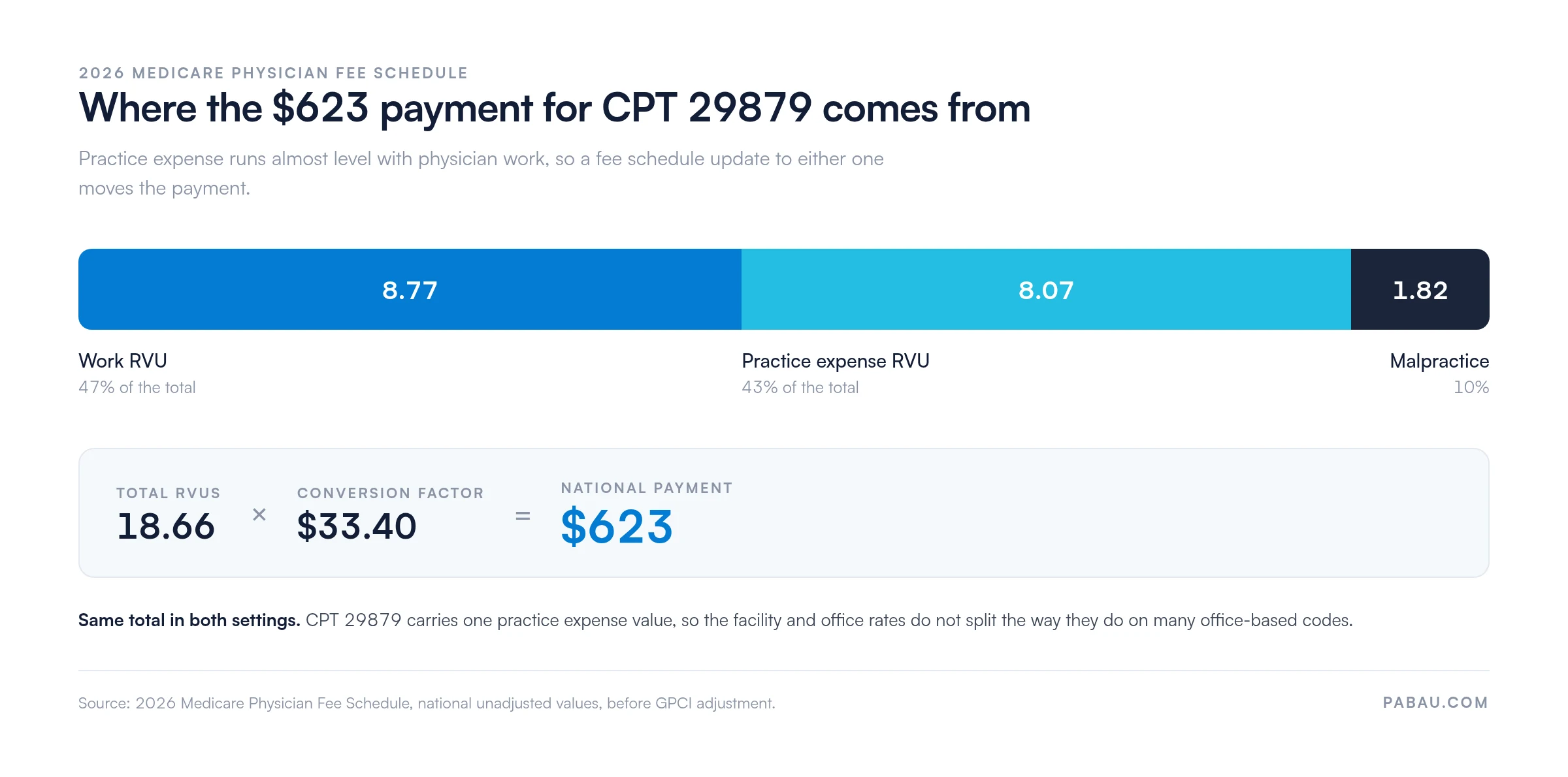
Total RVUs come to 18.66, split between work at 8.77, practice expense at 8.07, and malpractice at 1.82.
Modifiers LT and RT carry laterality, and modifier 59 applies when 29879 is billed with a knee code that would otherwise bundle.
Practice management software like Pabau pre-fills the claim from the client record, checks required fields, and routes it through a clearinghouse.
CPT 29879 is a surgical knee arthroscopy code aimed at damaged articular cartilage. The surgeon performs one of three techniques, not all three, and the code reads the same either way. Here is the official descriptor from the AMA’s CPT code set, word for word.
Full descriptor: “Arthroscopy, knee, surgical; abrasion arthroplasty (includes chondroplasty where necessary) or multiple drilling or microfracture”
All three reach the same goal by a different route. Abrasion arthroplasty uses a burr to take off damaged cartilage and prompt fibrocartilage regrowth.
Multiple drilling cuts channels through the subchondral bone to encourage vascular ingrowth. Microfracture perforates the subchondral plate with an awl or pick, releasing marrow cells that form repair tissue.
One detail decides the code. The American Academy of Orthopaedic Surgeons expects the note to show the surgeon worked down to bleeding subchondral bone.
Smoothing or shaving cartilage without reaching bone is chondroplasty, which is 29877.
The 2026 national payment for CPT 29879 is roughly $623 before geographic adjustment. That number does not change between settings.
Many surgical codes pay more in the office than in a facility, because the practice absorbs supply and staffing costs there. CPT 29879 carries a single practice expense value, so the office and facility rates land in the same place.
That $623 is a national average. Your payment moves with locality, through the GPCI multipliers that the CMS Physician Fee Schedule applies to work, practice expense, and malpractice separately.
A San Francisco practice collects more than a rural Mississippi one for the same operation. Pull the locality-adjusted figure before you quote a number to anyone.
Run a pre-authorization check before scheduling CPT 29879 procedures. Commercial payers frequently require prior authorization for knee arthroscopy, and verifying eligibility before the procedure date prevents post-service denial surprises. Use your practice management system to automate this step at scheduling.
Relative value units (RVUs) are how Medicare turns surgical work into money. CPT 29879 carries 18.66 total RVUs under the 2026 fee schedule, and the three components are worth knowing apart.
Practice expense sits almost level with physician work, which is why supply and staffing updates move this code as much as work revaluations do.
The math is short. Multiply 18.66 by the 2026 conversion factor of $33.40 and you get $623. Practices participating in a qualifying alternative payment model use $33.57 instead, which lifts the same code to roughly $626.
Apply your locality’s GPCI weights after that, not before.
Five modifiers come up on 29879 claims, and two of them are close to mandatory. A missing laterality modifier is the fastest way to get a claim kicked back.
Check the current AAPC coding resources and your payer’s own policy before you commit to any of them.
Modifier 59 deserves its own warning. Appending it to clear an edit, without an operative note that describes a separate service, is a federal compliance exposure rather than a billing shortcut.
Auditors pull 59 usage by code and by provider, and a surgeon whose 29879 claims carry it routinely will be asked to explain the pattern.
The National Correct Coding Initiative (NCCI) decides which code pairs collapse into one payment. On 29879 the conflicts cluster around two situations.
Either a diagnostic arthroscopy gets billed alongside the surgery, or a second arthroscopic service in the same session gets billed as though it stood alone. The CMS NCCI edit tables are the reference, and they refresh quarterly.
A worked example helps. Say the surgeon microfractures a chondral defect in the medial femoral condyle, then performs a lateral meniscectomy in the same sitting.
Two compartments, two procedures, two codes. Bill 29879 and 29881 with modifier 59. The operative note has to name both compartments explicitly, or the second line gets absorbed into the first.
Medical necessity is carried by the diagnosis, not the procedure. The claim needs one of the ICD-10-CM diagnosis codes that describes the cartilage defect the surgeon treated.
The operative report then has to back it up with the defect’s location, size, and depth, plus the clinical reasoning behind the technique chosen.
Payer policies vary on top of that. Aetna’s Clinical Policy Bulletin 673 sets specific indications for knee arthroscopy, and other commercial plans publish their own.
Most of them want evidence that conservative treatment was tried and failed, so that history belongs in the record before the surgery is scheduled.
CPT 29879 is a major surgical procedure with an 090 global indicator. That means the $623 payment already buys the day before surgery, the surgery itself, and 90 days of routine follow-up.
Billing an office visit for a normal post-op check inside that window is a duplicate claim, and it will be denied as such.
Some work inside those 90 days is still separately billable. Four modifiers reopen the window:
The practical risk is the front desk, not the coder. A patient who books a visit for something unrelated inside the window gets scheduled like any other appointment, and the claim goes out bare. Flag the global period on the record at surgery so the next person to touch that chart sees it.
Most 29879 denials are catchable at the desk. Work down this list before the claim goes out, and the traffic back from payers thins out fast.
Knee arthroscopy draws more than its share of audits. These five errors show up again and again on 29879 claims.
Commercial rates for CPT 29879 are negotiated one contract at a time, and none of them are published in a standard format. The range below is the working assumption most orthopedic groups start from.
Then track what actually lands. Compare paid amounts per payer against the contracted rate every quarter, and read the adjustment reason codes on the remittance when they disagree. Systematic underpayment on a surgical code is quiet money, and it compounds across a year of volume.
The knee arthroscopy family rewards careful reading. Coders pick the code matching the primary documented procedure. The table below covers the ones most often confused with 29879 or billed next to it.
When the operative note describes a meniscectomy rather than cartilage repair, 29881 is the code to bill.
Audit your 29879 denial rate quarterly. Pull every 29879 claim from the prior quarter and identify the top three denial reason codes. Then map each one to the step where the error started. Most practices find that a single upstream habit explains the bulk of them.
No software will tell you which modifier belongs on a claim. That call sits with the coder reading the operative note, and it should. What software can do is clear away the clerical failures that sink a surgical claim before anyone clinical ever looks at it.
Practice management software like Pabau builds the claim from the record rather than a blank form. The CPT code attached to the service lands on the charge line, and the ICD-10 slots are seeded from the client’s recorded problem list. Required fields have to be complete before the claim can be sent.
That last part matters more than it sounds. A missing authorization number or membership reference surfaces at the desk on the day, instead of three weeks later as a rejection. Pabau’s claims software for orthopedics then routes the finished claim to US payers through Claim.MD, its clearinghouse partner, which reaches thousands of them.
The same pipeline handles real-time eligibility checks, claim status tracking, and remittance posting. A biller can see where a 29879 claim sits without picking up the phone. Built-in ICD-10-CM and CPT lookup libraries sit alongside it for reference, refreshed with each official release.
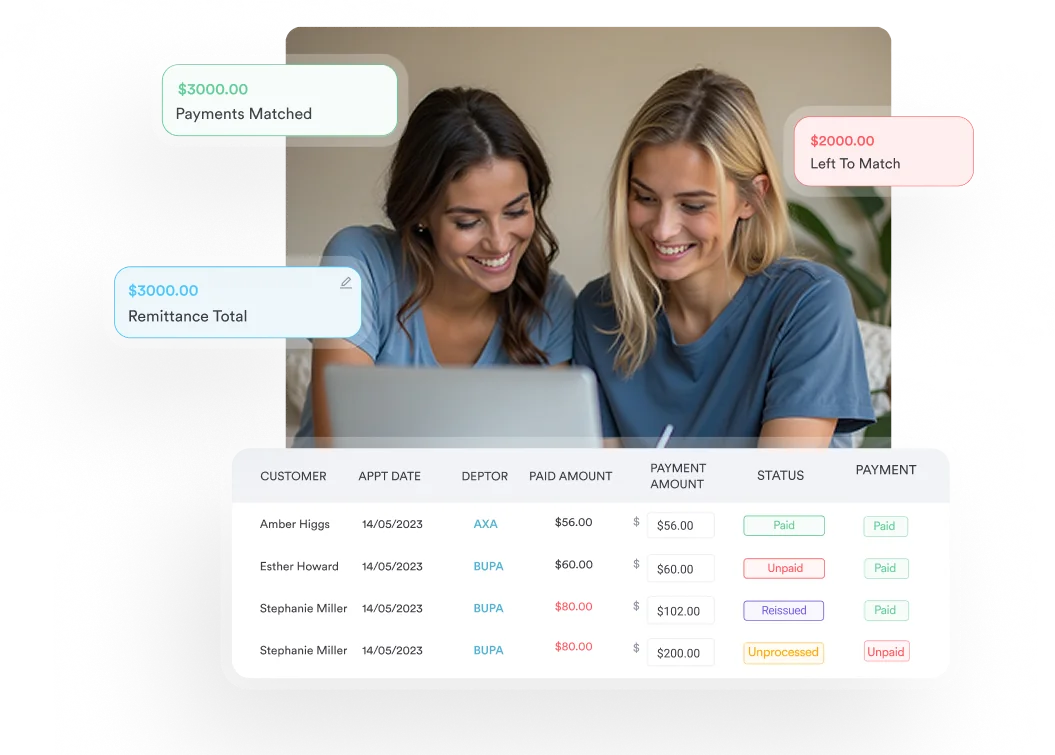

Pabau pre-fills the claim from the client record and checks that required fields are complete before it can be sent. Claims then route to US payers through Claim.MD.

CPT 29879 pays well for a short operation, and it stays paid when the operative note does its job. Name the technique, record the bleeding bone, put the defect in a compartment, and the bundling arguments mostly resolve themselves. The documentation is the billing.
The part practices underestimate is the 90 days after surgery. A single unflagged post-op visit turns a clean $623 into a denial and an appeal. Chasing it costs more staff time than the visit was ever worth.
If claim rework is eating your billing team’s week, it is worth seeing the alternative. Book a demo and we will walk through how Pabau moves a surgical claim from the operative note to the payer without retyping it.

Need to understand how claims reach payers? Medical claims clearinghouse explains how clearinghouses validate and route surgical claims before payer adjudication.
Want to read a denial before you appeal it? Denial codes in medical billing decodes the reason codes that show up most often on surgical claims.
Billing a meniscectomy instead? CPT code 29880 covers meniscectomy in both compartments, the sibling code most often confused with 29879.
Chasing a higher first-pass rate? Clean claim submission sets out what a payer needs on the first try, and what sends a claim straight back.
Looking for guidance on credentialing with payers? Getting credentialed with insurance companies walks through the enrollment process for surgical providers.
Sometimes, and the payer decides. The American Academy of Orthopaedic Surgeons treats abrasion arthroplasty as compartment-specific. A second unit may be reported when both the medial and lateral compartments are treated. Carriers split on whether the second line needs modifier 59 or 51. Confirm the policy before you bill it.
The surgery center does, on its own claim. The surgeon bills 29879 on the CMS-1500 for the professional work, and the center bills its facility fee separately under the ASC payment system. Two claims, two sets of payer rules, one date of service.
Traditional Medicare does not require it, but many Medicare Advantage and commercial plans do for knee arthroscopy. Run the check at scheduling rather than on the day of surgery. A retroactive authorization request rarely succeeds, and the write-off lands on the practice.
Once a year on the payment side. CMS publishes new RVUs and a new conversion factor with each January fee schedule. Bundling runs on a different clock. The NCCI edit tables update quarterly, so a code pair that billed cleanly in January can fail by July.



