

HCPCS code E0198: Water pressure pad billing guide
HCPCS code E0198 is a water pad for a standard mattress HCPCS code E0198 is the ...

Last Updated: Oct 13, 2026
29874 is the CPT code for arthroscopy, knee, surgical; for removal of loose body or foreign body (eg, osteochondritis dissecans fragmentation, chondral fragmentation).
Coders confuse it most often with 29877 (chondroplasty/debridement), because both codes cover knee arthroscopy for damaged cartilage. Most 29874 denials trace back to an operative note that reads as lavage. The surgeon has to state that an identifiable loose body was found and physically removed, not that debris was washed out.
Let Pabau's smart automation suggest the right codes, reduce claim denials, and keep your practice compliant—effortlessly.
Automate repetitive tasks and focus on what matters most—your patients.
Reduce coding errors and ensure compliance with the latest regulations.
Clean claims, fewer denials, and faster reimbursements.
Powerful insights and reporting to help your practice thrive.
HIPAA compliant SOC 2 certified GDPR-compliant Trusted by 4,000+ clinics worldwide

CPT code 29874 covers arthroscopic knee surgery to remove a loose or foreign body, not simple debridement or lavage.
A 90-day global surgery period applies under Medicare, so routine follow-up visits in that window are bundled into the surgical fee.
Most payers require modifier LT or RT. Billing without a laterality modifier is the leading cause of 29874 denials.
The operative note must name the fragment and describe its removal. A note that reads as a wash-out will not support the code.
Claims management software like Pabau flags missing laterality and modifier fields before the claim is submitted.
CPT code 29874 is classified under Endoscopy/Arthroscopy Procedures on the Musculoskeletal System, as maintained by the American Medical Association’s CPT code set. The code sits in the 29800s surgical arthroscopy range alongside codes for meniscectomy, chondroplasty, meniscus repair, and ligament reconstruction.
The procedure involves arthroscopic portal placement, joint inspection, and identification of the loose body. That fragment, whether osteochondral or chondral, is then physically extracted from the joint space. The descriptor’s parenthetical examples are not exhaustive. Any loose or foreign body removed arthroscopically from the knee qualifies, including traumatic cartilage fragments from acute injuries.
Bundled into 29874 is the complete arthroscopic approach: Portal placement, joint insufflation and irrigation, intra-articular inspection, and the removal itself. A common documentation error is describing the irrigation as the primary intervention. Payers require evidence of a distinct physical extraction, not simply a flush that washes debris out.
The critical distinction between 29874 and 29877 is surgical intent. If the operative note documents only smoothing or shaving of cartilage surfaces without removing an identifiable loose fragment, 29877 applies. If an osteochondral piece detached from a lesion is grasped and extracted, 29874 is correct. Both codes may be reportable in the same session when the procedures are genuinely distinct and separately documented. The chart below maps four common note wordings to the code each one supports.
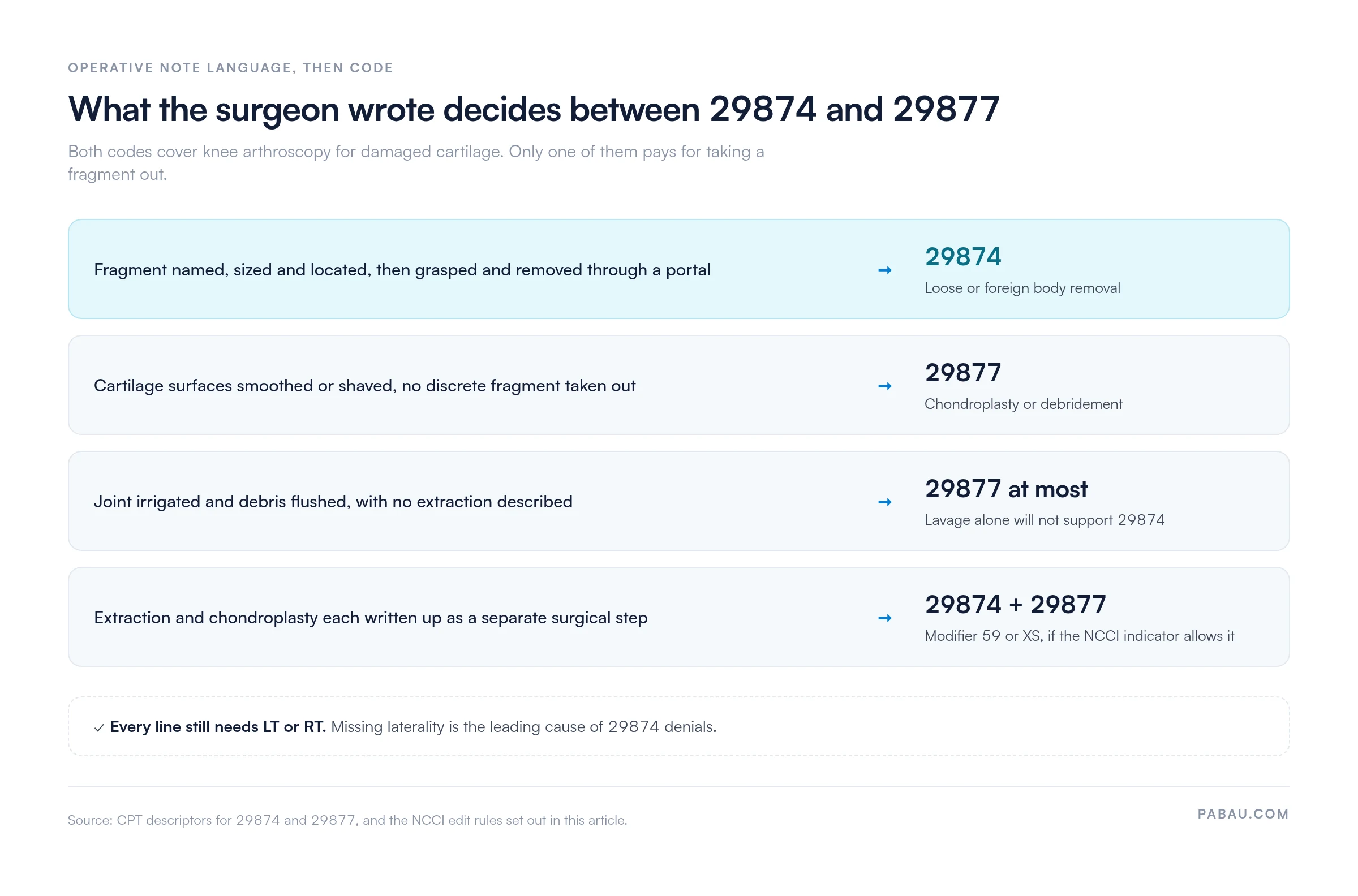
Missing or vague operative note language is the root cause of most 29874 denials. Payers audit these claims specifically because loose body removal is difficult to distinguish from lavage on a superficially worded note. A superbill alone will not carry the code. The payer reads the operative note behind it.
The same approach requirement runs through endoscopic codes in unrelated specialties. CPT 58562, hysteroscopic removal of an impacted foreign body, is denied when the note does not state the approach was hysteroscopic rather than open.
Building a documentation checklist into the pre-submission workflow catches these omissions before the claim reaches the payer. A 29874 claim denied for lavage-only language needs a full appeal with an addendum from the surgeon. That is far more work than getting the operative note right the first time.
The diagnosis code must support the clinical rationale for removing a loose body from the knee. Using a code that describes only arthritic changes without specifying a loose fragment is a common medical-necessity denial trigger.
Codes describing only degenerative joint disease (M17.x) without a specific loose body or OCD diagnosis typically fail medical necessity review for 29874. The diagnosis must logically support the removal of an identifiable fragment, not general arthritis. Before settling on M23.4x or M93.26x, read each code’s full descriptor and its Excludes notes in the ICD-10-CM codes library.
A patellar dislocation is one traumatic source of a loose fragment in the knee. When the same session also reconstructs the dislocating patella, check the bundling rules for 27422 before billing both.
The knee arthroscopy surgical family is one of the highest-volume sources of coding errors in orthopedic billing. These codes share the same approach but differ by what the surgeon does inside the joint.
Embedding these code-family rules in the billing workflow beats asking coders to recall them claim by claim, especially across a high-volume orthopedic caseload.
The National Correct Coding Initiative (NCCI) governs which knee arthroscopy codes can be reported together. Reporting 29874 alongside 29881 is a common scenario when a loose body removal and a meniscectomy are performed during the same session. NCCI edit status for code pairings changes quarterly. Always verify against the current CMS NCCI tables before submitting combination claims.
Modifier 59 signals a distinct procedural service, but it does not by itself override an NCCI edit if the documentation does not support separation. Payers increasingly audit modifier-59 usage on surgical code pairs. The operative note must describe the loose body procedure and the meniscectomy as separate surgical steps. Each has to address a different anatomical problem, rather than forming one continuous debridement.
Diagnostic arthroscopy is the pairing the table above leaves out. CPT 29870 falls on the column 2 side of its NCCI pair with surgical knee codes, so only 29874 goes on the claim.
Lysis of adhesions is the other pairing a knee operative note routinely produces. CPT 29884 carries a separate procedure label, so it bundles into a more definitive knee arthroscopy unless the note documents a different compartment.
Before appending modifier 59 to any 29874 pairing, pull the current NCCI table for that code pair and check the modifier indicator column. An indicator of 0 means no modifier can break the bundle. An indicator of 1 means modifier 59 or an X modifier may apply where the documentation supports it. Using modifier 59 against a 0 indicator triggers an automatic denial and flags the claim for audit.
Modifier selection for CPT code 29874 follows the same logic as other knee arthroscopy codes, with laterality modifiers as the non-negotiable starting point.
Medicare reimbursement for CPT code 29874 is set annually through the Medicare Physician Fee Schedule (MPFS). The amount a practice receives varies by Geographic Practice Cost Index (GPCI) locality, so national averages are a starting point rather than a guarantee. Use the CMS MPFS lookup tool with your MAC locality to get the rate that applies to your practice address.
Because MPFS figures change with each annual update and vary by locality, publishing a specific dollar amount here would go stale within months. Run the code through the CMS tool with your own GPCI locality instead. Commercial payers set their own fee schedules, usually as a multiplier of the Medicare rate, and negotiated rates vary widely by contract.
The 90-day global period bundles post-operative knee care into the 29874 payment. Any evaluation and management service inside that window counts as part of the surgical fee. Separate billing for routine follow-up inside that window will be denied. Unrelated E&M services can still be billed with modifier 24, which tells the payer the visit is not connected to the surgery. Tracking the global period start date against every subsequent visit is what stops those claims going out.
Medicare does not require prior authorization for CPT 29874 under standard Part B fee-for-service. Medicare Advantage plans follow their own authorization policies, and many of them require it. Commercial payers vary widely, and most require prior authorization for any arthroscopic surgical procedure.
Checking the auth requirement at scheduling prevents claim delays instead of fixing them after a denial. Tracking authorization status against the procedure date matters most for 29874, given how much commercial payer volume an orthopedic practice carries.
Practices using claims management software can link authorization numbers directly to the claim before submission. That removes the manual step of cross-referencing an auth log at billing time.
CPT code 29874 denials cluster around a small number of predictable causes. Most are preventable at the pre-submission stage with the right documentation and modifier review. A denial review step built into the billing cycle catches them before they reach the payer.
An appeal on a denied 29874 claim usually needs a cover letter quoting the operative note language that separates extraction from lavage. Attach the MRI report and any diagnostic arthroscopy images. Where the denial is an NCCI bundling edit, include a copy of the current table showing the modifier indicator. Add the note sections for each billed procedure.
CPT 29874 is almost exclusively performed in a hospital outpatient department (POS 22) or ambulatory surgery center (POS 24). The place of service decides which fee schedule applies to the physician’s claim. For Medicare, it also decides whether the facility or non-facility PE RVU is used.
Setting the POS code correctly at charge entry is what prevents this category of denial. A claim submitted with POS 11 for an ASC procedure will be rejected. Correcting it takes a full void and resubmission rather than an amendment.
On an electronic claim, the 837 file carries the POS code in the service line segment. Validating that field before submission heads off the same problem. The remittance advice on a denied facility-setting claim usually shows CARC 4 or CARC 96, depending on how the payer reads the mismatch.
In most orthopedic practices the checks on this code happen by hand. A coder opens the operative note and confirms the fragment was described as removed. Then they look up the authorization number in a separate log and append LT or RT. Each of those steps is a place where a clean claim quietly turns into a denial.
Practice management software like Pabau keeps the operative note, the authorization number, and the claim line in one patient record. Laterality and modifier fields are validated as the charge is entered, so a 29874 line cannot leave the practice without them. Claims then route to the payer through our Claim.MD clearinghouse integration, which scrubs the file before it goes out.
The global period runs against the procedure date in the same system. A post-operative visit booked inside the 90-day window is flagged before anyone bills it. Billers spend their time on the appeals that are worth fighting, rather than on rework the practice could have avoided.

Pabau’s claims management software tracks modifier requirements, authorization status, and global periods, so your 29874 claims submit clean the first time. See how it works for your practice.

This code stands or falls on one sentence in the operative note. Where the surgeon names the fragment and describes taking it out, 29874 survives an audit. Where the note reads as a wash-out, no modifier and no appeal letter will rescue the claim.
That puts the work before the claim exists rather than after it. Agree the wording with your surgeons, make laterality a required field at charge entry, and check the NCCI indicator before anyone appends modifier 59. Those three habits remove most of the denials described on this page, and they cost far less than the appeals they replace.
Book a demo to see how Pabau validates laterality, modifiers, and global periods on surgical claims before they reach the payer.

Need to understand how clearinghouse submission works? Medical claims clearinghouse guide explains how claims are scrubbed and routed before they reach the payer.
Want to reduce claim rejections before submission? Revenue cycle management overview covers the end-to-end billing workflow from charge capture to payment posting.
Billing multiple procedures in the same session? CPT coding reference for multi-procedure billing walks through how to document and report multiple codes on a single claim.
CPT code 29874 covers arthroscopic knee surgery performed specifically to remove a loose body or foreign body from the knee joint. Osteochondritis dissecans fragmentation and chondral fragmentation are the named clinical examples. The code includes portal placement, joint inspection, and physical extraction of the fragment, but not chondroplasty, meniscectomy, or simple lavage performed without a distinct removal.
Medicare reimbursement for CPT 29874 varies by GPCI locality and changes annually with the MPFS update. Use the CMS MPFS lookup tool at cms.gov with your MAC locality to find the facility and non-facility rates for your practice location. National averages from third-party sites should be checked against the official CMS data before you rely on them in fee schedule negotiations.
Yes, CPT 29874 and 29881 can be billed together when both procedures are distinctly performed and documented in the operative note. Verify the NCCI edit status for this pairing against the current quarterly table. If an edit is present, modifier 59 or XS is required. The operative note must then describe the meniscectomy and the loose body removal as separate surgical steps. Modifier 59 alone does not override a bundle without documentation behind it.
The required modifiers for CPT 29874 are LT (left) or RT (right) for laterality, and omitting them is the top denial cause. Modifier 59 or XS applies when billing 29874 alongside a bundled code such as 29877, provided the documentation supports separate procedures. Modifier 51 applies to the secondary procedure in multi-procedure sessions, and modifier 50 applies only in the rare case of bilateral same-session arthroscopy.
CPT 29874 is for extraction of an identifiable loose or foreign body from the knee joint. CPT 29877 is for chondroplasty or debridement, which means smoothing or shaving damaged cartilage without removing a discrete fragment. The distinction turns on the operative note. If the surgeon grasped and removed an osteochondral or chondral fragment, 29874 applies. If only abrasion or shaving of cartilage surfaces occurred, 29877 applies. Both may be reportable in the same session with appropriate modifier and documentation support.
Yes, CPT 29874 carries a 90-day global surgery period under Medicare. Routine postoperative follow-up visits within 90 days of the surgery date are bundled into the surgical reimbursement. They cannot be billed separately. E&M services for conditions unrelated to the arthroscopy may still be billed within the global window. Modifier 24 tells the payer the visit is for a separate problem.
Exact fee schedule amounts for CPT 29874 change annually with CMS MPFS updates and vary by geographic locality. For current 2025 or 2026 rates, use the CMS Physician Fee Schedule search tool at cms.gov with your practice’s GPCI locality code. Third-party rate sources should always be cross-referenced against official CMS data.
The most common denial reason for CPT 29874 is a missing laterality modifier, LT or RT. Close behind it sits an operative note that describes lavage rather than physical extraction. Others are an ICD-10 diagnosis code that does not support loose body removal, and bundling with 29877 without modifier 59 or XS. Missing prior authorization from commercial payers and billing within the 90-day global period without modifier 24 are also frequent causes.



