CPT Code 35820: Exploration for postoperative hemorrhage (thorax)
CPT Code 35820: Official descriptor and clinical overview CPT Code 35820 is defi...

Last Updated: Nov 13, 2026
29821 is the CPT code for arthroscopy, shoulder, surgical; synovectomy, complete. It covers arthroscopic removal of the synovial lining throughout the shoulder joint, rather than from one focal area.
A partial synovectomy is coded 29820, and 29822 and 29823 are debridement codes. A 29821 claim holds up when the operative report shows complete removal and no same-session code is bundled into it. Under Medicare, the +29826 add-on is the only shoulder arthroscopy code that pays alongside 29821 on the same shoulder.
Let Pabau's smart automation suggest the right codes, reduce claim denials, and keep your practice compliant—effortlessly.
Automate repetitive tasks and focus on what matters most—your patients.
Reduce coding errors and ensure compliance with the latest regulations.
Clean claims, fewer denials, and faster reimbursements.
Powerful insights and reporting to help your practice thrive.
HIPAA compliant SOC 2 certified GDPR-compliant Trusted by 4,000+ clinics worldwide

CPT code 29821 is a complete arthroscopic shoulder synovectomy, so the operative report must show synovium removed throughout the joint.
A partial synovectomy is 29820, while 29822 and 29823 are debridement codes counted by the number of discrete structures treated.
Under Medicare’s NCCI edits, 29821 bundles with every other surgical shoulder arthroscopy code on the same shoulder, and a modifier can’t bypass those edits.
The +29826 add-on is reported alongside 29821 and paid in full, with no multiple endoscopy reduction.
Pabau’s claims management software sends CMS-1500 claims through Claim.MD, runs eligibility checks and tracks prior authorizations on the case.
CPT code 29821 is the code for “Arthroscopy, shoulder, surgical; synovectomy, complete.” That wording comes from the AMA’s CPT code set, which the AMA’s CPT Editorial Panel maintains. The surgeon removes the synovial lining throughout the glenohumeral joint, not just one inflamed patch of it.
Because 29821 is a surgical arthroscopy, it already includes the diagnostic look at the same session. Don’t report diagnostic shoulder arthroscopy (29805) alongside it. The NCCI policy manual, chapter IV, says the same for every joint: a surgical arthroscopy includes the diagnostic one.
Most problems with this code start well before anyone opens the claim form. Here’s the path a typical 29821 case takes, and where each step can go wrong.
Steps two and three decide most outcomes. The next sections cover what the report needs and which code pairs payers accept.
An arthroscopic shoulder synovectomy starts with the patient in the beach-chair or lateral decubitus position. The surgeon sets up posterior and anterior portals and introduces the arthroscope into the glenohumeral joint. A motorized shaver or radiofrequency device then removes the synovial lining across the whole joint.
The report must describe each area treated and confirm the removal was complete rather than focal. Documentation that supports a CPT code 29821 claim includes:
“Synovial tissue was debrided as needed” tells a reviewer nothing about scope. A stronger version names the areas: “Hypertrophic synovium was resected from the rotator interval, the anterior and posterior recesses and the axillary pouch.” It then states that the synovectomy was complete. The second version is the one that survives a records request.
The code that sits next to 29821 is 29820, “Arthroscopy, shoulder, surgical; synovectomy, partial.” The difference is scope. Complete means synovium is removed throughout the joint, while partial means the surgeon treated a defined area only.
Debridement is a separate question. Code 29822 is limited debridement of 1 or 2 discrete structures, and 29823 is extensive debridement of 3 or more. Neither one describes a synovectomy, so neither is the “limited” version of 29821.
Auditors compare the report’s wording with the descriptor. A quarterly sample of 29821 claims, read against their operative reports, catches the cases that should have been 29820.
A complete synovectomy often happens in the same session as other shoulder work. Under Medicare’s NCCI edits, 29821 has a bundling edit with every other surgical shoulder arthroscopy code except the +29826 add-on. Here’s how each neighbor behaves on the same shoulder.
Two rules from the NCCI policy manual drive that table. Shoulder arthroscopy procedures include limited debridement, so 29822 isn’t separately payable with 29821 under Medicare. And a modifier such as 59 or XS can’t bypass an edit between two shoulder arthroscopy codes on the same shoulder.
The edits do allow a modifier when the two procedures are on opposite shoulders. For example, a rotator cuff repair with 29827 on the right shoulder and a synovectomy on the left can both be reported.
Commercial payers may run different edits, so check each pair against current CMS NCCI edits, the payer’s policy and the CPT guidelines. NCCI tables are updated quarterly.
Pull every 29821 claim from the past 90 days that also carried 29823, 29824, 29827 or 29828 on the same shoulder. Medicare doesn’t pay 29821 separately there, so a paid 29821 line may be an overpayment to refund.
CMS gives 29821 multiple procedure indicator 3, which puts it under the special rules for endoscopic procedures. Its endoscopic base code is 29805, the diagnostic shoulder arthroscopy.
When two codes from that family are paid together, Medicare pays the highest-valued one in full. Each other code pays its own value minus the base.
For 29821 the arithmetic is stark. Its 16.69 facility RVUs minus the 13.44 RVUs of 29805 leave 3.25 RVUs, about $108.55 at the 2026 conversion factor of $33.4009 before geographic adjustment. Because NCCI bundles 29821 with its same-shoulder neighbors, the rule mostly bites when the edits let two family codes pay together.
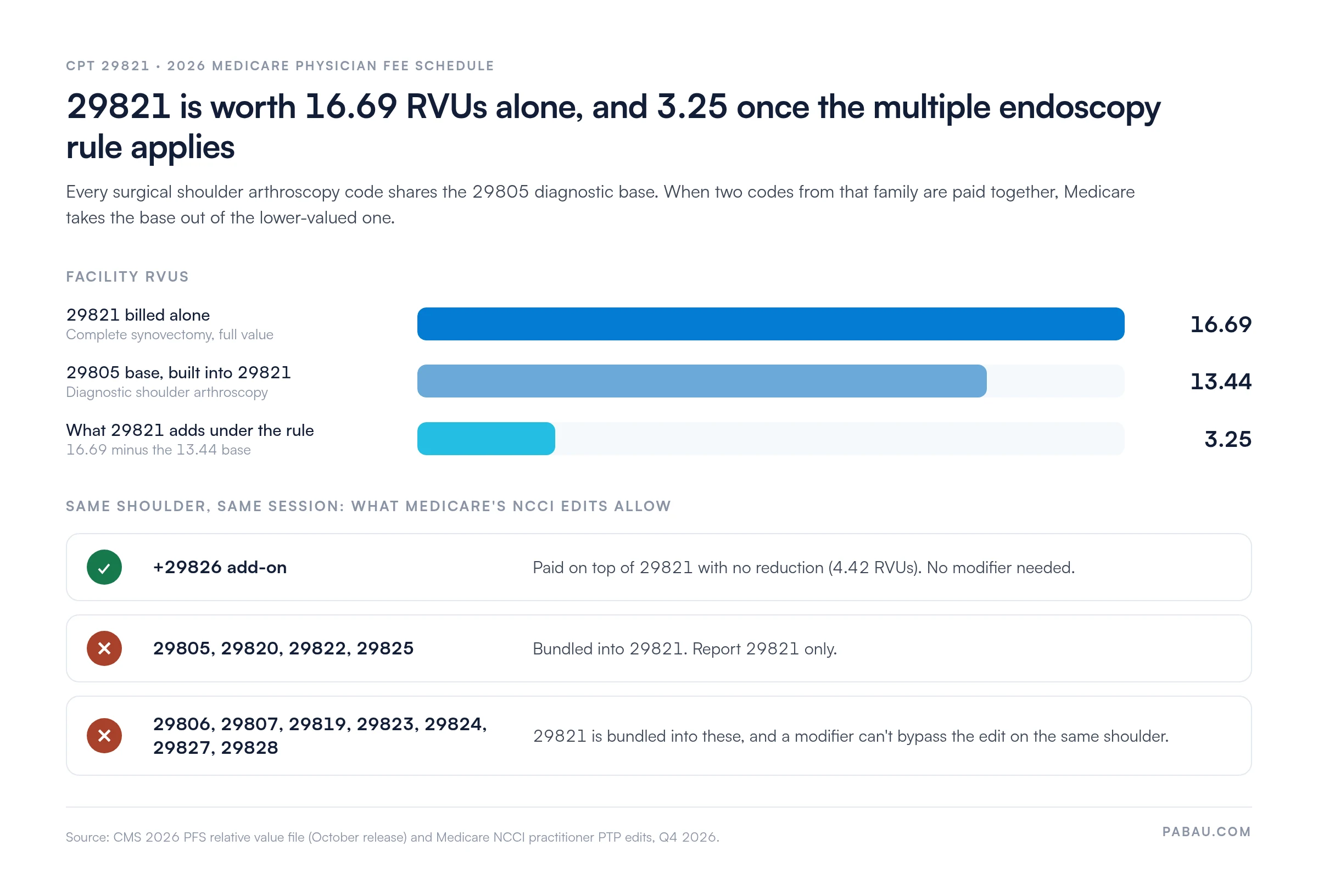
The add-on works differently. +29826 has been an add-on code since 2012, with a “ZZZ” global period and multiple procedure indicator 0. It’s reported with a primary shoulder arthroscopy code such as 29821, and it isn’t a base code. Medicare doesn’t reduce 29821 against it, and the add-on itself pays in full.
Rather than relying on a static estimate, use the CMS Physician Fee Schedule look-up tool to price a multi-code claim. The payer applies the reduction, not the coder, so the claim still lists every payable code at its full charge.
Medical necessity for a complete synovectomy usually rests on an inflammatory or proliferative synovial disease. A patient with mild degenerative change and no documented synovitis is unlikely to pass review for 29821.
Use the most specific code available, and match laterality to the operative report. An unspecified-side code on a right shoulder case is a correctable error, but it still delays payment. Check accepted diagnoses against each Local Coverage Determination, since Medicare Administrative Contractors set criteria by region.
In the 2026 Medicare Physician Fee Schedule, 29821 carries 7.69 work RVUs and 16.69 total facility RVUs. That works out to about $557.46 nationally before geographic adjustment. Rates change every year, so confirm the current figure in the CMS look-up tool before you quote it.
Many commercial payers and Medicare Advantage plans require prior authorization for shoulder arthroscopy, so verify it with each payer before surgery. Policies change often, and a missing authorization is one of the easiest denials to prevent. A typical request includes:
CPT 29821 claims fail for a predictable set of reasons. Most are preventable with better documentation and a check before the claim goes out.
Track denials by reason code rather than one claim at a time, so repeat documentation problems show up as a pattern. An electronic remittance advice carries a claim adjustment reason code for each line that didn’t pay in full. The medical billing denial codes guide explains what each one means and how to respond.
Sort every CPT 29821 denial from the past 60 days by reason code. If medical necessity leads the list, the fix belongs in the pre-surgical documentation workflow, not in the claim.
Run this list before the claim leaves the practice. It covers what payers most often ask for when they review or audit a 29821 claim.
A claim that clears every item is what payers call a clean claim. It can be paid on first submission, without a records request or a resubmission.
In many orthopedic practices, a 29821 case touches four systems. Authorization calls are logged in a spreadsheet, and the operative report sits in the EHR. Claims are keyed into a clearinghouse portal, and remittances arrive as PDFs that someone matches by hand.
Pabau, the practice management platform we build, keeps those steps on one patient record. Its claims management software creates CMS-1500 and 837P claims and sends them through Claim.MD, our US clearinghouse partner.
Your team runs eligibility checks before the appointment. The authorization code, dates and sessions are tracked on the case, with a warning when one is missing.
ERA remittances come back into Pabau. A bundled 29822 line or a missing authorization then shows up as a reason code your team can act on. Fewer claims leave without an authorization, and repeat denials point to the step that caused them.

Pabau sends CPT 29821 claims through Claim.MD, runs eligibility checks and posts ERA remittances in one place. Your billing team spends less time chasing denials.

Code 29821 only when the operative report earns the word “complete.” When decompression was done, add +29826 and expect it to pay in full. On a Medicare claim, leave the other same-shoulder arthroscopy codes off unless the edits allow them.
The trade-off is easy to miss. Paired with a bigger shoulder procedure, a complete synovectomy often adds little or nothing to the payment, but it still carries full audit risk. Tighten the dictation template first, because that’s where most 29821 problems begin.
Book a demo to see how Pabau tracks the authorization, sends the claim and posts the remittance for every shoulder arthroscopy case.

Need a denial tracking framework for arthroscopy codes? Denial management in healthcare covers how to categorize, track, and appeal claim denials systematically across your billing team.
Unfamiliar with how clearinghouses process surgical claims? Medical claims clearinghouse guide explains how EDI claims move from practice to payer and where errors get caught.
Want to understand the 837P file your clearinghouse submits? 837 file overview breaks down the electronic claim format used for professional claims including CPT 29821 submissions.
Debrided three or more structures in the same shoulder? CPT code 29823 covers extensive debridement of 3 or more structures in the shoulder.
Yes. CMS gives 29821 bilateral surgery indicator 1, so Medicare pays 150% of the fee schedule amount when both shoulders are treated in one session. Report it with modifier 50, or with RT and LT, as the payer instructs.
It can. CMS gives 29821 assistant at surgery indicator 2, which means an assistant may be paid. The assistant’s claim carries modifier 80, 82 or AS, depending on who assisted.
Routine ones aren’t. The 90-day global period covers normal postoperative care. Bill an unrelated visit with modifier 24 and an unrelated procedure with modifier 79. A return to the operating room for a complication takes modifier 78.
Open glenohumeral synovectomy is reported with arthrotomy code 23105, not 29821. If the surgeon converts an arthroscopy to an open procedure, NCCI rules allow only the open code.
Knee arthroscopic synovectomy uses 29875 for a limited synovectomy and 29876 for a major synovectomy of two or three compartments. NCCI limits when either can be billed with another procedure on the same knee.