CPT code 36468: Injection sclerotherapy of telangiectasia billing guide
CPT code 36468 covers spider veins on a limb or the trunk CPT code 36468 reports...

Last Updated: Nov 13, 2026
29820 is the CPT code for arthroscopy, shoulder, surgical; synovectomy, limited. It covers the arthroscopic removal of diseased synovial tissue from part of the shoulder joint lining.
The code sits in the musculoskeletal surgery section of the AMA CPT code set. Code selection turns on the op note. A partial resection supports 29820, and a complete resection is reported as 29821. Diagnostic arthroscopy (29815) is bundled in, and modifier -59 applies only to a documented distinct procedure.
Let Pabau's smart automation suggest the right codes, reduce claim denials, and keep your practice compliant—effortlessly.
Automate repetitive tasks and focus on what matters most—your patients.
Reduce coding errors and ensure compliance with the latest regulations.
Clean claims, fewer denials, and faster reimbursements.
Powerful insights and reporting to help your practice thrive.
HIPAA compliant SOC 2 certified GDPR-compliant Trusted by 4,000+ clinics worldwide

CPT code 29820 covers arthroscopic limited synovectomy of the shoulder, meaning partial removal of the synovial lining rather than all of it.
A complete resection of the joint lining is reported as 29821, so the op note has to state which scope the surgeon performed.
Diagnostic arthroscopy 29815 is bundled into 29820 at the same session, and modifier -59 or an X-modifier applies only to a documented distinct procedure.
The code carries a 90-day global period under Medicare, so a post-op E/M visit inside that window needs an unrelated diagnosis and modifier -24.
Pabau’s claims management software tracks each 29820 claim through submission, remittance, and denial follow-up via its Claim.MD clearinghouse integration.
CPT code 29820 describes arthroscopy, shoulder, surgical; synovectomy, limited. The procedure removes inflamed or hypertrophic synovial tissue from part of the joint lining under arthroscopic visualization. “Surgical” separates it from a diagnostic-only shoulder scope. “Limited” separates it from CPT 29821, the complete synovectomy code.
RVU and fee-schedule values change annually with the CMS conversion factor. Always verify current figures using the CMS Physician Fee Schedule lookup tool before quoting a reimbursement amount to a provider or payer.
The operative report must reflect a surgical arthroscopic approach, not merely a diagnostic one. Coders who code from an inadequate op note end up with down-coded claims or medical necessity denials.
Key steps the report should document for 29820:
The distinction between “limited” and “complete” is clinical and must be supported by surgeon documentation. Coders cannot infer scope from procedure time alone.
Ask the surgeon to state where synovium was removed and whether the resection was partial (limited) or complete. That one sentence in the op note decides between 29820 and 29821. It also decides whether the claim goes out clean or comes back with a documentation request.
CPT 29821 describes arthroscopy, shoulder, surgical; synovectomy, complete. The clinical and documentation thresholds that separate it from 29820 are specific.
Never report 29821 when the op note documents a partial resection, even if the procedure ran longer than expected. Code to the documentation, rather than to the surgeon’s intent or the time spent. The diagram below maps each documented scope to its code.
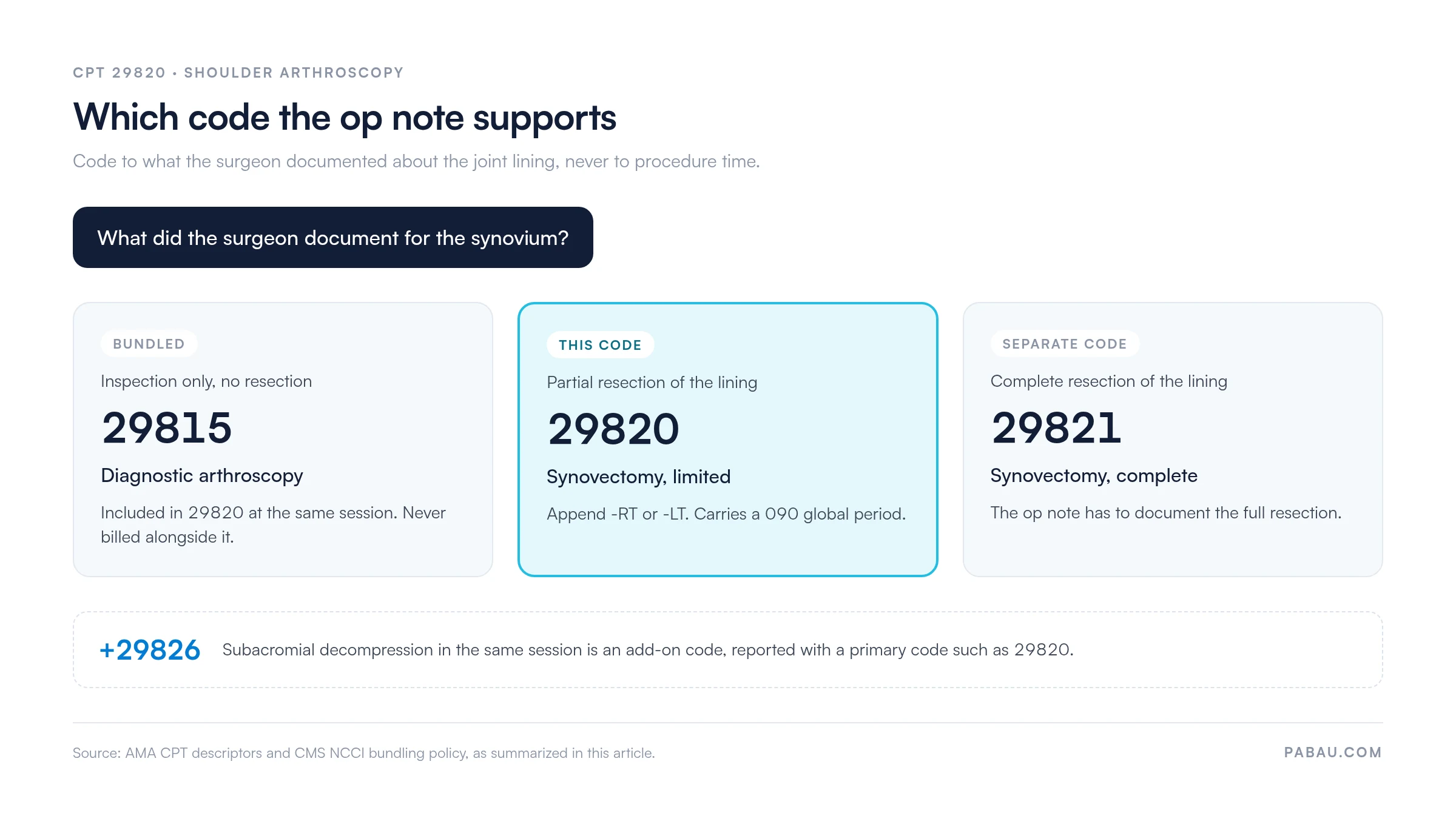
The 29820 family spans a range of distinct surgical arthroscopy codes. Picking the wrong adjacent code, or missing a bundling rule, drives the most common claim edits for orthopedic practices.
The AAPC Codify CPT lookup provides full descriptors and lay descriptions for each of these codes. It helps when you compare op note language with the official text before finalizing a claim.
Debridement raises the most co-billing questions. Limited debridement is 29822 and extensive debridement is 29823, and either can collide with 29820 under an NCCI edit pair.
The National Correct Coding Initiative (NCCI) governs which procedure codes CMS considers components of a more comprehensive service. For CPT code 29820, the core bundling principle is that diagnostic arthroscopy work (CPT 29815) is included in every surgical arthroscopy. The diagnostic component cannot be billed separately.
Key NCCI bundling points for 29820:
Quarterly NCCI table updates mean an edit pair that was modifier-allowed in Q1 can become bundled without override in Q2. Orthopedic practices should build a quarterly NCCI review into their compliance calendar. Pabau’s orthopedic claims management software tracks submitted codes and flags remittance denials tied to NCCI edits. Your billing team can then act on them without queuing each ERA by hand.
Modifiers on 29820 claims do two jobs. Laterality identification is required on every claim, while unbundling justification is situational. A missing laterality modifier causes automatic rejection, and a misused unbundling modifier invites a post-payment audit.
CMS issued specific guidance in 2015 recommending the X-modifiers (XS, XU, XE, XP) over -59 for Medicare claims where greater specificity is possible. For commercial payers, -59 remains widely accepted. Never append -59 or an X-modifier unless the op note explains why the second procedure is distinct. The modifier attests to that documentation, and an auditor will look for it.
Payers read the ICD-10 code paired with CPT code 29820 to decide whether the procedure was clinically indicated. Weak or mismatched diagnosis codes are among the most common denial reasons, alongside modifier errors.
Always code to the highest specificity available. Using an unspecified shoulder code (without laterality) when the operative side is documented is a preventable error that flags the claim for manual review. Confirm accepted diagnosis codes against your MAC’s local coverage determination for shoulder arthroscopy.
Medicare reimbursement for CPT code 29820 is calculated from the Medicare Physician Fee Schedule (MPFS). The MPFS applies a geographic adjustment factor (GPCI) to the national RVU total. The figure changes each January when CMS publishes the new conversion factor.
Use the FastRVU 2026 lookup tool to retrieve current work, PE, and MP RVU values for 29820. It also calculates the facility and non-facility reimbursement for your geography. Orthopedic practices that quote reimbursement from memory, instead of the current MPFS file, routinely misjudge their revenue projections.
Prior authorization requirements for CPT 29820 vary by payer type and cannot be stated as a universal rule. Medicare fee-for-service does not require prior authorization for most shoulder arthroscopy codes. Medicare Advantage plans, run by private insurers, frequently do. Commercial insurers and Medicaid managed care organizations assess authorization based on their own medical necessity criteria, which may differ from CMS guidelines.
Prior authorization reviews typically assess three clinical criteria:
Obtain authorization before scheduling. Retroactive requests are denied at a much higher rate.
CPT 29820 carries a 90-day global surgical period under Medicare. All routine post-operative care related to the shoulder arthroscopy is included in the global package. A standard follow-up E/M visit billed within the 90 days under the same diagnosis code is bundled and denied.
Two situations allow separate billing within the global window. A visit for a condition clearly unrelated to the shoulder procedure takes modifier -24 and an unrelated diagnosis code. A post-operative complication that requires a return to the OR takes modifier -78. Document the clinical rationale in the chart note for either exception.
Denials on CPT code 29820 claims cluster around four root causes. Each is preventable with the right pre-submission workflow.
Pabau integrates with Claim.MD, the US clearinghouse that processes 837P claims and returns electronic remittance advices (ERAs) with CARC denial reason codes. A 29820 claim might return with CO-97 (service included in the allowance for another service) or CO-50 (not deemed a medical necessity). Either way, the denial reason surfaces in the billing queue against the original claim, so nobody has to cross-reference the ERA by hand.
Build a CPT 29820 pre-submission checklist into your billing workflow. Confirm the laterality modifier and the NCCI edit status of any co-billed code. Check that the ICD-10 code is lateralized and off the payer exclusion list, and attach the prior auth number where required. Running this check at claim creation catches the four most common denial triggers before the ERA arrives.
A clean first-pass claim for CPT 29820 needs specific elements in three places. They are the operative report, the claim form, and the authorization record where one applies.
Operative report must contain:
Claim form must contain:
Authorization record must contain:
Reviewing what makes a clean claim and understanding denial management best practices gives orthopedic billing teams a framework for first-pass acceptance. That beats reacting to each ERA batch as it lands.
In many orthopedic practices, a coder reads the op note days after surgery and decides between 29820 and 29821 on the wording alone. Laterality, NCCI pairs and prior authorization numbers then get checked by hand, claim by claim. When a CO-97 comes back, someone has to match the ERA to the original line.
Pabau, the practice management platform we build, keeps the clinical note, the claim and the remittance in one patient record. Claims go out through the Claim.MD integration, and each denial reason lands in the billing queue against the CPT line it belongs to. Your team works the denial from the same screen that holds the op note behind it.
The result is fewer 29820 claims that bounce for a missing -RT or -LT, and faster appeals on the ones that do. Billing staff spend their time on the documentation questions that need a coder, instead of on ERA matching.

Pabau connects to Claim.MD to submit CPT 29820 claims, track remittances, and flag NCCI and medical necessity denials before they age. See how it fits an orthopedic or sports medicine practice.

A 29820 claim is won or lost on one sentence in the op note: whether the synovial resection was partial or complete. Get the surgeon to write that sentence every time, and the 29821 audit risk mostly disappears.
The rest is discipline at submission. Lateralize the diagnosis, append -RT or -LT, and check the NCCI pair before any co-billed code goes out. The trade-off is a few minutes per claim against weeks of CO-97 or CO-50 appeals.
Book a demo to see how Pabau tracks shoulder arthroscopy claims from submission to payment, with every denial tied back to its CPT line.

Need a framework for managing clearinghouse denials? Denial management in healthcare covers root-cause analysis and appeal workflows for high-volume surgical practices.
Want to understand what ERA data tells you? Electronic remittance advice explained breaks down CARC codes, 835 transaction structure, and how to read denial reasons from payer responses.
Billing a clean claim from submission to payment? What is medical billing gives orthopedic billing teams a full end-to-end overview of the revenue cycle from charge capture to payment posting.
Billing a rotator cuff repair in the same session? CPT code 29827 covers the arthroscopic rotator cuff repair rules and its NCCI pairings with other shoulder codes.
Excising the distal clavicle alongside the synovectomy? CPT code 29824 explains when distal claviculectomy is separately payable and how to document it.
CPT code 29820 covers arthroscopic limited synovectomy of the shoulder. That is the surgical removal of diseased synovial tissue from part of the joint lining under arthroscopic visualization. It does not cover a complete resection of the lining (29821), debridement of non-synovial structures, or any open shoulder procedure.
CPT 29820 is a limited synovectomy, meaning a partial resection of the joint lining, as documented by the surgeon. CPT 29821 is a complete synovectomy, meaning a complete resection of the joint lining, as documented by the surgeon. The operative report must state which scope was performed, because procedure time cannot settle it.
Laterality modifiers -RT (right) or -LT (left) are required on every 29820 claim. Modifier -59 applies when a co-procedure bundled by NCCI is documented as a distinct service. For Medicare, CMS prefers the X-modifiers XS, XU, XE and XP. Modifier -22 covers unusually extensive procedures, and modifier -52 covers partially performed services.
Yes, Medicare covers CPT 29820 when medical necessity is documented and the paired ICD-10 diagnosis code is on the MAC’s approved list for shoulder arthroscopy. Medicare Advantage plans may require prior authorization. Reimbursement rates are set annually by the MPFS and adjusted for geographic location.
CPT 29820 carries a 90-day global surgical period under Medicare. Routine post-operative shoulder care billed within those 90 days using the same diagnosis is bundled and not separately payable. E/M visits for unrelated conditions (modifier -24) or return-to-OR complications (modifier -78) may be billed separately with documentation.
Prior authorization requirements vary by payer. Traditional Medicare fee-for-service generally does not require it, but Medicare Advantage, commercial, and Medicaid managed care plans frequently do. Payers typically assess failure of conservative treatment and imaging evidence of shoulder pathology when reviewing authorization requests for 29820.
Four denial reasons come up most often. The first two are thin medical necessity documentation and an NCCI bundling edit without the required modifier. The others are a missing -RT or -LT modifier and a diagnosis code the payer’s LCD excludes. A pre-submission claim scrubbing rule prevents each one.