



CCSD code G5100: Bypass of duodenum billing guide
CCSD code G5100 bills a bypass that leaves the duodenum in place CCSD code G5100...

Last Updated: Oct 16, 2026

CPT code 29822 covers arthroscopic shoulder debridement of one or two articular structures, and CPT 29823 takes over at three or more.
The AMA made the structure count the deciding criterion in the CPT 2021 revision, replacing the older subjective reading of limited versus extensive.
The operative report has to name each structure debrided, because a payer cannot verify the count from a phrase like debridement performed.
Medicare pays roughly $516 for 29822 in 2026, with no facility or non-facility split, because the code is performed only in an operating room.
A 90-day global period applies, so routine post-operative care inside that window is already paid for in the surgical fee.
CPT code 29822 covers arthroscopic debridement of the shoulder, limited, which the AMA defines as tissue removal from one or two articular structures. Add a third structure and the claim moves to 29823. That count is the whole test, and it has to be readable in the operative report rather than inferred from it.
Medicare pays about $516 nationally for 29822 in 2026, and the code carries a 90-day global period. For orthopedic billers and coders, choosing wrong here means either an upcoding audit or an underpaid case.
The rest of this guide works through the count rule, the payment math, the documentation, and the NCCI edits.
CPT code 29822 describes arthroscopic debridement of the shoulder, limited, as published in the AMA’s CPT code set. The surgeon works through the scope and removes damaged, inflamed, or loose tissue from one or two articular structures.
Since the CPT 2021 revision, “limited” has meant that count alone. It says nothing about how difficult the case was or how long it took. Coders count the following structures in a shoulder.
So a surgeon who debrides the anterior labrum and the adjacent glenoid cartilage has addressed two structures. That case is 29822, and the note already proves it.
Until CPT 2021, coders read “limited” and “extensive” subjectively, with no threshold to point at. The revision replaced that reading with a number. An operative note written to the older standard no longer defends either code.
CPT 29822 applies to one or two articular structures. CPT 29823 applies to three or more in the same operative session. Time in the operating room does not move the code between them. Neither does the volume of tissue removed.
The chart below sets the count beside what each code pays, so the decision and its consequence sit in one place.
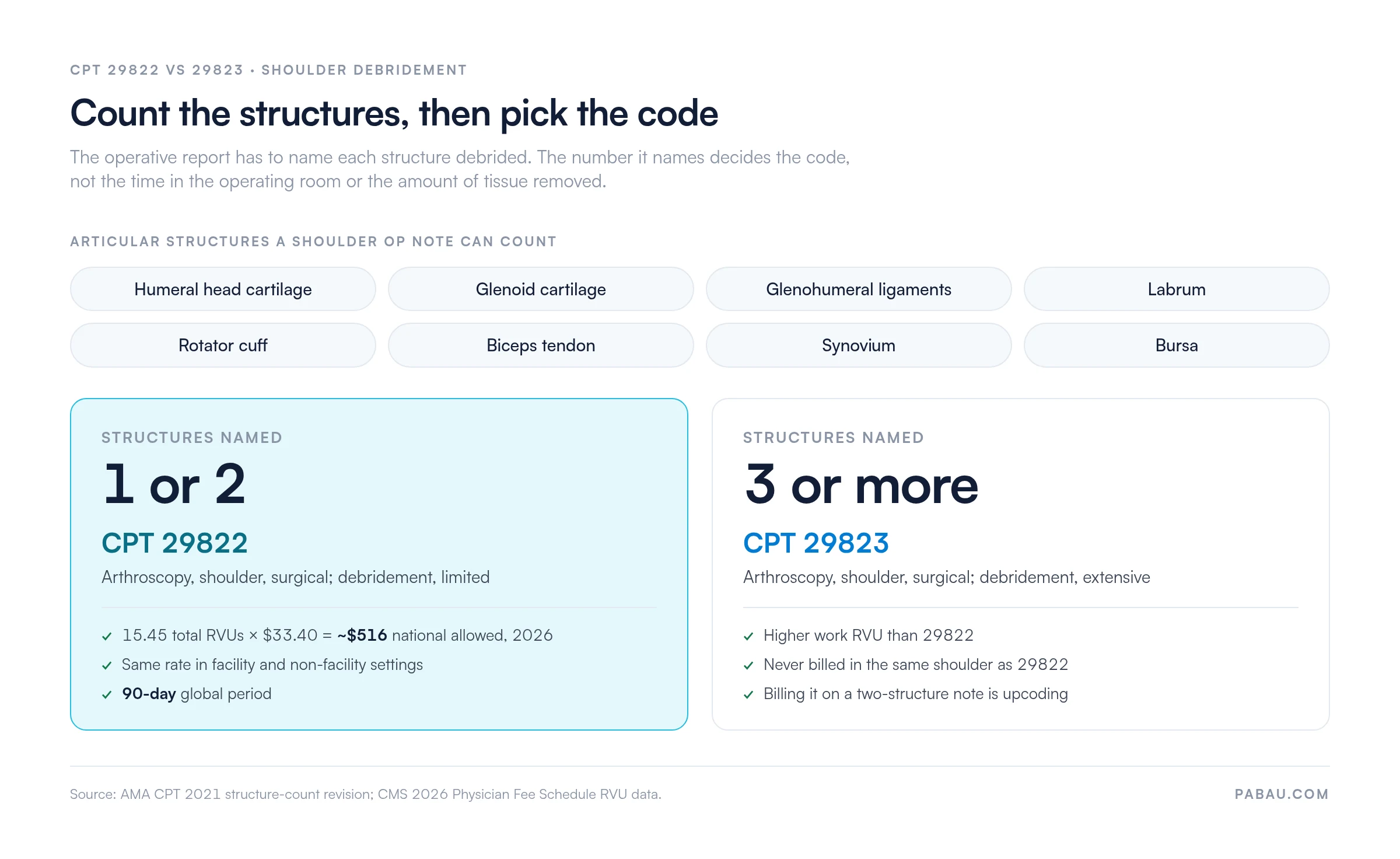
A surgeon who plans two structures and then addresses a third has performed 29823. The signed report controls the code, never the booking. Coders who assign from the pre-operative plan get caught in audits for exactly this.
Work through all four before the code reaches the charge line.
Three presentations land in 29822 more often than the rest. Isolated labral fraying with localized chondral damage is the classic one. Mild glenohumeral arthrosis confined to the humeral surface is another, and early SLAP pathology needing targeted debridement is the third.
In younger, active patients the pathology tends to be focal, which is why high-volume shoulder practices see far more 29822 than 29823.
Payers do not audit your scheduling system or your superbill. They audit the operative report. Medicare contractors and commercial plans both deny or request records when that report fails to establish the limited scope. Here is what it has to carry.
Never code from the procedure booked in the system. The pre-operative plan lists one code. The signed report may support another, and only one of them survives a records request.
Flag any operative report that uses the phrase ‘debridement performed’ without naming specific anatomical structures. Send it back to the surgeon for an addendum before billing. One sentence naming both structures debrided can be the difference between a clean claim and 30 to 45 days of recovery time.
Medicare’s 2026 national allowed amount for CPT 29822 is roughly $516, and place of service does not change it.
The procedure happens in an operating room, so the code carries no separate non-facility RVU set. There is no office rate to chase and no site-of-service differential to reconcile.
Your locality still moves the number. The Geographic Practice Cost Index adjusts each RVU component, so expensive metros land above $516 and rural localities land below it. Run your own ZIP through the CMS Physician Fee Schedule lookup before you set an expected-payment benchmark.
The 90-day global period is the part practices forget. Routine post-operative visits inside that window are already paid for in the surgical fee. Billing them separately produces a denial, and in an audit it produces a refund request.
On the money side, the claim leaves as an 837P and the payment comes back as an 835 remittance. Post that 835 against the original charge line rather than against the patient balance. That habit is what makes an underpayment against a contracted rate visible instead of quietly closing the account.
Four codes turn up in the same shoulder as 29822, and no two of them behave the same way on a claim. One is mutually exclusive, one is an add-on, and two are separately reportable when the operative note supports it.
The plus sign in front of 29826 matters. Its descriptor instructs you to list it in addition to the code for the primary procedure. Acromioplasty therefore cannot be the only line on a shoulder arthroscopy claim. Submitted alone, it rejects. Our page on 29826 sets out the primary codes it can attach to.
With 29827 the rule is anatomical. Debriding at the site being repaired is part of the repair and is not separately payable. Debriding somewhere else in the joint is a second service, and naming that location is what holds the second code up under review.
Only one of those four pairings turns on a modifier. 29823 is mutually exclusive with 29822, so there is nothing to unbundle. Acromioplasty is an add-on, so it sits beside a primary code rather than fighting one. Distal clavicle resection stands on its own, subject to the current tables.
The pair that needs judgment is 29822 with 29827. Where the debridement and the repair happen at the same site, the debridement is integral and stays off the claim. Where they happen at different sites, the operative note has to place them apart before a distinct-service modifier will hold up.
CMS refreshes the NCCI edit tables every quarter. Check the current version before you submit a claim carrying a modifier override, and keep a note of which edit you were working around. That record is what makes an appeal quick six months later.
Orthopedic billing teams hit the same five every year, in roughly this order of cost.
Sort rejections by cause before appealing any of them, because a necessity denial and an NCCI denial need different evidence. Our reference on denial codes covers how to read what the payer sent back.
Six checks, half a minute, and the failures above get caught while they are still cheap to fix.
The structure count starts in the operating room and survives three handoffs before a payer ever reads it. Practice management software like Pabau shortens that trip by keeping the record, the code, and the claim in one system.
When 29822 is attached to the service in the record, that code lands on the charge line of the CMS-1500 without being retyped. ICD-10 slots are seeded from the problem list already recorded against the client. Built-in ICD-10-CM and CPT lookup libraries sit behind a search icon, so a coder can confirm a descriptor without leaving the claim.
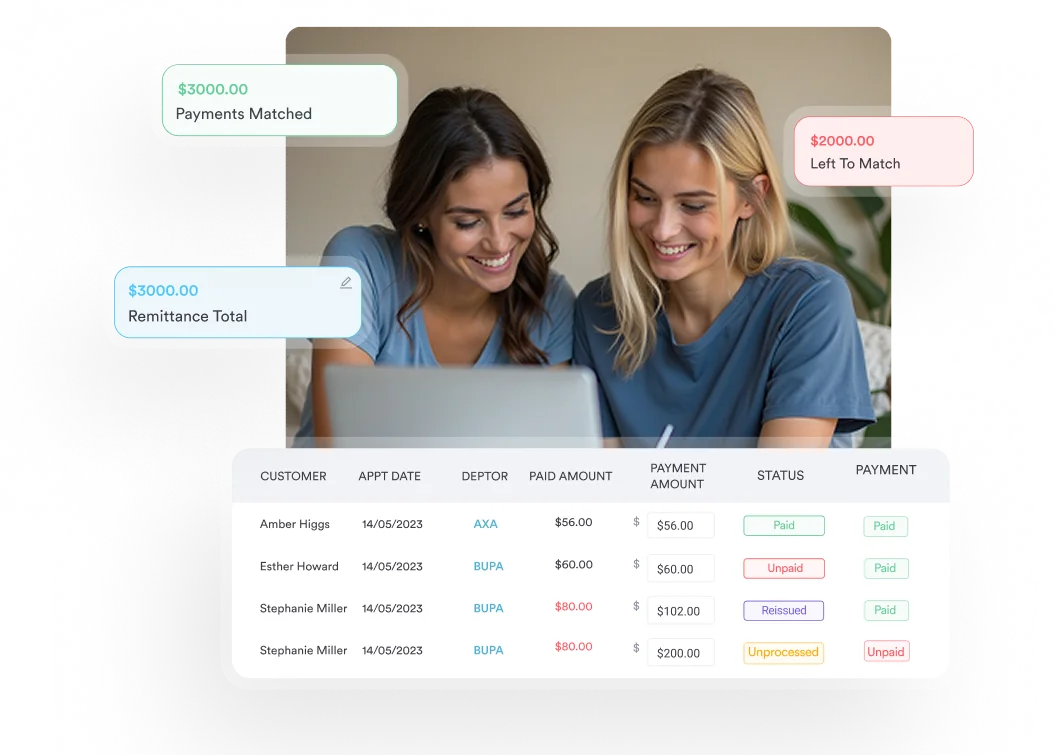
Pabau also checks that the fields a claim needs are complete before the send button unlocks. In the US, submissions route through Claim.MD, which adds eligibility checks, claim-status tracking, and ERA posting back against the original claim.
What it will not do is tell you whether the note supports one structure or three. That judgment stays with the coder, and cleaner claims management software keeps the answer intact on the way to the payer.

Pabau pre-fills the CMS-1500 from the client record, holds the claim until required fields are complete, and posts remittances back against what you sent.

CPT 29822 turns on one sentence in the operative report. Name the structures, let the coder count them, and the claim writes itself. Write “debridement performed” and nobody downstream can defend the code, however carefully the rest of the chart was built.
So the fix sits upstream of billing. Agree with your surgeons on what a debridement paragraph has to name, then hold claims that arrive without it. An addendum before submission costs a day. An addendum requested during an audit costs a great deal more, and it arrives with a refund demand attached.
Fixing it means changing how the note gets written, and that lands best when the note and the claim share one system. Book a demo to see how Pabau carries a code from the operative record onto the claim without a retype.

Billing a rotator cuff repair in the same shoulder? CPT code 29827 covers the descriptor, documentation and the distinct-site rule that keeps a debridement payable alongside it.
Need a framework for tracking arthroscopic code denials? Denial management in healthcare covers root-cause analysis for high-volume orthopedic coding rejections.
Want to understand the clearinghouse step in claim submission? How medical claims clearinghouses work explains validation, scrubbing and payer routing for surgical procedure codes.
Looking to tighten billing across the whole practice? What is revenue cycle management walks through the workflow from patient encounter to collected payment.
No. 29822 is shoulder-specific. Knee, ankle, elbow and wrist debridement each carry their own codes in the 29800 to 29999 arthroscopy family. A shoulder code on a knee claim rejects.
Report the open procedure only. Under CPT rules an arthroscopy that converts to an open procedure is not separately reported. 29822 comes off the claim even though the scope went in first.
Often, and it depends on the plan. Many commercial payers list arthroscopic shoulder debridement as a reviewable surgery, and Medicare Advantage plans frequently do too. Check the surgical policy before the date of service rather than after the denial.
Routine ones cannot, because the 90-day global period already pays for them. A visit for an unrelated problem takes modifier 24. A return to the operating room takes modifier 78 or 79, depending on whether it relates to the original surgery.



