

CCSD code G5100: Bypass of duodenum billing guide
CCSD code G5100 bills a bypass that leaves the duodenum in place CCSD code G5100...

Last Updated: Oct 16, 2026
J2710 is the HCPCS Level II code for injection, neostigmine methylsulfate, up to 0.5 mg.
It belongs to the J-series, which covers drugs given by routes other than oral. Those are mainly injectable agents billed to Medicare Part B and Medicaid in outpatient and physician-office settings.
CMS maintains the HCPCS Level II code set and publishes annual updates each January, with quarterly corrections through the year. According to the CMS HCPCS overview, J-series codes identify injectable drugs supplied and administered in covered settings. J2710 has stayed active through the current cycle without a major descriptor change.
Let Pabau's smart automation suggest the right codes, reduce claim denials, and keep your practice compliant—effortlessly.
Automate repetitive tasks and focus on what matters most—your patients.
Reduce coding errors and ensure compliance with the latest regulations.
Clean claims, fewer denials, and faster reimbursements.
Powerful insights and reporting to help your practice thrive.
HIPAA compliant SOC 2 certified GDPR-compliant Trusted by 4,000+ clinics worldwide

HCPCS code J2710 covers injection, neostigmine methylsulfate, up to 0.5 mg. It is a Level II J-code, active for 2025 and 2026.
One billing unit equals up to 0.5 mg, so any dose above 0.5 mg needs more than one unit. Miscounted units are the leading cause of J2710 denials.
Medicare Part B pays J2710 at ASP plus 6%. The rate updates every quarter and varies by MAC jurisdiction.
The NDC on the claim line has to come from the vial administered, written as 11 digits with the N4 qualifier.
Practice management software like Pabau captures the dose, the NDC, and the diagnosis link before the claim is built.
Neostigmine methylsulfate is a cholinesterase inhibitor. It blocks the enzyme that breaks down acetylcholine at the neuromuscular junction, which prolongs and strengthens muscle contraction signaling. That mechanism supports the indications below.
Branded as Bloxiverz in the United States, neostigmine methylsulfate comes in several concentrations. The drug administered has to match both the billed HCPCS code and the NDC on the claim. Identify the vial at the point of administration rather than later, from the order.
Medicare and most commercial payers require medical necessity support for J2710 claims. The diagnosis codes on the claim have to align with an approved indication for neostigmine methylsulfate. A mismatched or unsupported ICD-10 code is a leading denial trigger.
Covered ICD-10 codes vary by MAC jurisdiction and by commercial payer, so a pairing on this list never guarantees coverage. Verify the payer’s Local Coverage Determination (LCD) before you submit. When the documentation points to a diagnosis outside the five above, our ICD-10-CM code reference covers the wider code set.
Medicare Part B reimburses J2710 using the Average Sales Price (ASP) methodology. The rate is ASP plus 6%, applied to the dose actually administered and counted in 0.5 mg units.
Rates update every calendar quarter, based on manufacturer-reported sales data submitted to CMS. The current figures sit in the quarterly ASP Drug Pricing File published on CMS.gov.
CMS calculates ASP as the volume-weighted average of manufacturer sales to non-exempt purchasers, net of rebates and discounts. The 6% add-on covers what it costs a practice to acquire and handle the drug.
Because ASP tracks market transaction prices rather than list price, it moves every quarter. A practice that buys and bills J2710 should read each quarterly ASP file, so acquisition cost stays below the reimbursement ceiling.
In a physician office using buy-and-bill, the practice purchases the drug, administers it, and bills the payer. Once payment posts, the electronic remittance advice reconciles what was paid against what was billed and flags any adjustment by line item.
Medicaid coverage for J2710 varies by state. Most state programs cover medically necessary neostigmine methylsulfate injections, and some require prior authorization for outpatient MG management.
Verify with the specific state program before billing. Check whether the state pays a fee-for-service rate or a managed care organization (MCO) rate, because either can differ from the Medicare ASP benchmark.
Check your MAC’s Local Coverage Determination before submitting J2710 claims for myasthenia gravis management in outpatient settings. Some MACs require documentation of oral medication failure before they approve injectable neostigmine for MG. A missing note there is one of the fastest routes to a denial.
The J2710 rate changes quarterly, so this article does not publish a dollar figure. Any number here would be out of date within 90 days. Use the sources below, and confirm the rate before you calculate a patient’s cost share.
Cross-check any third-party figure against the official CMS quarterly file. Commercial tools can lag a quarter behind.
CMS requires National Drug Code (NDC) reporting on Medicare Part B claims for physician-administered drugs. The NDC identifies the product dispensed, down to the manufacturer, the formulation, and the package size. A J2710 claim line without the required NDC is a preventable denial.
Use the NDC from the vial you actually dispensed, never an assumed one. On the claim, the NDC runs to 11 digits in 5-4-2 format with an N4 qualifier.
Report the NDC unit and quantity on the same claim line as J2710. Your MAC publishes the current NDC-to-HCPCS crosswalk file, and that is the version to check against.
The J2710 descriptor specifies up to 0.5 mg per billing unit. That is a hard threshold, not a rounding rule. One unit covers any dose from a trace amount up to exactly 0.5 mg, and a larger dose needs additional units.
Document the exact dose in milligrams in the patient record before billing. The administered dose drives the unit count, and the unit count drives reimbursement. Billing fewer units than administered under-pays the practice. Billing more is an overpayment and a compliance risk.
Buy-and-bill is the standard Medicare Part B reimbursement model for physician-administered injectable drugs. The practice buys the drug, administers it, and bills the payer for both the drug and the administration. For J2710, the process runs as follows.
The window between drug acquisition and payment runs from 30 to 90 days, depending on the payer. A practice with high neostigmine volume should track acquisition cost against each quarterly ASP update. That flags any period where the drug costs more than the payment.
Four errors account for most J2710 denials, and each one has a specific fix. The table below pairs them, so a biller can check a claim on the way out instead of appealing it a month later. Submitting clean claims from the start removes most of these scenarios.
Appealing any of these means pulling the administration record, the NDC from the vial, and the prior authorization if one applied. Sorting systematic errors from one-off keying mistakes tells the billing team which claims need a process fix rather than an appeal.
Audit your J2710 claims quarterly. Pull the units billed against the administered doses in the clinical record. A steady mismatch between documented dose and billed units points to a calculation error in the billing workflow. That is the pattern a Medicare audit looks for, and it can end in a recoupment demand.
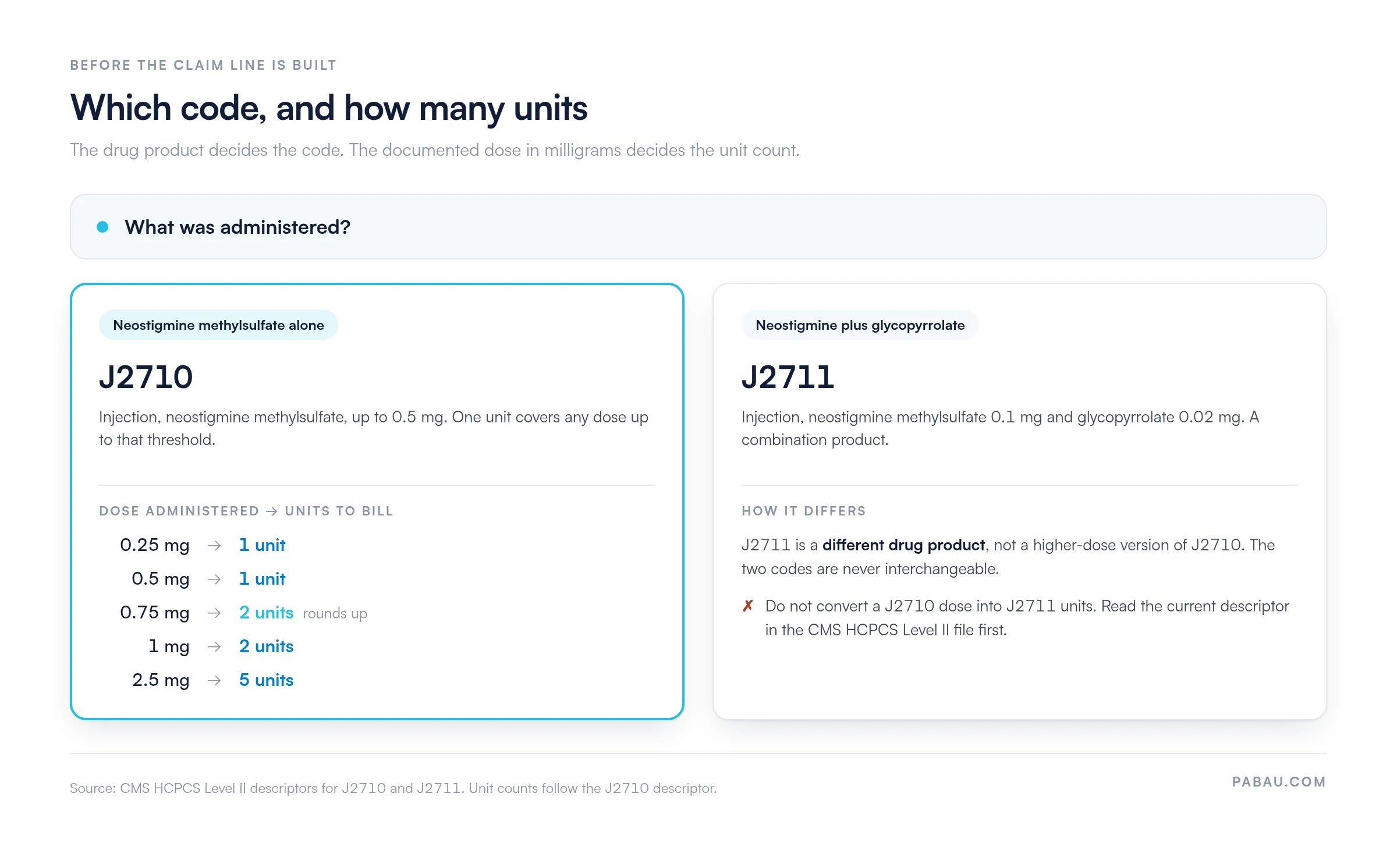
J2711 sits beside J2710 in the code set, and coders sometimes reach for the wrong one. The difference is the drug product, not the dose. J2711 covers a combination of neostigmine methylsulfate and glycopyrrolate, so it is not a higher-dose version of J2710.
Billing J2711 for neostigmine given on its own misstates what the patient received, and payers catch it through their drug-pricing edits. Check the vial and the clinician’s order before you choose between the two codes. The chart below puts that choice next to the unit math for J2710.
Most J2710 errors happen before the claim is built. The dose sits in the clinical note, the NDC is on the vial, and the diagnosis is in the chart. When a biller has to reassemble those three from separate places, the unit count is the first figure to slip.
Practice management software like Pabau keeps the three together. Pabau’s claims management software records the administered dose, the vial NDC, and the diagnosis link against the visit. The claim line is then built from what the clinician documented, not from the vial size.
That gives the billing team one place to check units, NDC format, and place of service before submission. It also traces a denial back to the visit record in a couple of clicks. The practice can then fix the process instead of re-keying the same claim.

Pabau’s claims management software handles J-code documentation, NDC capture at the point of care, and claim preparation for in-office injectable drugs. Your billing team spends less time chasing errors and more time getting paid.

J2710 is a short descriptor with a single threshold of 0.5 mg per unit. What decides whether the claim pays is the record around it. That means the documented dose, the vial NDC, the diagnosis link, and the place of service.
Get the documentation step right and the other three follow, because every figure on the claim line comes from it. That is cheaper than appealing, and it still holds up when a MAC asks for the administration record two years later.
If your practice administers J-code drugs and wants less rework on drug billing, book a demo to see how the workflow fits your team.

Need a framework for tracking claim outcomes across drug billing? Revenue cycle management fundamentals covers how reimbursement flows from administration through payment reconciliation.
Want to understand how clearinghouses validate J-code claims before submission? How a medical claims clearinghouse works explains the validation steps that catch NDC and unit errors before they reach the payer.
Building a denial prevention process for your billing team? Denial management in healthcare walks through the systematic approach to tracking, appealing, and eliminating recurring claim denials.
HCPCS code J2710 is the Level II HCPCS code for injection, neostigmine methylsulfate, up to 0.5 mg. It bills Medicare Part B and Medicaid for physician-administered neostigmine methylsulfate in outpatient and physician-office settings. One billing unit covers doses up to 0.5 mg, and higher doses require additional units.
Bill 2 units of J2710 for a 1 mg dose. Each unit covers up to 0.5 mg, so a 1 mg dose comes to 2 units. Always base the unit count on the documented administered dose in milligrams, not the vial size.
Medicare reimburses J2710 at ASP (Average Sales Price) plus 6% in physician-office settings. The dollar amount updates every calendar quarter, based on manufacturer-reported sales data. Check the current CMS ASP Drug Pricing File or the CMS Physician Fee Schedule lookup for the rate in your MAC jurisdiction.
J2710 and J2711 cover different drug products. J2710 is neostigmine methylsulfate on its own, up to 0.5 mg per unit. J2711 is the combination product, neostigmine methylsulfate 0.1 mg and glycopyrrolate 0.02 mg. Billing one code for the other misstates what the patient received.
Medicaid coverage for J2710 varies by state. Most state programs cover medically necessary neostigmine methylsulfate injections, but prior authorization rules and approved diagnosis codes differ. Verify coverage with the specific state Medicaid program or MCO before billing.
Yes, NDC reporting is required on Medicare Part B claims for J2710, and most Medicaid programs expect it too. Report the NDC from the vial administered, written as 11 digits with the N4 qualifier. A missing or misformatted NDC is one of the four most common J2710 denial causes.



