

CCSD code G5100: Bypass of duodenum billing guide
CCSD code G5100 bills a bypass that leaves the duodenum in place CCSD code G5100...

Last Updated: Oct 16, 2026
28270 is the CPT code for capsulotomy; metatarsophalangeal joint, with or without tenorrhaphy, each joint (separate procedure). It covers soft tissue release of the MTP joint capsule, with tendon repair at the same joint bundled into it.
The each joint (separate procedure) wording drives three billing questions. Can the code be reported per toe, how is bilateral surgery handled, and when does a more comprehensive foot procedure absorb it? Coders most often go wrong by billing 28270 alongside 28285 without applying the CCI edit, or by omitting the laterality modifier.
Let Pabau's smart automation suggest the right codes, reduce claim denials, and keep your practice compliant—effortlessly.
Automate repetitive tasks and focus on what matters most—your patients.
Reduce coding errors and ensure compliance with the latest regulations.
Clean claims, fewer denials, and faster reimbursements.
Powerful insights and reporting to help your practice thrive.
HIPAA compliant SOC 2 certified GDPR-compliant Trusted by 4,000+ clinics worldwide

CPT 28270 covers capsulotomy of one MTP joint, with or without tenorrhaphy. The each-joint wording allows one unit per joint treated in the same session.
The separate procedure parenthetical blocks 28270 whenever a more comprehensive foot procedure, such as 28285, is performed at the same site.
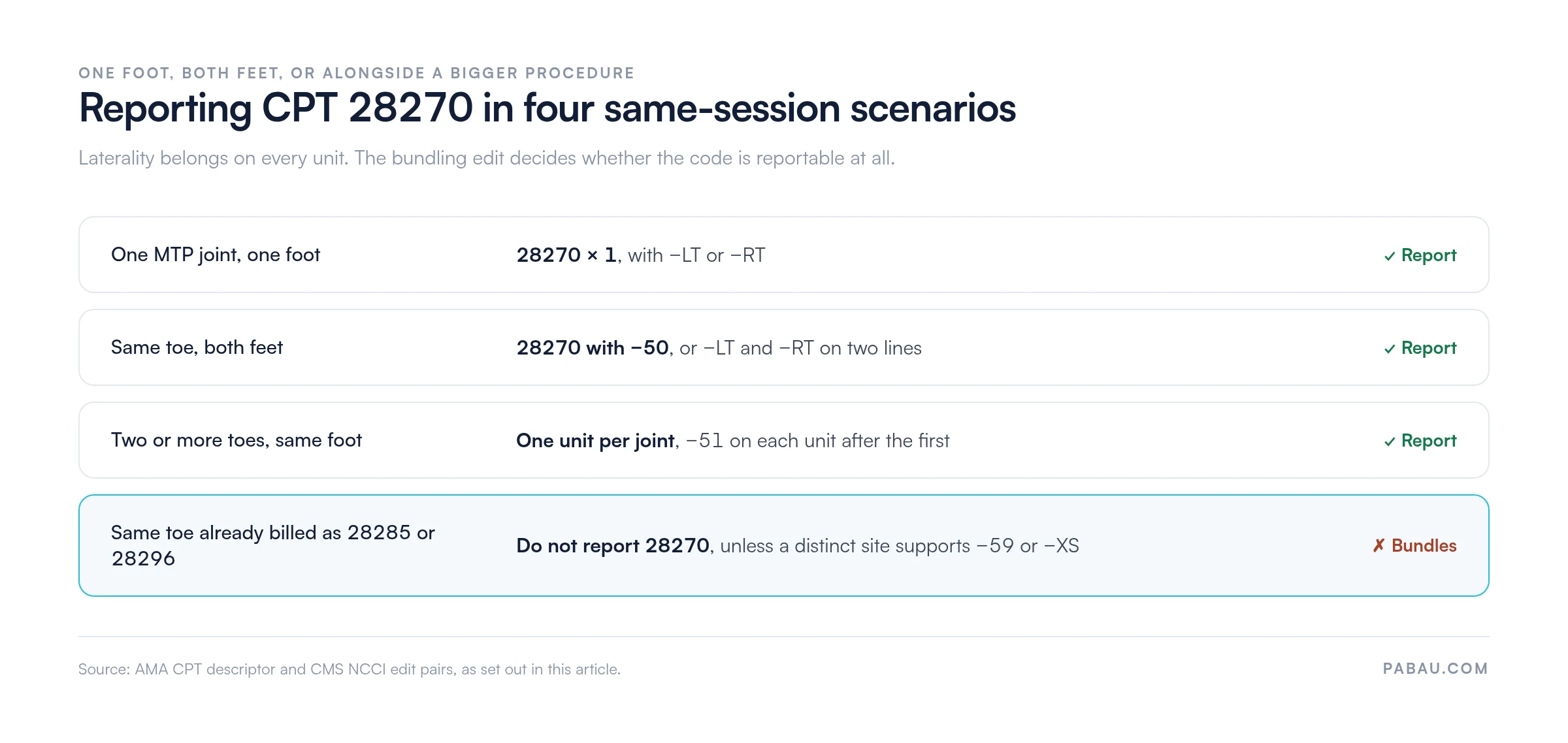
Modifier -50 covers a bilateral same-toe capsulotomy. For extra toes on one foot, report additional units and add -51 where the payer requires it.
Every unilateral 28270 claim carries -LT or -RT. A missing laterality modifier is the fastest route to a rejection.
Pabau keeps the operative note and the claim in one record, so the billing team stops retyping 28270 details into a separate system.
CPT Code 28270 describes capsulotomy of the metatarsophalangeal joint, with or without tenorrhaphy, each joint (separate procedure). Published by the American Medical Association (AMA), the code sits in the Repair, Revision, and/or Reconstruction subsection of the Musculoskeletal System chapter. It covers soft tissue release of the MTP joint capsule, with an optional tendon repair component.
Three phrases in the descriptor carry direct billing consequences:
The code sits in the foot and toes range, 28001-28899, inside the musculoskeletal system section of the CPT code set. Our CPT code reference covers the neighboring codes a foot surgery claim tends to pull in.
MTP capsulotomy is a soft tissue release of the capsule around the metatarsophalangeal joint. Surgeons perform it when capsular contracture restricts how far the toe can move. Matching that description to the operative note is what keeps the code defensible.
Common clinical indications include:
The approach may be open, through a standard incision, or percutaneous. An optional tenorrhaphy component covers repair or reattachment of an intrinsic tendon at the same MTP joint.
Bone work at the same joint changes the code. An osteotomy, an implant, or an arthroplasty pushes the session into a more comprehensive code. The operative note therefore has to separate the soft tissue release from any bony work. One such procedure is a bunionette resection of the fifth metatarsal head, reported as CPT code 28110.
Excision sits outside 28270 as well. When the note documents removal of a capsular lesion or ganglion rather than a release, CPT code 28090 covers that work.
The table below sets out which components 28270 already pays for, and which ones need a code of their own.
The descriptor closes with the words “separate procedure”, and that parenthetical governs when 28270 may be reported at all.
The AMA rule is straightforward. A procedure designated “separate procedure” is not reported separately when it forms part of a larger, more comprehensive service. Its work already sits inside the comprehensive code’s descriptor.
For CPT 28270, this creates two practical scenarios:
Modifier -59 (distinct procedural service) can override the separate procedure rule in limited circumstances. It applies only where the capsulotomy was performed at a distinct site with its own operative documentation. Payers will audit claims where -59 is applied routinely to 28270 alongside 28285 at the same toe.
Modifier selection drives the most common 28270 rejections. Payer-specific policy always takes precedence over general CPT guidance here. Confirm bilateral payment policy with each payer before assuming modifier -50 doubles the allowed amount.
Do not apply modifier -51 when billing 28270 alongside a procedure that is exempt from multiple procedure reduction (those carrying the “51 exempt” status). Check the procedures’ status indicators before adding -51.
The “each joint” language is the source of most multi-joint billing questions. Per the AMA convention, it means CPT 28270 can be reported once per MTP joint treated in a session. The operative note has to document distinct work at each joint.
The four scenarios below cover almost every foot surgery session that includes a capsulotomy.
Payer variance on bilateral payment is significant. Some commercial payers pay 100% for each side rather than the 150% Medicare standard. Verify benefit schedules before estimating reimbursement on bilateral cases.
The National Correct Coding Initiative (NCCI) publishes column 1 and column 2 edit pairs. Those pairs decide when two codes cannot be billed together without a valid modifier. Check them before submitting any claim that pairs 28270 with another foot procedure.
AAPC’s Orthopedic Coding Alert has addressed the hammertoe edit on capsulotomies directly. It notes that 28270 bundles into 28285 at the same toe in the same operative session. The key pairs involving 28270 are:
CCI edits are updated quarterly. Always verify the current edit file from CMS before applying modifier -59 to override a bundling pair. An outdated reference is no defense in an audit.
Download the current CMS NCCI edit files directly from the CMS website each quarter. Filter for procedure code 28270 in both the practitioner and outpatient files. Flag any new pairs added mid-year, especially during the October update when ICD-10-CM code changes take effect and some procedure pairings shift.
Four codes are commonly confused with 28270 or billed alongside it. Picking the wrong one, or failing to recognize when 28270 bundles into a neighbor, drives most foot surgery denials. 28285 and 28296 are the two most frequent mismatch sources.
Keep 28298 and 28299 apart. 28298 is the single Akin osteotomy of the proximal phalanx, while 28299 covers a double osteotomy, meaning two separate osteotomies in the same correction.
Payers adjudicate 28270 against the reported diagnosis code to assess medical necessity. An ICD-10-CM code that does not map logically to MTP capsulotomy triggers an automated denial, however complete the operative note is. The diagnosis has to justify the procedure performed.
Unspecified laterality codes (those ending in 0 or 9) may satisfy claim submission technically but increase the likelihood of a medical necessity review. Assign the most specific ICD-10-CM code available given the documented clinical findings.
CPT 28270 carries a 90-day global surgical period. Post-operative visits inside those 90 days are included in the single payment, so follow-up work on that toe is not billed again.
Verify RVU values against the CMS Medicare Physician Fee Schedule (MPFS) lookup tool for each plan year and locality. The table below carries national averages as a reference benchmark. Actual payment moves with the geographic practice cost index (GPCI), so use the FastRVU lookup tool for a locality-adjusted figure.
Practice management software like Pabau supports cleaner claims management by checking that the required claim details are present before a 28270 claim goes out. That check covers items such as membership and authorization numbers.
Claim status then comes back through the Claim.MD clearinghouse, so the billing team can see where a claim sits without calling the payer. Choosing the modifier and clearing the bundling edit stays with the coder.
Payers audit 28270 claims for documentation completeness. The scrutiny rises when the code is billed with a modifier that overrides a CCI edit, or when multiple units are reported.
Your operative note must clearly establish:
The superbill should carry the procedure code, every applicable modifier, and the authorizing diagnosis before it reaches the billing team.
CPT 28270 denials cluster around five errors, and each has a straightforward correction. Structured denial management workflows should address all five as part of a standard appeals process.
A short pre-submission check catches most of these errors before they reach the payer. The AAPC CPT code lookup carries additional guidance on modifier application for foot procedures.
Build a charge capture checklist for foot surgery sessions. List every MTP joint treated, confirm no bone work at each one, and assign a laterality modifier to every 28270 unit. Then cross-reference the CCI edit table for any code billed alongside 28270. A 60-second pre-submission check on these four points eliminates the most common denial reasons.
In most practices the operative note lives in one system and the claim is built in another. Someone reads the note, then retypes the joint, the laterality and the modifier into a billing screen. That handover is where 28270 lines lose a detail.
Pabau keeps the note and the claim in the same patient record. The billing team opens the appointment, reads what the surgeon documented at each MTP joint, and builds the claim from that. Required claim details are checked before submission, and status comes back from the clearinghouse.
The coding decision still belongs to the coder. Pabau will not pick the modifier or clear a CCI edit for you. What it removes is the retyping step where the joint or the laterality goes missing.

Pabau keeps operative documentation and claim submission in one workflow. Coders read the joint and the laterality straight from the record, and billing staff can see where each claim sits.

CPT Code 28270 is a simple soft tissue release code with three complications attached to it. The separate procedure parenthetical, the hammertoe edit with 28285, and the multi-joint modifier rules decide whether it gets paid. Get the laterality modifier right, then confirm the edit status before submission. That alone clears most 28270 denials.
Pabau carries the documentation captured during the appointment straight through to the billing team. That removes the retyping step where foot surgery codes most often go wrong. To see how the workflow handles multi-unit and bilateral scenarios, book a demo with the Pabau team.

Need to understand how claims reach payers? 837 file submission guide explains the electronic claim format Medicare and commercial payers require for foot and ankle surgery codes.
Dealing with remittance posting after 28270 claims adjudicate? Electronic remittance advice (ERA) processing covers how to read EOBs and post payments accurately against surgical claims.
Want to verify insurance eligibility before surgery? Insurance eligibility verification walks through pre-authorization and benefit checks that prevent post-surgical claim surprises.
CPT Code 28270 is a surgical billing code for capsulotomy of the metatarsophalangeal (MTP) joint, with or without tenorrhaphy. It is reported per joint as a separate procedure. The code covers soft tissue release of the joint capsule and any tendon repair at the same site. Bone work such as osteotomy or implant placement is excluded.
Yes, CPT 28270 can be billed bilaterally using modifier -50 when the same MTP joint is treated on both feet in the same session. Medicare pays approximately 150% of the single-side rate; some commercial payers pay 100% per side. For multiple toes on the same foot, report additional units with modifier -51. Always confirm bilateral payment policy with the specific payer before assuming the standard reduction schedule applies.
The most commonly accepted ICD-10-CM codes paired with CPT 28270 include M20.10-M20.12 (hallux valgus), M20.40-M20.42 (hammer toe, acquired), and M20.5×1-M20.5×9 (other acquired toe deformities). For post-traumatic or inflammatory MTP stiffness, M25.671-M25.672 applies. Pain-only codes such as M79.671 are insufficient to support surgical medical necessity without an accompanying structural diagnosis code.
The work RVU (wRVU) for CPT 28270 is 4.81, based on CMS MPFS data. Total RVU and the resulting Medicare payment vary by site of service and by geographic practice cost index. Verify the current-year values with the CMS MPFS lookup tool or the FastRVU calculator for your locality.



