CCSD Code B2710: Radical mastectomy including block dissection
CCSD Code B2710: Definition and clinical scope CCSD Code B2710 is the UK private...

Last Updated: Nov 13, 2026
28415 is the CPT code for open treatment of calcaneal fracture, includes internal fixation, when performed. Surgeons report it after an open approach to a heel bone fracture, and it covers any plates or screws placed. A harvested autogenous bone graft moves the case to 28420.
Claims for this code fail on missing laterality modifiers, wrong ICD-10 seventh characters and bundled ancillary codes billed without a valid override.
Let Pabau's smart automation suggest the right codes, reduce claim denials, and keep your practice compliant—effortlessly.
Automate repetitive tasks and focus on what matters most—your patients.
Reduce coding errors and ensure compliance with the latest regulations.
Clean claims, fewer denials, and faster reimbursements.
Powerful insights and reporting to help your practice thrive.
HIPAA compliant SOC 2 certified GDPR-compliant Trusted by 4,000+ clinics worldwide

CPT code 28415 reports open treatment of a calcaneal fracture, including any internal fixation, and switches to 28420 when autogenous bone graft is harvested.
Pair it with an S92.01- code for a body fracture or an S92.06- code for an intraarticular fracture, with the right side and seventh character.
The 90-day global period runs from the day before surgery to 90 days after it, so routine post-op visits aren’t billed separately.
Medicare’s 2026 values put 28415 at about 16 work RVUs and about 32 total facility RVUs.
Pabau sends US claims through Claim.MD to thousands of payers, with real-time eligibility checks, ERA remittances and secondary claims.
CPT code 28415 reports open treatment of a calcaneal fracture, and any internal fixation the surgeon places is part of the code.
The descriptor reads “Open treatment of calcaneal fracture, includes internal fixation, when performed,” as quoted in AAPC’s Podiatry Coding & Billing Alert. The American Medical Association owns that wording.
A harvested autograft changes the code. CPT 28420 is the separate code for open treatment “with primary iliac or other autogenous bone graft, includes internal fixation, when performed.” The graft language in the operative note decides between the two.
The calcaneal fracture series runs from closed care to open repair with graft. Confirm where the case sits before you pick a code. A fracture of another tarsal bone, such as the cuboid or navicular, treated closed without manipulation codes to 28450 instead.
Two questions in the operative note settle the choice, and the diagram walks through them in order.
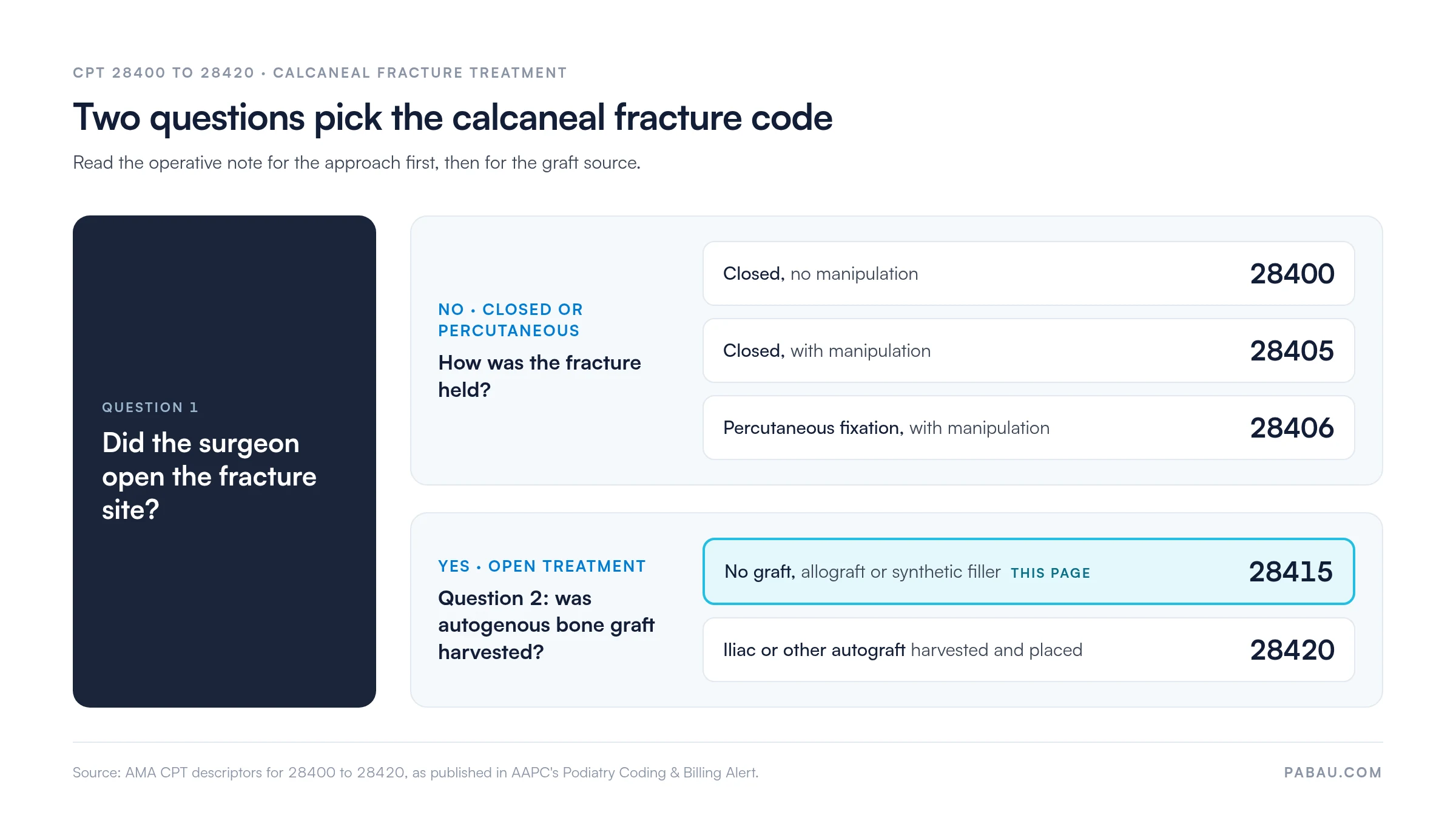
The one coding decision between 28415 and 28420 is whether autogenous bone graft was harvested and placed in the same session.
CPT code 28415 applies when the surgeon performs open reduction and internal fixation without a graft from the iliac crest or another donor site. CPT 28420 applies when autogenous graft fills a void or supports the fixation.
Synthetic or allograft bone substitute does not trigger 28420. If the surgeon uses demineralized bone matrix or calcium phosphate filler and harvests nothing, CPT code 28415 stays correct. For a 28420 claim to survive an audit, the operative report must name the graft source.
A malunion treated later with a calcaneal osteotomy is a different procedure. It codes to 28300, not to either fracture code.
Payers expect medical necessity on file before they approve CPT code 28415. Closed treatment codes (28400 and 28405) fit a fracture with minimal displacement that responds to conservative care.
Open treatment becomes the documented choice when displacement, articular step-off or a collapsed Böhler’s angle passes the threshold in the operative indication. That is often an articular step-off over 2 mm or marked comminution, though payer policies vary.
The operative report and the pre-operative CT together form the medical necessity record. Commercial payers routinely deny prior authorization requests for 28415 that arrive without CT imaging, and many Medicare Advantage plans apply the same standard.
Attach the pre-operative CT report to every prior authorization request for CPT 28415. Plain radiographs alone rarely satisfy commercial payers for a calcaneal ORIF. Document Böhler’s angle, articular congruence and failed conservative care in the indication note.
A CPT 28415 claim needs an ICD-10-CM code from S92.0-, fracture of calcaneus. Use S92.01- for a fracture of the body of the calcaneus and S92.06- for an intraarticular fracture.
Other parts of the bone have their own subcategories. S92.02- covers the anterior process, S92.03- an avulsion fracture of the tuberosity, S92.04- other tuberosity fractures and S92.05- other extraarticular fractures.
In S92.01-, the sixth character carries displacement and side together. S92.011, S92.012 and S92.013 are displaced fractures of the right, left and unspecified heel. S92.014, S92.015 and S92.016 are the nondisplaced versions.
Leave the unspecified side for cases where the record truly doesn’t say. A displaced extraarticular fracture with no side documented codes to S92.053A, and payers often query that missing laterality.
Episode-of-care reminder: the seventh character “A” belongs on the surgery date. Post-op visits in the global period use “D” for routine healing or “G” for delayed healing. A wrong seventh character on a follow-up visit trips an edit against the date-of-service pattern already on file.
A calcaneal ORIF claim passes through six hands before it is paid. Here is the route, step by step.
Most rework starts at step three. The next sections cover what the claim is worth, what the global period bundles and which edits decide whether step four passes.
CPT code 28415 is a major surgical code. The CMS 2026 fee schedule file, viewed through the FastRVU lookup tool, puts its work RVU at about 16. Total facility RVUs come to about 32, and non-facility totals to about 34.
Values change every year with the CMS final rule. Check the current CMS Physician Fee Schedule before you quote expected payment.
Geographic locality changes the dollar amount a practice receives. Medicare payment is Total RVU x Geographic Adjustment Factor (GAF) x Conversion Factor. For a locality-specific rate, search the CMS fee schedule and filter by your MAC jurisdiction.
CPT code 28415 carries a 90-day global surgical period, confirmed by CMS with a 090 global indicator. The Medicare global package covers the day before surgery, the day of surgery and the 90 days after it.
Routine post-op care in that window is bundled into the surgical fee. Medicare and most commercial payers won’t pay it separately.
Bundled (cannot be billed separately):
Billable with a modifier during the global period:
The right modifier keeps a CPT code 28415 claim out of automatic denial. The table lists the modifiers that matter for calcaneal ORIF, when each applies and the documentation behind it.
The AAPC Codify reference and the CMS NCCI edit tables show which codes bundle with CPT code 28415 on the same claim. NCCI edits update quarterly, so check the current edit status before you submit a multi-line claim.
CPT 29515 (application of short leg splint, static) is the code that bundles most often. A splint applied at the close of a calcaneal ORIF is part of the surgery and isn’t billed separately. Modifier -59 does not override this edit, because the splint is integral to the procedure.
A complete operative report is the base of a clean claim for CPT code 28415. Payers audit calcaneal ORIF records closely because the code carries high RVUs. The note should cover each element below.
The superbill for the encounter should carry CPT 28415, the matching ICD-10 code and the laterality modifier. Add the anesthesia provider before the claim leaves the practice.
Run this list against every 28415 claim at charge capture. Each item maps to a denial in the table further down.
Calcaneal ORIF claims tend to fail on a short list of avoidable errors. The table maps each denial reason to its root cause and a prevention step.
High-volume foot and ankle practices feel these denials most. Structured denial management and a tracker of common denial codes cut the rework that slows collections.
Audit every CPT 28415 claim from the previous quarter. Filter by denial reason, claims sent without -RT or -LT, and dates where 28415 and 29515 appear together. That one report shows which fix to make first.
In many practices, the steps above run through separate tools. The authorization sits in an email, the op note in the EHR and the claim in a clearinghouse portal.
Pabau, the practice management platform we build, runs US insurance billing through Claim.MD. Its claims management software sends 837P claims electronically to thousands of US payers. It also handles real-time eligibility checks (270/271), ERA remittances and secondary claims.
Prior authorization is tracked on the patient’s case, with the auth code, dates and sessions recorded. Pabau warns staff when an auth is missing, so a calcaneal ORIF doesn’t reach the schedule without one.
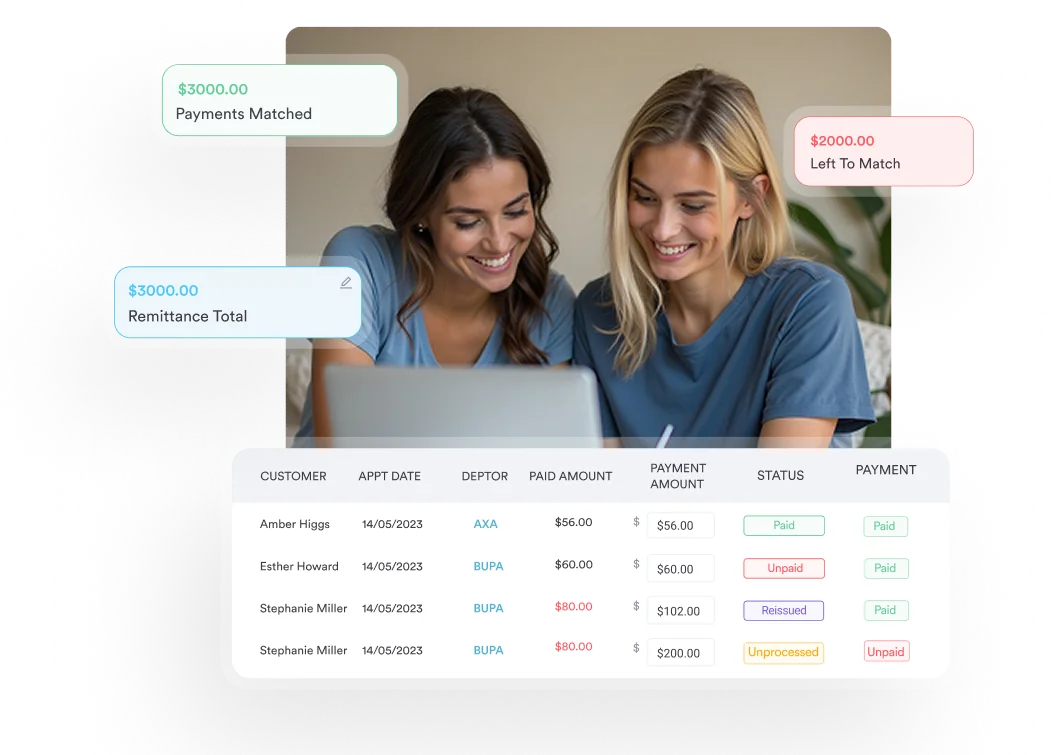

Pabau sends CPT 28415 claims electronically through Claim.MD to thousands of US payers. Real-time eligibility checks, ERA remittances and secondary claims run from the same patient record.

CPT code 28415 rewards coders who read the operative note before the code book. The approach and the graft source settle the CPT code. The side, the fracture part and the episode settle the ICD-10 code.
If you change one habit, move the six-point check into charge capture instead of denial follow-up. A claim fixed before submission takes minutes, while a resubmitted one holds up payment for weeks.
Book a demo to see how Pabau checks eligibility and sends calcaneal fracture claims through Claim.MD from one patient record.

Need to understand how clearinghouse billing works for surgical codes? Medical claims clearinghouse guide explains how payer connections, claim scrubbing, and ERA processing reduce surgical code denials.
Looking to understand the full revenue cycle for orthopedic practices? Revenue cycle management guide covers the end-to-end billing workflow from eligibility to payment posting.
Need a reference for electronic claim formats and 837P submission? 837P file guide explains HIPAA transaction standards, claim segments, and how surgical claims are structured for payer submission.
Coding the follow-up visits after a calcaneal ORIF? Calcaneus fracture coding guide walks through seventh characters for delayed healing on a tuberosity fracture.
Treating a calcaneal malunion instead? CPT code 28300 covers calcaneal osteotomy billing and reimbursement.
Yes. Report each heel with its own laterality, either as separate RT and LT lines or with modifier 50, as the payer requires. Check the Medicare bilateral indicator for 28415 before you submit.
Yes, where state law lets podiatrists operate on the rearfoot. Scope of practice for calcaneal surgery varies by state, so confirm your state’s rules and the payer’s credentialing first.
Yes. Removal of a deep implant is reported with 20680. Inside the 90-day global period, add modifier 58 for a planned removal or 78 for an unplanned return to the OR.
CPT 28415 covers open treatment of the calcaneus. CPT 28465 covers open treatment of other tarsal bone fractures, excluding the talus and calcaneus. Code the bone the operative note names.
Traditional Medicare doesn’t list calcaneal ORIF in its prior authorization program, but most commercial and Medicare Advantage plans ask for one. Attach the CT report and the failed conservative care note.