ICD-10 Code S42.444P: Medial epicondyle fracture, right humerus
ICD-10 Code S42.444P: full descriptor and code validity ICD-10 Code S42.444P car...

Last Updated: Oct 13, 2026
Billable Code Specific Code
S92.053A is the billable ICD-10-CM code for displaced other extraarticular fracture of unspecified calcaneus, initial encounter for closed fracture.
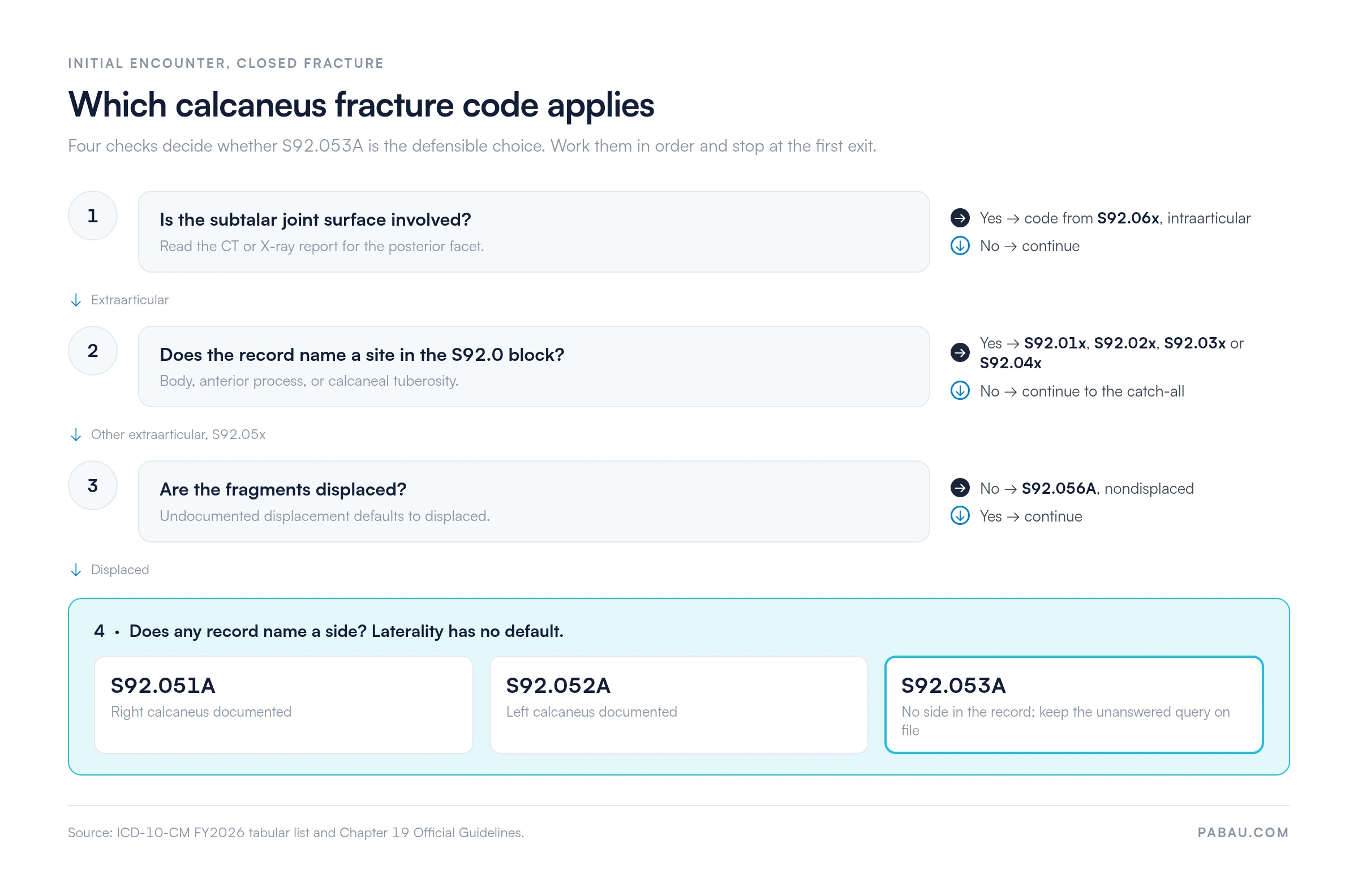
The code carries no laterality. Coders reach for it when imaging confirms a displaced heel fracture that leaves the subtalar joint intact, and no record names a side. Once the side is documented, the claim moves to S92.051A for the right calcaneus or S92.052A for the left.
Let Pabau's smart automation suggest the right codes, reduce claim denials, and keep your practice compliant—effortlessly.
Automate repetitive tasks and focus on what matters most—your patients.
Reduce coding errors and ensure compliance with the latest regulations.
Clean claims, fewer denials, and faster reimbursements.
Powerful insights and reporting to help your practice thrive.
HIPAA compliant SOC 2 certified GDPR-compliant Trusted by 4,000+ clinics worldwide

S92.053A is the billable ICD-10-CM code for a displaced, extraarticular calcaneus fracture at initial encounter when the record does not state a side.
Laterality is unspecified in this code, so move to S92.051A (right) or S92.052A (left) as soon as the record names a side.
S92.053A covers extraarticular fractures only. Any subtalar joint involvement moves coding to the intraarticular S92.06x range.
The 7th character A applies only during active treatment. Switch to D, G, K, or P once the visit turns to monitoring a healing fracture.
Practice management software like Pabau flags unspecified laterality and 7th character errors before the claim leaves the practice.
ICD-10 Code S92.053A is valid and billable for FY2026 per the CMS ICD-10-CM code files.
It reports a displaced extraarticular fracture of the heel bone at an active treatment visit, with no side recorded. The table below captures the full code hierarchy and the most critical billing facts at a glance.
The descriptor breaks into four codeable elements, each of which must map to clinical documentation before the code is defensible. “Displaced” means the fracture fragments have shifted out of normal anatomical alignment, confirmed on imaging. “Other extraarticular” covers calcaneus fractures that leave the subtalar joint surface intact and do not match one of the named sites in the S92.0 block.
“Unspecified calcaneus” is the element coders read past most often. It does not mean the right heel. It means the record available at the time of coding never states which heel was injured. The right-sided equivalent is S92.051A and the left-sided equivalent is S92.052A, and either one outranks S92.053A the moment a side appears in the chart.
“Initial encounter for closed fracture” is carried by the 7th character A. It means the patient is receiving active treatment for the injury. The fracture is closed by convention when the record does not document skin disruption or an open wound at the fracture site.
The calcaneus is the largest tarsal bone and bears the full weight of heel strike during gait. Its posterior surface forms the calcaneal tuberosity. Its superior surface articulates with the talus at the subtalar joint, and its anterior process articulates with the cuboid. Fractures split into intraarticular and extraarticular patterns based on whether that subtalar joint surface is disrupted.
Intraarticular calcaneus fractures account for roughly three quarters of all calcaneal fractures in high-energy mechanisms such as axial loading falls. In ICD-10-CM they are coded from S92.06x, a separate subcategory from the extraarticular codes. S92.053A is reserved for extraarticular fractures only. When an imaging report describes involvement of the posterior facet of the subtalar joint, the claim belongs in S92.06x, whatever the displacement status.
That range subdivides the same way this one does. A nondisplaced intraarticular fracture with no side documented, seen later for routine healing, is coded S92.066D.
The extraarticular side of the S92.0 block names three anatomical sites before it reaches the catch-all. S92.05x is the catch-all, which is why its descriptor reads “other extraarticular.” Check the named sites first, then fall through to S92.053A. The list and the diagram below run those checks in the order a coder works them.
The 7th character in S92.053A encodes the episode of care. Choosing the wrong character is the single most common denial trigger for calcaneus fracture claims. An auditor who finds a follow-up visit coded A as an initial encounter will reverse the claim. The CDC ICD-10-CM coding tool includes the full character table for S92 codes.
In ICD-10-CM, “initial encounter” does not mean the patient’s first-ever visit for this injury. It means any visit where active treatment is being delivered.
Consider a patient whose fracture was managed at one facility. If they present to a new ortho practice for ongoing surgical planning, the encounter is still coded A while treatment is active. The switch to D follows the treatment plan, not the change of provider.
The same character table applies to the named-site codes listed earlier. At a follow-up where a nondisplaced, non-avulsion tuberosity fracture shows delayed healing and no side is documented, the claim goes to S92.046G.
The S92.0 block is dense, and S92.053A sits one keystroke away from several codes that mean something different. These are the codes most often selected in error when S92.053A is correct. They are also the codes S92.053A is most often selected in place of.
ICD-10-CM Chapter 19 Official Guidelines require code selection to be supported by contemporaneous clinical documentation. A superbill notation of “calcaneus fracture” without qualifying detail will not withstand a Medicare audit. Documentation integrity at the point of care is cheaper than correcting the claim after submission.
ICD-10-CM Official Guidelines Chapter 19 specify two defaults that protect coders when documentation is incomplete. If displacement is not stated, code as displaced. If open versus closed is not stated, code as closed. No comparable default exists for laterality, which is exactly why S92.053A exists as a separate code rather than a shortcut.
S92.053A pairs with different CPT codes depending on the treatment approach chosen at the initial encounter. Capture the diagnosis code and the procedure code together at the point of service. A CPT submitted without its supporting ICD-10 code gets denied for medical necessity.
An operative CPT code carries its own laterality modifier, RT or LT, which the surgeon and billing specialist take from the operative note. When the operative report names a side, that side belongs in the diagnosis code too, so the claim moves off S92.053A. A claim pairing an RT-modified CPT with an unspecified-laterality ICD-10 code is an obvious edit target. Verify CPT-to-ICD crosswalk requirements with the AAPC ICD-10-CM code lookup and individual payer policy before submission.
Medicare does not typically require prior authorization for the diagnostic evaluation of a calcaneus fracture. Surgical treatment, though, consistently triggers prior auth requirements from commercial payers. Meeting payer requirements on a fracture claim starts with knowing which plan governs it. That answer is needed before the surgical booking, not on the morning of the procedure.
Practices managing orthopedic fracture claims at volume benefit from claims management software that tracks authorization status per encounter rather than relying on manual follow-up. All prior authorization requirements stated here are general guidance; verify with individual payers, as payer rules change.
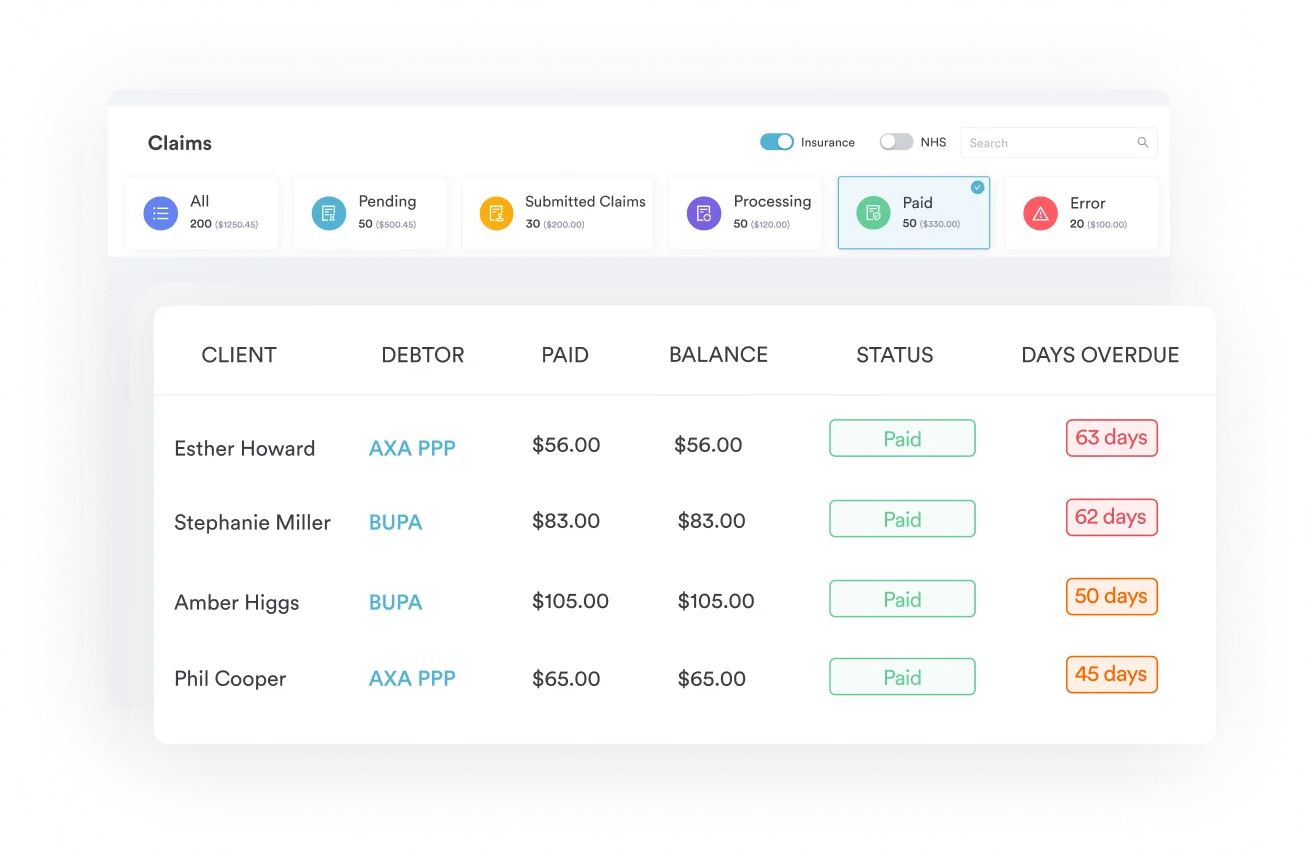
Denial patterns for S92.053A cluster around a handful of predictable errors, and the unspecified laterality in the descriptor drives most of them. Reworking a denial after the fact costs far more than correcting it at the point of coding.
Each denial reason below has a direct fix that starts at documentation, not at the clearinghouse. A working knowledge of denial codes in medical billing helps billing teams map the remittance CARC reason code back to its documentation cause.
Submitting through a clearinghouse that runs clean claim edits before the payer sees the claim catches the most common of these errors automatically. That happens well before a remittance advice comes back with a CO-4 or CO-16 denial code.
ICD-10-CM Official Guidelines Chapter 19 govern all trauma and injury codes, including the S92 fracture block. Five rules from that chapter bear directly on S92.053A claims.
Run a monthly audit of S92.053A claims against your remittance CARC codes. A cluster of specificity denials usually means the side was in the chart the whole time and the coder never saw it. Pull five of those charts and check whether the operative note or radiology report named a side. If it did, the fix is a query workflow at intake, not an appeal after the fact.
Three encounters show where the unspecified code holds up, and where it stops being defensible.
Scenario 1: Emergency department, side never dictated. A 45-year-old construction worker falls from scaffolding and presents to the ED with heel pain and swelling. CT confirms a displaced calcaneus fracture with no subtalar joint involvement, and the radiologist documents “extraarticular.” Neither the CT report nor the ED note states right or left. The coder sends a query, which is still unanswered when the claim window closes. Code: S92.053A, with the query retained in the encounter record. Add the external cause code for the fall mechanism.
Scenario 2: Records received from an outside facility. A patient transfers in for surgical planning carrying imaging on disc and an unsigned outside report. The report describes a displaced extraarticular calcaneal fracture but names no side, and the new practice has not yet imaged the patient. Active treatment is under way, so the 7th character is A. Code: S92.053A for that encounter. Once the practice’s own imaging is read and the side is documented, later encounters move to S92.051A or S92.052A.
Scenario 3: The query comes back answered. The surgeon responds to the coder’s query and confirms a right calcaneus fracture, and the operative note for the ORIF names the right side. S92.053A is no longer the correct code for that encounter. Code: S92.051A paired with CPT 28415 and an RT modifier. If S92.053A was already billed for an earlier encounter in the same episode, that claim is corrected rather than appealed.
In most orthopedic practices, the laterality problem behind S92.053A is a handoff problem. The radiologist dictates into one system, the surgeon documents in another, and the coder works from whichever note reached the billing queue first. A query gets sent by email and the answer lands in someone’s inbox. The claim goes out with the unspecified code because nobody linked the two.
Practice management software like Pabau keeps the clinical record and the claim in the same system. The diagnosis code is selected against the note it came from. A coder choosing S92.053A can see at once whether the operative report or radiology result already names a side. Open documentation queries sit on the encounter rather than in an inbox, and the claim can be held until one is answered.
Pabau’s claims management also runs its checks before submission rather than after remittance. Unspecified-laterality codes, 7th character mismatches, and missing prior authorizations are flagged at the point of coding. Your team corrects them while the chart is still open. The outcome is fewer specificity denials to rework, and payment that lands sooner after the encounter.

Pabau’s integrated claims management links ICD-10 code selection to the clinical note behind it. Unspecified-side codes and 7th character errors are flagged before the claim leaves your system.

S92.053A comes down to three documentation checkpoints and one honest question. Displacement must be confirmed on imaging. The fracture must be classified as extraarticular, with the subtalar joint left intact. The visit must deliver active treatment, which is what the 7th character records.
The honest question is whether the side is genuinely absent from the record. S92.053A is the right code only while that stays true. As soon as a note, report, or operative dictation names a heel, the claim belongs to S92.051A or S92.052A.
Pabau’s claims management software surfaces laterality and episode-of-care errors before claims leave the practice, turning a post-denial audit into a pre-submission catch. To see how it fits an orthopedic or sports medicine workflow, book a demo.

Need a complete framework for denial prevention across your ICD-10 claims? Denial management in healthcare walks through root-cause analysis and appeal workflows by remittance code.
Submitting fracture claims electronically and want to understand clearinghouse routing? 837 electronic claim file guide explains how 837P and 837I formats carry ICD-10 diagnosis codes to the payer.
Working on building a cleaner billing workflow from encounter to payment? What is medical billing covers the end-to-end process from charge capture through remittance posting.
ICD-10 Code S92.053A is the billable diagnosis code for a displaced other extraarticular fracture of unspecified calcaneus, initial encounter for closed fracture. It tells the payer four things. The fragments are out of alignment and the subtalar joint is not involved. The visit is delivering active treatment, and the record does not state which heel was injured.
Yes. S92.053A is a valid and billable ICD-10-CM code for FY2026. It is a full seven-character code that meets CMS requirements for claim submission. Being billable is not the same as being the best available code, so use a side-specific code whenever the documentation supports one.
No. S92.053A carries no laterality at all. The right calcaneus code is S92.051A and the left is S92.052A, both for a displaced extraarticular fracture at the initial encounter. S92.053A applies only when no note, report, or dictation in the record names a side.
Displacement. S92.053A codes a displaced fracture and S92.056A codes a nondisplaced one at the same site, both with laterality unspecified. Choose on imaging: if fragments have shifted from anatomical position, use S92.053A. When displacement is not documented at all, ICD-10-CM guidelines default to displaced.
S92.053A covers closed fractures only. The 7th character A specifies an initial encounter for a closed fracture. When clinical documentation confirms an open fracture with skin disruption at the fracture site, a different 7th character is required. Default to closed when open or closed is not documented.
Switch to S92.053D when the plan moves from active intervention to routine healing monitoring. Use A if the visit involves casting, ORIF planning, wound management, or another active treatment decision. Use D if the visit is purely a scheduled check confirming normal healing.
Some will. Several commercial plans run specificity edits that reject unspecified-side codes when a side-specific option exists. The denial usually means the side was in the chart and the coder did not see it. Query the provider before billing, and keep an unanswered query on the encounter as your audit trail.
Auditors look for four things. Imaging must confirm displacement, and the record must state that the subtalar joint is not involved. The note must show that the visit delivered active treatment. Finally, no record can name a side. That last item is usually a documentation query with no answer on file. Missing any one creates audit exposure with any payer.