

CCSD code G5100: Bypass of duodenum billing guide
CCSD code G5100 bills a bypass that leaves the duodenum in place CCSD code G5100...

Last Updated: Oct 16, 2026
28725 is the CPT code for subtalar arthrodesis, the surgical fusion of the talocalcaneal joint in the hindfoot. The official AMA descriptor reads "Arthrodesis, subtalar," and the code carries a 90-day global period.
Use 28725 only when the subtalar joint is the sole joint fused. Adding the talonavicular and calcaneocuboid joints makes it a triple arthrodesis (28715). Fusing the ankle, subtalar and talonavicular joints together is a pantalar arthrodesis (28705).
Let Pabau's smart automation suggest the right codes, reduce claim denials, and keep your practice compliant—effortlessly.
Automate repetitive tasks and focus on what matters most—your patients.
Reduce coding errors and ensure compliance with the latest regulations.
Clean claims, fewer denials, and faster reimbursements.
Powerful insights and reporting to help your practice thrive.
HIPAA compliant SOC 2 certified GDPR-compliant Trusted by 4,000+ clinics worldwide

CPT code 28725 covers fusion of the subtalar joint only, so fusing any adjacent joint at the same session calls for a different code.
The 2026 national unadjusted Medicare payment is about $729.14, from 21.83 total RVUs in both facility and non-facility settings.
A 90-day global period applies, and separately billing included services such as fixation or routine imaging triggers bundling denials.
RT or LT modifiers report laterality, and modifier 58 covers a staged procedure planned at the original operative session.
Pabau’s claims management software submits 28725 claims electronically with built-in CPT and ICD-10 catalogs.
CPT code 28725 is the procedure code for arthrodesis, or surgical fusion, of the subtalar joint. The American Medical Association’s CPT code set gives it the official descriptor “Arthrodesis, subtalar.”
The subtalar joint (also called the talocalcaneal joint) forms where the underside of the talus meets the upper surface of the calcaneus. It controls inversion and eversion of the hindfoot.
Surgeons perform subtalar arthrodesis after conservative management has failed for conditions such as:
The code belongs to the foot arthrodesis family (28705-28760), and every code in it carries a 90-day global period. The family runs from pantalar arthrodesis at 28705 to the Jones-type great toe fusion at 28760.
Picking the wrong code within this family is a common reason hindfoot fusion claims are downcoded or denied. Our procedure codes library covers the other musculoskeletal surgery codes you may need alongside it.
Knowing what’s bundled into CPT code 28725 prevents the most frequent unbundling denials.
Coders must confirm that the operative report shows the subtalar joint as the sole fused joint before assigning 28725.
Payer scrutiny of CPT code 28725 focuses almost entirely on the operative report. The report must show that only the subtalar joint was fused, and document the approach, fixation method and graft material used.
Key operative documentation elements payers require:
Payers increasingly use automated claim edits to flag operative reports where the approach described does not match the code billed. A lateral sinus tarsi approach note paired with a claim for a more extensive code is a common trigger for medical record requests.
Medicare pays CPT code 28725 from its relative value unit (RVU) total, multiplied by the annual conversion factor. The geographic practice cost index (GPCI) then adjusts it for your locality. For 2026, the national unadjusted payment is about $729.14.
Rates change each January when the Centers for Medicare and Medicaid Services (CMS) publishes the updated Physician Fee Schedule. The table below shows the 2026 national unadjusted values. Confirm your locality’s rate with the CMS lookup or the FastRVU lookup tool before billing.
Most subtalar arthrodesis procedures take place in a hospital or ambulatory surgical center (ASC), and the facility bills its own institutional rate separately. Because 28725 carries the same practice expense RVU in both settings, the RVU total is identical. Only the GPCI and the conversion factor change the physician’s payment.
Modifier selection errors are the second most common denial trigger on CPT code 28725 claims. The table below covers the modifiers coders apply most often.
Bilateral subtalar arthrodesis at the same sitting is unusual. When it happens, bill 28725 twice with RT and LT, or apply modifier 50 if the payer accepts it in place of separate lines. Verify the payer’s bilateral billing preference before submission.
Check payer-specific modifier rules before filing. Some commercial payers require modifier 50 for bilateral procedures on the same claim line, while others require two separate line items with RT and LT. Medicare generally accepts the two-line format. Submitting the wrong format delays payment by 30-45 days, and the denial reason often reads only ‘modifier conflict’ with no further detail.
Medical necessity for CPT code 28725 must be established through a supporting ICD-10-CM diagnosis code. A mismatch between the procedure and the diagnosis is one of the top denial triggers. These are the primary codes used to justify subtalar arthrodesis, in line with billing compliance requirements for surgical procedures.
Every ICD-10 code on the claim must reflect the physician’s documented diagnosis and align with the operative findings. Don’t assign a diagnosis code just because it appears on an “accepted” list, since the medical record must support it. For post-traumatic cases, payers frequently cross-reference prior claims to confirm the mechanism of injury.
Selecting the wrong code within the foot arthrodesis family is the most consequential coding error on these cases. Each code maps to a distinct set of joints, and payers use operative notes to verify that the billed code matches what was performed.
The decision rule is simple. Count the joints the operative note says were fused, then pick the code whose scope covers exactly those joints. The diagram below maps each combination to its code, and when the note is unclear, query the surgeon before filing.
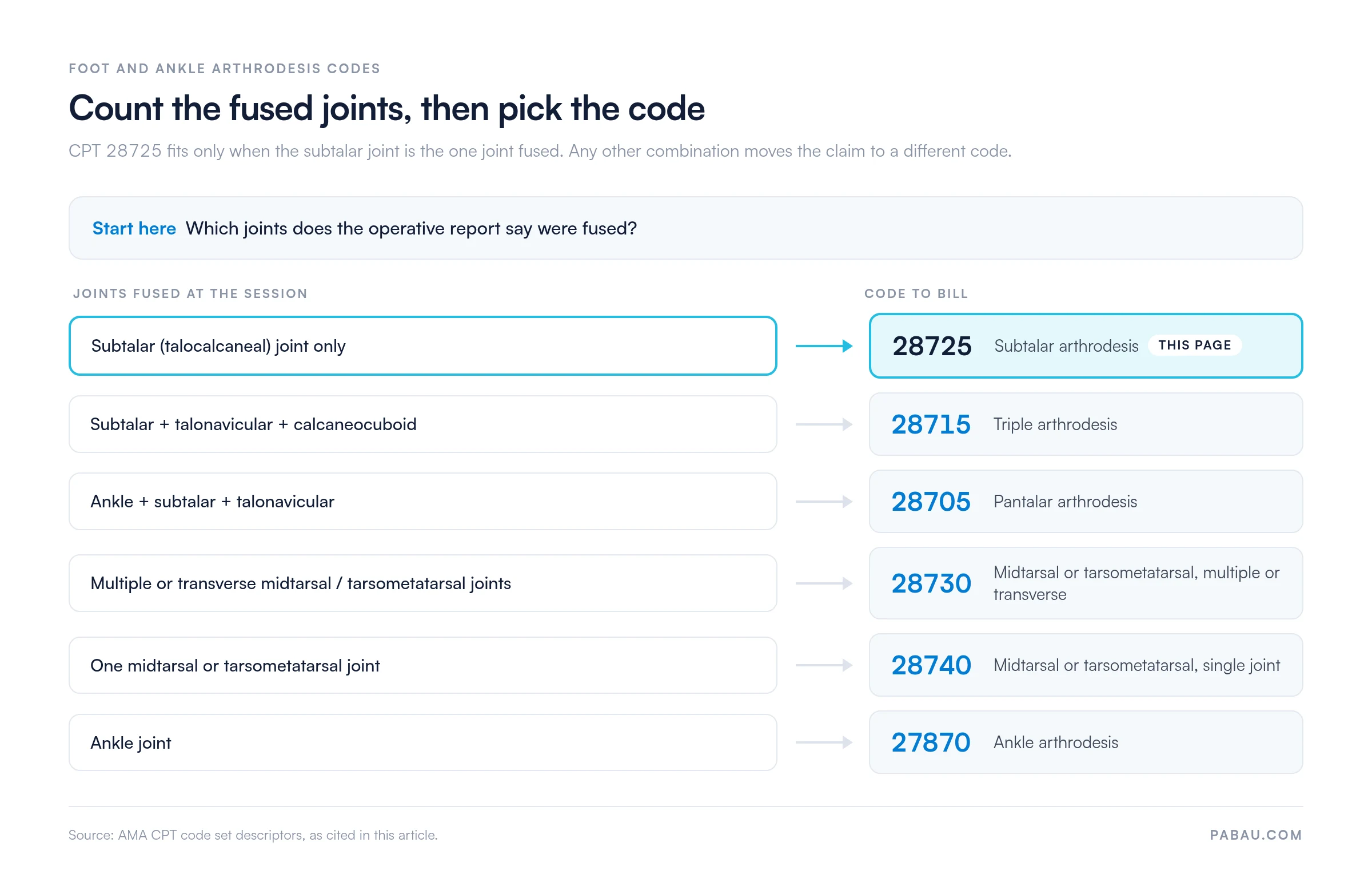
Most commercial payers and Medicare Advantage plans require prior authorization for CPT code 28725. They treat subtalar arthrodesis as a non-emergent elective procedure, so approval has to be in place before the surgery date.
Documentation payers typically require before authorizing 28725:
Traditional Medicare (Parts A and B) does not require prior authorization for most elective foot surgeries, but Medicare Advantage plans follow their own policies. Blue Cross, Aetna, Cigna and UnitedHealthcare all maintain arthrodesis-specific medical policies. Review them once a year as part of your pre-authorization workflow.
Denial patterns on CPT code 28725 are predictable. A sound denial management workflow addresses most of them before a claim reaches the payer.
For appeals, the strongest package combines the operative report, the surgeon’s clinical summary letter and relevant imaging reports. Add the payer’s LCD or medical policy language that supports the claim. Getting a clean claim out on the first attempt avoids 60- to 90-day resubmission cycles that cut into practice cash flow.
Practices that route 28725 and related foot surgical claims through a superbill documentation workflow before submission catch diagnosis-procedure mismatches at the point of coding. That beats finding them after the denial letter arrives.
Run a pre-submission audit for every CPT 28725 claim. Confirm the operative report names only the subtalar joint and the ICD-10 code is an arthritis or deformity code for the same side. Then check that RT or LT is appended and no global period is active from a prior foot procedure. A five-minute check prevents a 60-day denial cycle.
Most practices billing hindfoot fusions still check the operative report by hand, then rekey the code, modifier and diagnosis into a clearinghouse portal. Every handoff is a chance for a missing RT modifier or a 28715 that should have been 28725.
Pabau’s claims management software builds the claim from the invoice your team already raises, with CPT and ICD-10 catalogs built in. Through Claim.MD, Pabau’s US clearinghouse partner, you can run a real-time eligibility check before the procedure date and submit the claim electronically as a CMS-1500.
Claim statuses and electronic remittance advice come back into Pabau. Your billing team can see which 28725 claims are paid, pending or denied without logging into a second system.
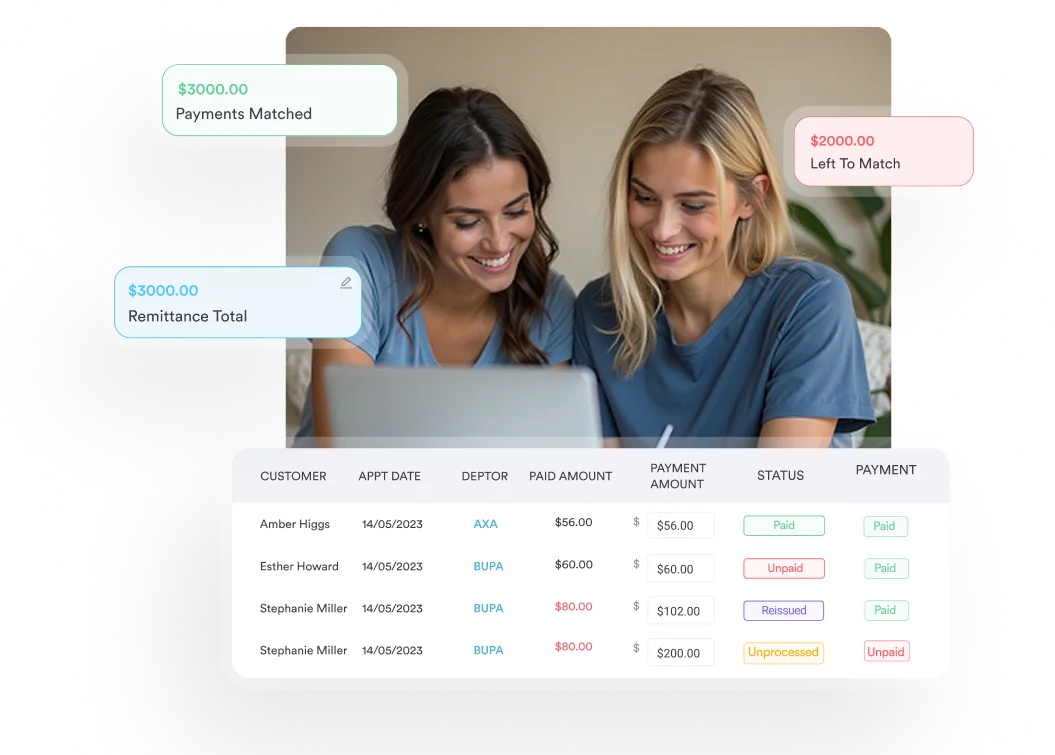

Pabau integrates with Claim.MD to submit CPT 28725 and related arthrodesis claims electronically to thousands of US payers. Real-time eligibility checks and ERA remittance tracking are built in.

CPT code 28725 is a narrow code, and the operative report decides whether it applies. If the note names one fused joint, bill 28725 with the matching laterality modifier and an arthritis or deformity diagnosis for the same side.
If the note is vague about which joints were fused, query the surgeon before you file rather than picking the higher-paying code. A day spent on that query costs far less than a 60-day denial cycle or a recoupment after an upcoding audit.
Pabau’s Claim.MD clearinghouse integration submits CMS-1500 claims directly to thousands of US payers, with built-in CPT and ICD-10 catalogs. Book a demo to see how Pabau takes foot surgical claims from eligibility check to ERA remittance.

Need to verify clean claim requirements before filing? Clean claim submission guidelines covers what payers check before adjudicating surgical claims.
Managing denials across your foot and ankle caseload? Denial codes in medical billing explains the most common CARC denial reasons and how to respond.
Want to understand the broader revenue cycle behind surgical billing? Revenue cycle management walks through the end-to-end claim lifecycle from eligibility to payment posting.
Billing a great toe fusion as well? CPT code 28760 covers Jones-type arthrodesis, the last code in the foot arthrodesis family.
CPT code 28725 is the billing code for arthrodesis of the subtalar (talocalcaneal) joint when a surgeon fuses that joint in isolation. It treats post-traumatic arthritis, primary osteoarthritis or hindfoot deformity after conservative care has failed.
The most common are RT or LT for laterality, which most payers require. Modifier 51 applies when 28725 is a secondary procedure at the same session. Modifier 58 covers a planned staged procedure during the 90-day global period, and modifier 78 covers an unplanned return to the OR.
The 2026 national unadjusted Medicare payment for CPT 28725 is about $729.14, based on 21.83 total RVUs in both facility and non-facility settings. Your local rate depends on your GPCI, so confirm it with the CMS Physician Fee Schedule lookup each January.
CPT 28725 covers fusion of the subtalar joint only, while CPT 28730 covers multiple or transverse midtarsal or tarsometatarsal joints. Fusing the subtalar, talonavicular and calcaneocuboid joints together is triple arthrodesis, CPT 28715. CPT 28740 is a single midtarsal or tarsometatarsal joint and never includes the subtalar joint.
The most frequent reasons are bundling errors, such as separately coding fixation already included in 28725, and missing or incorrect RT/LT modifiers. Claims also fail when the diagnosis does not establish medical necessity. Filing inside a prior foot procedure’s 90-day global period without the right modifier causes denials too.
The operative report must name the subtalar joint as the only fused articulation and describe the approach, fixation hardware, graft material and laterality. Most commercial payers also want records of failed conservative treatment and supporting imaging in the pre-authorization package.



