HCPCS code Q4154: Biovance billing, Medicare rate and denial guide
HCPCS code Q4154: definition and code details HCPCS code Q4154 is a Level II cod...

Last Updated: Oct 6, 2026
Billable Code
28825 is the CPT code for amputation, toe; interphalangeal joint. It covers disarticulation of a single toe at the proximal or distal interphalangeal joint, inside the toe rather than at its base.
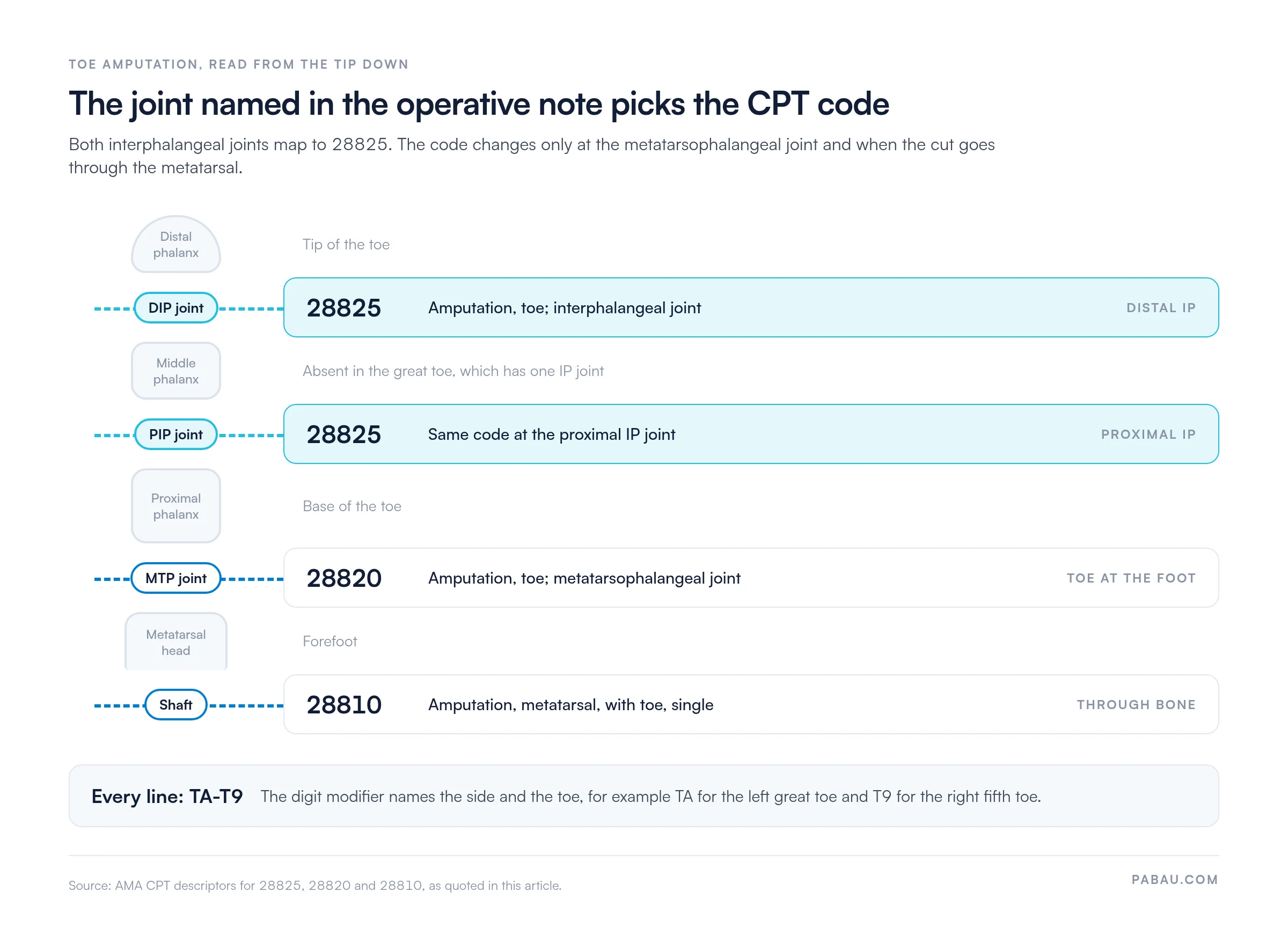
The joint level in the operative note decides the code. Amputation at the metatarsophalangeal joint is 28820, and amputation through the metatarsal, including the toe, is 28810. Missing TA-T9 digit modifiers commonly cause denials or rejections, depending on payer or MAC policy.
Let Pabau's smart automation suggest the right codes, reduce claim denials, and keep your practice compliant—effortlessly.
Automate repetitive tasks and focus on what matters most—your patients.
Reduce coding errors and ensure compliance with the latest regulations.
Clean claims, fewer denials, and faster reimbursements.
Powerful insights and reporting to help your practice thrive.
HIPAA compliant SOC 2 certified GDPR-compliant Trusted by 4,000+ clinics worldwide

CPT code 28825 covers toe amputation at the interphalangeal joint, while amputation at the metatarsophalangeal joint is CPT 28820.
The operative note must name the proximal or distal interphalangeal joint, because a note that only says the toe was removed cannot support 28825.
The TA-T9 digit modifiers identify both the side and the toe, so LT/RT is not additionally required unless a payer’s own policy asks for it.
The code carries a 90-day surgical global period, and post-op wound care visits billed separately within that window are a common audit finding.
Pabau’s claims management software checks insurer details before submission and sends CMS-1500 claims to thousands of US payers through Claim.MD.
CPT code 28825 is described by the American Medical Association as “Amputation, toe; interphalangeal joint.” The procedure is a disarticulation at the IP joint, not a cut through bone. The surgeon opens the skin over the joint, transects the collateral ligaments, separates the joint surfaces, and closes the flap over the remaining stump.
The code applies whether the surgeon works at the proximal IP (PIP) or distal IP (DIP) joint. That detail belongs in the operative note, but it doesn’t change the CPT selection. Amputation through the metatarsal, including the toe, is 28810. Amputation at the metatarsophalangeal joint is 28820. The diagram below maps each level to its code.
The overwhelming majority of IP joint toe amputations in the United States are driven by diabetic foot complications and peripheral vascular disease. According to the Centers for Medicare and Medicaid Services, payers require the operative record to show failed conservative management before covering an elective amputation. For urgent cases such as gangrene or wet infection, document imaging or lab evidence of tissue non-viability.
Medical necessity criteria vary by MAC jurisdiction. Check the applicable Local Coverage Determination for lower-extremity amputations before billing, as part of your routine billing compliance checks.
Diagnosis selection must reflect the operative note, not just the billing template. A diabetes code on a trauma-related amputation, or the reverse, is a medical necessity mismatch that auditors flag routinely. The table below shows the most frequently paired ICD-10-CM codes. Treat it as a starting framework and check each code against the patient’s documented clinical picture.
Diabetic cases rarely stand on one code. E11.621 carries a “use additional code” note, so pair it with the L97.5- code that records the toe ulcer’s site and severity.
Run an ICD-10 crosswalk before finalizing your diagnosis codes. The AAPC CPT-to-ICD-10 crosswalk tool lists accepted pairings by code and flags known edits. That reduces the risk of a medical necessity mismatch denial before the claim ever leaves the practice.
A 28825 claim identifies the toe with a digit modifier from TA to T9. Each one encodes the side as well as the digit, from TA for the left great toe to T9 for the right fifth toe. LT/RT is therefore not additionally required, although some payers ask for it in their own policies. Missing digit modifiers commonly cause denials or rejections, depending on payer or MAC policy.
Under the CMS Physician Fee Schedule, CPT code 28825 carries a 90-day surgical global period. Post-operative visits related to the amputation during that window are bundled into the global payment. Billing them separately is a recurring audit finding flagged by the OIG.
Payment amounts vary by Geographic Practice Cost Index (GPCI) and by facility or non-facility setting. Annual updates take effect each January 1, so check current RVUs and rates in the CMS MPFS Look-Up Tool. The table below shows how the setting changes the calculation and carries no dollar figures.
What the 90-day global includes: The amputation itself, plus the pre-operative E/M on the day of surgery. That E/M is bundled when the decision for surgery was made at a prior visit. The global also covers intraoperative services and every related post-operative visit in the 90 days, including wound checks and suture removal.
What is not bundled: Treatment for unrelated conditions and significant new complications that need a return to the OR. E/M visits documented as unrelated to the amputation are also billable. Bill these with modifier 24 (unrelated E/M during global) or modifier 78 (return to OR for a related complication).
Medicaid reimbursement varies by state program and is typically lower than Medicare. Commercial payers set their own fee schedules, so check each payer’s allowable before assuming Medicare rates apply.
Vague operative notes are the primary audit trigger on CPT 28825 claims. “Toe removed” does not specify the joint level, so it cannot support 28825 over 28820. The operative note must name the interphalangeal joint explicitly.
Most 28825 denials follow a predictable pattern. Catching them before submission through systematic denial management is significantly cheaper than working a remittance after the fact.
High-volume podiatric surgery practices should review denial codes in medical billing by code family each month, which reveals patterns before they become systemic. A single modifier error in a billing template can repeat across dozens of claims before anyone catches it on remittance review.
After any 28825 denial, check whether the same billing template was used for other toe amputation claims in the same billing period. A missing TA-T9 modifier on one claim typically means the same omission exists across every claim submitted from that template. Correct the template first, then rework the individual claims.
Without an integrated system, a 28825 claim often means re-keying patient, procedure, and payer details into a separate clearinghouse portal. Each re-keyed field is another chance to drop a digit modifier or mistype a member ID.
Pabau, the practice management platform we build, includes built-in claims management that generates the claim from the invoice you already raised. Background validation checks confirm that insurer details such as membership numbers and authorization codes are in place before it goes out. Through the Claim.MD integration, CMS-1500 claims reach thousands of US payers without leaving Pabau.
Eligibility checks run before treatment, and remittances come back into Pabau against the claims they settle. Your team sees each claim move from submitted to paid or denied in one view. That way, a denial gets worked while the operative note is still fresh.

Pabau builds each claim from the invoice you already raised and sends it to thousands of US payers through Claim.MD. Statuses and remittances flow back into the same record, so denials surface fast.

The code on a toe amputation comes down to one phrase in the operative note. If the surgeon names the interphalangeal joint, 28825 holds up. If the note only says the toe was removed, no modifier or diagnosis code will rescue the claim.
So fix the inputs before the claim leaves. Use an operative-note template that forces the joint level, and check the TA-T9 modifier against the side in the diagnosis code. Then track the 90 days after surgery so post-op visits stay inside the global payment.
The trade-off is a minute or two of extra documentation per case, against reworking denied claims weeks later. Book a demo to see how Pabau keeps your 28825 claims, statuses, and remittances in one place.

Need to understand how clearinghouse edits catch errors before submission? Our Claim.MD clearinghouse guide explains how pre-submission validation works before a claim reaches the payer.
Looking for a structured approach to reducing denied claims across your practice? Our clean claim guide covers the documentation and submission standards that keep rejection rates low.
Curious how electronic remittance works after a claim is paid or denied? Our electronic remittance advice guide walks through ERA formats and how to action denial reason codes efficiently.
CPT code 28825 is the procedure code for amputation of a toe at the interphalangeal joint. It covers disarticulation at either the proximal or distal IP joint. CPT 28820 covers amputation at the metatarsophalangeal joint, and 28810 covers amputation through the metatarsal, including the toe.
The joint level decides the code. 28825 applies when the surgeon disarticulates at an interphalangeal joint, inside the toe. 28820 applies at the metatarsophalangeal joint, where the toe meets the foot. The operative note must state the joint level, because vague wording such as “toe removed” supports neither code on appeal.
Medicare expects a TA-T9 digit modifier that identifies the exact toe amputated. For example, TA is the left great toe and T9 is the right fifth toe. Because the T-modifiers already encode the side, LT/RT is not additionally required. Policy varies by payer and MAC, so check the local rules before submitting.
CPT 28825 carries a 90-day surgical global period under the Medicare Physician Fee Schedule. Post-operative visits related to the amputation within that window are bundled into the global payment. Billing a wound check or suture removal as a separate E/M visit in that period is a common audit finding. Use modifier 24 only for documented unrelated visits.
No. A transmetatarsal amputation removes all the toes by cutting through the metatarsal shafts, and it is coded separately (typically CPT 28805). CPT 28825 is limited to disarticulation at the interphalangeal joint of a single toe, and the metatarsal bones are not involved.
Denials on CPT 28825 usually trace to one of three causes. A TA-T9 digit modifier is missing, the operative note is vague about joint level, or medical necessity documentation is thin. Thin documentation usually means a missing vascular assessment or wound care history. Global period violations, where post-op visits are billed separately within 90 days, also recur.