

CCSD code G5100: Bypass of duodenum billing guide
CCSD code G5100 bills a bypass that leaves the duodenum in place CCSD code G5100...

Last Updated: Oct 16, 2026
L0468 is the HCPCS Level II code for tlso, sagittal-coronal control, rigid posterior frame and flexible soft anterior apron with straps, closures and padding, extends from sacrococcygeal junction over scapulae, lateral strength provided by pelvic, thoracic, and lateral frame pieces, restricts gross trunk motion in sagittal, and coronal planes, produces intracavitary pressure to reduce load on intervertebral disks, prefabricated item that has been trimmed, bent, molded, assembled, or otherwise customized to fit a specific patient by an individual with expertise.
One detail decides the claim. L0468 is the custom fitted half of a two-code pair, and L0469 is the off-the-shelf half. Both codes describe the same device, so the fitting performed at delivery picks the code. Bill the wrong half and Medicare denies it as incorrect coding.
Let Pabau's smart automation suggest the right codes, reduce claim denials, and keep your practice compliant—effortlessly.
Automate repetitive tasks and focus on what matters most—your patients.
Reduce coding errors and ensure compliance with the latest regulations.
Clean claims, fewer denials, and faster reimbursements.
Powerful insights and reporting to help your practice thrive.
HIPAA compliant SOC 2 certified GDPR-compliant Trusted by 4,000+ clinics worldwide

HCPCS code L0468 is the custom fitted code for a sagittal-coronal control TLSO. It applies only when a qualified practitioner modifies the brace at delivery.
L0469 describes the identical brace supplied off-the-shelf. CMS Policy Article A52500 pairs the two as a corresponding code set that differs only in the fitting performed.
Coverage sits under LCD L33790, Spinal Orthoses: TLSO and LSO. It covers a brace ordered to reduce trunk pain, support healing, or support weak or deformed spinal muscles.
Billing the wrong half of the pair is denied as incorrect coding. The supplier record must describe why the modifications were needed and what was done.
Neither LCD L33790 nor Policy Article A52500 asks for a KX modifier on a spinal orthosis claim. Much published billing advice says otherwise.
Practice management software like Pabau captures the fitting narrative at the appointment, so the documentation exists before anyone builds the claim.
HCPCS code L0468 bills a thoracic-lumbar-sacral orthosis that restricts gross trunk motion in the sagittal and coronal planes. The brace extends from the sacrococcygeal junction up over the scapulae, and pelvic, thoracic, and lateral frame pieces supply its lateral strength.
The device also produces intracavitary pressure to reduce load on the intervertebral disks. Change any one of those elements, such as the control plane or the frame design, and the claim moves to a different L-code.
The code sits in HCPCS Level II, the code set the Centers for Medicare and Medicaid Services (CMS) maintains for non-physician items and services. L0468 is a DMEPOS code, so the supplier must hold an active DMEPOS enrollment to bill it. Billing without that enrollment is a compliance problem rather than a paperwork slip.
The official long descriptor breaks into a fixed set of elements. Each one has to be true of the device you dispensed.
That last element is the one that decides the claim. The short descriptor compresses the whole thing to “Tlso rig fram pelvic pre cst”, where “cst” stands for custom fitted.
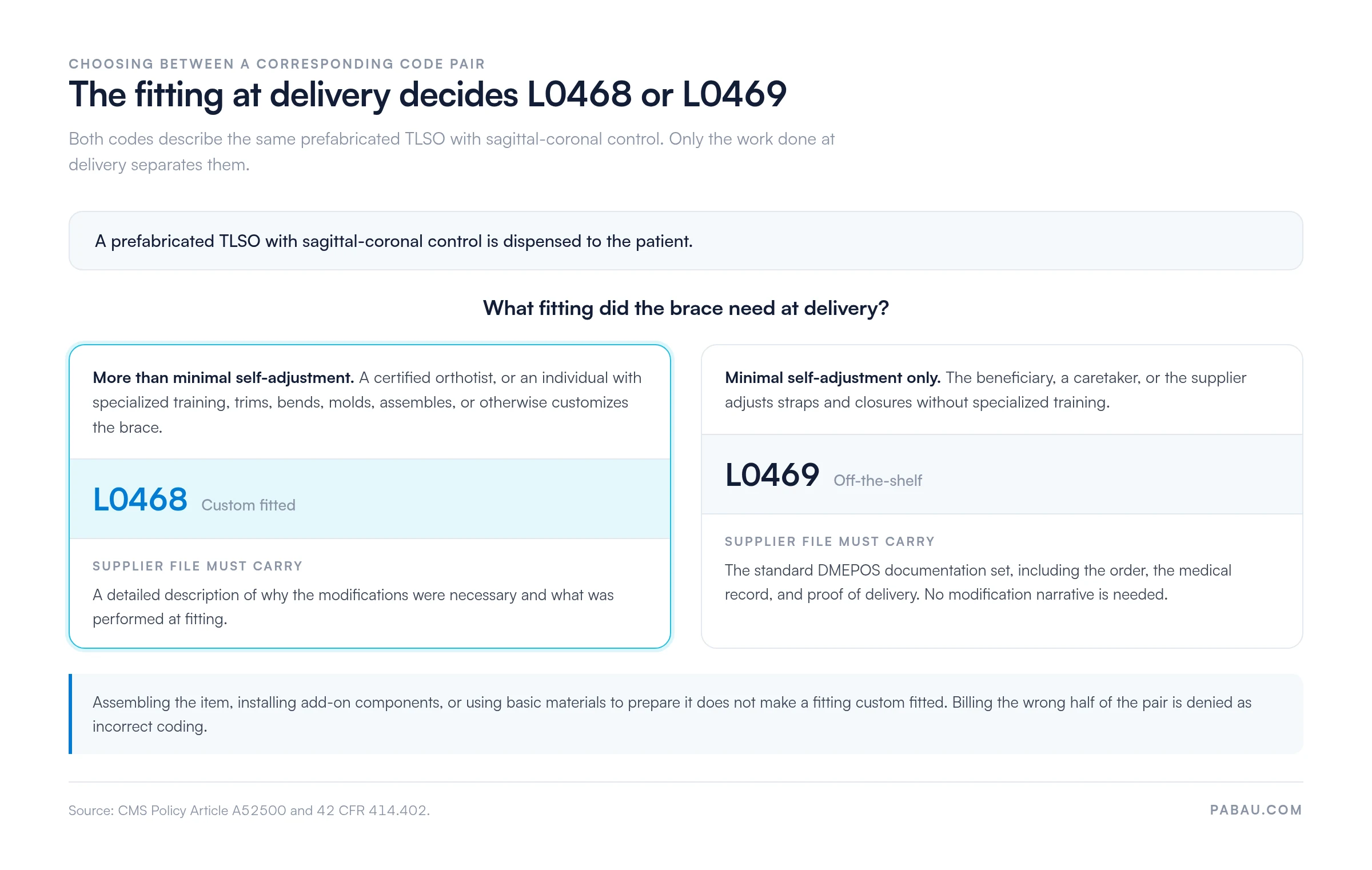
Choosing between L0468 and L0469 has nothing to do with the brace on the shelf. CMS Policy Article A52500 is blunt about it. For prefabricated orthoses there is no physical difference between a device coded custom fitted and one coded off-the-shelf.
Both are prefabricated braces for Medicare coding purposes. What separates the two codes is the fitting performed at the moment of delivery.
42 CFR 414.402 sets the test as “minimal self-adjustment”. A minimal adjustment is one the beneficiary, a caretaker, or the supplier can perform without specialized training. Adjusting straps and closures, or bending and trimming for final comfort, falls into that category.
Those items are coded off-the-shelf, which for this device means L0469. Anything requiring more than minimal self-adjustment by a qualified practitioner is coded custom fitted, and that is L0468. The whole choice runs as a single branch, traced below.
A custom fabricated orthosis is individually made for one patient from castings, tracings, measurements, or images. No other patient could use it. In the TLSO range those codes are L0452, L0480, L0482, L0484, and L0486. The L0486 descriptor names the method outright, since it includes a carved plaster or CAD-CAM model.
Codes such as L0456, L0460, and L0462 are sometimes described as custom fabrication codes. They are not.
L0456 carries the same trimmed, bent, molded, assembled, or otherwise customized language as L0468, which makes it a prefabricated custom fitted code. L0460 and L0462 are prefabricated as well, and A52500 lists all three among the codes CMS treats as custom fitted.
A dispensing record that captures the fitting at the point of delivery settles the custom fitted question before the claim goes out. That beats settling it after a denial comes back.
Write the fitting note while the patient is still in the room. A52500 expects a detailed description of why the modifications were necessary and what was performed at fitting. A note reading “adjusted to fit” describes neither one, and it will not support L0468 on review. Name the frame pieces that were bent or trimmed, the anatomical reason, and the person with expertise who did the work.
Three roles have to line up on an L0468 claim, and suppliers often check only one of them. The billing side needs an active DMEPOS enrollment for the date of service. The clinical side needs someone qualified to make the brace fit, plus a treating practitioner whose record justifies the device.
One detail catches suppliers out repeatedly. A52500 states it plainly. Assembling the item, installing add-on components, or using basic materials to prepare it does not make a fitting custom fitted.
Unpacking a brace and clipping on an accessory is not expertise in trimming, bending, or molding. If that is the whole of the work at delivery, the claim belongs on L0469.
Medicare covers L0468 under Part B as a brace. The device has to be medically necessary, ordered by a treating practitioner, and supplied by an enrolled DMEPOS supplier.
The governing rules are LCD L33790 and CMS Policy Article A52500. Both documents get revised, so verify against the current version before dispensing to a new patient.
Coverage does not follow automatically from an order, either. The supplier has to confirm independently that the clinical picture meets one of the LCD indications.
LCD L33790 covers a spinal orthosis, L0468 included, when it is ordered for any one of four indications.
Only one of the four has to apply. What the LCD will not accept is an order that names none of them. If a spinal orthosis is supplied and the coverage criteria are not met, the item is denied as not medically necessary.
Some denials are statutory rather than clinical. To qualify under the braces benefit, the device has to be rigid or semi-rigid and capable of supporting a weak or deformed body part.
An elastic support garment does not meet that definition. It is noncovered with no Medicare benefit, which is why code A4467 is denied outright.
Place of service creates a second group of noncovered situations. Payment for a spinal orthosis is bundled into the hospital or skilled nursing facility payment in one situation.
That is when the brace is supplied during an inpatient stay for treatment or rehabilitation. No claim should go to the DME MAC in that case.
There is one exception worth knowing. A brace left in the room for the patient to take home within two days of discharge stays eligible for DME MAC coverage.
L0468 is paid from the DMEPOS fee schedule, and the allowable varies by state and MAC jurisdiction. CMS republishes the schedule each January.
Verify the current amount for your jurisdiction with the CMS DMEPOS fee schedule rather than carrying last year’s figure forward.
One point about the allowable matters more for L0468 than for most codes. The extra work at delivery is clinical labor, and it is not separately payable.
A52500 folds beneficiary evaluation, measurement or casting, and fitting or adjustment into the allowance for the orthosis itself. CAD/CAM technology used in fabrication is bundled the same way.
A supplier who bills L0468 at last year’s allowable, without adjusting for locality, quietly undercollects on every claim. Claims management software that holds the current fee schedule by code catches that drift before January arrives.
Every L0468 claim needs at least one ICD-10-CM diagnosis code. LCD L33790 publishes no list of diagnoses that support medical necessity, and its ICD-10 coding groups are empty. So no code on its own buys coverage.
The diagnosis has to support one of the four covered indications, and the treating practitioner’s record has to back it up. If the order names a condition you rarely bill, check it against the ICD-10-CM codes reference before you assume it supports a spinal orthosis.
The pairings below turn up most often on TLSO claims. Confirm each one against the current CDC ICD-10-CM tool before submission, because codes are added and retired every October.
Two retirements still catch DMEPOS billers out. M54.5 (low back pain) was withdrawn from ICD-10-CM effective October 1, 2021, so use M54.50, M54.51, or M54.59 depending on the presentation. M51.36 went the same way on October 1, 2024, and now needs a 6th character.
This is where a lot of L0468 billing advice goes wrong. Plenty of published guidance tells suppliers that a KX modifier is required on spinal orthosis claims.
Neither LCD L33790 nor Policy Article A52500 says so, and the letters KX do not appear in either document. The one policy-specific modifier A52500 names for spinal orthoses is CG, and it applies only to L0450, L0454, L0455, L0621, L0625, and L0628.
Modifier rules change, and the DME MACs publish bulletin articles between LCD revisions. Check the current LCD, the policy article, and your own MAC’s guidance before you build a modifier into a claim template.
LCD L33790 sets four general requirements for any DMEPOS claim, and A52500 adds one that belongs to custom fitted codes specifically.
Assemble the file after a denial and you are appealing with whatever the record happens to hold. Running the list at the point of delivery, while the patient is still there, is the practical way to stay audit-ready.
Billing HCPCS code L0468 follows a set sequence, and the order matters because two steps have to happen before the patient leaves. Here is how the claim actually moves for a DMEPOS supplier.
Before the claim leaves your system, run one last check.
Holding a claim for a day beats appealing it for a month.
The failure patterns below come from the coding rules in A52500 and from how DMEPOS audits read a supplier file. Preventing the denial costs less than decoding it afterward.
Reviewing these patterns across a supplier’s L0468 volume is what keeps the first-pass rate up. Skip that review and the team spends most of its week working appeals instead.
L0468 sits in a family of TLSO codes separated by device design and by fitting classification. Picking the wrong neighbor is one of the commonest errors in spinal orthosis billing.
The table below sets out the codes most likely to be confused with L0468.
The pair that causes the most trouble is L0468 and L0469. They describe the same brace, so the product catalog cannot answer the question for you.
If a qualified practitioner had to trim, bend, mold, or otherwise customize the device, bill L0468. If the patient, a caretaker, or the supplier could have handled the adjustment, bill L0469. Keeping a dispensing record that states which one happened is part of the audit trail.
A third scenario has its own answer. Some codes carry the phrase “prefabricated, includes fitting and adjustment”, such as L0470 and L0472. Those are custom fitted codes. If the item was actually supplied off-the-shelf, A52500 directs the supplier to the miscellaneous spinal orthosis code L1499 instead.
Audit your L0468 and L0469 split each quarter, but audit it against the fitting notes rather than the totals. A supplier whose claims are 95% L0468 is not automatically wrong, and one with a balanced split is not automatically right. What matters on review is whether each L0468 claim carries a note describing a modification that needed expertise. Pull ten files at random and check that one thing.
Most L0468 denials trace back to the same moment. The brace was fitted, the patient went home, and the note was written later from memory. By then nobody recalls which frame piece was bent or why. The claim goes out on a code the file cannot support.
Practice management software like Pabau closes that loop at the appointment. Custom forms capture the fitting narrative while the patient is still in the chair. The modification, the reason, and the person who performed it all get recorded against the visit.
The Standard Written Order, the clinical notes, and proof of delivery then sit in the same patient record. The documentation is assembled before anyone touches a claim.
Pabau’s claims management software carries that file into submission. You attach the ICD-10 code, apply only the modifiers current policy calls for, and send the claim without rekeying anything.
For a DME supplier, that means a shorter path from delivery to payment and fewer files that fall apart on review.

Pabau’s claims management software helps DME suppliers and orthotics practices capture fitting documentation, attach ICD-10 codes, and submit complete claims. See how it fits your billing workflow.

L0468 rewards the supplier who settles the code in the fitting room rather than at the keyboard. The device is identical either way. What separates a paid claim from an incorrect-coding denial is the note written at delivery.
So build the habit around that moment, not around month-end. Capture who modified the brace, what they changed, and why, before the patient leaves the room. Hold the Standard Written Order before you submit, and confirm one LCD L33790 indication sits in the treating practitioner’s record.
Do that consistently and an audit request becomes a file you can send, rather than one you have to reconstruct. Pabau keeps the fitting narrative, the order, and proof of delivery in one patient record. Book a demo to see how that shortens the path from a DMEPOS delivery to a paid claim.

Dispensing the same brace with no more than a strap adjustment? HCPCS code L0469 covers the off-the-shelf half of the pair, including its documentation and denial patterns.
Billing a lumbar-sacral orthosis that needs authorization first? HCPCS code L0648 walks through the prior authorization request and the coverage rules behind it.
Want fewer DMEPOS claims coming back for rework? Clean claim sets out what a payer needs on first submission and how to check for it.
Need to understand denial patterns across your DME claims? Denial management in healthcare covers how to identify, track, and reduce claim denials across billing workflows.
Want to see how claims move from submission to payment? Revenue cycle management explains the full billing lifecycle from order to ERA posting.
As a purchase. Medicare pays orthoses under the braces benefit on a lump-sum purchase basis, so no rental option exists for L0468. The supplier bills once, and Medicare pays 80% of the allowable after the deductible. That is also why rental modifiers have no standing role on this code.
No. The CMS Required Prior Authorization List for DMEPOS names certain lumbar-sacral orthoses, including L0648, L0650, L0631, L0637, and L0639. L0468 is not on that list as of the January 2026 update. CMS revises the list periodically, so check the current version before you dispense.
Not automatically. LCD L33790 and Policy Article A52500 bind Medicare claims, and each commercial plan writes its own orthotic policy. Medicare Advantage plans often add prior authorization where original Medicare asks for none. Read the payer’s medical policy and authorization rules before delivery, not after the denial.
No. PDAC code verification applies only to the codes CMS names for it, such as L0648, L0650, L1832, L1833, and L1851. Suppliers can still search the PDAC Product Classification List to confirm that a manufacturer’s brace maps to L0468. That check costs nothing and settles a coding argument early.



