



CCSD code G5100: Bypass of duodenum billing guide
CCSD code G5100 bills a bypass that leaves the duodenum in place CCSD code G5100...

Last Updated: Oct 16, 2026
CPT Code 28122 covers partial excision of a tarsal or metatarsal bone, excluding the talus and the calcaneus. Specifically, surgeons report it when osteomyelitis or bone bossing calls for craterization, saucerization, sequestrectomy, or diaphysectomy. Because of that, the operative note has to name the bone and the technique used.
This reference covers the official descriptor, how Medicare pays the code in 2026, and the RVU components. It also sets out the modifiers, the ICD-10 crosswalk, documentation requirements, and NCCI bundling rules.

CPT Code 28122 covers partial excision of a tarsal or metatarsal bone, excluding the talus and the calcaneus.
The code applies to osteomyelitis and bone bossing, and the operative note must name the bone involved.
Craterization, saucerization, sequestrectomy and diaphysectomy each need naming in the note, because 28122 covers all four.
Billing 28122 with CPT 28306 can trigger an NCCI edit, so modifier 59 or XS needs documentation behind it.
Practice management software like Pabau submits 28122 claims through Claim.MD and tracks status and remittances.
CPT Code 28122 sits within the Excision Procedures on the Foot and Toes section of the American Medical Association’s CPT code set. The AMA maintains the code set annually through the CPT Editorial Panel, and as a result, 28122 has remained stable in its current descriptor form.
The four procedure variants are not interchangeable labels. For instance, craterization and saucerization describe the shape of bone removed to achieve drainage. Sequestrectomy, by contrast, specifically removes necrotic sequestrum from an osteomyelitic focus. Diaphysectomy, meanwhile, refers to excision of a segment of the bone shaft. Because of these distinctions, the operative note must identify which technique was used.
Two clinical scenarios drive use of CPT Code 28122. First, osteomyelitis in a tarsal or metatarsal bone, where infection has reached bone and partial excision removes the necrotic or infected segment. Second, bone bossing, also called exostosis, where a bony prominence causes pain, pressure, or functional impairment.
Anatomical exclusions matter. The talus and the calcaneus are explicitly out of scope for 28122. Consequently, when the procedure involves either of those two bones, CPT 28120 applies instead. Coding the wrong bone is, in fact, the most common error on 28122 claims, and it rarely survives a pre-payment review.
A bunionette produces a bony prominence as well, and that is where a second mix-up starts. Resection of the fifth metatarsal head for a bunionette is CPT 28110, and billing it with 28122 on that same head is unbundling.
Medicare payment for CPT Code 28122 varies by place of service and by geographic locality. For that reason, the CMS Physician Fee Schedule lookup tool publishes the 2026 rate for each locality. Still, check your own locality rather than a national average, because GPCI adjustments move the payment in both directions.
Relative value units (RVUs) are the building blocks of Medicare payment. Specifically, the total RVU for CPT Code 28122 is the sum of its work, practice expense, and malpractice RVUs. From there, payment applies the GPCI adjustment to each component, then multiplies the adjusted total by the conversion factor. The CMS relative value files, meanwhile, carry the current figure for each component.
Modifier selection for CPT Code 28122 affects both payment and claim integrity. In particular, missing a required laterality modifier is one of the most frequent reasons this code is rejected on initial submission. Payer rules vary, so verify modifier requirements against your specific contract and payer policies before submitting.
Modifiers 59 and XS matter most when CPT 28122 is billed alongside CPT 28306. The NCCI section below, in turn, covers when the modifier is clinically appropriate, and how payers judge the pair.
Medical necessity for CPT Code 28122 rests on the diagnosis that supports the procedure. For that reason, the codes below are the diagnoses most often paired with it, and each one can be checked against the ICD-10-CM code directory. The pairing has to reflect the clinical documentation, so a diagnosis is never chosen for billing convenience.
Always cross-reference diagnosis selection against the CDC/NCHS ICD-10-CM web tool for the current fiscal year to confirm codes remain valid and unretired before submitting.
Inadequate documentation is the second most common reason CPT Code 28122 claims are denied after audit. Specifically, the operative note must let a reviewer confirm medical necessity, the bone involved, and the type of excision performed.
Capture the procedure type, the anatomical site, and the medical necessity indicators at the point of care. In turn, that keeps the coder from working backwards from an incomplete note.
Flag every 28122 claim for internal review before submission if the operative note does not explicitly name the tarsal or metatarsal bone involved. Auditors look for this specificity first, and a generic ‘foot bone’ notation will not survive a payer’s post-payment review.
The National Correct Coding Initiative (NCCI) edits are how CMS prevents payment for code combinations that overlap. For example, when CPT Code 28122 and CPT 28306 (osteotomy, first metatarsal) are billed on the same date, a payer may deny one of them. Because of this, sound denial management starts with knowing which of the two an edit will strike.
CMS updates the NCCI edits quarterly. As a result, the column arrangement for the 28122/28306 pair decides whether a modifier can unbundle it. Where both procedures are distinct services at separate anatomical sites, however, modifier 59 or XS may apply.
The operative note has to carry the separate indication. Otherwise, applying a modifier without that documentation, purely to clear an edit, is a compliance risk.
CPT Code 28122 attracts a predictable set of billing errors. In fact, the same three or four issues repeat until a practice builds a pre-submission check that catches them.
Choosing between the adjacent foot excision codes is where 28122 errors usually start. Specifically, the distinction rests on which bone was involved, and on whether the surgeon performed a partial excision, a total excision, or an osteotomy.
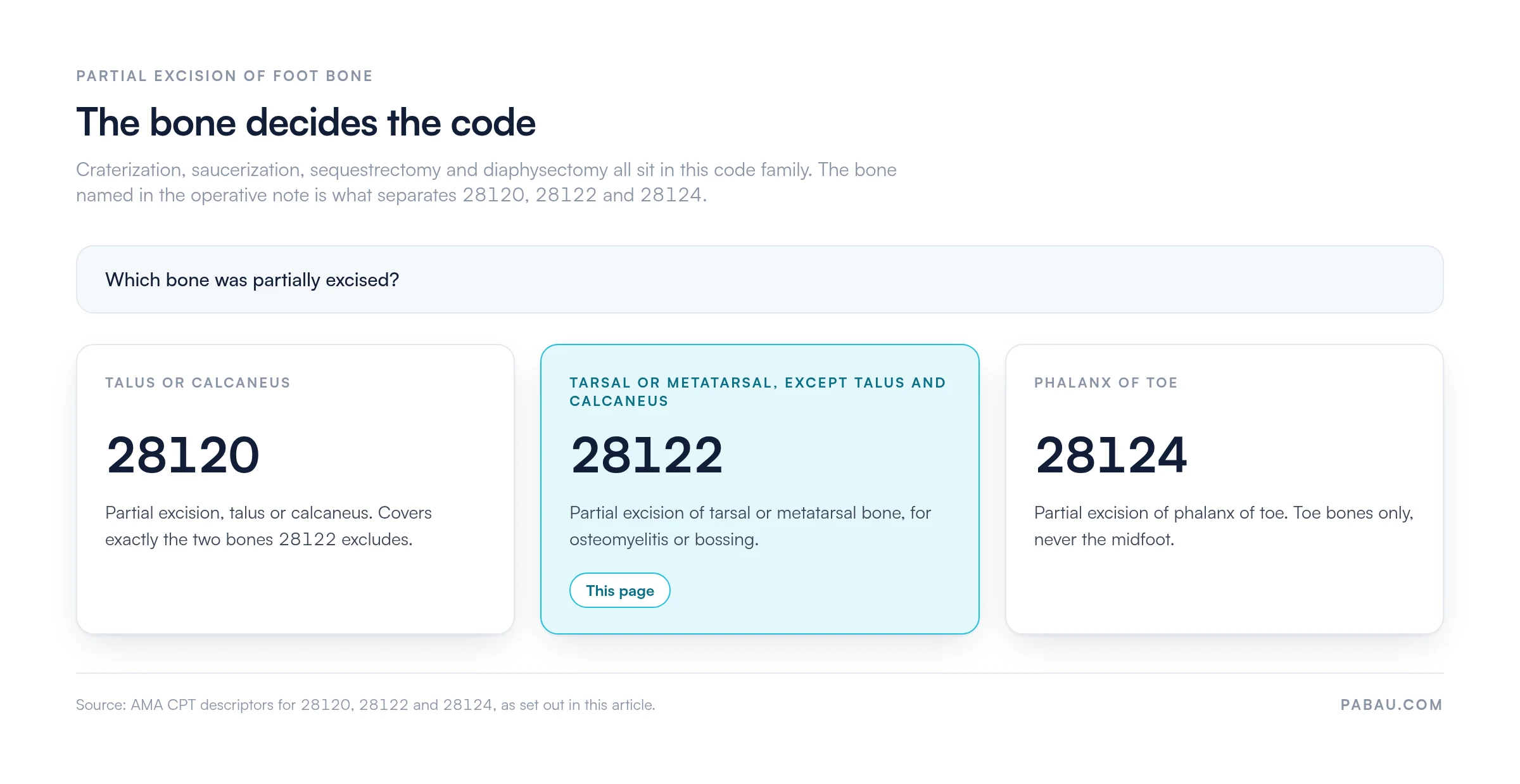
The 28120/28122 distinction is the one that matters most. To settle it, read the operative note for the bone involved. The talus or the calcaneus takes 28120, while any other tarsal or metatarsal bone takes 28122. Even so, a claim coded the wrong way round still passes an automated scrubber, then fails on post-payment audit. The chart below maps each bone to its code.
Partial excision assumes the toe stays in place. When the surgeon removes the toe along with its metatarsal shaft, that is a single ray amputation and the claim moves to CPT 28810. A toe taken off at the interphalangeal joint leaves the metatarsal intact, and that claim is CPT 28825.
Bone bossing is not the only cause of a painful prominence on the foot. If the operative note describes excising a ganglion from a tendon sheath or joint capsule, the claim belongs to CPT 28090 instead.
Podiatric and orthopedic practices billing CPT Code 28122 work against four recurring risks. Together, the excluded bones, the laterality modifier, the NCCI pair with 28306, and the ICD-10 match decide whether the claim survives review.
Pabau is an all-in-one practice management system for medical and aesthetic practices. As part of that, its podiatry billing software submits each claim from the record that already holds the patient, treatment, and insurer details.
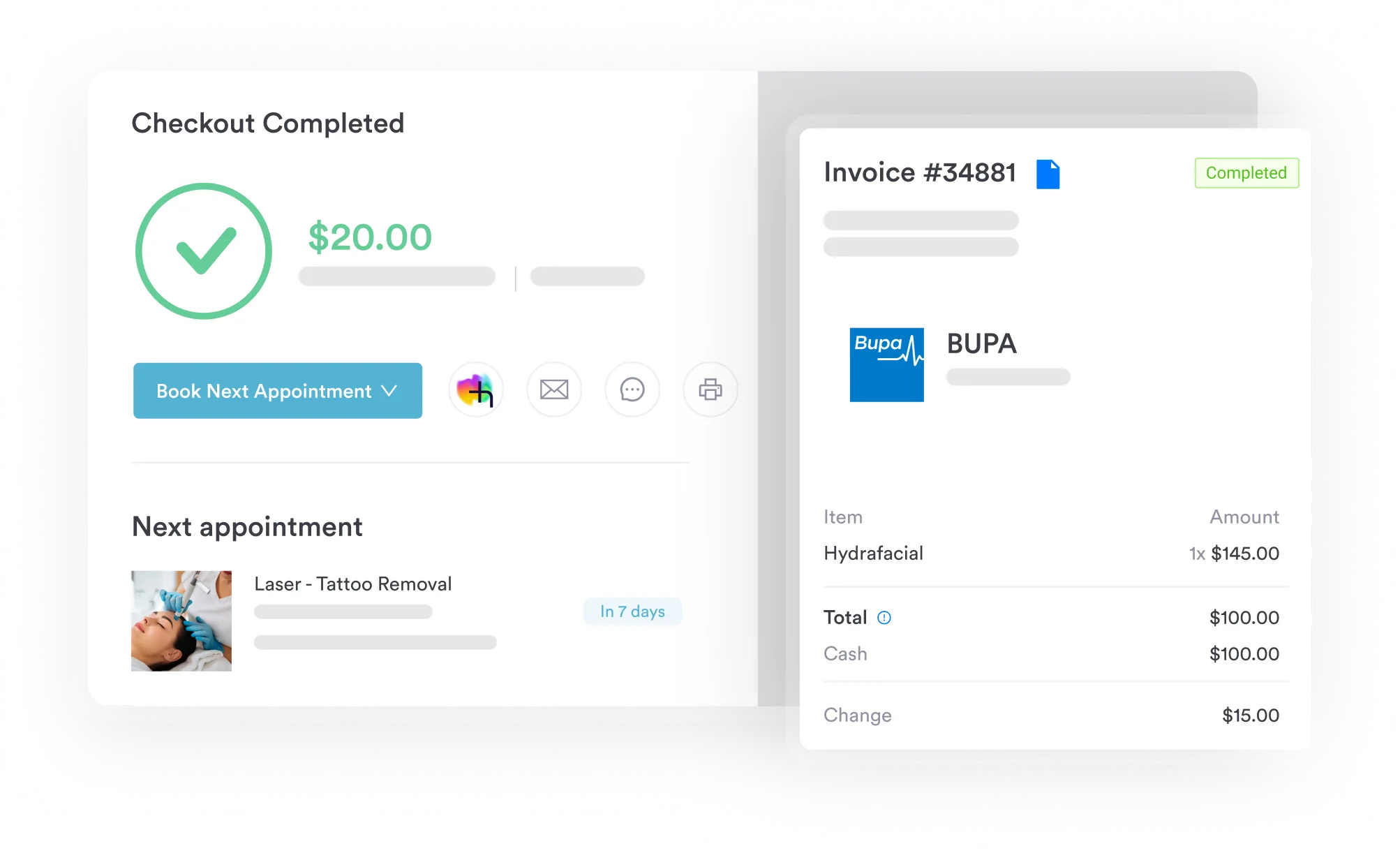
In the US, Pabau connects to Claim.MD. From there, practices submit electronically to thousands of payers, run real-time eligibility checks, track claim status, and post ERA remittances from one dashboard. Nothing is re-keyed at the billing step, so the note, the code, and the claim stay in agreement.
Run a quarterly audit of your 28122 denials. If more than 10% fail on a missing modifier or the wrong bone site, the operative note template is the place to fix it. Add a prompt for anatomical site and excision type at the point of care.

Pabau sends claims to Claim.MD straight from the invoice. The patient, treatment, and insurer details come from the record, and remittances post back to the same dashboard.

Two lines in the operative note decide how a 28122 claim ends. Specifically, name the bone, and name the technique the surgeon used. From there, the modifier, the diagnosis, and the NCCI decision all follow.
The trade-off is that the work happens at the point of care, not in the billing queue. After all, no coder can reconstruct which bone the surgeon worked on weeks later. Book a demo to see how Pabau keeps the note, the code, and the claim on one record.

Need to understand how claim denials are classified? Revenue cycle management explained covers how RCM workflows connect coding accuracy to payment timelines.
Billing multiple surgical codes on the same encounter? Medical billing compliance guidance outlines the documentation and modifier standards that protect against post-payment audits.
Want to verify insurance eligibility before surgery day? Insurance eligibility verification explains how real-time checks reduce day-of-service billing surprises for surgical procedures.
CPT Code 28122 is used for partial excision of a tarsal or metatarsal bone, excluding the talus and the calcaneus. It treats osteomyelitis or bone bossing (exostosis). The code covers craterization, saucerization, sequestrectomy, and diaphysectomy, each a distinct technique for removing bone tissue.
Medicare reimbursement for CPT 28122 varies by place of service and geographic locality. Facility rates are lower than non-facility rates because the practice expense RVU component is reduced when the facility bills separately. Use the CMS Physician Fee Schedule lookup tool to retrieve the 2026 rate for your locality. GPCI adjustments can shift the payment well away from the national average.
LT and RT carry laterality, and most payers expect one of them on every 28122 claim. Modifier 59 or XS unbundles 28122 from a separately identifiable procedure such as CPT 28306. Modifier 22 covers increased complexity, and modifier 51 applies when several procedures are billed on one date. Clinical documentation has to support the choice.
Common pairings include M86.671 and M86.672, chronic osteomyelitis of the right and left ankle and foot. M89.871 covers other specified bone disorders of the right ankle and foot, which fits bone bossing at a non-calcaneal site. The diagnosis has to match the clinical documentation, not the procedure being billed.
Sequestrectomy of a tarsal or metatarsal bone, excluding the talus and the calcaneus, is reported under CPT Code 28122. The descriptor lists sequestrectomy alongside craterization, saucerization, and diaphysectomy. For sequestrectomy of the talus or the calcaneus, use CPT 28120 instead.



