

CCSD code G5100: Bypass of duodenum billing guide
CCSD code G5100 bills a bypass that leaves the duodenum in place CCSD code G5100...

Last Updated: Oct 16, 2026
28810 is the CPT code for amputation, metatarsal, with toe, single. It covers removal of one metatarsal shaft together with the toe it supports, known as a single ray amputation. A transmetatarsal amputation across several rays is coded 28805 instead.
Two documentation problems drive most denials on this code. Operative notes often fail to confirm that the shaft, and not just the metatarsal head, was transected. Claims also arrive without the RT or LT laterality modifier.
Let Pabau's smart automation suggest the right codes, reduce claim denials, and keep your practice compliant—effortlessly.
Automate repetitive tasks and focus on what matters most—your patients.
Reduce coding errors and ensure compliance with the latest regulations.
Clean claims, fewer denials, and faster reimbursements.
Powerful insights and reporting to help your practice thrive.
HIPAA compliant SOC 2 certified GDPR-compliant Trusted by 4,000+ clinics worldwide

CPT 28810 covers amputation of one metatarsal with its attached toe, and the word single rules out a transmetatarsal amputation.
28810 removes the metatarsal shaft, while 28820 disarticulates the toe at the metatarsophalangeal joint and leaves the shaft in place.
Most payers require the RT or LT laterality modifier, and a missing one is the most common denial trigger on this code.
CPT 28122 covers partial excision of a tarsal or metatarsal bone, so its scope is not limited to the metatarsal head.
Practice management software like Pabau tracks modifier requirements and flags incomplete documentation before a claim is submitted.
CPT code 28810 is defined by the American Medical Association (AMA) CPT code set with the descriptor: Amputation, metatarsal, with toe, single. The word “single” is what the code turns on. In practice, it applies when one metatarsal shaft is transected along with the digit it supports. However, it does not apply when several metatarsals come off at the same level, which is a transmetatarsal amputation. It also does not apply when only the metatarsal head is resected and the shaft stays behind.
Clinically, 28810 is most often performed for diabetic foot disease with osteomyelitis or for peripheral vascular disease with gangrenous change. It also applies to non-healing ulcers where conservative wound management has failed. The procedure removes the entire metatarsal shaft together with the toe, so the remaining rays stay intact.
Deep infection does not always end in a ray amputation. Where the operative plan is drainage below the fascia in multiple areas of the foot, the code is CPT 28003.
Code 28810 sits in the Surgery section of CPT, under the Foot and Toes subsection, within the Amputation grouping 28800-28825. As a result, knowing the grouping helps coders move between adjacent codes and avoid picking the wrong level of service.
The operative report is the coder’s primary evidence for 28810. If it does not state that the full metatarsal shaft was resected, payers will therefore downcode to 28820 or deny for medical necessity. The elements to look for are:
When any of these elements is absent or vague, the operative note becomes a liability. For example, a note reading “toe amputation performed with bone resection”, with no mention of the metatarsal shaft, is routinely downcoded. Instead, surgeons should name the anatomical level of bone transection. “The metatarsal shaft was transected at its mid-diaphysis” is clear. By contrast, “The ray was amputated” is not.
The difference between 28810 and 28820 is anatomical, and it comes down to how much bone is removed. CPT 28820 covers amputation of a toe at the metatarsophalangeal (MTP) joint, and the metatarsal shaft stays behind. In contrast, CPT 28810 removes the metatarsal shaft along with the toe.
One scenario comes up repeatedly. For example, the surgeon removes the second toe and resects the metatarsal head to smooth the stump. If the operative note says only “second toe amputation with metatarsal head resection”, a strict reading supports 28820 rather than 28810. To bill 28810, the note must state that the metatarsal shaft proximal to the head was also transected.
Amputation levels continue past the MTP joint. Disarticulation inside the toe, at the interphalangeal joint, is coded CPT 28825.
Coders choosing between 28810 and its neighbors need one fact above all others: how much bone leaves the foot. So, the ladder below sorts the forefoot codes from the most proximal amputation down to a resection that removes no digit at all.
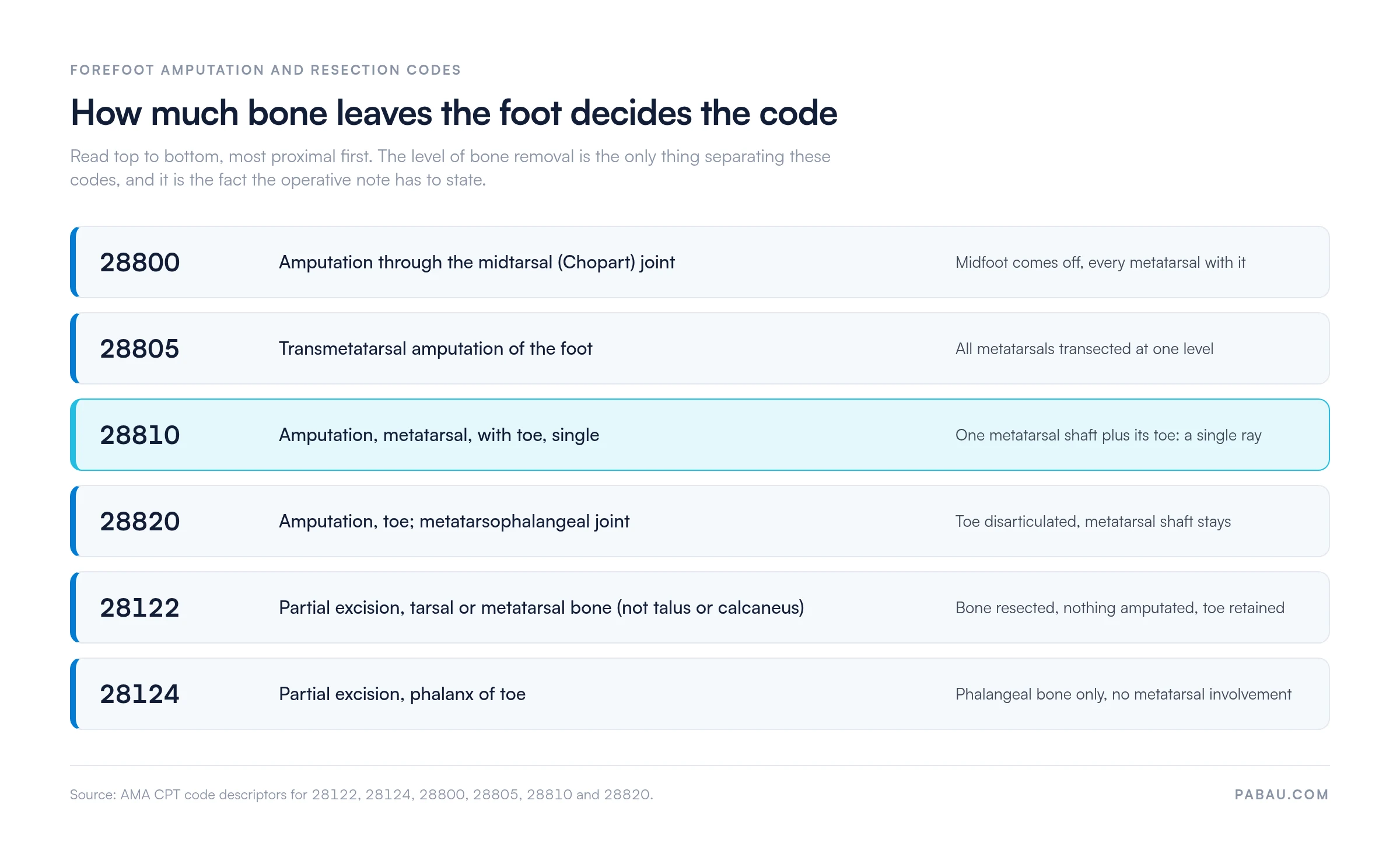
The critical boundary sits between 28122 and 28810. CPT 28122 covers partial excision of a tarsal or metatarsal bone, excluding the talus and calcaneus, with no amputation performed. However, its scope covers the whole bone, not only the metatarsal head. When a surgeon saucerizes part of a metatarsal to relieve a pressure ulcer and leaves the digit attached, 28122 is correct. Once the toe comes off with any portion of the metatarsal shaft, 28810 applies.
Medicare and most commercial payers require a specific ICD-10-CM diagnosis code to establish medical necessity for 28810. So, laterality and complication detail inside that code decide whether the claim is accepted.
Always code to the highest level of specificity. E11.621 on its own, with no laterality-specific wound code from the L97 series, gives payers an opening to deny on vague documentation. In other words, the diagnosis code and the operative report must tell the same story about which foot and which pathology drove the amputation.
Modifier selection for 28810 is straightforward once you know what each modifier signals to the payer. So, missing or misapplied modifiers account for a large share of denials on this code.
RT and LT are not optional. The National Correct Coding Initiative (NCCI) and standard payer policies treat foot procedures as bilateral-capable. As a result, omitting a laterality modifier tells the payer the claim could duplicate an earlier submission. Therefore, append RT or LT to every 28810 claim without exception.
Audit every 28810 claim before it leaves the practice. Confirm the RT or LT modifier is on the line. Check that the ICD-10 laterality matches the operative note. Confirm the claim date matches the surgery date. Those three checks catch most preventable denials on this code.
Medicare pays CPT 28810 under the Medicare Physician Fee Schedule (MPFS), based on its RVU values. The CMS Physician Fee Schedule lookup tool gives the current year’s payment amounts by locality. In addition, for 2026, practices can confirm exact figures with the FastRVU 2026 RVU lookup.
Commercial rates for 28810 vary widely and are not published. Most commercial contracts pay a percentage of Medicare or a fixed fee schedule rate. So, verify contracted rates with each payer rather than assuming Medicare rates apply.
CPT 28810 carries a 90-day global surgical period under the Medicare Physician Fee Schedule. During those 90 days, routine post-operative care is bundled into the original payment. As a result, billing a standard office visit for a wound check inside the global window will be denied as already included.
Three modifiers allow separate billing within the global period when the clinical situation truly warrants it:
A return to the OR is not automatically billable with modifier 78. Instead, the documentation has to establish that the complication is distinct from routine post-op care. Track the global period end date for every 28810 case, because a service billed inside the window without the right modifier will be denied.
Traditional Medicare Part B generally does not require prior authorization for CPT 28810. The code is not on the current CMS prior-authorization model list for outpatient services. However, Medicare Advantage plans and most commercial payers do treat amputation as a pre-authorized procedure, and their requirements vary by plan. So, verify each payer’s rules before surgery is scheduled.
Typical documentation payers request when granting authorization for 28810:
Missing prior authorization is one of the top denial triggers for 28810 claims with commercial payers. When a denial arrives because authorization was never obtained, the appeal needs all of the documentation above. It also needs the clinical reason the procedure could not be safely delayed.
The operative note carries the claim, but an auditor asks for the whole file. Use the list below when you assemble records for a pre-payment review or an appeal, on top of the operative note elements covered earlier.
Vague operative notes remain the most common source of downcoding from 28810 to 28820. For example, a surgeon who dictates only that they “performed a ray amputation” leaves the coder without the one fact the payer checks. So, a structured operative note template built into the EHR is the most reliable prevention.
Denial patterns for 28810 are predictable, and each one has a specific corrective action. Treating them as recurring patterns rather than individual errors is what stops them repeating. A reference guide to denial codes also helps your team read the explanation of benefits faster.
The denial most worth preventing is the code-level mismatch. Once a payer has downcoded to 28820, recovering the difference needs a full appeal with clinical documentation, which typically takes 60 to 90 days. So, pre-submission review of the operative note pays for itself faster than any appeal does. Knowing what makes a clean claim keeps days in accounts receivable down for a surgical practice.
When a payer downcodes 28810 to 28820, appeal with the operative note attached. Quote the sentence naming the level of bone transection in your cover letter. The reviewer reads the cover letter before the chart, so the deciding sentence belongs at the top of it.
Most podiatry practices find a 28810 problem after the remittance arrives. By then the line has been downcoded to 28820 or denied outright, and recovering the money means a written appeal with the operative note attached.
Practice management software like Pabau moves that check earlier. Eligibility runs at booking, so prior-authorization requirements surface before the surgery date rather than after it. As a result, the coded charge, the modifier and the diagnosis sit on the patient record next to the operative note. That way, the billing team is not rebuilding the claim from three separate systems.
Pabau then submits finished claims online through Claim.MD, a clearinghouse that reaches thousands of US payers, and tracks each one through to its remittance. Expected and received payments are compared, so an underpaid 28810 line surfaces in the week it is paid. A podiatry practice gets that from smarter claims management rather than from a quarterly review.
The coder still decides the code and the modifier. Instead, what the software removes is the part where a correct decision never reaches the payer intact.


Pabau’s claims management tools verify eligibility, hold the coded charge next to the operative note, and track every claim to its remittance. Fewer 28810 lines reach the denial queue.

CPT 28810 has a narrow scope. It covers one metatarsal shaft removed with the toe it supports. The code still generates a large share of denials, because operative notes rarely name the level of bone transection and laterality modifiers go missing.
The corrective actions are not complicated. Confirm metatarsal shaft transection in the operative note and append RT or LT to every claim. Match the ICD-10 laterality exactly, and check prior authorization before the procedure date. A practice that runs those four checks before submission stops arguing about 28810 afterwards.
The trade-off worth remembering is time. A pre-submission review costs minutes. By contrast, an appeal against a downcode costs 60 to 90 days of cash flow. Book a demo to see how Pabau carries a podiatry claim from the operative note through to the remittance.

Coding an MTP disarticulation instead? In that case, CPT 28820 is the code to use. It covers the joint-level amputation where the metatarsal shaft stays in place, so payers reach for it whenever the note doesn’t say the shaft was removed.
No toe removed at all? Then CPT 28122 fits better. It is the partial excision code for a tarsal or metatarsal bone, used when the toe stays attached.
Need the steps for getting prior authorization from a Medicare Advantage or commercial payer? The prior authorization process covers it all: first each step, then the CMS time limits, and finally how to appeal a denial.
CPT code 28810 covers amputation of a single metatarsal with its attached toe. The full metatarsal shaft must be transected, not only the metatarsal head or the toe at the joint. It is used when one ray is removed for osteomyelitis, vascular disease, or diabetic foot complications.
CPT 28810 removes the metatarsal shaft along with the toe. By contrast, CPT 28820 disarticulates at the metatarsophalangeal joint and leaves the metatarsal shaft in place. If the operative note does not confirm shaft transection, payers will apply 28820 rather than 28810.
RT or LT is required by most payers and must always be appended. Modifier 51 applies when 28810 is performed with another procedure in the same session. In addition, modifier 22 covers much greater complexity. Modifiers 24, 78, and 79 apply to services inside the 90-day global period.
CPT 28810 carries a 90-day global period. Routine post-operative visits are bundled into the procedure payment during this window. So, separate billing needs a modifier. Use 24 for an unrelated office visit, 79 for an unrelated procedure, and 78 for a related return to the OR.
Traditional Medicare Part B generally does not require prior authorization for CPT 28810, but Medicare Advantage plans and most commercial payers do. So, verify authorization requirements with each individual payer before scheduling the procedure.
No. Transmetatarsal amputation (TMA), which removes all or most metatarsals at the same level, is coded with CPT 28805. Instead, CPT 28810 only covers a single metatarsal with its attached toe. The word “single” in the descriptor is the qualifier that rules TMA out.



