HCPCS Code L0472: Hyperextension TLSO billing guide
HCPCS code L0472: Official descriptor and device definition HCPCS code L0472 des...

Last Updated: Nov 5, 2026
28113 is the CPT code for ostectomy, complete excision; fifth metatarsal head. It covers removing the whole head of the fifth metatarsal, the bone just behind the little toe, and is reported once per foot.
Surgeons use it for a severe bunionette, an intractable plantar keratosis under the fifth head, or arthritis or infection of the fifth metatarsophalangeal joint. Partial removal of the bunionette prominence reports as 28110. Medicare assigns a 90-day global period.
Let Pabau's smart automation suggest the right codes, reduce claim denials, and keep your practice compliant—effortlessly.
Automate repetitive tasks and focus on what matters most—your patients.
Reduce coding errors and ensure compliance with the latest regulations.
Clean claims, fewer denials, and faster reimbursements.
Powerful insights and reporting to help your practice thrive.
HIPAA compliant SOC 2 certified GDPR-compliant Trusted by 4,000+ clinics worldwide

CPT 28113 reports complete excision of the fifth metatarsal head, the bone just behind the little toe.
Report it once per foot, because each foot has one fifth metatarsal and the Medicare MUE is one unit per date of service.
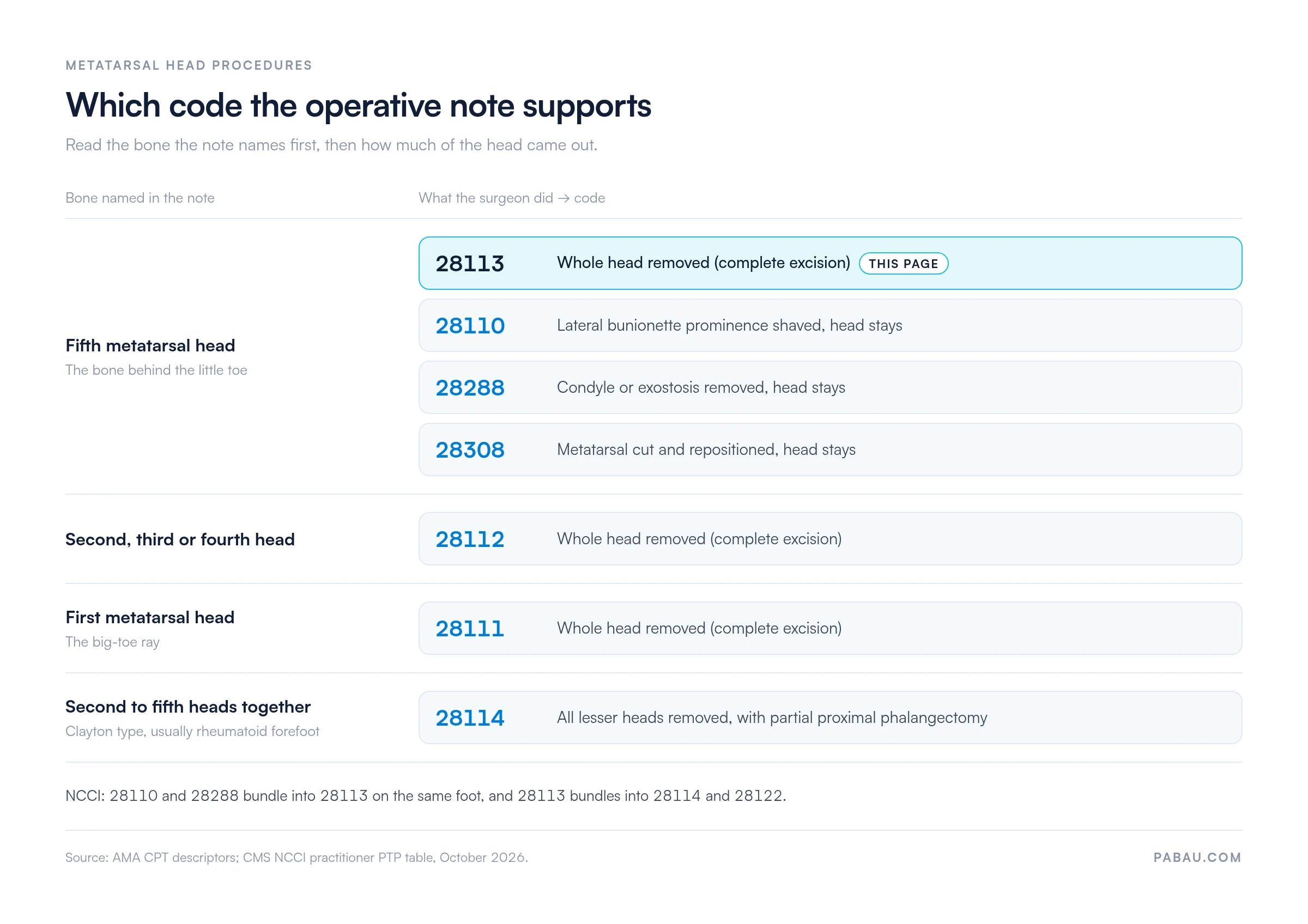
The first to fourth metatarsal heads have their own codes, 28111 and 28112, and a partial bunionette excision reports as 28110.
The CY2026 work RVU is 5.96 and the global period is 90 days, so routine post-op visits are not billed separately.
NCCI bundles 28110 and 28288 into 28113 on the same foot, while 28113 itself bundles into 28114 and 28122.
CPT code 28113 is the code for ostectomy, complete excision; fifth metatarsal head, as published in the American Medical Association’s CPT code set. The surgeon removes the whole head of the fifth metatarsal, leaving the shaft behind it. The code applies to the fifth metatarsal only, and it is reported once per foot.
The word “complete” is what separates 28113 from CPT 28110, which removes only the bunionette prominence on the outer side of the head. The other metatarsal heads have their own codes. The first head reports as 28111, and the second, third or fourth head reports as 28112.
Surgeons remove the whole fifth metatarsal head when a smaller procedure would not relieve the pain or clear the disease. These are the indications most often documented with 28113:
The code does not include a tendon transfer, an implant or work on another ray. Each of those carries its own code, subject to the NCCI edits below.
A coder who knows the surgical steps can match the operative note to the descriptor more reliably. A fifth metatarsal head ostectomy usually follows this sequence:
What auditors look for: The report must name the fifth metatarsal and confirm that the whole head was removed. A note that describes shaving the lateral eminence supports 28110, not 28113. A bone cut that repositions the metatarsal and keeps the head is an osteotomy, which reports as 28308.
The 281xx and 282xx foot codes split by which bone is treated and how much of it is removed. The NCCI column below comes from the Medicare practitioner procedure-to-procedure (PTP) table effective October 1, 2026.
Report 28113 once per foot. Each foot has a single fifth metatarsal, so the code is never multiplied by the number of heads removed. The Medicare MUE for 28113 is 1 unit per date of service, with a policy-based adjudication indicator.
When both fifth metatarsal heads come out in one session, Medicare expects one line with modifier 50 and 1 unit. The CY2026 bilateral surgery indicator is 1, so the bilateral line pays 150% of the single-side amount. Some commercial payers want two lines with RT and LT instead, so check each payer’s rules.
If another procedure is done in the same session, multiple procedure indicator 2 applies. The highest-valued procedure pays in full and each additional one pays at 50%. An assistant at surgery is payable only when documentation shows medical necessity.
The CMS National Correct Coding Initiative (NCCI) PTP table lists code pairs. The column 2 code in each pair is not paid separately when billed with the column 1 code on the same day. These pairs involving 28113 appear in the October 2026 practitioner table:
Each of these pairs carries modifier indicator 1. A modifier such as XS or 59 bypasses the edit only when the second procedure was on a separate structure. The other foot is the usual example. Never use one to unbundle work on the same metatarsal.
NCCI tables change every quarter, so confirm a pair in the current file before you appeal a bundling denial.
Payers check medical necessity by matching the procedure to a supporting diagnosis. These ICD-10-CM codes fit the usual indications for fifth metatarsal head excision:
Confirm every code against the current fiscal-year ICD-10-CM release. FY 2027 codes took effect on October 1, 2026.
The figures below come from the CMS CY2026 Physician Fee Schedule RVU file (October 2026 release). They are national and unadjusted. Your local rate also depends on the Geographic Practice Cost Index, so check it in the CMS Physician Fee Schedule Look-Up Tool.
CY2026 has two conversion factors. Clinicians who qualify for the Advanced APM incentive (QP) use $33.5675, and everyone else uses $33.4009. Commercial rates are set by each contract, so compare them against your own fee schedule.
The global package covers the day before surgery, the operative day and 90 post-operative days. CMS splits the payment into 10% pre-operative, 69% intra-operative and 21% post-operative care. Routine wound checks, suture removal and standard follow-up visits in that window are not billed separately.
These services can be billed during the global period with the right modifier:
Prior authorization rules for fifth metatarsal head excision vary by payer and plan year. Check each payer’s provider portal before you schedule the case. These patterns hold broadly:
On audit, a 28113 claim stands or falls on the operative report and the pre-operative chart. Together they should cover these points:
Strong medical billing compliance means the whole record, from the first visit to the post-op notes, supports the decision to operate.
Before you submit a 28113 claim, check three points. The note names the fifth metatarsal head, the word complete describes the excision, and the claim carries one unit per foot. Each one matches a denial reason in the table below.
Claims for CPT code 28113 fail for a predictable set of reasons. Understanding the denial codes in medical billing you receive helps you fix each one quickly.
A clean claim on the first pass is the fastest route to payment for foot surgery codes.
Foot surgery billing often runs across several tools. The operative note sits in one system, the claim is keyed into another and remittances arrive by mail or a separate portal. Each handoff is a chance to send the wrong units or lose track of a denial.
Pabau, the practice management and EHR platform we build, keeps the consultation notes, consent forms and operative records in the patient file. Your billing team enters the codes and modifiers, then sends the claim through the Claim.MD clearinghouse. Pabau’s claims management software then tracks each claim’s status.
Electronic remittance advice (835 files) comes back into Pabau, so payments and denials post against the claim they belong to. Your team can see which 28113 claims are paid, pending or denied without chasing paper.

Pabau sends claims through Claim.MD, tracks their status and posts 835 remittances against them. Your team spends less time chasing 28113 payments and denials.

CPT 28113 is a narrow code, and that narrowness protects the claim. It covers the whole fifth metatarsal head, on one foot, once. When the note names the fifth metatarsal and describes a complete excision, the code choice is settled.
Two habits cause the avoidable denials. One is billing 28113 per head instead of per foot, and the other is adding a bundled partial excision on the same foot. Drop both, and use modifiers 24, 58, 78 or 79 for work inside the 90-day window. Book a demo to see how Pabau tracks foot surgery claims from submission to remittance.

Need to contest a downcoded or bundled claim? Medical appeal form template gives you a structured form for disputing a denied claim.
Want to understand how 835 remittance files work? Electronic remittance advice explained covers the 835 transaction set and how to match payments to claims.
Looking for a structured approach to reducing write-offs? Revenue cycle management fundamentals walks through the billing workflow from eligibility check to payment posting.
CPT code 28113 covers ostectomy with complete excision of the fifth metatarsal head, reported once per foot. Partial removal of the bunionette prominence reports as 28110. The first metatarsal head reports as 28111, and the second to fourth heads report as 28112.
Bill one unit per foot. Each foot has only one fifth metatarsal, and the Medicare MUE for 28113 is 1 unit per date of service. For both feet, Medicare expects one line with modifier 50, which pays 150% of the single-side amount.
For CY2026 the national facility payment is $408.52 with the QP conversion factor and $406.49 without it. The non-facility amounts are $587.43 and $584.52. Your local rate differs by GPCI, so check the CMS Physician Fee Schedule Look-Up Tool.
CPT 28113 has a 90-day global period. It covers the day before surgery, the operative day and 90 days of routine post-operative care. An unrelated E/M visit in that window uses modifier 24, and an unrelated procedure uses modifier 79.
CPT 28113 removes the fifth metatarsal head, while 28285 corrects a hammertoe through interphalangeal fusion or partial or total phalangectomy. The October 2026 NCCI practitioner table lists no PTP edit between the two codes. Document each procedure with its own indication.
In the CY2026 CMS RVU file, 28113 carries a work RVU of 5.96 and a malpractice RVU of 0.60. Practice expense is 5.61 RVUs in a facility and 10.94 outside one. That gives totals of 12.17 facility and 17.50 non-facility.