

HCPCS Code L0472: Hyperextension TLSO billing guide
HCPCS code L0472: Official descriptor and device definition HCPCS code L0472 des...

Last Updated: Nov 5, 2026
26750 is the CPT code for closed treatment of a distal phalangeal fracture, finger or thumb, without manipulation, each. It covers a fingertip fracture that's splinted or taped but never reduced, and you bill it once per injured digit.
The code carries a 90-day global period, so routine follow-up visits are already paid for. That's where claims slip. The same-day visit that decides on fracture care takes modifier 57, not 25. Each finger needs its own digit modifier, and the first splint is bundled. The sections below walk a 26750 claim from the exam room to a clean submission.
Let Pabau's smart automation suggest the right codes, reduce claim denials, and keep your practice compliant—effortlessly.
Automate repetitive tasks and focus on what matters most—your patients.
Reduce coding errors and ensure compliance with the latest regulations.
Clean claims, fewer denials, and faster reimbursements.
Powerful insights and reporting to help your practice thrive.
HIPAA compliant SOC 2 certified GDPR-compliant Trusted by 4,000+ clinics worldwide

CPT code 26750 covers closed treatment of a distal phalanx fracture in a finger or thumb when no reduction is performed.
Each fractured digit gets its own claim line and digit modifier, such as F6 for the right index finger.
The first finger splint, coded 29130 or 29131, is bundled into the 90-day global package for 26750.
A same-day visit that leads to the fracture-care decision takes modifier 57, while modifier 25 is for an unrelated problem.
Pabau’s claims management software pre-fills the claim from the patient record and checks required fields before it goes out.
CPT code 26750 reports closed treatment of a distal phalanx fracture, finger or thumb, without manipulation, each.
The American Medical Association publishes the full descriptor as “Closed treatment of distal phalangeal fracture, finger or thumb; without manipulation, each.” It sits in the Surgery section, under Hand and Fingers, in the 26720-26765 finger fracture family.
Two phrases decide whether it fits. “Closed treatment” means no incision, so the skin over the fracture stays intact. “Without manipulation” means nobody reduced the fracture. The last word, “each,” lets you bill 26750 once per fractured digit at the same encounter.
The distal phalanx is the bone at the tip of each finger and the thumb. Breaks here are often called fingertip or terminal phalanx fractures. Crush injuries, a finger caught in a door, and ball sports cause most of them. A tuft fracture, where the very tip breaks into pieces, is the typical injury billed with CPT code 26750.
Clinically, the work is short. The provider confirms the fracture on X-ray, decides it doesn’t need reducing, and protects it. There’s no incision, and no one repositions the bone. A typical encounter runs in five steps:
“Without manipulation” is the phrase that makes or breaks the claim. If the provider tries to reduce the fracture, even partly, 26750 no longer applies. A closed reduction is 26755, which is closed treatment with manipulation. Pinning through the skin is 26756, and open treatment of a distal phalanx fracture is 26765.
The finger fracture codes split by bone and by what the provider did to it. Auditors flag the wrong pick often, because the note has to show whether anyone attempted a reduction. Here’s how 26750 compares with its neighbors:
The fastest way to choose is to read what the note says happened to the bone, as the chart below shows.
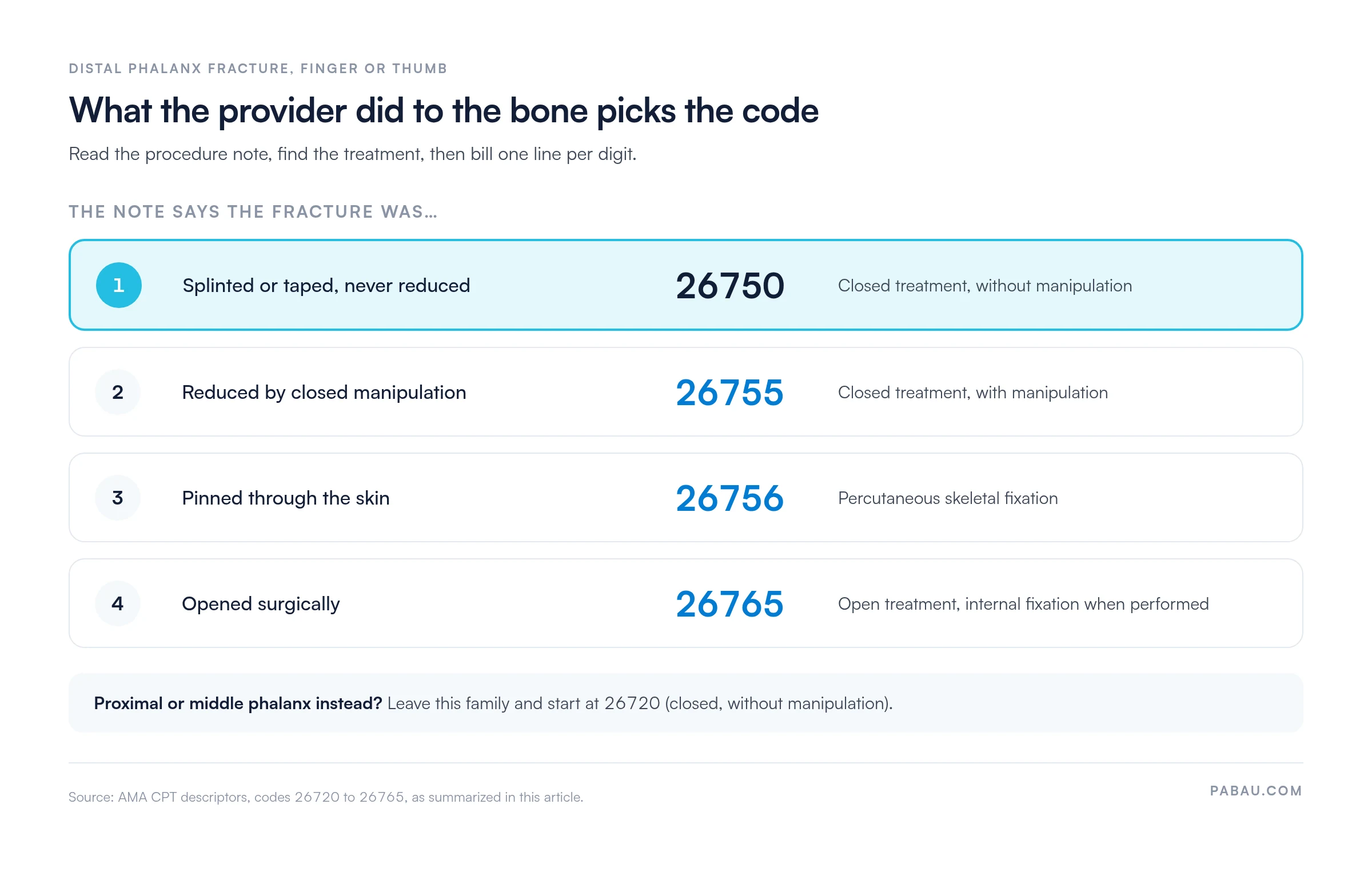
The 26750 vs. 26755 call: A note that reads “nondisplaced, splinted” with no mention of reduction supports 26750. A note that reads “reduced under digital block” or “fracture repositioned” needs 26755. If the break is in the middle or proximal phalanx instead, start at 26720.
Knowing the global package keeps you clear of unbundling denials. The table shows what’s included under most payer policies and what can go on its own line. Commercial contracts can differ from Medicare’s bundling rules, so check yours.
With 26750, modifiers carry as much weight as the code itself. Four come up again and again, and each answers a different question for the payer.
A patient shuts a car door on their right hand. X-rays show nondisplaced tuft fractures of the index and middle fingers. The provider evaluates them, decides on splinting and splints both. The claim looks like this:
Bill one line per digit and don’t stack units on a single 26750 line. Add modifier 51 to the second and later lines only if the payer’s multiple-procedure policy asks for it.
CPT code 26750 carries a 090, or 90-day, global period on the Medicare Physician Fee Schedule. You can confirm the indicator each year in the CMS Physician Fee Schedule lookup tool. During those 90 days, these services are part of the package and can’t be billed separately without a modifier:
Run an insurance eligibility verification before each follow-up as well. A plan that changes mid-global period shifts who pays for the next service.
When care transfers mid-global period, the two providers split 26750. The provider who treats the fracture but won’t follow it adds modifier 54, Surgical Care Only.
The provider who takes over adds modifier 55, Postoperative Management Only. Both should document the transfer and its date. This happens most when urgent care hands the patient to an orthopedist.
Every 26750 line needs a supporting diagnosis from the ICD-10-CM code set. For fingers, use S62.66- for a nondisplaced distal phalanx fracture or S62.63- for a displaced one. For the thumb, use S62.52-. Each code needs the digit, the side and a 7th character for the encounter.
A common denial trigger: keeping the “A” character on follow-ups after active treatment ends. Once the patient is in routine healing, switch to “D.” Billing “A” past that point can prompt a medical necessity review.
Medicare prices CPT code 26750 with relative value units (RVUs) under the resource-based relative value scale.
Work, practice expense and malpractice RVUs are each adjusted by the geographic practice cost index for your locality. The total is then multiplied by the annual conversion factor. You can look up the current values in the FastRVU 2026 RVU lookup tool.
Rates change with every annual fee schedule final rule. So never quote a dollar figure for 26750 without its calendar year and locality. Commercial allowables are negotiated separately and often differ from Medicare.
Thin documentation is the most preventable cause of 26750 denials and recoupments. The note has to justify conservative care and show that no one manipulated the fracture. Auditors look for these six elements:
Contradictions are what auditors catch first. If the note mentions a reduction attempt but the claim says 26750, expect a denial and possibly a recoupment.
Once the documentation is solid, denials on 26750 come down to a short list of avoidable errors. A denial management workflow catches most of them before submission.
A pre-submission edit check, built into your clean claim process, stops missing modifiers and vague diagnoses before the payer sees them.
Set a scrubber rule in your billing system or clearinghouse that holds any 26750 line without an FA-F9 digit modifier. It’s a one-time setup that stops the most common rejection for this code.
The finger splint codes are 29130 for a static splint and 29131 for a dynamic one. Whether either can go on a claim with 26750 depends on timing and the payer.
The AAPC Codify CPT lookup shows the NCCI code pairs that bundle. Check your payer’s own policy before adding a splint line to 26750, since commercial payers may not follow CMS.
With the rules in place, the last step is a quick check before the claim leaves the practice. Run these six questions on every 26750 claim:
Many orthopedic and urgent care teams still retype each fracture visit into a clearinghouse portal. Every retyped field is another chance to drop a digit modifier or a 7th character.
Pabau, the practice management platform we build, fills the claim from the patient record instead. The CPT code on the service lands on the charge line, and the ICD-10 slots draw from the recorded diagnoses. Our claims management software won’t send a claim until its required fields are complete.
In the US, claims go out through Claim.MD with real-time eligibility checks. Payments come back as electronic remittances and post to the claim. So you can see which 26750 lines were paid, and which need a second look.

Pabau pre-fills CPT code 26750 claims from the patient record and checks required fields before submission. Claims go through Claim.MD with real-time eligibility checks and automatic remittance posting.

Treat 26750 as a documentation code first. When the note names the digit and says the fracture was splinted and never reduced, the coding follows.
The money is usually lost after the visit. A follow-up billed inside the 90 days, a 25 where a 57 belonged, or a first splint on its own line will each come back. Build those three checks into your routine, and these claims stop bouncing.
Book a demo to see how Pabau sends a 26750 claim from the patient record, with the eligibility check already done.

Need to verify claim submission workflows? Claim.MD clearinghouse overview explains how electronic claim routing and payer enrollment work through Pabau’s clearinghouse partner.
Seeing a pattern of denials on fracture care codes? Denial codes in medical billing covers the most common CARC and RARC codes and what each means for your appeal strategy.
Want to understand how ERAs map back to submitted claims? Electronic remittance advice (ERA) breaks down 835 file structure and how to reconcile remittances against 26750 and other fracture care claims.
Pinning a proximal or middle phalanx shaft fracture? CPT code 26727 covers percutaneous fixation of an unstable shaft fracture higher up the finger.
Yes. 26750 sits in the CPT Surgery section, and fracture care counts as a surgical package even without an incision. That’s why it carries a 90-day global period. It’s also why routine splint checks aren’t billed separately.
Yes. The descriptor reads “finger or thumb,” so an unreduced fracture of the thumb’s distal phalanx also codes to 26750. Pair it with an S62.52- diagnosis and modifier FA for the left thumb or F5 for the right.
Yes, with a split. The urgent care provider bills 26750 with modifier 54 for the surgical care only. The orthopedist bills 26750 with modifier 55 for postoperative management. Both notes should record the date care changed hands.
Manipulation. 26750 means the fracture was splinted without any reduction. 26755 means the provider reduced a displaced fracture by closed manipulation. If the note mentions a reduction attempt, even a partial one, 26750 no longer fits.
Once per fractured digit. The descriptor ends in “each,” so three injured fingertips mean three lines, each with its own digit modifier. Don’t stack units on a single line.



