CCSD code XR320: Nasolacrimal duct stenting billing guide
CCSD code XR320 is the UK private insurance code for dilatation or stenting of t...

Last Updated: Nov 24, 2026
26756 is the CPT code for percutaneous skeletal fixation of a distal phalangeal fracture, finger or thumb, reported once per digit. The surgeon stabilizes the fingertip bone with a pin or K-wire placed through the skin, without opening the fracture site.
The code turns on technique. An opened fracture site moves the claim to 26765, and a closed reduction with no hardware belongs under 26755. Payers commonly expect a digit modifier on each line, matched to the side in the ICD-10-CM code.
Let Pabau's smart automation suggest the right codes, reduce claim denials, and keep your practice compliant—effortlessly.
Automate repetitive tasks and focus on what matters most—your patients.
Reduce coding errors and ensure compliance with the latest regulations.
Clean claims, fewer denials, and faster reimbursements.
Powerful insights and reporting to help your practice thrive.
HIPAA compliant SOC 2 certified GDPR-compliant Trusted by 4,000+ clinics worldwide

CPT code 26756 covers percutaneous pin or wire fixation of a distal phalanx fracture of a finger or thumb, reported once per digit.
Closed treatment belongs under 26750 (without manipulation) or 26755 (with manipulation), and an opened fracture site moves the claim to 26765.
The operative note must name the percutaneous technique, the hardware, fluoroscopy, and the exact digit and side.
Payers commonly expect an F-series digit modifier on each line, so check payer policy and match the modifier to the ICD-10-CM side.
Pabau, a practice management platform, connects to Claim.MD so US practices can run eligibility checks and send CMS-1500 claims electronically.
CPT code 26756 reports percutaneous skeletal fixation of a distal phalangeal fracture in a finger or thumb, once per digit. AAPC’s lay description spells out the technique: the provider stabilizes the fracture with pins, wires or screws placed through the skin. No incision is made at the fracture site.
“Each” in the descriptor means one line per digit. Pin two fingers in one session and you report 26756 twice, with a different digit modifier on each line. The American Medical Association owns the CPT code set, so its descriptor wording is the one to match in the note.
The surgeon lines up the fracture fragments, then drives a Kirschner wire (K-wire) or pin through the skin and across the break. You don’t need to know how to do it. You do need to see each step in the operative note before you assign 26756.
An incision at the fracture site for direct visualization makes it open treatment, coded 26765. If no hardware went in at all, closed treatment code 26750 (without manipulation) or 26755 (with manipulation) applies. What the surgeon did decides the code, not how bad the fracture looked on the X-ray.
Four codes cover treatment of a distal phalanx fracture, and they differ only in technique. Billing 26750 when a wire was placed is a downcoding error. Billing 26756 when the surgeon opened the fracture is an upcoding error.
Read the operative note with three questions, in the order shown below. The first yes picks the code.
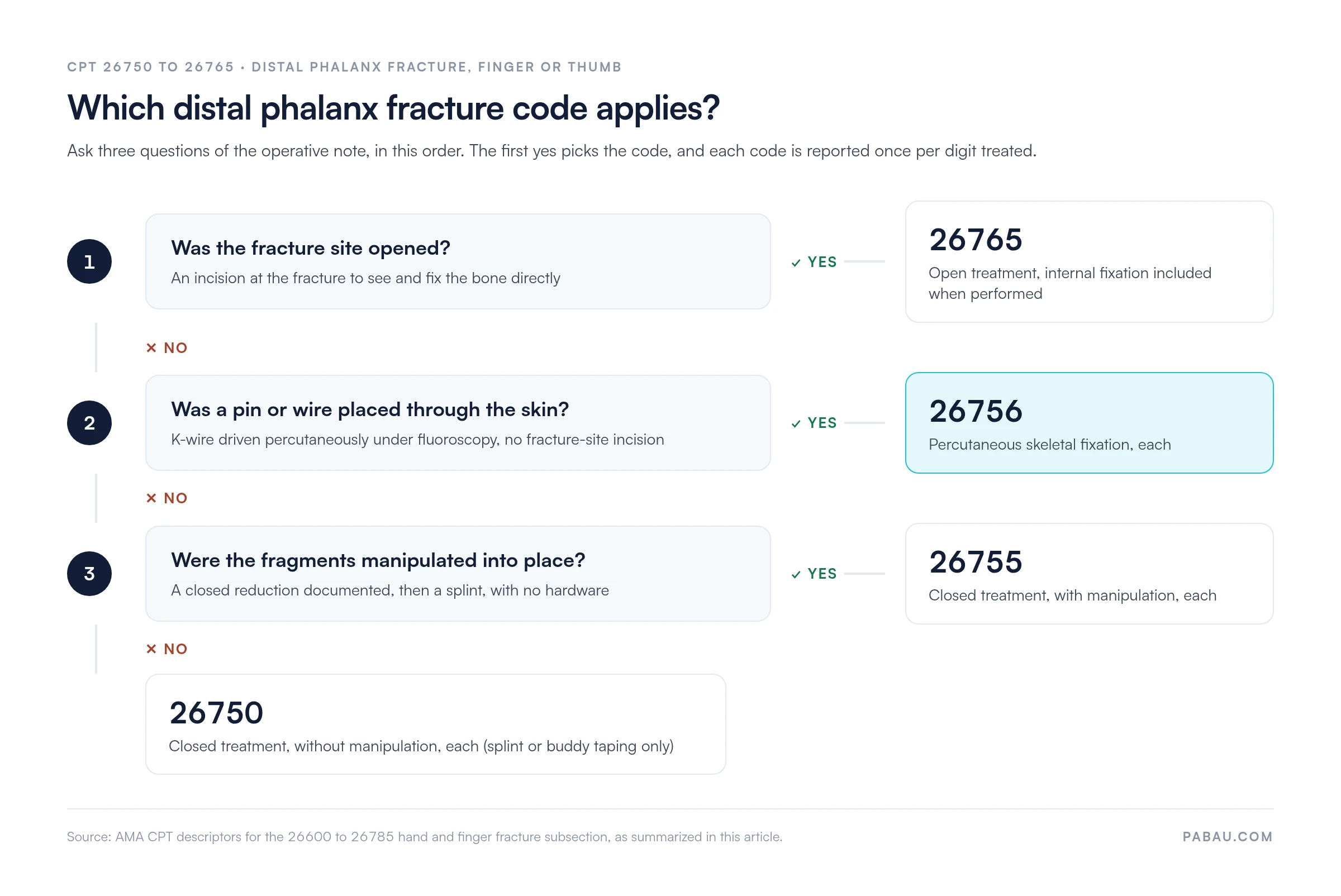
No incision at the fracture, but hardware through the skin, points to 26756. A reduction with no hardware is 26755, and a splint alone is 26750. Direct bone exposure at the fracture points to 26765.
A few codes often appear next to 26756, or get confused with it. Each is separately billable only under specific conditions, and NCCI bundling rules govern the rest.
Fluoroscopy is the usual trap. A separate line for 76000 or 77002 often denies automatically unless an NCCI edit allows it. A crushed fingertip with a torn nail bed is different, because 11760 treats a separate injury. The AAPC code lookup tool shows current bundling and edit details for each code.
Run an NCCI edit check before you bill fluoroscopy guidance alongside 26756. Payers routinely bundle imaging guidance into percutaneous fixation codes, so a separate line without an edit exception usually comes back denied.
Every 26756 line needs an ICD-10-CM fracture code that supports it. Distal phalangeal fractures of the thumb are S62.52-. For the other fingers, use S62.63- (displaced) or S62.66- (nondisplaced). The sixth character carries the side and the finger, so a code with an “x” in that slot is invalid.
Displaced fractures are the ones usually pinned, but a nondisplaced code is correct when the note says so. Middle, ring and little fingers follow the same pattern, with sixth characters 2 to 7.
The seventh character tracks the encounter. Use “A” for the initial operative encounter of a closed fracture, and “B” if the fracture was open. Follow-up visits take “D” for routine healing, “G” for delayed healing, “K” for nonunion, as in S62.630K, and “P” for malunion.
The operative note is the most audited document behind a 26756 claim. Each item below ties to a denial or audit finding when it’s missing or vague.
Three modifier groups come up with 26756: digit identification, bilateral reporting and distinct services. The F-series digit modifiers are HCPCS modifiers that CMS describes for hand and finger procedures. Payers commonly expect or require them, so verify each payer’s policy.
Meeting medical billing compliance rules here means one side, three times over. The digit modifier, the operative note and the ICD-10-CM code must all name the same finger. Modifier F1 (left index) paired with a right index finger code rejects at the edit level.
Medicare pays 26756 from the relative value units (RVUs) set in the CMS Physician Fee Schedule. Dollar amounts vary by locality and change with each final rule. The figures below reflect 2026 national values, so check the current PFS before quoting them.
The 90-day global bundles routine post-op visits, wire removal and splint checks into the 26756 payment. A visit within that window for an unrelated problem needs modifier 24 and notes showing it wasn’t about the fracture.
Medicare generally doesn’t require prior authorization for 26756, but confirm it against the current CMS prior authorization lists. Other payers are a different story.
Most payers won’t approve authorization retroactively once the procedure is done. Build an auth check into scheduling for every elective hand fixation case.
Here’s how a typical case moves through billing. A patient catches their left hand in a car door and fractures two fingertips. The surgeon pins the distal phalanx of the left index and left middle fingers under fluoroscopy in one session.
If the note had said “left hand fingers” without naming them, neither line could carry the right modifier. That’s why the digit and side check comes before code selection, not after.
Most 26756 denials are preventable. These are the patterns that come back again and again.
A solid denial management process catches most of these before submission. For 26756, a short check on documentation, modifier and diagnosis pairing saves a round of denial, appeal and resubmission.
When a 26756 claim does come back, the remittance code tells you which of these errors to fix. Our guide to common denial codes explains the CARC codes you’re most likely to see.
Hand surgery billing often runs across a scheduling tool, a billing spreadsheet and a payer portal. Authorizations get lost between them, and claims wait on paper forms.
Pabau’s medical billing software keeps those steps in one place. US practices connect their own Claim.MD account to check eligibility and submit CMS-1500 claims electronically to thousands of US payers. Remittances and secondary claims come back through the same connection.
Prior authorization sits on the patient’s case too. The auth code, dates and sessions are tracked there, and Pabau warns your team when one is missing. So a pinned fingertip doesn’t go to surgery without the approval it needs.

Pabau tracks prior authorization on each case and sends CMS-1500 claims through its Claim.MD integration. Your team checks eligibility and follows remittances without switching systems.

26756 rewards coders who read the note before they pick a code. Settle the technique first, then the finger, then the side. The modifier and diagnosis follow from those three answers.
If your team changes one habit, make it the incision question. It separates 26756 from 26765 and 26750 faster than any other check. Then match each payer’s modifier rules, because they still differ from plan to plan.
Want authorizations, eligibility and claims for hand surgery in one system? Book a demo to see how Pabau sends 26756 claims through Claim.MD with the auth already on file.

Need to understand how claims reach payers? Medical claims clearinghouse guide explains how EDI transactions route from practice to payer and where edit failures occur.
Want to reduce claim rejections across your practice? Revenue cycle management overview covers the claim lifecycle from eligibility through payment posting.
Got a 26756 claim back with a remittance code? Denial codes in medical billing decodes the CARC and RARC codes that appear when hand surgery claims are rejected.
Fracture treated with a splint and no hardware? CPT code 26750 covers closed treatment of a distal phalanx fracture without manipulation.
Usually not. Pulling percutaneous pins during the 90-day global is part of the 26756 payment. A planned return to the operating room may be billable with modifier 58 or 78, depending on why it happened.
If the distal phalanx fracture itself is pinned through the skin, 26756 fits. A mallet injury of the extensor tendon without a fracture fragment falls under 26432 instead. Check the imaging report before choosing.
Use 26727, percutaneous skeletal fixation of an unstable phalangeal shaft fracture of the proximal or middle phalanx. 26756 is limited to the distal phalanx, the bone at the fingertip.
Only when that visit led to the decision for surgery. Append modifier 57 to the E/M code. A routine pre-op visit on the day before or the day of surgery is part of the global payment.
Yes, when the fracture is pinned percutaneously and stays within the distal phalanx. An open repair of the joint surface moves the claim to 26765, so the note must state the approach.