HCPCS Code J1110: Dihydroergotamine mesylate injection billing guide
HCPCS Code J1110: Official descriptor and drug overview HCPCS Code J1110 is the ...

Last Updated: Oct 29, 2026
26116 is the CPT code for excision, tumor, soft tissue, or vascular malformation, of hand or finger, subfascial (eg, intramuscular); less than 1.5 cm.
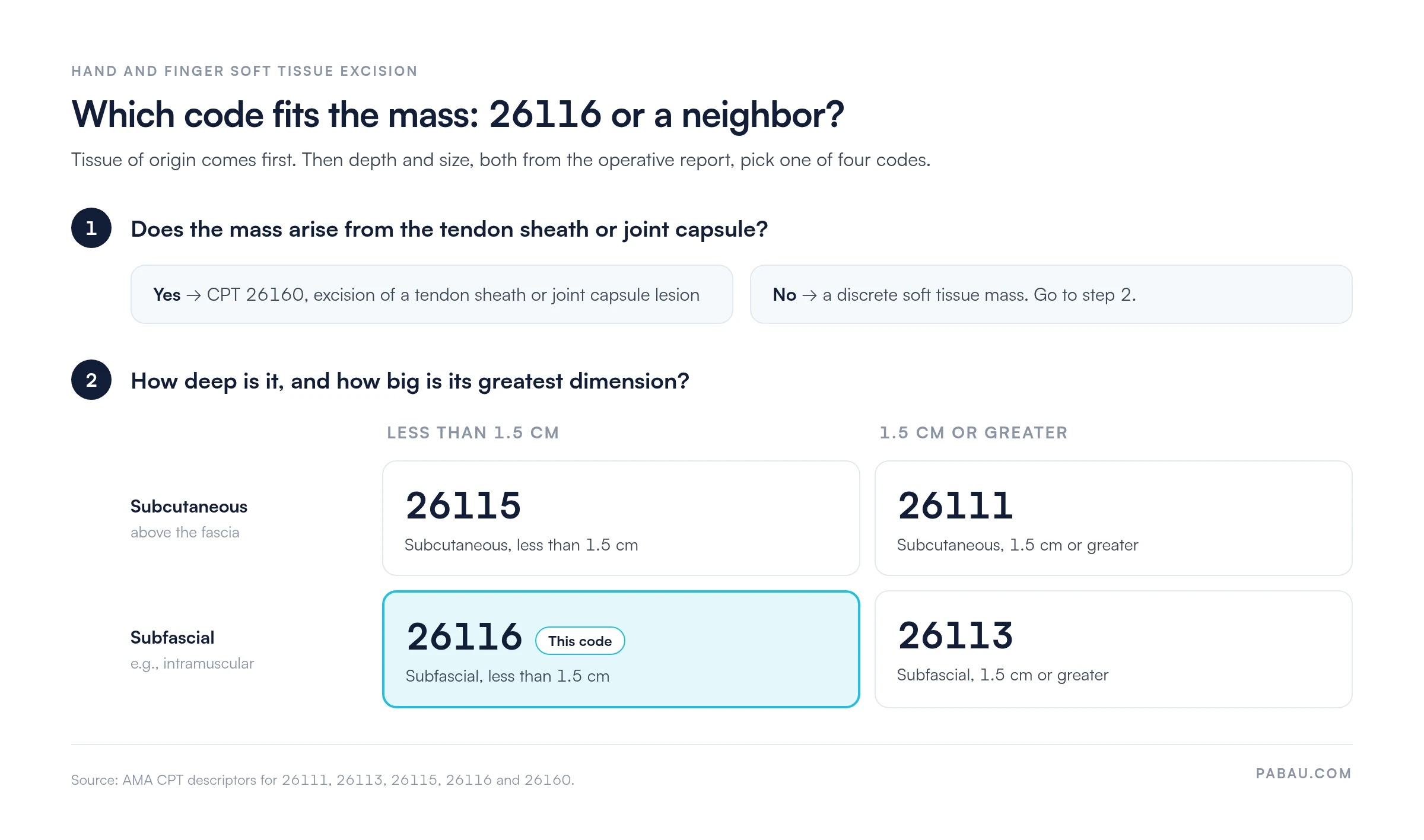
It sits in the musculoskeletal surgery section of the AMA CPT code set. The code needs two conditions together: a mass deep to the fascia and a measurement under 1.5 cm. A subcutaneous mass under 1.5 cm codes 26115 instead, and a subfascial mass of 1.5 cm or more codes 26113.
Let Pabau's smart automation suggest the right codes, reduce claim denials, and keep your practice compliant—effortlessly.
Automate repetitive tasks and focus on what matters most—your patients.
Reduce coding errors and ensure compliance with the latest regulations.
Clean claims, fewer denials, and faster reimbursements.
Powerful insights and reporting to help your practice thrive.
HIPAA compliant SOC 2 certified GDPR-compliant Trusted by 4,000+ clinics worldwide

CPT code 26116 covers excision of a subfascial hand or finger soft tissue tumor under 1.5 cm. Depth and size together decide between 26111, 26113, 26115 and 26116.
Tumor size and anatomical depth must both appear in the operative note, and missing either is a common cause of 26116 claim denials.
ICD-10-CM D21.11 or D21.12 are the primary diagnosis codes, chosen by laterality. M67.441 or M67.442 apply when the excised mass is a ganglion cyst not arising from the tendon sheath.
Pabau, the practice management platform we build, validates each claim and checks eligibility through Claim.MD before a CPT 26116 claim goes out.
CPT code 26116 covers excision of a hand or finger soft tissue tumor or vascular malformation.
The mass sits below the fascia and measures under 1.5 cm. The AMA descriptor reads: Excision, tumor, soft tissue, or vascular malformation, of hand or finger, subfascial (eg, intramuscular); less than 1.5 cm. The anatomical scope covers the palm, fingers, and thumb, for masses that sit deep to the fascial layer.
The code applies only when two conditions hold together. The surgeon dissects below the fascia to reach the mass, and the mass measures less than 1.5 cm. A deep mass of 1.5 cm or greater codes 26113 instead. Size alone never moves a superficial mass into 26116. A subcutaneous mass codes 26115 under 1.5 cm and 26111 at 1.5 cm or greater.
CPT code 26116 covers the complete surgical excision of a hand or finger soft tissue tumor or vascular malformation. The mass lies beneath the fascia and measures under 1.5 cm. The work includes incision, dissection to the tumor margin, tumor removal with adequate surrounding tissue, wound irrigation, and layered closure. The code bundles all intraoperative work performed to remove the mass.
Knowing what is excluded prevents the most common over-coding errors on hand surgery claims.
CPT 26116 and 26115 both describe masses under 1.5 cm in the same anatomical territory. They split on one criterion only, which is the depth of the mass relative to the fascia. Once a mass reaches 1.5 cm, the pair changes to 26111 for subcutaneous masses and 26113 for subfascial ones.
When the operative report states only “tumor excised from the finger” with no size and no depth description, it cannot support 26116. The payer may deny the claim or ask for records before paying. Documenting the measurement in centimeters and the fascial plane entered prevents both outcomes.
CPT 26160 covers excision of a lesion of the tendon sheath or joint capsule of the hand or finger. That is a structurally different procedure from the soft tissue tumor excision in CPT code 26116. The distinction matters because payers treat them as representing different clinical work, and NCCI edits may flag certain combinations.
Ganglion cysts deserve special attention. A ganglion originating from the tendon sheath codes to 26160. A ganglion or other cystic mass that does not arise from the tendon sheath or capsule is coded as a soft tissue mass. It codes to 26111, 26113, 26115 or 26116, depending on depth and size. The operative report must clearly state the tissue of origin to support the selected code.
Check whether the operative report identifies the mass as arising from the tendon sheath or capsule before assigning 26116. If the surgeon documents a discrete soft tissue mass without sheath involvement, depth and size decide between 26111, 26113, 26115 and 26116. If sheath origin is documented, 26160 applies instead.
Payers audit the operative report against the CPT code 26116 descriptor. If the note leaves out depth or size, the code is unsupported and open to denial.
Selecting the correct ICD-10-CM code is as important as selecting the correct CPT code. Payers run automated edits that match diagnosis codes against procedure codes, and a mismatch can trigger a denial. The table below covers the most frequently paired diagnoses for CPT code 26116.
Always confirm laterality before submitting. ICD-10-CM requires right, left, or bilateral specification. A claim with D21.11 on a left-hand procedure is likely to be denied because the laterality does not match the operative site. Verify the correct ICD-10-CM code year using the CDC/NCHS ICD-10-CM web tool.
Prior authorization requirements for CPT code 26116 vary by payer, plan, and clinical setting. No universal rule applies, so confirm authorization requirements before scheduling. A documented prior authorization process keeps that check from being skipped. Certain patterns still hold across major commercial payers.
CPT code 26116 reimbursement under Medicare is calculated using the CMS Physician Fee Schedule (PFS). The PFS assigns relative value units (RVUs) to the code, then applies a conversion factor and geographic adjustment to produce the payment amount. The PFS updates annually, and payment varies by geographic practice cost index (GPCI). That makes the CMS Physician Fee Schedule lookup tool the only reliable source for current figures. Never rely on a static rate published in an article.
Three RVU components set the payment: work RVU (physician effort), practice expense RVU, and malpractice RVU. Non-facility (office) payments are higher than facility payments in a hospital or ambulatory surgery center (ASC). The practice expense component is what differs by setting. Use a current-year RVU calculator such as the FastRVU lookup tool to calculate the estimated payment for your locality.
CPT code 26116 carries a 90-day global surgical period under the CMS Physician Fee Schedule. All routine postoperative care in the 90 days after the procedure is bundled into the surgical payment. Billing a separate evaluation and management (E&M) visit for routine wound checks within that window will be denied unless a recognized modifier applies.
Modifiers that legitimately appear on 26116 claims:
CMS increasingly prefers the X modifiers over -59 for specificity. They are XS for separate structure, XE for separate encounter, XP for separate practitioner, and XU for unusual non-overlapping service. When a payer accepts X modifiers, use the most specific one rather than the generic -59.
The reasons below are where CPT code 26116 claims tend to fail. Each denial comes back with a reason code. Reading those medical billing denial codes tells you whether to fix the note or the claim.
Run a monthly denial analysis on all CPT 26116 claims submitted in the prior 30 days. Filter for denial reason code CO-4 (procedure inconsistent with modifier) and CO-97 (bundled service). Both point to a problem you can fix at the documentation or charge-entry stage, which shortens the rework loop.
Run these checks before any CPT code 26116 claim goes out. The decision grid below settles the code itself, and the checklist covers the documentation and claim details around it.
A CPT 26116 denial usually starts with a detail that never reached the claim. The measurement is missing, the laterality is wrong, or nobody attached the authorization number. Each one stops a clean claim before it starts, and the team only finds out when the payer responds.
Pabau, the practice management platform we build, moves those checks ahead of submission. Its claims management software scrubs each claim for missing or invalid details, then submits CMS-1500 claims through Claim.MD. Eligibility checks run before the visit. A prior authorization is stored as a case, so its code follows the appointment through to the claim.
If a claim still comes back rejected, Pabau flags it as Needs action and links straight to the field that needs fixing. Payments settle straight from electronic remittance advice files, so your team can see which 26116 claims paid without chasing each payer.

Pabau validates each CPT 26116 claim before it leaves, checks eligibility through Claim.MD, and flags rejected claims with the field to fix. Your billing team spends less time on hand surgery rework.

CPT code 26116 is easy to misbill because the choice between 26111, 26113, 26115 and 26116 rests on two details surgeons do not always dictate. A 26116 claim needs both a subfascial mass and a measurement under 1.5 cm. The fix is upstream. Build tumor size and fascial depth into every hand surgery operative report template. Then confirm ICD-10 laterality and prior authorization before every claim goes out.
The trade-off is a few extra words of dictation against weeks of rework on a denied claim. Book a demo to see how Pabau catches claim errors at charge entry, before a hand surgery claim reaches the payer.

Need guidance on denial management workflows? Denial management in healthcare covers how to build a systematic appeal and prevention process for surgical claim denials.
Want to understand the clearinghouse submission process? Medical claims clearinghouse explains how clearinghouses validate claims before they reach payers, and what that means for CPT 26116 submissions.
Looking for guidance on billing compliance requirements? Medical billing compliance covers the documentation and audit standards that apply to musculoskeletal surgery billing.
CPT code 26116 covers surgical excision of a hand or finger soft tissue tumor or vascular malformation. The mass must be subfascial (eg, intramuscular) and measure less than 1.5 cm. The code includes the full excision procedure, from incision and dissection to tumor removal and layered closure. It does not include bone tumor excision, radical resection, or tendon sheath lesion excision.
Both codes cover hand or finger soft tissue masses under 1.5 cm, and they differ on depth alone. CPT 26115 applies to a subcutaneous mass, and CPT 26116 applies to a subfascial (eg, intramuscular) mass. At 1.5 cm or greater, the codes become 26111 (subcutaneous) and 26113 (subfascial). The operative report must document tumor size in centimeters and the fascial plane to support whichever code is selected.
CPT 26160 covers excision of a lesion of the tendon sheath or joint capsule. CPT 26116 covers a discrete soft tissue tumor that does not originate from the tendon sheath or capsule. A ganglion cyst arising from the flexor tendon sheath codes to 26160. A soft tissue fibroma or lipoma in the same hand codes to 26111, 26113, 26115 or 26116 based on depth and size. The operative report must identify the tissue of origin clearly to support the correct code assignment.
CPT 26116 carries a 90-day global surgical period under the CMS Physician Fee Schedule. Routine postoperative wound checks and follow-up visits within those 90 days are bundled into the surgical payment. A separate E&M visit during the global period requires modifier -24 (unrelated E&M) or modifier -79 (unrelated procedure) to be payable. Payers deny the visit without one.
Medicare payment for CPT 26116 is calculated from the CMS Physician Fee Schedule and varies by setting (facility vs. non-facility) and geographic location. The fee schedule updates annually and applies geographic adjustment factors. Consult the CMS PFS lookup tool for current-year rates in your locality rather than relying on a static figure in an article.
Yes, in specific circumstances. A soft tissue ganglion cyst of the hand that does not arise from the tendon sheath codes to 26111, 26113, 26115 or 26116. 26116 applies only when it is subfascial and under 1.5 cm. A ganglion cyst arising from the flexor tendon sheath or joint capsule codes to 26160 instead. The operative report must state the tissue of origin, because sheath-origin language routes the claim to 26160, not 26116.
The primary ICD-10-CM codes paired with CPT 26116 are D21.11 (right upper limb benign soft tissue neoplasm) and D21.12 (left upper limb). For ganglion cysts not arising from the tendon sheath, M67.441 (right hand) and M67.442 (left hand) apply. Always confirm laterality before submitting, as the laterality suffix must match the operative side documented in the note.