

HCPCS code E0198: Water pressure pad billing guide
HCPCS code E0198 is a water pad for a standard mattress HCPCS code E0198 is the ...

Last Updated: Oct 13, 2026
26160 is the CPT code for excision of a lesion of the tendon sheath or joint capsule of the hand or finger. Ganglion cysts, mucous cysts and tendon sheath cysts all belong here, as long as the lesion arose from the sheath or the capsule.
Site and technique are what trip claims up. The same lesion at the wrist is 25111, and opening the sheath instead of excising the lesion is 26055. Picking wrong costs weeks of rework. What follows is the descriptor line by line, the modifier families payers accept, the ICD-10 pairings and the documentation an audit asks for.
Let Pabau's smart automation suggest the right codes, reduce claim denials, and keep your practice compliant—effortlessly.
Automate repetitive tasks and focus on what matters most—your patients.
Reduce coding errors and ensure compliance with the latest regulations.
Clean claims, fewer denials, and faster reimbursements.
Powerful insights and reporting to help your practice thrive.
HIPAA compliant SOC 2 certified GDPR-compliant Trusted by 4,000+ clinics worldwide

CPT code 26160 covers excision of a tendon sheath or joint capsule lesion of the hand or finger, never the wrist.
The operative note has to name the lesion type, the exact site, the side, and the excision technique.
Most denials come from billing 25111 for a hand site, a missing laterality modifier, or a diagnosis that does not match.
ICD-10-CM has no finger-specific ganglion code, so M67.441 and M67.442 cover the digits as well as the palm.
Practice management software like Pabau submits 26160 claims through Claim.MD and checks patient eligibility before the visit.
CPT code 26160 covers the surgical excision of a lesion of the tendon sheath or joint capsule of the hand or finger. The American Medical Association defines it as: “Excision of lesion of tendon sheath or joint capsule (e.g., cyst, mucous cyst, or ganglion), hand or finger.”
Three phrases in that descriptor carry the billing weight. “Lesion of tendon sheath or joint capsule” sets the tissue origin. “Hand or finger” sets the anatomical boundary. The examples in brackets confirm that ganglion cysts, mucous cysts and tendon sheath cysts all qualify, as long as they arise from that tissue.
Here are the reference facts a biller reaches for most often with this code.
CPT code 26160 covers lesions that grow out of the tendon sheath or the joint capsule, in the hand or the finger. Tissue origin is the gate. A lesion sitting in the surrounding soft tissue belongs to a different code, however similar it looks in the treatment room.
Lesion types within scope:
Lesion types that do not qualify for 26160:
One sentence in the operative report settles most of this. If the surgeon records that the lesion arose from the tendon sheath or joint capsule, the claim has its support. A pathology report naming the tissue backs that up when a payer audits.
Payers downcode aspirations billed as excisions, so the note for CPT code 26160 has to describe a surgical approach. That means walking through what happened, in order, rather than summarizing the visit in two lines.
Same-site, same-day work changes the picture. If the surgeon also releases a trigger finger at that site, National Correct Coding Initiative (NCCI) bundling rules apply. The related codes section below covers those pairings. Compliance starts in the operative note, not on the claim form.
Thin documentation causes most 26160 denials. Each element below has to appear somewhere in the operative note, and a reviewer will look for all seven.
A payer sees only what the coder submits. When the note is vague about tissue origin, the reviewer defaults to a denial. Three facts do most of the work here: lesion type, tissue origin, and the exact location.
Modifier choice for CPT code 26160 turns on three questions. Which hand or finger was treated? Was any other procedure performed that day? Did the patient return to the operating room inside the global period?
One error shows up more than the rest. Practices bill RT or LT when the payer’s policy asks for a digit-specific FA-F9 modifier. A remark code about missing digit specificity is the signal to switch families. Confirm each payer’s preference during the pre-authorization step.
Flag each patient’s payer policy for digit modifier requirements before the procedure date. Keep a one-page reference in your billing system: payer A requires FA-F9, payer B accepts RT or LT. That single step removes the most common modifier rejection on 26160 claims.
The ICD-10 code carries the medical necessity for the excision, so it needs both the site and the side. Unspecified codes raise audit risk. They also fail edits at Medicare Advantage plans more often than coders expect.
One detail catches people out. ICD-10-CM has no separate ganglion code for the fingers, so M67.441 and M67.442 cover the digits as well as the palm. If you are checking a neighboring diagnosis, the ICD-10-CM code library lists the full M67 range.
Verify every code against the current tabular list before billing. The CDC ICD-10-CM tool is the authoritative US lookup. M67.44 is not billable on its own, so add the laterality digit or the claim will fail the payer’s edits.
Hand and wrist codes share anatomy, which is why the wrong one gets picked so often. The AAPC Codify CPT lookup puts the descriptors side by side. The decision itself runs in a fixed order, and each question below rules something out.
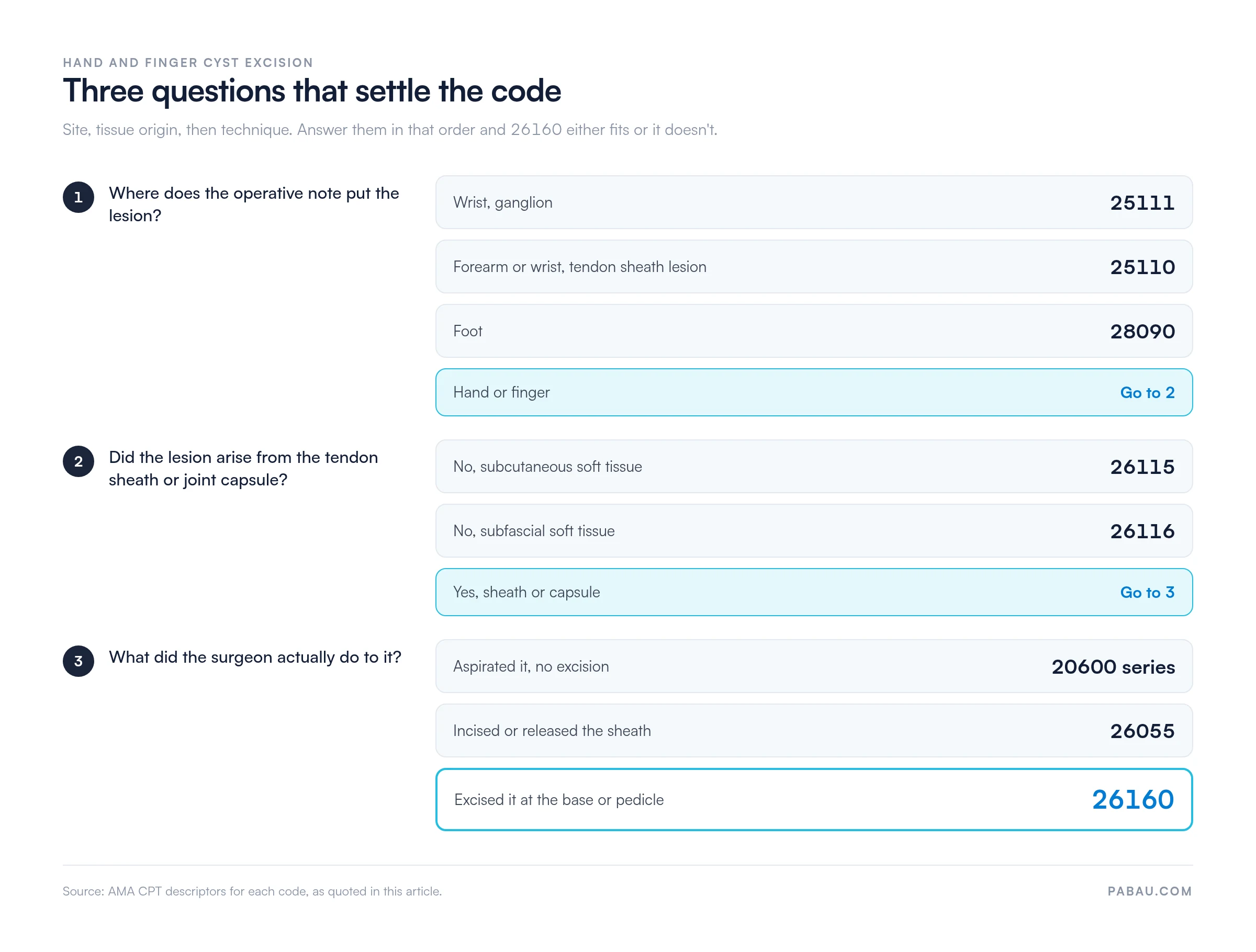
CPT 25111 covers a ganglion cyst at the wrist, and CPT 26160 covers the same lesion at the hand or finger. Site is the whole distinction. A dorsal wrist ganglion off the scapholunate ligament is 25111. A ganglion along a flexor sheath in the palm is 26160.
Move the same tendon sheath lesion up the arm and the code becomes 25110.
CPT 26055 describes incision of the tendon sheath, the trigger finger release. CPT 26160 describes excision of a lesion from that sheath. Billing 26160 for a pulley release is upcoding, and billing 26055 for a cyst excision underpays the practice.
NCCI edits may bundle the pair when both are performed at the same site on the same date. Check the current column 1 and column 2 edit table before you bill them together.
CPT 26115 covers excision of a subcutaneous soft tissue tumor of the hand or finger. A lesion from the sheath or capsule is 26160. A lipoma, a fibroma or an unattached dermoid cyst is 26115. When the origin is unclear during surgery, pathology settles which code the claim should carry.
Payment for CPT code 26160 comes from Medicare’s Resource-Based Relative Value Scale, known as RBRVS. The amount moves with the year, the locality and the place of service. Pull the current figure from the CMS Physician Fee Schedule lookup tool before quoting anyone.
The table below holds approximate national averages, so treat them as a sense check rather than a quote. For the work, practice and malpractice RVU splits behind them, the FastRVU 2026 RVU lookup searches the same MPFS data.
In an ASC the practice collects the physician component only, while the center bills its own facility claim. Two claims, two payments, one procedure. Reconciling the remittance when payment posts is what catches an underpayment, because the money still arrives and the shortfall is easy to miss.
Medicare does not usually require prior authorization for CPT 26160. Plenty of commercial plans and Medicare Advantage plans do. Policies also change with the plan year, so treat authorization as a per-patient check rather than a standing assumption.
When a payer does require it, the medical necessity file usually has to show:
Attach the clinical notes and any imaging to the request, then confirm benefits before you send it. A plan-year benefit change caught at this stage costs a phone call. The same change caught after surgery costs the whole claim.
Denials for CPT code 26160 usually trace back to one of five causes. Naming the cause tells you what to do next. The answer is a corrected claim, an appeal, or a conversation with the surgeon about the note.
Work each denial by its cause rather than by its date. A missing modifier is a corrected claim. A vague operative note is an appeal with the full note attached. A wrong site code is a rebill. Sorting them this way also shows which cause keeps coming back.
A patient arrives with a ganglion cyst on the right index finger, arising from the flexor tendon sheath. The surgeon excises it in the office under local anesthetic. Here is what the claim looks like on its way out.
That sequence holds no surprises. The claim pays because the note, the procedure code, the modifier and the diagnosis all describe the same finger on the same hand.
Run this list before the claim leaves the practice. It takes a minute, and it catches the errors that otherwise cost weeks.
Where the procedure happens changes the physician payment for 26160. Reference pages for this code rarely spell the difference out, and it costs practices money every year.
In the office, the physician bills the non-facility rate. It is higher because it includes a practice expense component for supplies, equipment and overhead. The practice pays for the sterile instruments, the drapes, the local anesthetic and the suture.
Many hand surgeons excise uncomplicated ganglion cysts under local anesthetic, which makes POS 11 the most common setting for this code.
A clean superbill from an office case captures four things. It needs the procedure, the diagnosis with laterality, the modifier, and any separately billable evaluation and management service under modifier -25.
In an ASC, the physician bills the lower facility rate. The center bills separately for facility fees, anesthesia supplies and equipment, so the physician’s claim reflects professional work only.
One error repeats here. Practices submit the non-facility rate for an ASC case, and the payer applies the facility rate anyway. Without remittance reconciliation, that shortfall goes unnoticed for months.
Audit your place-of-service codes monthly against the procedure locations recorded in your scheduling system. A single POS mismatch on a high-volume code like 26160 can underpay a practice by thousands of dollars a year without ever triggering a denial.
Most hand surgery practices run this code through three disconnected steps. Eligibility is checked in a payer portal, the claim is keyed into a clearinghouse, and the remittance is reconciled in a spreadsheet weeks later. Each handoff is a chance to lose a detail.
Practice management software like Pabau keeps those steps in one system. Pabau’s claims software for practices handles the mechanical part of the job:
The coding judgment stays with your team, where it belongs. What changes is the admin around it. You get fewer portal logins, fewer rekeyed claims, and a denied 26160 that surfaces while it is still worth appealing.
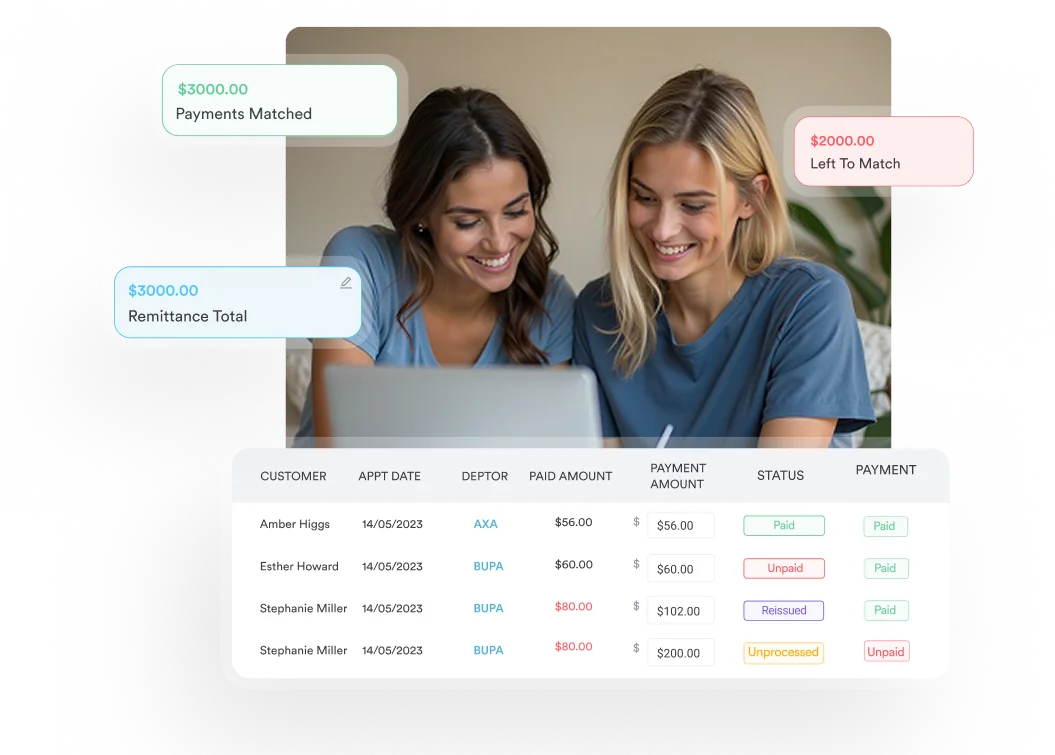

Pabau’s claims management software submits CPT 26160 claims through Claim.MD, checks patient eligibility before the date of service, and flags denied claims for rework. See how it fits your orthopedic billing workflow.

CPT code 26160 has a narrow scope and a short list of ways to get it wrong. Site, tissue origin and technique decide whether it applies at all. Settle those three in the operative note and the coding follows on its own.
Practices that stop seeing 26160 denials tend to share one habit. They read the operative note against the code before the claim goes out, rather than after it comes back. The pre-flight list above is that habit, written down.
If that check is the part that keeps slipping, practice management software like Pabau can carry it for you. Book a demo to see how Pabau submits hand surgery claims and surfaces the denied ones while they are still worth appealing.

Want to understand how clearinghouse validation reduces claim denials? How Claim.MD clearinghouse works explains the eligibility and claim scrubbing process that catches 26160 errors before submission.
Need a reference for the most common denial reason codes? Denial codes in medical billing maps CARC and RARC codes to root causes and resolution steps for hand surgery claims.
Coding the same lesion one joint higher? CPT code 25110 covers excision of a tendon sheath lesion of the forearm and wrist, where 26160 no longer applies.
Looking to improve billing accuracy across all your procedure codes? Medical billing compliance best practices covers the documentation standards that reduce audit risk on surgical excision codes.
Report 26160 once per digit, each line carrying its own FA-F9 modifier, and append modifier -51 to the second line. The lower-valued line is usually paid at a reduced rate under multiple-procedure rules.
Yes. A repeat excision at the same site still meets the descriptor. If the patient returns inside the 90-day global period, append modifier -78 for an unplanned return to the operating room. Outside that window, bill 26160 normally.
Yes. The pathologist bills the specimen examination on their own claim. Payment for 26160 covers the excision itself, so sending a specimen adds no charge to the surgeon’s line.
Often not. Commercial payers look for functional impairment such as pain, weakness or restricted movement. Without it, the excision reads as cosmetic, so document the limitation before the procedure.
Foot lesions use CPT 28090, which covers excision of a lesion of the tendon sheath or joint capsule of the foot. CPT 26160 applies to the hand and finger only.



