

HCPCS code E0198: Water pressure pad billing guide
HCPCS code E0198 is a water pad for a standard mattress HCPCS code E0198 is the ...

Last Updated: Oct 13, 2026
CPT code 25607 is the code for open treatment of a distal radial extra-articular fracture or epiphyseal separation, with internal fixation. In plain terms, the surgeon opens the wrist, reduces a fracture that stays outside the joint, and fixes it, usually with a volar locking plate.
The joint surface is the deciding fact. Once the fracture line enters the joint, the claim moves to 25608 or 25609, and pins placed through the skin belong to 25606. Payers check that choice against the operative report and the diagnosis code, so a mismatch invites a denial. The sections below cover the code family, modifiers, documentation, and 2026 Medicare values.
Let Pabau's smart automation suggest the right codes, reduce claim denials, and keep your practice compliant—effortlessly.
Automate repetitive tasks and focus on what matters most—your patients.
Reduce coding errors and ensure compliance with the latest regulations.
Clean claims, fewer denials, and faster reimbursements.
Powerful insights and reporting to help your practice thrive.
HIPAA compliant SOC 2 certified GDPR-compliant Trusted by 4,000+ clinics worldwide

CPT code 25607 covers open treatment of an extra-articular distal radius fracture or epiphyseal separation, with internal fixation.
Joint involvement decides the code: 25607 is extra-articular, while 25608 and 25609 cover intra-articular fractures by fragment count.
25606 and 25607 describe different approaches, percutaneous pins versus open fixation, so report the one that matches the definitive repair.
Bone graft from a separate incision is reported with 20900 or 20902, never with the spine-only graft codes 20930, 20931 and 20936 to 20938.
Medicare values 25607 at 20.88 total RVUs for CY 2026, about $697 nationally before geographic adjustment, with a 90-day global period.
CPT code 25607 is published by the American Medical Association (AMA). Its official descriptor reads: Open treatment of distal radial extra-articular fracture or epiphyseal separation, with internal fixation. It is the open repair code for a distal radius fracture whose fracture line stays outside the joint surface.
Colles and Smith fractures that need surgery are typical examples. The surgeon makes an incision, usually through a volar approach, and reduces the fracture under direct view. A plate, screws, or both then hold the reduction while the bone heals.
The code covers the open reduction, the internal fixation, intraoperative imaging to confirm alignment, and closure. An epiphyseal separation in a child, treated openly with internal fixation, also reports here.
The distal radius family splits first on approach. Closed codes cover treatment without an incision, 25606 covers pins or wires placed through the skin, and the open codes cover direct exposure.
Within the open codes, the joint surface decides the rest. An extra-articular fracture takes 25607, whatever the number of pieces. Fragment count only matters once the fracture enters the joint.
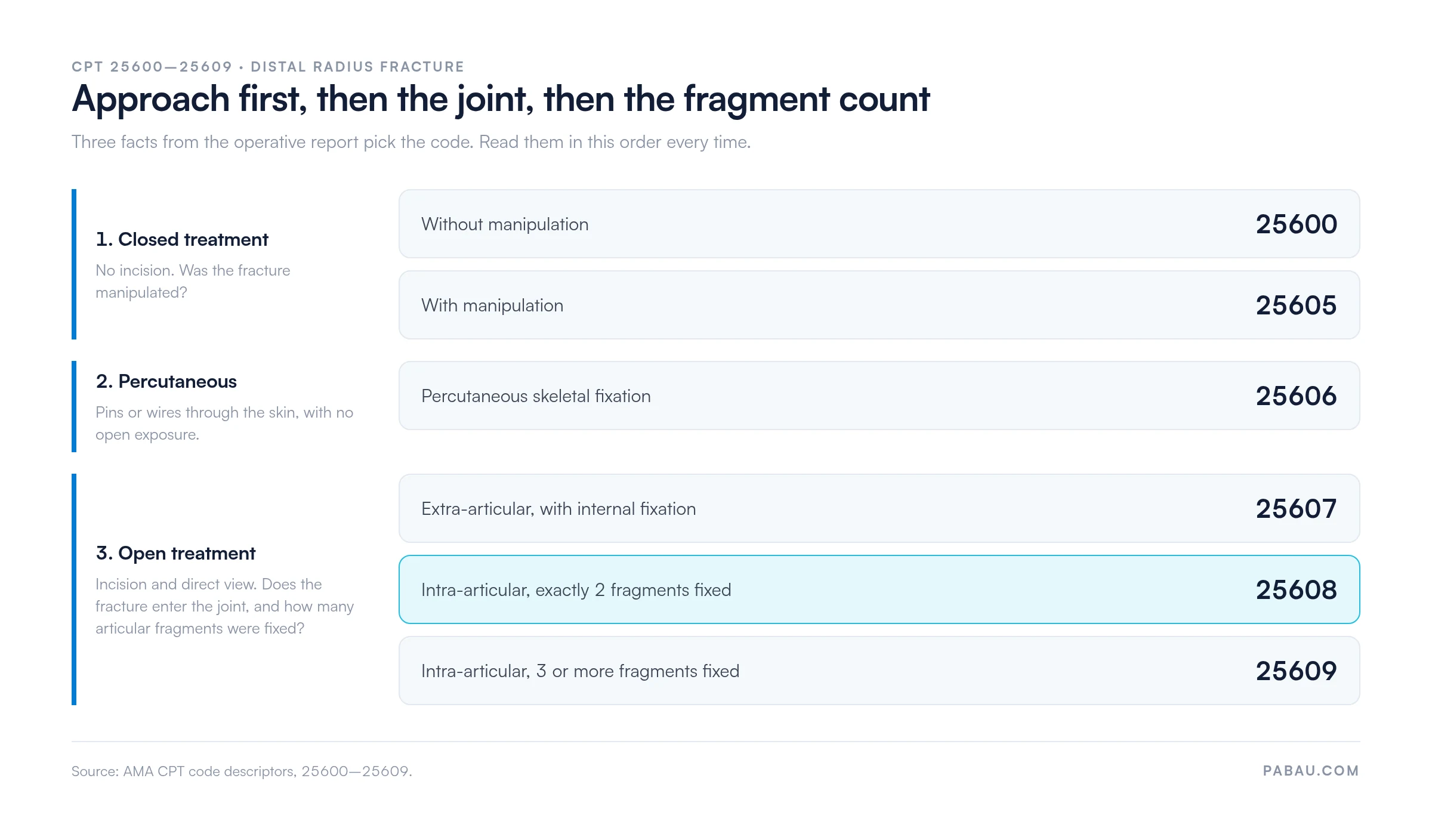
All six codes carry a 90-day global period. The closed codes include closed treatment of an ulnar styloid fracture when it is performed.
CPT 25606 and 25607 describe two alternative ways to treat the same fracture. 25606 is percutaneous skeletal fixation, with no open exposure of the fracture site. 25607 requires an incision, open reduction, and internal fixation.
Report the code that matches the definitive repair. If the surgeon starts with percutaneous pinning and converts to an open plate, the claim carries 25607 alone. Pins added during an open repair are part of the internal fixation, not a separate 25606.
A different bone is a different matter. Fixation of a separate fracture, such as the ulna or a carpal bone, has its own code. Check the current National Correct Coding Initiative (NCCI) table for that pair, and document the distinct site.
This is the choice that drives most 25607 audits. The operative report and imaging must show whether the fracture line reaches the articular surface.
A claim that pairs 25607 with an intra-articular diagnosis will not survive review. The same goes for 25608 or 25609 billed against an extra-articular diagnosis. Keep the CPT code and the ICD-10-CM code telling the same story.
Here is how that plays out on a common case. A patient has a dorsally displaced Colles fracture of the right wrist, and imaging shows no joint involvement. The surgeon fixes it through a volar incision with a locking plate. The claim carries 25607-RT with S52.531A, however many metaphyseal pieces the plate holds.
Modifiers on CPT code 25607 tell the payer which wrist, and where the service falls in the surgical timeline. Get them wrong and payment, laterality tracking, and audit exposure all suffer. These are the ones orthopedic billing teams reach for most.
A clean claim submission for CPT code 25607 starts with an operative report that answers a reviewer’s questions before they are asked. The report should document each of these points:
Diagnosis codes for 25607 come from the extra-articular codes in category S52.5, fracture of lower end of radius. Physeal fractures in children come from S59.2. Each code needs laterality and a 7th character.
Intra-articular codes do not belong on a 25607 claim. Barton’s fractures (S52.56-) and other intraarticular fractures of the lower end of radius (S52.571, S52.572, S52.579) point to 25608 or 25609.
At the operative encounter, use 7th character A for a closed fracture. Open fractures take B for type I or II, and C for type IIIA, IIIB, or IIIC. Follow-up visits use D with routine healing. Verify every code in the CDC/NCHS ICD-10-CM web tool before submission.
CPT code 25607 carries a 90-day global surgical period under the Medicare Physician Fee Schedule. The package starts with the preoperative visit the day before surgery and runs 90 days after the procedure.
Services included in the global package and not separately billable:
Services separately billable during the global period, with the right modifier:
A routine fracture check billed as a standard E/M visit inside the window is a common error. It often pays at first, then gets recouped after a post-payment review. A sound revenue cycle management workflow holds every E/M claim for a patient in an active global period until someone reviews it.
Medicare reimbursement for CPT code 25607 is set each year through the CMS Physician Fee Schedule. For CY 2026, the code carries 20.88 total RVUs, which works out to about $697 nationally before geographic adjustment.
CMS set two conversion factors for 2026. Qualifying APM participants are paid at $33.5675, slightly above the figure in the table. Each RVU component is then adjusted by its own Geographic Practice Cost Index, so your locality moves the number.
Use the FastRVU lookup tool or the CMS lookup to confirm current values for your locality. Commercial payment depends on each payer contract, so check the contracted rate before you quote a patient.
Several codes are often reported in the same session as 25607. None of them is a CPT add-on code, so each follows the multiple-procedure rules and its own NCCI edits.
Some codes do not belong on a 25607 claim. The spine graft codes 20930, 20931, and 20936 to 20938 apply only to spine surgery. Fluoroscopy during the repair is not reported separately. Code 77002 describes needle placement guidance, so it has no place on a fracture fixation claim either.
The superbill for a distal radius ORIF should list the primary code, any companion codes, the diagnosis, the surgeon, the facility, and any authorization number. Missing fields at charge capture delay the claim.
A distal radius ORIF claim changes hands several times before it pays. Each handoff is a chance for one detail to drop out.
Steps two and four are the cheapest places to catch an error. When the coder and the claim reviewer both read the operative report, each denial below gets two chances to be stopped.
CPT code 25607 denials cluster around a handful of root causes. A structured denial management workflow that tracks each one cuts rework and protects revenue.
Map each rejection to its reason code with this list of medical billing denial codes, then fix the root cause before resubmitting.
Two minutes at charge capture beats weeks on an appeal. Before the claim goes out, confirm each of these:
In many orthopedic practices, a biller still builds surgical claims by hand. The CPT code, the diagnosis, the side, and the authorization number get copied from several screens. Each copy is a chance to send a claim with a field missing.
Pabau, the practice management and billing platform we build, pre-fills the claim from the patient record. The CPT code on the service and the diagnoses on the problem list land on the claim form, so nobody retypes them.
Pabau’s claims management software keeps the send button locked until required fields, such as the authorization number, are complete.
US claims go through Claim.MD with eligibility checks, claim status tracking, and remittance posting. Billers spend less time chasing rejected 25607 claims and more time on the ones that need a coder’s judgment.

Pabau pre-fills each claim from the patient record and blocks submission until required fields are complete. US claims go through Claim.MD with eligibility checks and remittance posting built in.

CPT code 25607 is the easiest open code in the distal radius family to choose, once one fact is on the record. That fact is whether the fracture line reaches the joint, and fragment count never enters into it.
So put that answer in the operative report in plain words, and pick the diagnosis code to match it. Grafts, external fixation, and anesthesia then follow from the same record. Spend your effort at charge capture rather than on appeals, because a recouped claim costs far more time than a checklist.
Practices that capture those details once, at the point of care, stop reworking the same 25607 denials. Book a demo to see how Pabau carries the code, diagnosis, and authorization number from the patient record onto a complete claim.

Fixing an intra-articular fracture instead? CPT code 25608: Distal radius ORIF with 2 fragments covers the open code that takes over once the fracture enters the joint.
Treating the fracture without surgery? CPT code 25600: Closed treatment of distal radial fracture explains the closed code at the other end of the family.
Need to understand how denial codes map to root causes? Medical billing denial codes reference covers the most common CARC and RARC codes used by commercial and Medicare payers.
Want to reduce claim rework across your orthopedic practice? Electronic remittance advice guide explains how ERA processing accelerates payment posting and denial identification.
Looking for guidance on the clearinghouse workflow? Medical claims clearinghouse overview walks through how 837P claims are validated, transmitted, and acknowledged.
CPT code 25607 reports open treatment of an extra-articular distal radius fracture or epiphyseal separation, with internal fixation. The surgeon exposes the fracture, reduces it under direct view, and holds it with a plate or screws.
Joint involvement separates them. CPT 25607 covers a fracture that stays outside the joint, whatever the fragment count. CPT 25608 covers an intra-articular fracture with 2 fragments fixed, and 25609 covers 3 or more.
An open plate or screw repair of a Colles fracture reports 25607, with S52.531A or S52.532A for a closed fracture. Closed reduction reports 25605, and percutaneous pinning reports 25606.
Often, yes. Many commercial and Medicare Advantage plans require it for elective ORIF. Confirm the requirement before scheduling, and record the authorization number on the claim.
For CY 2026, Medicare values CPT 25607 at 20.88 total RVUs. At the $33.4009 conversion factor, that is about $697 nationally, before geographic adjustment.
The anesthesia provider reports 01830, which covers open procedures on the distal radius, distal ulna, wrist, or hand joints. Code 01820 covers closed procedures, so it does not fit an open repair.



