

CCSD code G5100: Bypass of duodenum billing guide
CCSD code G5100 bills a bypass that leaves the duodenum in place CCSD code G5100...

Last Updated: Oct 16, 2026
25606 is the CPT code for percutaneous skeletal fixation of a distal radial fracture or epiphyseal separation. The surgeon stabilizes the fracture with K-wires or pins passed through the skin, usually under fluoroscopy, without opening the fracture site.
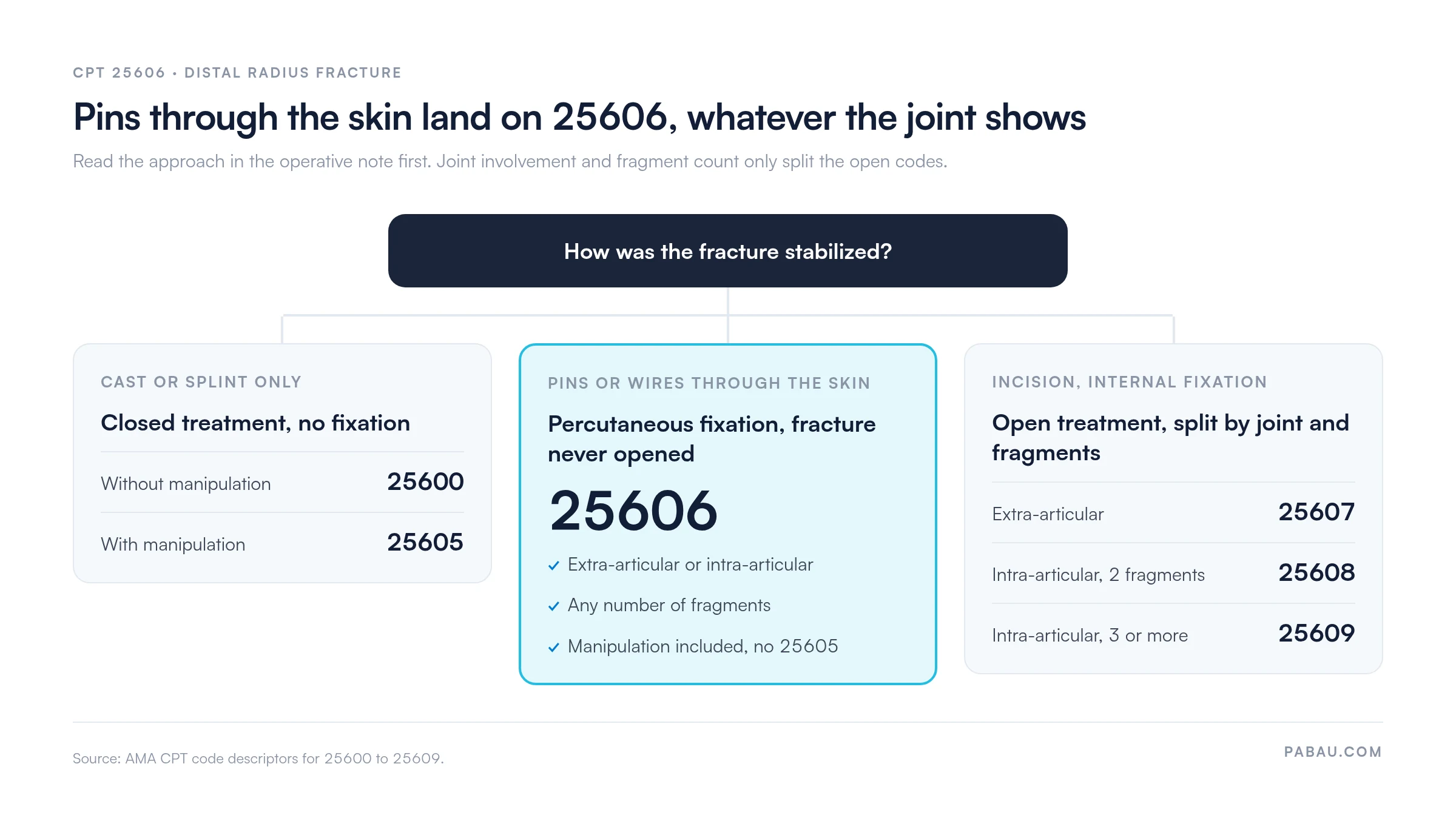
The approach is what sets 25606 apart. A closed reduction with no fixation is 25605, and an open repair with internal fixation is 25607, 25608, or 25609. The descriptor has no articular requirement, so joint involvement and fragment count never decide it. The code carries a 90-day global period.
Let Pabau's smart automation suggest the right codes, reduce claim denials, and keep your practice compliant—effortlessly.
Automate repetitive tasks and focus on what matters most—your patients.
Reduce coding errors and ensure compliance with the latest regulations.
Clean claims, fewer denials, and faster reimbursements.
Powerful insights and reporting to help your practice thrive.
HIPAA compliant SOC 2 certified GDPR-compliant Trusted by 4,000+ clinics worldwide

CPT code 25606 reports percutaneous skeletal fixation of a distal radius fracture or epiphyseal separation, with pins or wires placed through the skin.
The approach picks the code: closed manipulation is 25605, percutaneous pinning is 25606, and open treatment with internal fixation is 25607 to 25609.
Joint involvement and fragment count only matter among the open codes, so an intra-articular fracture pinned through the skin still takes 25606.
The 90-day global period bundles routine follow-up visits, cast changes, and pin removal into the surgical payment.
Pabau, our practice management and billing platform, submits US claims through its Claim.MD integration and tracks their status after submission.
CPT code 25606 is defined by the American Medical Association as “Percutaneous skeletal fixation of distal radial fracture or epiphyseal separation.” The code reports fixation placed across the fracture through the skin, without open exposure of the fracture site.
In practice, the surgeon aligns the distal radius under fluoroscopy, then drives K-wires or pins through the skin and across the fracture to hold it. Any manipulation needed to reach that alignment is part of the procedure, so 25605 is not reported for the same fracture.
The distal radius family splits on approach first. The closed codes, 25600 and 25605, involve no fixation through the skin, and 25606 covers percutaneous pins or wires. The open codes cover direct exposure with internal fixation.
Joint involvement and fragment count only come into play among the open codes. That is why an intra-articular fracture pinned through the skin still lands on 25606.
All six codes carry a 90-day global period in the CY 2026 CMS RVU file. The two closed codes also include closed treatment of an ulnar styloid fracture when it is performed.
These two codes are the pair most often confused, because both can follow the same reduction. The deciding question is whether the surgeon placed fixation through the skin.
If the fracture was manipulated and held only with a cast or splint, bill 25605. If pins or wires were placed across the fracture, bill 25606.
The documentation rule follows from the table. The operative note for 25606 must describe the pins or wires placed and confirm the fracture was not opened. Imaging language about the joint surface supports the diagnosis code, but it does not change the CPT choice.
Once the surgeon opens the fracture to place internal fixation, 25606 no longer applies. The open codes then split on joint involvement and, for intra-articular fractures, on the number of fragments fixed.
Fragment count never moves a pinned fracture into 25608 or 25609. Those codes require open treatment with internal fixation, so the operative note must describe an incision and direct exposure of the fracture.
Billing 25608 for a percutaneous procedure misstates the service, and so does billing 25606 for an open plate repair. Match the code to the approach first.
When the operative report describes a comminuted intra-articular fracture, read the approach before the fragment count. If the fragments were pinned through the skin with no open exposure, CPT code 25606 applies. Fragment count only chooses between 25608 and 25609 once the fracture was opened and internally fixed.
The operative note has to support each element of the descriptor. Auditors look for proof that fixation crossed the fracture through the skin and that the fracture site was never opened.
Because 25606 has no articular requirement, it can pair with any distal radius fracture code in category S52.5. A child’s epiphyseal separation takes a physeal code from S59.2. Each code needs laterality and a 7th character.
S52.509A is a weak choice on a surgical claim. It names neither the side nor the fracture pattern, so replace it with a specific code once the imaging report allows.
At the operative encounter, 7th character A covers a closed fracture. Open fractures take B for type I or II, and C for type IIIA, IIIB, or IIIC. Verify every code in the CDC/NCHS ICD-10-CM web tool before submission.
CPT 20690, application of a uniplanar external fixation system, may be separately reportable with 25606. Whether it is depends on the current NCCI edit for the pair, the payer, and whether the fixator was a distinct procedural step.
NCCI edits are updated every quarter. Look up the pair in the CMS NCCI procedure-to-procedure edits or your clearinghouse’s NCCI checker before submitting the combination.
Medicare pays about $642 nationally for CPT code 25606 in CY 2026, before geographic adjustment. The figure is the code’s 19.21 total RVUs multiplied by the $33.4009 conversion factor.
These values come from the October 2026 release of the CMS PFS relative value files. Each RVU component is then adjusted by its own Geographic Practice Cost Index, so your locality moves the number.
Use the CMS Physician Fee Schedule lookup tool to confirm the rate for your locality. Commercial payment depends on each payer contract, so check the contracted rate before you quote it.
CPT code 25606 carries a 90-day global surgery period, with Medicare indicator 090. The surgical payment covers a defined bundle of related services before and after the procedure, and billing those services separately is a compliance risk.
A frequent global period error is a routine follow-up E/M visit billed with no modifier or no documented unrelated condition. Recording the global end date against each patient’s surgery date helps prevent duplicate billing. Your denial management workflow should include a global period check at the claim creation stage.
Flag the global period end date in the patient record at the time of surgery, not at the first follow-up. Practices that set the reminder on day one catch billing errors before the 90-day window closes. Those that track it reactively often find the error after the payer has recouped the payment.
Denials on CPT code 25606 cluster around a small set of documentation and code-selection problems. Knowing the patterns makes it faster to build a prevention checklist and an appeal template.
For a denied claim, lead the appeal with the operative note’s description of the percutaneous fixation and the imaging that supports the diagnosis. The denial codes reference covers the CARC codes you are likely to see on a 25606 denial. The specific code tells you which appeal argument to lead with.
Many orthopedic billers send surgical claims from one system and check their status in another. A 25606 claim that stalls at the payer can sit unnoticed for weeks before anyone follows up.
In Pabau, US claims are submitted through the Claim.MD integration. Each claim’s status is tracked after submission, so billers can see which claims were accepted, which are pending, and which were rejected.
With status-tracking claims software, your team spends less time chasing 25606 claims. That leaves more time for the coding questions that need a person’s judgment.

Pabau submits US claims through its Claim.MD integration and tracks their status, so your team can see which 25606 claims need follow-up.

Put the approach at the top of your coding checklist for distal radius repairs, ahead of the imaging report. When the note proves pins crossed the fracture through the skin with no open exposure, 25606 holds up even on a comminuted intra-articular fracture.
The cost of that rule falls on documentation. If the note skips the pin details or the fluoroscopy statement, the payer can read the claim as 25605 or an open code. Any appeal then starts from a weaker record.
Tracking each claim after submission is part of revenue cycle management, and Pabau handles it by sending US claims through Claim.MD and following their status. Book a demo to see how that workflow fits orthopedic billing.

Need to understand how clearinghouse validation works before a claim reaches Medicare? Medical claims clearinghouse guide explains how electronic claim scrubbing catches errors before submission.
Want to understand the 837 electronic claim format used for CPT submissions? 837 file reference covers the EDI transaction set structure payers require.
Dealing with ERA remittance codes after a 25606 denial? Electronic remittance advice guide walks through reading 835 ERA files and mapping CARC denial codes to appeal actions.
Coding an open plate repair instead of a pinning? CPT code 25607 guide covers open treatment of an extra-articular distal radius fracture with internal fixation.
Was the fracture treated without manipulation or pins? CPT code 25600 guide explains closed treatment of a distal radius fracture without manipulation.
CPT code 25606 covers percutaneous skeletal fixation of a distal radial fracture or epiphyseal separation. The surgeon places K-wires or pins across the fracture through the skin, usually under fluoroscopy, without opening the fracture site. The code applies to extra-articular and intra-articular fractures alike.
CPT 25605 is closed treatment with manipulation, where the fracture is reduced and held in a cast or splint with no fixation. CPT 25606 is percutaneous skeletal fixation, where pins or wires are placed across the fracture through the skin. Joint involvement does not decide between them. Do not report 25605 with 25606 for the same fracture.
No. The 25606 descriptor sets no articular requirement, so it applies to extra-articular and intra-articular distal radius fractures. Joint involvement only decides between the open codes, 25607 for extra-articular fractures and 25608 or 25609 for intra-articular ones.
CPT 20690 may be separately reportable with 25606 when an external fixator is applied in addition to percutaneous pinning and both steps are documented. Whether the pair is payable depends on the current NCCI edit and the payer. Check the NCCI table for the current quarter before you submit the combination.



