

HCPCS code E0198: Water pressure pad billing guide
HCPCS code E0198 is a water pad for a standard mattress HCPCS code E0198 is the ...

Last Updated: Oct 13, 2026
25608 is the CPT code for open treatment of a distal radial intra-articular fracture or epiphyseal separation, with internal fixation of 2 fragments.
The code applies only when the surgeon opens the wrist and reduces the fracture under direct view. Exactly two articular fragments must be fixed. Three or more fragments move the claim to 25609. An extra-articular fracture fixed openly belongs to 25607 instead.
Let Pabau's smart automation suggest the right codes, reduce claim denials, and keep your practice compliant—effortlessly.
Automate repetitive tasks and focus on what matters most—your patients.
Reduce coding errors and ensure compliance with the latest regulations.
Clean claims, fewer denials, and faster reimbursements.
Powerful insights and reporting to help your practice thrive.
HIPAA compliant SOC 2 certified GDPR-compliant Trusted by 4,000+ clinics worldwide

CPT code 25608 covers open treatment of a distal radial intra-articular fracture with internal fixation of exactly 2 fragments.
Fragment count comes from the operative report, not from the hardware used to hold the fracture.
Three or more articular fragments move the claim to 25609, and billing that without a documented count invites an audit.
The 90-day global period bundles routine post-op visits, cast checks, and suture removal into the surgical payment.
Every 25608 line needs -RT or -LT for the side, plus an ICD-10 code that supports medical necessity.
CPT code 25608 covers open treatment of a distal radial intra-articular fracture or epiphyseal separation, with internal fixation of 2 fragments. The surgeon opens the wrist, reduces the fracture under direct view, and fixes exactly two articular fragments. Every other pattern in the 25600 family takes a different code.
Clinically, the volar locking plate is the usual construct. Pins or screws alone can also qualify, as long as the approach was open. Percutaneous pinning, extra-articular fractures, and cases with three or more articular fragments all fall outside 25608. Open internal fixation of an extra-articular fracture belongs to 25607 instead.
The American Medical Association’s CPT code set is the authority for the full descriptor. Read it as a checklist, because a payer reads it the same way.
Three facts from the operative report pick the code: approach, articular involvement, and fragment count. Read them in that order and the family stops being confusing.
The chart below runs the same three questions a payer will.
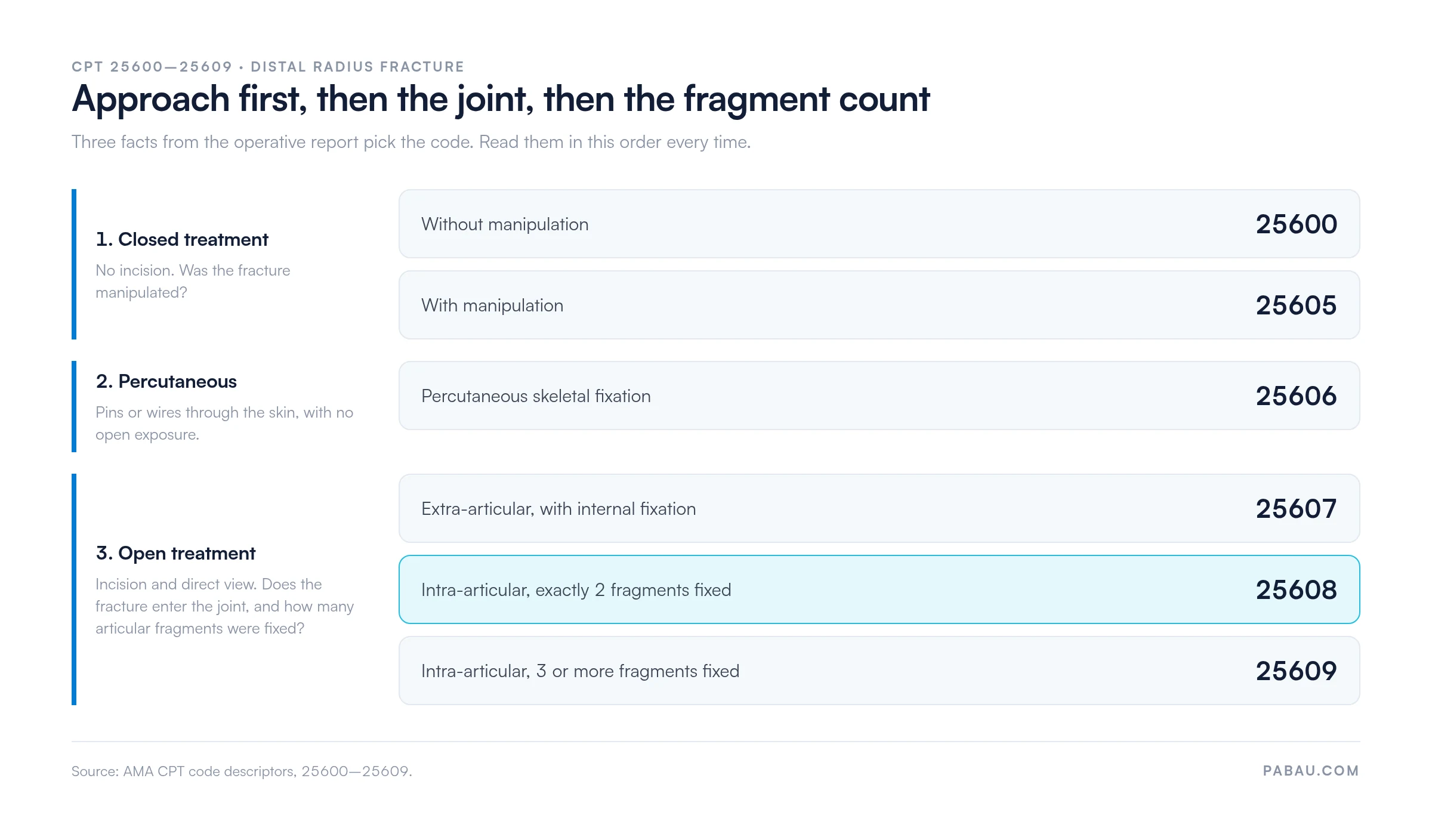
Two rows trip people up. 25606 looks like open treatment because hardware goes in. The pins pass through the skin, though, not through an incision. And 25600 covers a fracture nobody manipulated. That is what a payer expects when splinting was the whole treatment.
The only clinical difference between the two is the number of articular fragments reduced and fixed. 25608 applies to exactly 2. 25609 applies to 3 or more in the same session. Plate size and construct complexity do not enter into it. A long volar locking plate holding two fragments is still 25608.
That puts the burden on the operative report, which has to state the number. Language like “comminuted fracture reduced with plate fixation” will not support 25609. Query the surgeon before the claim goes out. Fragment count is one of the most flagged items in orthopedic coding audits.
Every 25608 claim needs a side. Most payers reject it outright without -RT or -LT. That single omission drives more front-end rejections than the rest of the modifier set combined. What else you append depends on what happened in the operating room.
Medicare values CPT code 25608 at 23.11 total RVUs, which works out to roughly $772 nationally before geographic adjustment.
Each component is then adjusted by its own geographic index, so your locality moves the number. The CMS Physician Fee Schedule lookup tool gives the figure for your ZIP code.
CMS publishes the same practice expense RVU for both settings on this code. The site of service does not change the surgeon’s payment. Use the FastRVU lookup tool to confirm the current values and apply your geographic practice cost index.
Implant costs sit outside that payment. The hospital or ASC bills for the volar locking plate and screws under its own rate. That charge never runs through the surgeon’s 25608 line.
Confirm with the facility that implant documentation is complete before either claim goes out. That keeps the same hardware from being charged twice.
Medicare now runs two conversion factors, one for qualifying APM participants and one for everyone else. Check which applies to your group before you set an internal fee schedule. Both reset every January 1, so lock the schedule in at the start of the calendar year.
Under Medicare Part B, 25608 is a major surgical procedure with a 90-day global period. Payment covers the pre-operative visit the day before surgery, the procedure itself, and routine post-op care inside the window. Commercial payers generally follow that designation, then write their own prior authorization rules on top.
25608 carries a 90-day global surgery period, and the clock starts the day before surgery. Routine post-op care inside that window is bundled into the surgical payment. Bill a separate E/M for a fracture check, a cast change, or suture removal and it will be denied.
Some services do stay separately billable during the window, but only with the right modifier:
Therapy is the exception people forget. Physical and occupational therapy ordered after surgery are not bundled into the surgeon’s global payment. Therapists bill their own evaluation and treatment codes.
A clean 25608 claim starts in the operative report, not in the billing system. Auditors look for language confirming each element of the descriptor. Post-payment takebacks on orthopedic surgical codes usually trace back to one missing line.
Coders learn the code and rarely see what happens to it afterward. Here is the path a 25608 claim takes, and where each stage tends to stall.
Before the claim leaves the practice, run four checks:
Orthopedic surgical codes are among the most audited in the CPT set, and 25608 denials cluster into five patterns. Knowing which denial codes show up most often lets a billing team fix the cause instead of reworking the claim.
Track the reason codes over a quarter and one pattern usually dominates. That is the one worth fixing upstream, in the operative note template or in the pre-auth workflow.
Distal radius ORIF rarely happens alone. Several codes are regularly reported in the same operative session. Knowing which pairings trigger an NCCI edit prevents both undercoding and rejection.
Every 25608 claim needs a diagnosis code that supports the surgery, carrying the correct side and encounter character. A wrong 7th character is one of the most common front-end rejections on this code.
Use 7th character “A” at the time of surgery. On the S52 codes above, “A” means initial encounter for a closed fracture. Open treatment describes how the surgeon reached the bone.
Whether the skin was broken is a separate fact, and that is what the 7th character reports. Post-operative visits inside the global period use “D”, and “S” is reserved for sequela claims.
A 25608 claim usually fails upstream of the billing screen. The fragment count reads as vague. The side never made it into the note. The authorization number is sitting in someone’s inbox. By the time the claim is built, the coder is rebuilding the case from memory.
Practice management software like Pabau closes that distance by holding the record and the claim in one system. The CPT code attached to the service lands on the charge line. ICD-10 slots are seeded from the patient’s recorded problem list. Required fields, authorization codes included, have to be complete before the send button unlocks.
For US practices, submission runs through Claim.MD. Eligibility checks, claim status tracking, and ERA remittance posting come back down the same pipeline. Modifier selection still belongs to the coder, but a claim missing a required field never leaves the practice.
For a surgical practice, orthopedic claims management pays off in two places. Fewer claims come back for rework, and fewer queries land on a surgeon’s desk three weeks after the case.
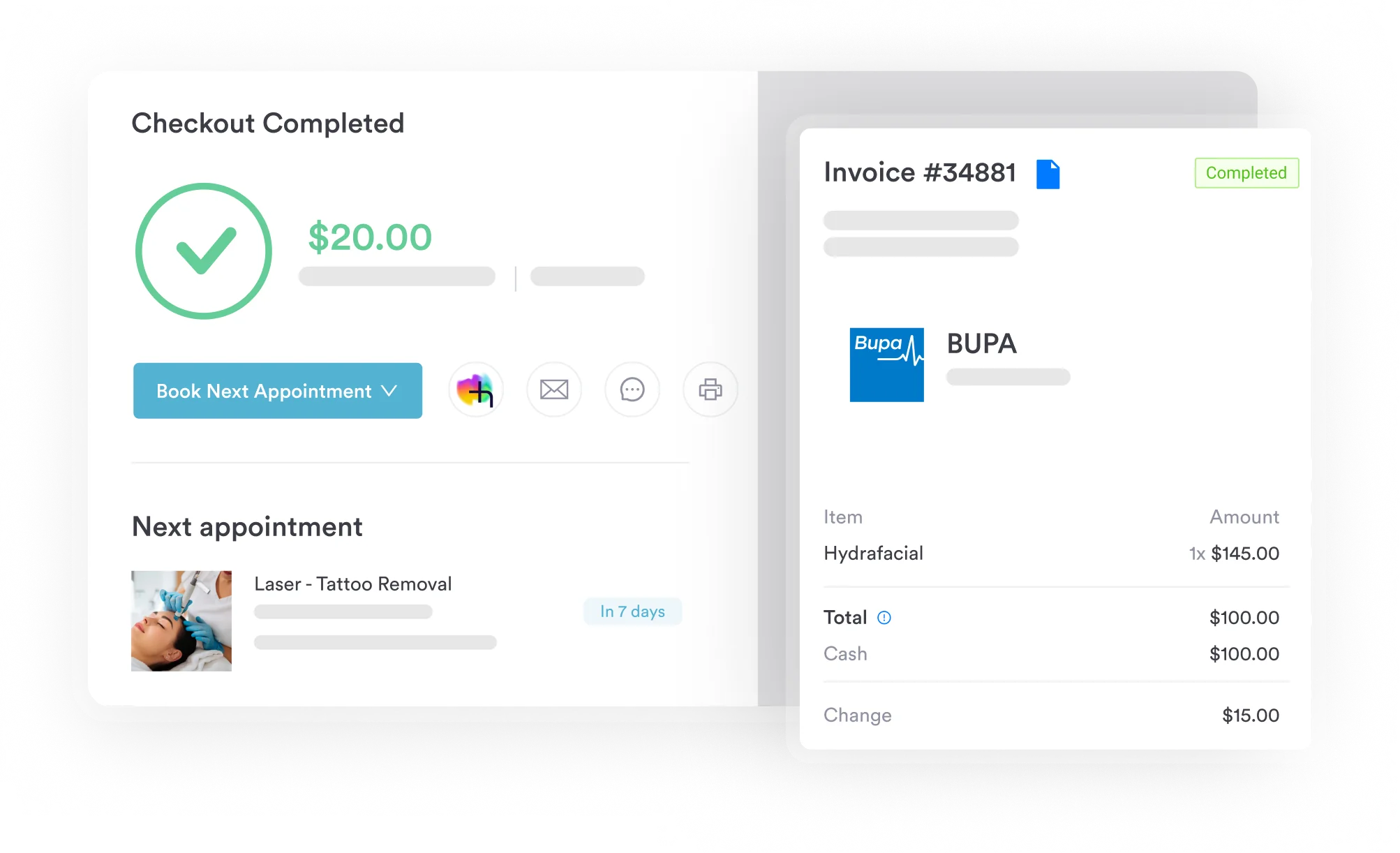

Pabau builds the claim from the patient record, checks required fields before submission, and tracks status and remittance through Claim.MD. Your billing team reworks fewer orthopedic claims.

25608 is a narrow code, and that is what makes it manageable. Open approach, intra-articular fracture, internal fixation, exactly two fragments. When a claim on this code fails, one of those four is usually missing from the operative report. Sometimes it is the side, missing from the claim line.
So the fix sits upstream of billing. Build the fragment count into the operative note template and the rest of the claim follows. Query the surgeon while the case is fresh, rather than when a denial arrives 45 days later.
If your billing team is rebuilding surgical claims from memory, that is a workflow problem worth solving. Book a demo to see how Pabau carries the operative record straight through to the claim.

Need a framework for managing claim denials systematically? Denial management in healthcare covers workflows for tracking, appealing, and preventing common orthopedic claim rejections.
Want to know what makes a surgical claim clean? Submitting a clean claim breaks down the fields, attachments, and payer requirements behind first-pass acceptance rates.
Looking for guidance on the 837 electronic claim format? 837 claim file submission explains the transaction set used to send 25608 and other surgical codes to payers.
Building the charge sheet for a surgical case? What a superbill includes walks through the fields a payer expects on the document that feeds the claim.
Yes, but report it once per side. Most payers want two lines carrying -RT and -LT, each supported by its own documentation. Some commercial plans prefer modifier -50 on a single line instead. Check the payer’s bilateral surgery policy before you submit.
Yes. The descriptor names epiphyseal separation alongside intra-articular fracture, so a physeal injury of the distal radius fits. Pair the claim with S59.201A or S59.202A, and document the two fixed fragments exactly as you would for an adult.
25608. The code follows the articular fragments reduced and fixed during the case, not the fragments visible on pre-operative imaging. Ask the surgeon to state the fixed count in the operative report so the claim and the record agree.
No. CMS publishes the same RVUs for 25608 in both settings, so the surgeon’s allowable is identical. The facility bills its own rate separately, which is why implant documentation should be coordinated before either claim goes out.



