

HCPCS Code Q4185: Cellesta flowable amnion billing guide
HCPCS Code Q4185: definition and official descriptor HCPCS Code Q4185 is the Lev...

Last Updated: Nov 20, 2026
23410 is the CPT code for repair of ruptured musculotendinous cuff (eg, rotator cuff) open; acute. It covers open surgical repair of a recently torn rotator cuff through a formal incision.
Coders most often stumble on this code at two decision points. The first is choosing between 23410 (acute) and 23412 (chronic) when documentation is ambiguous. The second is telling the open approach apart from arthroscopic CPT 29827.
Let Pabau's smart automation suggest the right codes, reduce claim denials, and keep your practice compliant—effortlessly.
Automate repetitive tasks and focus on what matters most—your patients.
Reduce coding errors and ensure compliance with the latest regulations.
Clean claims, fewer denials, and faster reimbursements.
Powerful insights and reporting to help your practice thrive.
HIPAA compliant SOC 2 certified GDPR-compliant Trusted by 4,000+ clinics worldwide

CPT code 23410 covers open repair of a ruptured rotator cuff in the acute phase. Chronic tears bill under 23412, and arthroscopic repairs under 29827.
Documentation must establish acuity. Operative notes should describe fresh tendon tissue, hemorrhage, or a clinical history of sudden-onset injury.
Most payers require modifier LT or RT for laterality, and a missing one is a common denial reason for shoulder surgery codes.
In 2026, 23410 carries 11.11 work RVUs and 22.90 total facility RVUs, slightly less than the chronic code 23412.
Pabau’s claims management tracks the prior authorization on the patient’s case and sends US claims through Claim.MD with eligibility checks and ERA remittances.
CPT code 23410 is the code for open repair of a ruptured rotator cuff in the acute phase.
CMS’s 2026 relative value file lists it as “Repair rotator cuff acute,” a 90-day global surgery with 11.11 work RVUs.
The code sits in the musculoskeletal section of the AMA CPT code set, in the 23395-23491 range for shoulder repair, revision, and reconstruction. The official descriptor reads: Repair of ruptured musculotendinous cuff (eg, rotator cuff) open; acute.
The AMA maintains the CPT code set and publishes the official descriptor annually. For the authoritative descriptor and any coding guidelines specific to 23410, consult the AMA’s CPT code set overview.
Open rotator cuff repair uses a deltoid-splitting or deltoid-detaching incision that exposes the supraspinatus and, when involved, the infraspinatus tendon. The surgeon debrides frayed tissue, prepares the tuberosity footprint, and reattaches the torn tendon with suture anchors or transosseous tunnels.
The repair counts as open because the surgeon sees the repair site directly through a formal incision, not through arthroscopic portals.
What the operative report must establish for the claim to be payable:
The acute/chronic distinction is a frequent coding question for this code family. CPT 23412 describes open repair of a chronic rotator cuff tear. The surgical approach is the same, but the clinical presentation differs.
The AMA does not define a strict timeframe separating acute from chronic. What matters is what the operative note describes. A patient with six months of symptoms who sustains an acute-on-chronic tear with documented fresh hemorrhage could still support 23410. The documentation drives the code selection, never the other way around.
The decision path below shows how the approach, then the operative findings, narrow the choice to one code and one diagnosis pairing.
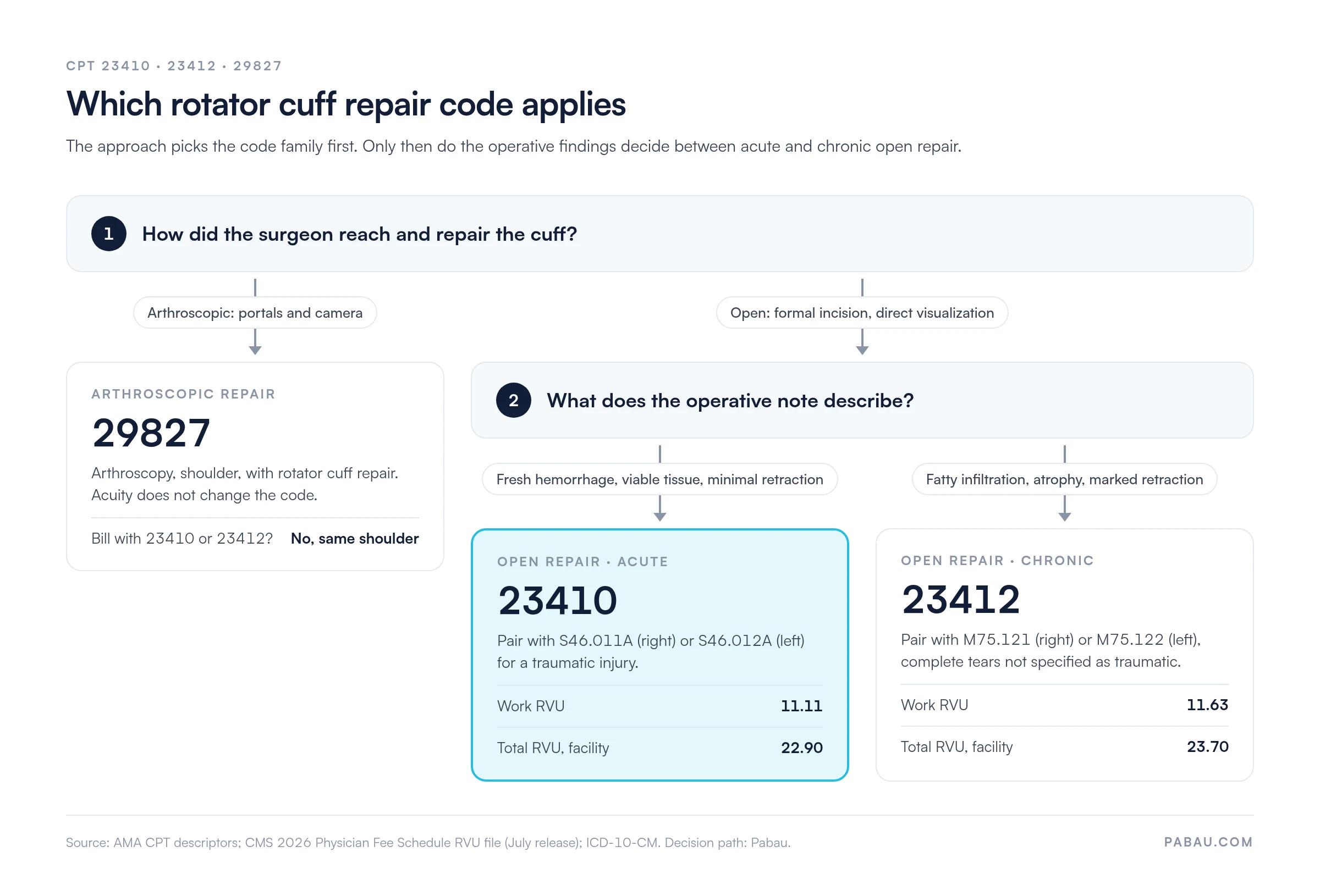
One more factor sits upstream of acuity. The surgical approach decides whether the 23400 series applies at all.
CPT 29827 describes arthroscopic rotator cuff repair. The two codes are mutually exclusive for the same shoulder, because the approach determines code selection, not tear severity or repair complexity.
These are the shoulder codes most often confused with, or billed alongside, CPT code 23410.
A mismatched diagnosis code is a common denial reason for CPT code 23410, alongside missing laterality modifiers. The ICD-10-CM codes you pair with it must reflect an acute injury, not a degenerative process, to support medical necessity for the acute repair.
Laterality in the ICD-10 code and the CPT modifier must match. A right-shoulder S46.011A paired with modifier LT is a laterality conflict. Most clearinghouses catch it on edit, but some claims pass through and deny at the payer level. If the operative note describes a degenerative tear instead, M75.121 or M75.122 points the claim toward 23412. For official ICD-10-CM code lookup and guidance, the CDC/NCHS ICD-10-CM web tool is the authoritative US reference.
Most commercial insurers and Medicare Advantage plans require prior authorization for shoulder surgery. Traditional Medicare (Parts A and B) generally does not require it for CPT 23410. Medicaid requirements vary by state and managed care organization.
Payer-specific prior authorization requirements change frequently. Always verify the patient’s plan-specific requirements before scheduling elective shoulder surgery.
Before scheduling open rotator cuff repair, run an insurance eligibility check and confirm prior auth requirements for the specific plan. Document the authorization number on the claim and in the patient record. For Medicare Advantage patients, check the plan’s list of codes requiring auth — many plans publish a searchable tool. A single missed auth step on a 23410 claim can hold up reimbursement for weeks.
Medicare pays CPT code 23410 from the Physician Fee Schedule, using three RVU components: work, practice expense, and malpractice. Each component is adjusted by a Geographic Practice Cost Index (GPCI) for the payment locality, then multiplied by the annual conversion factor.
At the 2026 conversion factor of $33.4009, 22.90 RVUs come to roughly $765 before locality adjustment. The chronic code 23412 carries 11.63 work RVUs and 23.70 total facility RVUs, so coding acute on thin documentation earns no extra payment.
Dollar amounts move with the annual conversion factor and locality adjustments. The CMS Physician Fee Schedule lookup tool provides current rates by locality, year, and place of service. For a free RVU calculator that imports current CMS data and applies GPCI multipliers, FastRVU’s 2026 lookup is a useful reference. The figures above come from the CMS July 2026 relative value file. Always pull current-year rates from the official CMS tool before billing or quoting reimbursement to physicians.
CPT 23410 carries a 90-day global surgical period under CMS. Routine pre-operative and post-operative services within that window are bundled into the procedure payment. Billing separately for included services is a compliance risk.
What is bundled into the 90-day global period:
What can be billed separately within the global period:
Modifier selection for CPT code 23410 affects both payment and compliance. The laterality modifier matters most, and it is also a frequent omission.
Open rotator cuff repair claims deny for predictable reasons. Each one traces back to a specific root cause in the claim or the operative note.
The National Correct Coding Initiative (NCCI) publishes quarterly edits that determine which procedure code pairs are considered bundled by CMS. For CPT code 23410, bundling most commonly affects ancillary shoulder procedures performed on the same day.
Key NCCI bundling principles for 23410:
Most 23410 denials start before the claim leaves the practice. A laterality modifier is left off, an M75 code rides on an acute repair, or the prior authorization number never reaches the claim. Billing teams often learn about it weeks later, on the remittance.
Pabau, the practice management platform we build, keeps the surgical case and the claim in one record. Its claims management software tracks the authorization code, dates, and sessions on the patient’s case, and warns staff when one is missing.
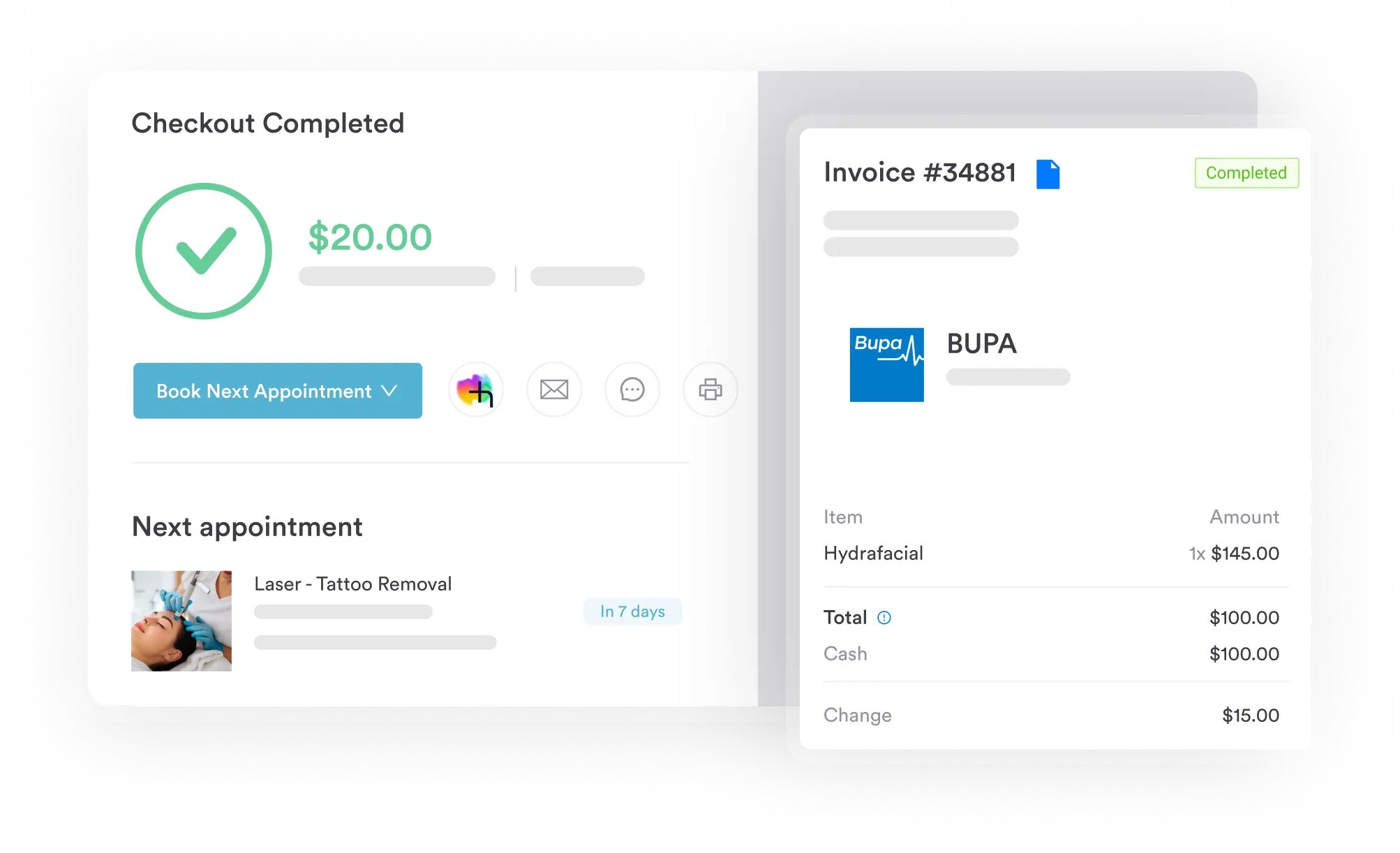
US claims go out as CMS-1500/837P through Claim.MD, our Claim.MD clearinghouse partner. Eligibility checks run before the surgery date, and ERA remittances tie each payment back to its original claim.

Pabau tracks prior authorizations on the case and sends US claims through Claim.MD. Eligibility checks and ERA remittances cut the rework on denied claims.

For CPT code 23410, the operative note decides the claim. When the surgeon records fresh hemorrhage, viable tissue, and the side, the code, the S46.01- diagnosis, and the modifier all follow from it.
Remember that 23410 pays slightly less than 23412. Choosing the acute code on thin documentation buys no revenue and invites an audit, so code to what the note supports.
Book a demo to see how Pabau keeps prior authorizations, claims, and remittances for orthopedic surgery in one workflow.

Need a clearinghouse that catches modifier errors automatically? Pabau’s Claim.MD clearinghouse guide explains how real-time claim validation works across 4,000+ US payers.
Seeing recurring denial patterns across your orthopedic claims? Denial management in healthcare covers root-cause workflows to reduce rework systematically.
Want to understand how claims flow from submission to ERA? Electronic remittance advice (ERA) explains 835 file processing and how ERA ties payments back to original claims.
CPT code 23410 covers open surgical repair of a ruptured (acute) rotator cuff. The surgeon uses a formal open incision, not arthroscopic portals, to directly visualize and reattach a recently torn tendon, typically the supraspinatus or infraspinatus.
CPT 23410 is for acute rotator cuff tears with fresh hemorrhagic tissue and minimal retraction. CPT 23412 is for chronic tears with degenerative changes, fatty infiltration, and significant retraction. The intraoperative findings in the operative report determine which code applies, not the symptom duration alone.
Medicare reimbursement varies by payment locality and changes annually with the conversion factor. In the 2026 fee schedule, 23410 carries 11.11 work RVUs and 22.90 total facility RVUs. Use the CMS Physician Fee Schedule lookup tool for current rates in your locality.
Most payers, including CMS, require modifier LT (left) or RT (right), and a missing one is a common denial cause. Modifier 51 covers multiple procedures on the same date, and 59 unbundles a genuinely distinct service. Modifier 78 marks an unplanned return to the OR.
No. CPT 23410 and 23412 describe the same procedure on the same structure and differ only in acuity. Only one repair code applies per shoulder per operative session. Billing both on the same date for the same shoulder is a duplicate-service edit that payers will reject.
CPT 23410 has a 90-day global surgical period under Medicare. Routine post-operative E&M visits, wound checks, and complication management related to the original surgery are bundled into the procedure payment for 90 days. Unrelated services and return-to-OR complications can be billed separately with appropriate modifiers (24, 78, 79).
The primary ICD-10 pairings for CPT 23410 are S46.011A (right shoulder, initial encounter) and S46.012A (left shoulder, initial encounter). Both are the traumatic rotator cuff injury codes. Avoid M75.121 and M75.122 (complete tears not specified as traumatic) with 23410, as they trigger acute/chronic mismatch denials.





