



CCSD code G5100: Bypass of duodenum billing guide
CCSD code G5100 bills a bypass that leaves the duodenum in place CCSD code G5100...

Last Updated: Oct 16, 2026

CPT code 21465 covers open treatment of a mandibular condylar fracture, whatever fixation the surgeon uses.
There is no closed-treatment code specific to the condyle, so closed care is reported with 21450 or 21451.
Medicare pays the same amount in a facility and an office, because CMS marks non-facility pricing NA for this code.
Condylar-process diagnoses now need laterality, so S02.611A or S02.612A replaces the retired S02.61XA.
Practice management software like Pabau keeps operative documentation, modifiers, and global periods in one record.
CPT code 21465 reports the open treatment of a mandibular condylar fracture. It sits in the Musculoskeletal System chapter of the AMA’s CPT code set, in the Head range that runs from 21000 to 21499.
The code covers surgical access to the fracture, reduction of the condylar segment, and any plates or screws the surgeon places along the way. Fixation hardware is part of that work rather than a separate charge. What defines the code is the incision, not the hardware.
There is no closed-treatment code specific to the condyle. Plenty of coding round-ups cite 21460 as the closed counterpart to 21465, but 21460 is not a CPT code and never has been. Closed care of a condylar fracture is reported with the general mandibular codes, 21450 or 21451.
The operative note has to name the surgical approach to support 21465. Preauricular, retromandibular, and transparotid are the three you will see most often. A note that describes manipulation and arch bars does not support an open code, however displaced the condyle was on imaging.
That distinction decides the payment as much as the code choice does. Reconstructive teams that run structured operative templates in a plastic surgery EMR tend to clear this bar without extra effort.
The approach becomes a required field rather than something the surgeon has to remember to dictate.
Medicare pays about $723.80 for CPT code 21465 in 2026, before locality adjustment. The figure is the same in a hospital, an ambulatory surgical center, and an office. CMS marks the non-facility practice expense “NA” for this code, so there is no separate office rate to chase.
2026 is the first year with two conversion factors. Qualifying participants in an advanced alternative payment model are paid at $33.5675, and everyone else at $33.4009.
The difference is small on a single case, but it compounds across a busy trauma service. Our guide to Medicare billing covers how that split works across the rest of the fee schedule.
Commercial and managed care payers set their own rates against contract terms, so treat these figures as the Medicare baseline. You can confirm your own locality with the CMS Physician Fee Schedule lookup tool.
Locality adjustment moves this payment further than most people expect. Run the 2026 geographic indices across the same 21.67 RVUs and the identical repair pays roughly $665 in Arkansas and roughly $858 in San Jose. Alaska sits above $930 because of its 1.5 work index. Check your own locality before you quote a number to a patient.
CPT code 21465 carries 21.67 total RVUs in 2026, of which 12.79 are work. The facility and non-facility columns are identical, because CMS does not price this code in an office setting. The values below come from the CMS physician fee schedule relative value files.
An “NA” in the non-facility column is a pricing instruction, not a missing value. CMS uses it for procedures it does not expect to see performed in an office. The facility figure then applies wherever the case is billed. Treat any source that shows a higher office rate for 21465 as inverted.
CMS republishes these values every January, and the work RVU has drifted down over recent cycles. It stood at 13.12 in 2024 and 12.79 in 2026. Pull the current file before you build a productivity target around it.
CMS attaches payment policy indicators to every code, and they settle most modifier arguments before they start. For 21465 the bilateral, co-surgeon, and assistant indicators are all permissive, while team surgery is not.
The multiple procedure indicator is 2, so standard reduction rules apply when 21465 is billed alongside another facial repair in the same session. Tracking which modifier belongs on which case is where surgical teams lose money. Pabau’s claims management software keeps that detail attached to the treatment record instead of a side spreadsheet. A clean claim carries the code, the modifiers and the diagnosis in agreement, and needs no rework before payment. Electronic remittance files post payments automatically, and the adjustment codes explain what was reduced and why.
Condylar-process fractures need a laterality code. S02.611A covers the right side and S02.612A the left, both for an initial encounter with a closed fracture. Use S02.610A only where the operative record genuinely does not state a side.
Two codes that still circulate widely are no longer valid. S02.61XA, S02.61XB, and S02.61XD were retired on September 30, 2016, when the condylar subcategory gained laterality.
S02.60XA went the same way, and its replacement is S02.609A. You can check any of these against the current ICD-10-CM code files.
Condylar and subcondylar are separate subcategories, and radiology reports use the terms loosely. If the imaging says subcondylar and the surgeon repaired the condyle, resolve it in the chart before the claim goes out. Query the surgeon rather than picking the code that matches the procedure.
Mandibular fracture codes split along two axes: open versus closed, and whether interdental fixation was used. Picking the wrong sibling is a common audit trigger in oral and maxillofacial surgery, so it helps to see the family side by side.
Facial trauma rarely arrives one fracture at a time. A condylar repair often sits on the same operative note as work on the orbit or the midface. That brings 21407 and 21365 into the same claim.
Frontal sinus involvement adds 21343 to the picture. Sequence the highest-valued code first and let the multiple procedure rules reduce the rest, rather than leaving the payer to guess at the primary procedure.
Groups that also bill musculoskeletal repairs in a sports medicine practice will recognize the same sequencing logic.
Accurate billing for 21465 starts in the operating room. What the surgeon dictates on the day decides whether the claim survives a review months later.
Global periods catch practices out most often when a patient transfers between surgeons mid-recovery. The same applies to other 90-day surgical codes such as codes such as 19316, where the post-operative split has to be agreed in writing before either party bills.
Enrollment details matter too, since a claim under the wrong billing arrangement is denied before anyone reads the operative note. Our guide to the Medicare provider number covers what has to be on file for a surgical group.
Teams still working from scanned paper carry the most risk here. An illegible dictation cannot show the surgical approach, and that single omission turns an open code into a denial.
Structured medical forms and typed operative records remove the argument entirely, and they also make HIPAA compliance easier to demonstrate at audit.
Most surgical billing problems are handoff problems. Think about where the detail for a single condylar repair usually sits.
Each handoff is a chance for something to drop, and a dropped detail on this code costs about $724.
Practice management software like Pabau removes those handoffs by keeping the whole case in one client record. The appointment, the consent, the operative note, the photographs, and the invoice all sit against the same patient. The person coding the claim can see what the surgeon actually did.
That matters most on codes like 21465. One missing sentence about the approach is the difference between payment and a denial. Structured forms turn the approach into a field, and reporting shows which codes are being denied and why.
Pabau’s patient management software ties the clinical and financial sides of a case together. Its digital forms capture pre-operative assessments in a format a payer can follow.
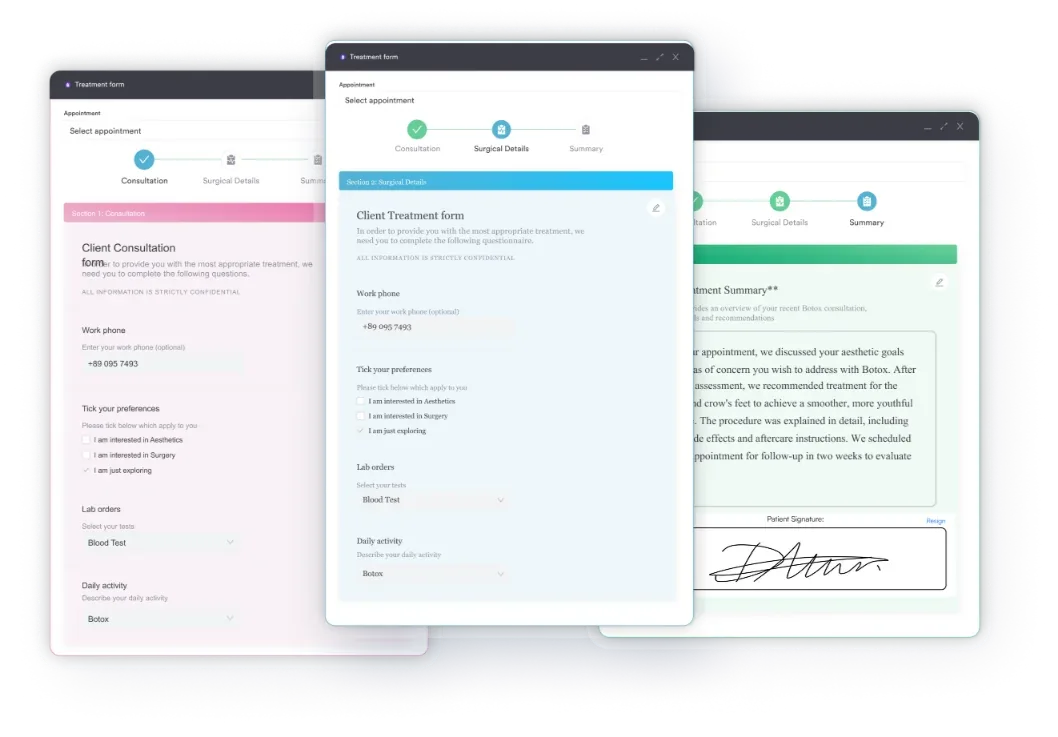
Every Pabau subscription includes every feature, so a two-surgeon practice gets the same reporting and documentation tools as a multi-site group. The practice management software overview walks through how those pieces fit together for a surgical team.

Pabau keeps the operative note, the consent, and the invoice against one client record. Your billing team can see what the surgeon did before the claim ever goes out.

If you take one thing from this page, make it the open-versus-closed test. There is no condyle-specific closed code, so the incision in the operative note is what earns 21465 and its 21.67 RVUs. Everything else follows from that sentence in the chart.
The trade-off worth remembering is that this code rewards documentation discipline rather than clinical complexity. A straightforward repair with a clear approach note gets paid. A difficult one with a vague note does not, and the appeal costs more than the difference.
Fix that at the point of dictation and the rest of the billing cycle gets quieter. Book a demo to see how Pabau keeps operative documentation, modifiers, and global periods together for oral and maxillofacial surgery teams.

Coding a metacarpal fracture that healed with malunion? ICD-10 Code S62.202P covers a left first metacarpal fracture healed with malunion at a follow-up visit.
Coding a healed metacarpal fracture with residual pain? ICD-10 code S62.232S covers the sequela of a first metacarpal fracture once the healing is complete.
Coding another facial fracture repair? CPT code 21337 walks through the closed nasoseptal repair and its documentation requirements.
Billing debridement on the same admission? CPT code 11043 covers depth, measurement, and the reporting rules that decide the unit count.
Coding a late complication from a metacarpal fracture? ICD-10 code S62.367S covers the billable code for late-effect complications of a fifth metacarpal fracture.
CPT code 21465 reports the open treatment of a mandibular condylar fracture. It covers surgical access to the fracture, reduction of the displaced condylar segment, and any plates or screws placed during the repair. The fixation hardware is included in the code rather than billed separately.
No. CPT has no condyle-specific closed code, and 21460 is not a valid code despite appearing in many coding round-ups. Closed care of a condylar fracture is reported with 21450 without manipulation, or 21451 with manipulation.
No. The descriptor reads “Open treatment of mandibular condylar fracture” and says nothing about fixation. Surgical exposure of the fracture site is what defines the code. Where the surgeon places no hardware, the operative note should record the clinical reasoning.
Condylar-process fractures require laterality. Use S02.611A for the right side and S02.612A for the left, both initial encounter for a closed fracture. S02.610A covers an unspecified side. The older S02.61XA was retired in 2016 and will be rejected.
CPT 21465 carries 12.79 work RVUs, 7.42 practice expense RVUs, and 1.46 malpractice RVUs in 2026. That totals 21.67 RVUs. The facility and non-facility values are identical, because CMS marks non-facility pricing NA for this code.
CPT code 21465 carries a 90-day global surgical period under Medicare. Evaluation and management visits inside that window are part of the surgical fee. A new and unrelated problem can be billed separately, provided the note documents it as such.



