



CCSD code G5100: Bypass of duodenum billing guide
CCSD code G5100 bills a bypass that leaves the duodenum in place CCSD code G5100...

Last Updated: Oct 16, 2026

CPT Code 21343 covers open treatment of a depressed frontal sinus fracture, reported under the head fracture and dislocation subsection.
The global period is 090 days, so routine postoperative care for three months is bundled into the surgical fee.
Facility and non-facility RVU values differ, so check current work RVU figures against the CMS Physician Fee Schedule before billing.
The operative note decides between 21343 and 21344, since posterior table repair or cranialization moves the case to 21344.
Practice management software like Pabau links CPT selection to the treatment record, so coders and surgeons work from one document.
CPT Code 21343 is the billable code for open treatment of a depressed frontal sinus fracture. It covers surgical access to the fracture site, elevation of the depressed bone fragments, and stabilization of the anterior table. Coders reach for it when facial trauma goes to the operating room without documented intracranial involvement.
This reference covers the official descriptor, RVU structure, global period, Medicare reimbursement, modifiers, and the ICD-10 codes that support medical necessity.
It also compares 21343 with 21340, 21344, and 21345, the adjacent codes coders most often confuse it with. Plastic surgery practices and oral and maxillofacial groups bill this code from trauma referrals.
The American Medical Association (AMA) maintains the CPT code set and classifies 21343 as major surgery. A clean claim needs the right supporting ICD-10 diagnosis, accurate modifiers, and an operative note confirming open access, reduction, and stabilization.
CPT Code 21343 carries the following official descriptors as published in the AMA CPT manual:
In lay terms, the surgeon makes an incision to reach a frontal sinus fracture where bone fragments have been pushed inward.
The physician then elevates or repositions the displaced bone, stabilizes the fragments, and repairs the anterior or posterior table as needed. Open treatment means surgical access to the fracture site, not manipulation from outside the skin surface.
The frontal sinus sits behind the forehead, between the outer and inner tables of the skull. Depressed fractures here carry a risk of intracranial involvement and dural injury.
That risk is why the choice between 21343 and 21344 rests on a careful read of the operative report. When no intracranial injury or significant dural disruption is documented, 21343 is usually the right code.
Before billing CPT Code 21343, confirm the operative note reflects each of these stages. A note that records the fracture diagnosis without confirming open access and fragment reduction will not support the code on audit.
The American Association of Oral and Maxillofacial Surgeons publishes a Trauma Coding Paper that references 21343 for frontal sinus repair.
Coders in oral, maxillofacial, or head and neck surgery can treat it as a specialty companion to the AMA CPT manual. It also answers common sequencing questions about facial fracture repairs billed alongside 21343.
Relative Value Units (RVUs) drive the base reimbursement calculation under the Medicare Physician Fee Schedule (MPFS). The FastRVU 2026 lookup tool and the CMS MPFS data files are the most reliable sources for current figures. RVUs are adjusted every year, so check the current fiscal year before billing.
Because 21343 is major surgery, the facility rate applies in almost every billing scenario. Open frontal sinus repair needs an operating room, which means a hospital or an ambulatory surgery center.
The non-facility rate applies only in the rare case of an office-based operating room. Record the place of service accurately so the payer applies the correct RVU tier.
Check CPT Code 21343 RVU values in the CMS Physician Fee Schedule Look-Up Tool at the start of each calendar year. AMA and CMS publish RVU updates annually, and reusing a prior-year value can lead to under- or overbilling.
CPT Code 21343 carries a 090-day global period under the Medicare global surgical package policy. That matches the CMS standard for major surgery. Medicare and most commercial payers bundle the following services into the single surgical fee, with no separate payment during the global window:
Some services sit outside the package and can be billed separately:
Append modifier -25 to the qualifying E/M code and document medical necessity clearly.
Payers flag these claims for medical review more often than they used to. Surgical trauma cases draw extra attention, because follow-up visits are expected to be frequent.
Hand the patient a structured patient discharge form at the end of the surgical visit. It records the postoperative plan and dates the start of the 90-day window.
Practices managing reconstructive surgery workflows should flag when each patient’s 90-day global window expires. Billing a follow-up visit inside the global period without a qualifying modifier is one of the most common audit recoveries in surgical practices.
Medicare payment for CPT Code 21343 starts with the total RVU multiplied by the annual conversion factor. That figure is then adjusted for the Geographic Practice Cost Index (GPCI) of the provider’s locality.
The CMS Physician Fee Schedule lookup tool searches current allowed amounts by locality and place of service. Geographic adjustment varies widely, so a metropolitan practice and a rural one are paid different amounts for the same code.
Key reimbursement considerations for 21343 claims:
Practice management software like Pabau tracks reimbursement outcomes by CPT code, so procedure documentation and payment data sit in one platform. Pabau’s claims management software keeps that reporting in the same system your team already documents in, with no separate export.
Modifier selection for 21343 follows standard CMS National Correct Coding Initiative rules. Incorrect modifiers are among the most common reasons surgical claims are rejected. The table below covers the modifiers that apply most often to this code:
Modifier -22 needs the most careful documentation. Writing “complex case” in the operative note is not enough. The note has to name what pushed the case beyond the usual, such as severe comminution, a sinus obliteration decision, or scarring from previous surgery. Payers increasingly ask for a written explanation before they process a claim carrying -22. Payment for this code arrives with a remittance advice that explains any adjustment line by line.
Pairing 21343 with an unsupported ICD-10 diagnosis is a fast route to a medical necessity denial. The codes below are commonly accepted as supporting open treatment of a depressed frontal sinus fracture.
Local determinations vary, so check coverage against your MAC and your payer’s policies. Head trauma often carries a companion diagnosis, and codes such as codes such as S06.6X1D can appear on the same claim.
The 7th character extension is mandatory on every ICD-10-CM injury code. Claims submitted without it are usually rejected at the clearinghouse. The initial surgical encounter takes “A”, and follow-up visits inside the global period take “D”. Sequela coding with “S” applies when a late effect of the fracture is treated after healing is complete.
Operative note completeness decides whether 21343 survives a retrospective audit. Many of these fractures arrive by referral from emergency departments or sports medicine practices, so the imaging predates the surgical visit. Reference that scan by date in the note. Do not submit 21343 until the report documents each of the following:
Three denial triggers account for most 21343 rejections. The first is submitting the code with no CT imaging referenced in the note. The second is billing 21343 when the documentation actually describes 21344 criteria. The third is a missing 7th character on the ICD-10 code.
Keeping HIPAA-compliant documentation practices satisfies the regulator and builds an audit-ready record at the same time, which cuts claim review time. Digital operative note templates in your practice management system capture the mandatory fields before a case is closed.

CPT Code 21343 sits in a cluster of codes covering different approaches and complexity levels for facial fracture repair. The AAPC Codify CPT lookup and the AMA CPT manual are the authoritative references for comparing descriptors.
Open fracture codes elsewhere in the musculoskeletal chapter, such as 22318, follow the same open-versus-closed logic.
The distinction between 21343 and 21344 is the one that moves money. If the operative report documents posterior table involvement with significant dural repair, brain injury management, or sinus cranialization, the case has crossed into 21344.
Upcoding to 21344 without that documentation is an audit risk. Downcoding a 21344 case to 21343 costs the practice reimbursement it has earned.
Before assigning 21343 or 21344, ask one question. Does the operative report describe posterior table repair, sinus cranialization, or intracranial access? If it does, review the 21344 criteria. If the repair stayed on the anterior table with standard fragment reduction, 21343 is the right code.
Standalone code lookup tools make billing staff leave the practice management system, find a code, and re-enter it on the claim. Every handoff is a chance to mistype something.
Pabau puts procedure code selection inside the clinical documentation workflow instead. Surgeons confirm the CPT code while documenting the treatment, and billing staff work from that same record.
For surgical codes like 21343, that matters most at the modifier and ICD-10 pairing level. The patient record management tools keep operative documentation, diagnosis codes, and billing codes linked in one record.
A claim is far less likely to go out with the wrong 7th character or a missing modifier. Software for plastic surgeons earns its place here because surgical billing lives or dies by the operative note.
Pabau also reports at procedure level. A billing manager can see how often 21343 is billed, what average reimbursement looks like, and where claims are denied. None of that needs an export to a separate analytics tool.
Those numbers show whether a documentation pattern is driving denials before a payer opens a formal review. Among surgical practice management tools, that closed loop is what turns a denial trend into something you catch early.
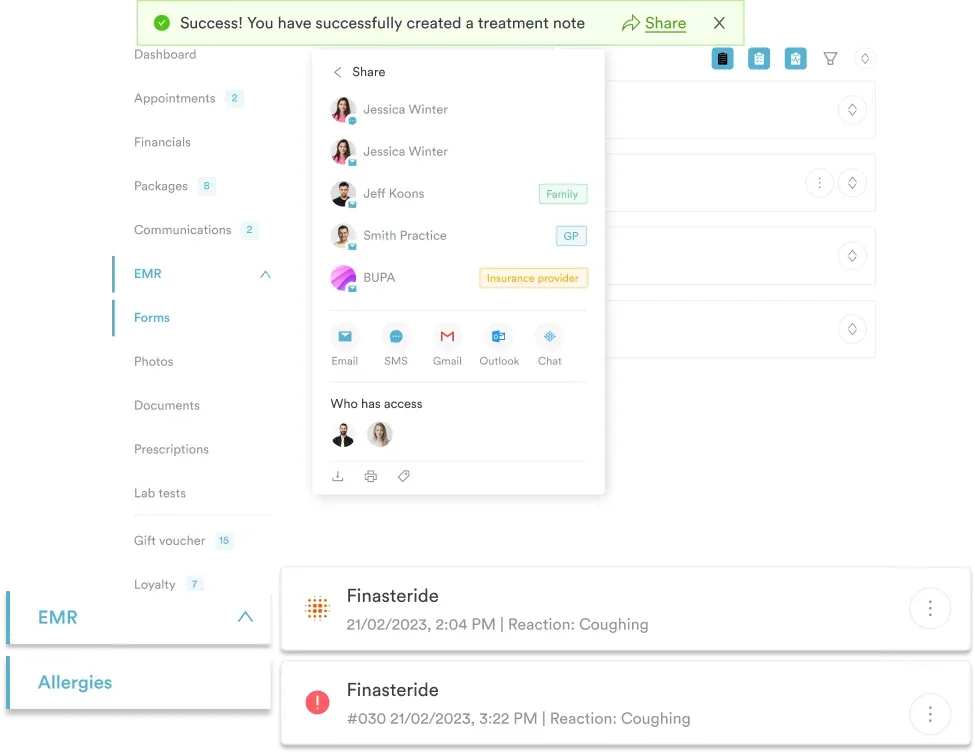

Pabau puts CPT code selection inside the treatment record, so surgeons and billing staff work from the same documentation. Track global periods, store operative notes, and send cleaner claims.

21343 is a narrow code, and the operative note is what keeps it defensible. Write the note so a reviewer can see open access, the reduction, the fixation, and which sinus table was treated. Choose the code after that, never before.
The trade-off worth remembering sits between 21343 and 21344. Reaching for the higher code without posterior table documentation invites recoupment. Staying with 21343 on a case that clearly crossed the line gives away money the practice has already earned. One line in the operative report settles it.
Keeping the note, the diagnosis, and the code in one linked record is what makes that judgment quick instead of a scavenger hunt. Book a demo to see how Pabau handles frontal sinus fracture billing from operative note to submitted claim.

Billing another plastic surgery procedure? 19324 covers the descriptor, documentation requirements, and denial triggers for that code.
Coding a head injury alongside the fracture? S06.2X2D explains the encounter characters and the documentation each one needs.
Coding a kidney contusion follow-up visit? ICD-10 Code S37.029D covers a major contusion of an unspecified kidney once active treatment has ended.
Coding an adrenal gland injury? ICD-10 code S37.812A covers an adrenal gland contusion at the initial encounter and notes the related laceration code.
CPT Code 21343 bills open surgical treatment of a depressed frontal sinus fracture. The procedure covers surgical access to the fracture site, reduction of displaced bone fragments, and stabilization of the anterior table. It sits in the Musculoskeletal System’s Fracture and/or Dislocation Procedures on the Head subsection of the AMA CPT manual.
The global period is 090 days, which classifies 21343 as major surgery under CMS guidelines. Every routine postoperative visit within 90 days of surgery is bundled into the surgical fee. Services outside the package can be billed separately with the right documentation and modifier. Those include a return to the operating room and an unrelated procedure.
CPT 21343 covers open treatment of a depressed frontal sinus fracture limited to the anterior table, with no complex intracranial involvement. CPT 21344 describes a more complex repair involving the posterior wall, severe comminution, or a coronal or multiple-approach access. The operative report decides it: posterior table repair or intracranial access moves the case from 21343 to 21344.
The codes paired most often are S02.19XA for a closed fracture of other specified skull and facial bones, and S02.19XB for the open fracture equivalent. S02.0XXA and S02.0XXB apply when frontal bone involvement extends to the skull vault. Every injury code needs the correct 7th character: A for the initial encounter, D for subsequent, and S for sequela. Check pairing acceptability against your MAC’s local coverage determination.
Medicare reimbursement is the total RVU multiplied by the annual CMS conversion factor, adjusted for the provider’s Geographic Practice Cost Index locality. Geographic adjustment varies widely across the United States, so the allowed amount differs by location. Use the CMS Physician Fee Schedule Look-Up Tool to pull current rates by place of service and locality before billing.
The operative report must record the supporting CT imaging, the surgical access approach, the reduction and stabilization technique, and the extent of sinus table involvement. It also has to identify the surgeon, and both surgeons when modifier -62 is appended. With modifier -22, the note must quantify what pushed the case beyond the usual complexity. Incomplete operative reports are the leading cause of retrospective denial and recoupment for this code.



