

HCPCS Code L0472: Hyperextension TLSO billing guide
HCPCS code L0472: Official descriptor and device definition HCPCS code L0472 des...

Last Updated: Nov 5, 2026
19101 is the CPT code for biopsy of breast; open, incisional. The surgeon makes a skin incision, reaches the lesion and removes a tissue sample for pathology, without aiming for clear margins.
It differs from needle core biopsy (19100) and the percutaneous imaging-guided codes (19081-19086), which need no incision. A wire, seed or clip placed before surgery goes on its own line with a code from 19281-19288.
Let Pabau's smart automation suggest the right codes, reduce claim denials, and keep your practice compliant—effortlessly.
Automate repetitive tasks and focus on what matters most—your patients.
Reduce coding errors and ensure compliance with the latest regulations.
Clean claims, fewer denials, and faster reimbursements.
Powerful insights and reporting to help your practice thrive.
HIPAA compliant SOC 2 certified GDPR-compliant Trusted by 4,000+ clinics worldwide

CPT Code 19101 describes an open incisional (surgical) breast biopsy performed through a skin incision. It is distinct from needle core biopsy without imaging (19100) and the percutaneous imaging-guided codes (19081-19086).
Imaging-guided localization before an open biopsy does not change the code: report 19101 plus a placement code from 19281-19288.
The operative note must document the open/incisional approach, specimen laterality, and any localization device placed beforehand. Missing any of these invites a denial.
Pabau’s claims management software builds the CMS-1500 claim from the invoice and checks it for missing or invalid details before it goes to Claim.MD.
CPT Code 19101 reports an open incisional breast biopsy, where the surgeon makes a skin incision and removes part of a lesion for diagnosis.
It sits in the breast subsection of the integumentary system range in the Surgery section of the AMA CPT code set. Use this table to confirm the code before you build the claim.
The official AMA CPT descriptor for 19101 is: Biopsy of breast; open, incisional. In plain clinical terms, the surgeon makes a skin incision, dissects to the target lesion, and removes a tissue specimen for pathological analysis. The intent is diagnostic. The surgeon removes a sample rather than the whole lesion and does not aim for clear surgical margins.
Bundled within 19101: Local or regional anesthesia administered by the operating surgeon, wound closure, and routine intraoperative hemostasis.
Not included in 19101 (bill separately if performed):
The localization exclusion is the most consequential. A non-palpable lesion is often marked with a wire or seed under imaging before surgery. The surgeon still reports 19101 for the open biopsy, and the placement goes on its own line with a code from 19281-19288. Imaging used during an open biopsy never turns it into a percutaneous code.
CPT 19100 reports a percutaneous needle core breast biopsy without imaging guidance. It is the code most often confused with CPT Code 19101. The difference is the approach. 19100 needs no skin incision, while 19101 requires one.
If the operative note describes a needle core approach with no incision and no imaging guidance, 19100 is correct. If it documents an incision, dissection, and specimen excision, CPT Code 19101 applies. See the AMA’s CPT code set overview for the governing descriptor definitions.
CPT 19081-19086 describe percutaneous needle breast biopsies that include imaging guidance. Each modality has a first-lesion code and an add-on for each additional lesion. They are not alternatives to an open incisional biopsy: the approach, not the imaging, decides the code.
The practical rule comes down to two questions, mapped in the diagram below. A percutaneous imaging-guided biopsy takes a code from 19081-19086, starting with 19081 for a stereotactic first lesion. An open biopsy stays 19101, with or without imaging. When a localization device is placed first, add the matching 19281-19288 code.
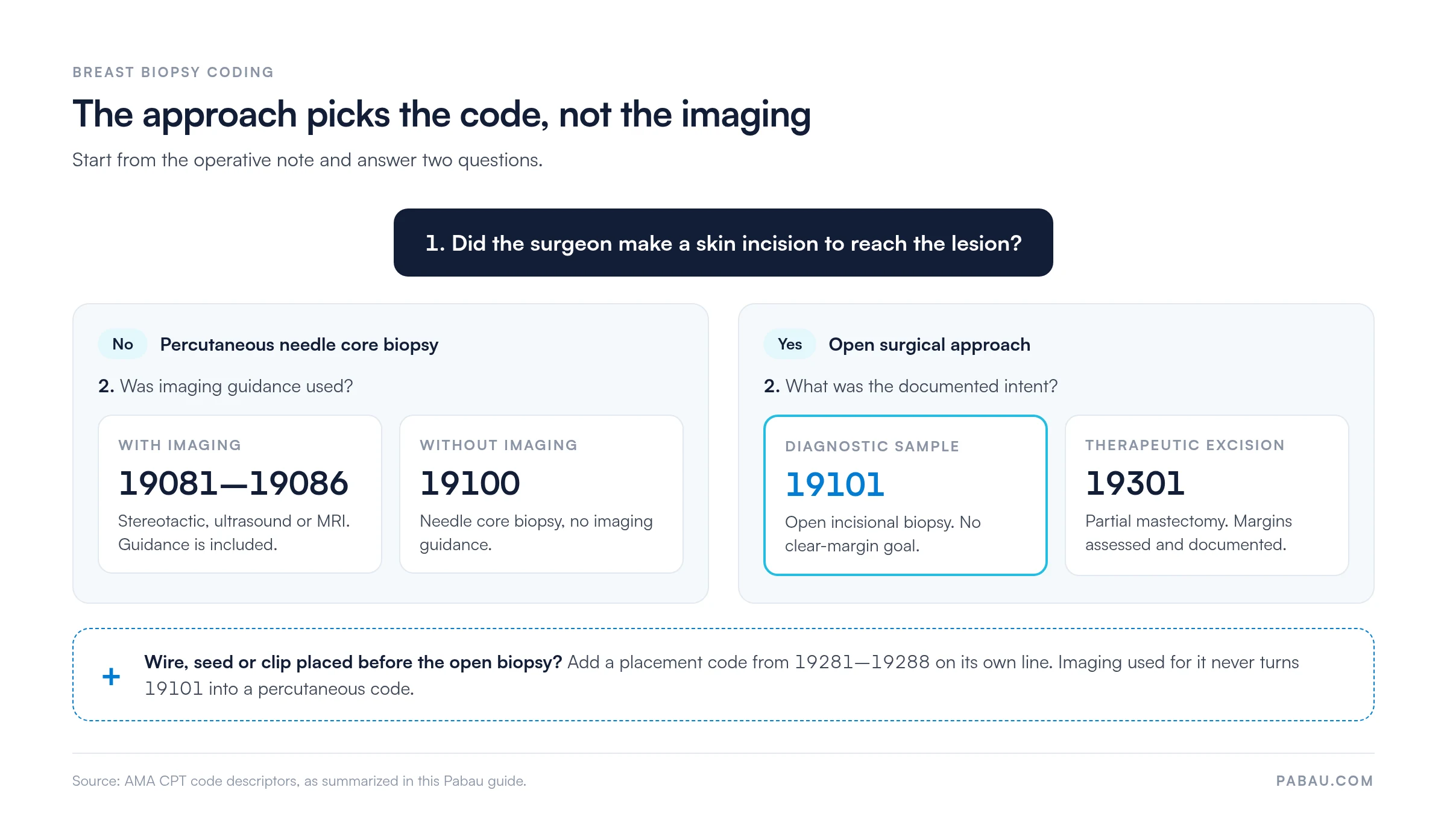
The radiologist bills the placement code when a different provider places the device.
19301 covers partial mastectomy, including lumpectomy, and it is the most common upcoding risk for 19101. Both involve surgical excision of breast tissue through an open approach. The differentiator is intent and margin documentation.
Sometimes frozen-section pathology confirms malignancy and the biopsy converts to a therapeutic excision. The operative note must then document this change of intent to support the higher-level code. Without that documentation, payers will downcode 19301 to 19101 on audit.
Every element below must appear in the operative note, because a payer that finds one missing can deny the claim. In an audit, the same omission can trigger recoupment of 19101 claims already paid.
Audit 19101 documentation before submission. Check that your operative note template includes a laterality field, a localization statement, and a margin-intent statement. A one-time template review prevents the most common denial triggers across your entire breast biopsy caseload.
The ICD-10-CM diagnosis code on a 19101 claim establishes medical necessity. Laterality in the diagnosis code must match laterality in the procedure code. A left-sided biopsy claimed with a right-sided diagnosis code triggers an automatic edit. Below are the most commonly paired codes.
When the biopsy indication is a mammographic finding rather than a palpable mass, R92.8 is often the most accurate code before pathology returns. Once pathology returns, update the diagnosis on subsequent claims to reflect the confirmed finding.
A wrong or missing modifier is a common reason a 19101 claim stops at an edit. The table below covers the modifiers coders encounter most often on this code, with payer-specific notes where they diverge.
For medical billing compliance, always verify Modifier 50 billing rules with the specific payer before submission. Medicare and commercial payers handle bilateral coding differently, and mixing up the approach can cause underpayment or denial.
Medicare reimburses CPT Code 19101 through the Medicare Physician Fee Schedule (MPFS) using a resource-based relative value unit (RVU) calculation. Payment adds work, practice expense, and malpractice RVUs, each adjusted by the geographic factor for the practice location. That total is multiplied by the annual conversion factor.
Because rates change annually and vary by Medicare Administrative Contractor (MAC) locality, never use a fixed published dollar figure for 19101. Use the CMS Physician Fee Schedule lookup tool to retrieve the current year’s payment for your locality. For RVU values, the FastRVU lookup tool provides current work, practice expense, and malpractice RVUs with geographic multipliers.
10-day global period: Within the 10-day postoperative global period bundled with 19101, Medicare will not separately reimburse routine follow-up visits, dressing changes, or staple/suture removal. Bill additional E/M services in this period only when the visit addresses a complication or a new, unrelated problem. Append Modifier 24 to the E/M code and document the distinction.
Prior authorization: Medicare does not require prior authorization for CPT 19101 as of the current PA requirements list, but commercial payer requirements vary widely. Major commercial payers often ask for:
Contact each payer or check their portal before scheduling. Getting authorization after a denial is much harder than securing it in advance. Billing software such as Pabau runs eligibility checks through its Claim.MD integration. Your team can then confirm coverage at scheduling rather than at claim submission.
Localization device placement — wire, seed, radioactive marker, or clip — guides the surgeon to a non-palpable lesion. It is reported separately from CPT Code 19101 with its own code.
Codes for localization device placement (19281-19288):
When a radiologist places the localization device before the surgeon performs the open biopsy, each provider bills their own component. The radiologist bills the placement code, such as 19281 for a first lesion under mammographic guidance. The surgeon bills CPT Code 19101 for the biopsy. NCCI edits do not bundle these when separate providers perform them on the same date.
The same surgeon sometimes performs both the localization and the biopsy. Both codes remain separately reportable in that case, provided each service is documented on its own. Record each component as a distinct service in the operative note, so both codes hold up when billed on the same date.
Before billing localization codes alongside 19101, check whether the payer’s LCD specifies that localization must be performed in a radiology setting to be separately reportable. Some MACs restrict dual-billing when the surgeon performs both components in the operating room.
Open incisional breast biopsy claims are denied for a predictable set of reasons. The table below maps the most common triggers to their root cause and the correction to make before resubmission.
For structured denial management workflows, track 19101 denial reasons by payer over a rolling 90-day window. The trend shows whether the problem sits in your documentation template or in a payer’s unannounced policy change. Each remittance names the denial with standard medical billing denial codes, which point your team to the root cause.
A 19101 claim often involves two providers. The radiologist places the localization device, the surgeon performs the open biopsy, and a coder sorts out who bills which line. Each hand-off is a chance to drop a laterality modifier or a prior authorization number.
In Pabau, the CMS-1500 claim is built from the invoice you already raised and goes out through Claim.MD. Claim validation scrubs it for missing or invalid details first, and eligibility checks through Claim.MD run before the visit. Your coder still owns the code and modifier decisions, but nobody re-types them.
Claim status and ERA payments are tracked in the claims dashboard, next to the invoice they came from.

Pabau’s claim validation checks claims for missing or invalid details before submission, so fewer 19101 claims bounce back. Claim.MD returns status and remittances, and Pabau shows the reason for any rejection.

Choose 19101 by the approach in the operative note, never by the imaging used around it. When a wire or seed went in first, the separate 19281-19288 line is where the localization gets paid.
The change that pays back fastest is in your operative note template. Give it fields for approach, laterality, localization and intent, and coders stop chasing surgeons for details after a denial.
Pabau’s claims management software then turns the invoice into a CMS-1500 and checks it for missing or invalid details before submission. Book a demo to see how it fits your breast surgery billing.

Wondering how a clearinghouse moves your surgical claims? Our Claim.MD clearinghouse guide explains claim submission, status tracking and ERA processing.
Seeing recurring denials across your surgical caseload? Submitting a clean claim breaks down the components payers check at first pass and how to eliminate the most common rejection triggers.
Want to understand how the ERA maps to your 19101 denials? Electronic remittance advice explained covers how to read ERA files, interpret CARC denial reason codes, and structure your appeals workflow.
Billing an ultrasound-guided needle biopsy instead? CPT code 19083 covers the percutaneous first-lesion code with ultrasound guidance included.
Localizing the lesion under ultrasound first? CPT code 19285 explains the placement code that goes on its own line beside 19101.
CPT code 19101 is the billing code for an open incisional breast biopsy. The surgeon makes an incision to access and remove a breast tissue specimen for pathological examination. It falls within the integumentary system breast surgery code range (19000-19499) and carries a 10-day global period under Medicare.
No. CPT 19101 is an open incisional biopsy, and imaging used during it does not change the code. Percutaneous imaging-guided needle biopsies use 19081-19086, which include the guidance. If a localization device is placed before the open biopsy, report it with 19281-19288, which also include imaging. The radiologist bills that placement when a different provider performs it.
CPT 19100 covers a percutaneous needle core biopsy done without imaging guidance or a skin incision. CPT 19101 covers an open incisional biopsy, which requires a surgical incision to access the target tissue. If the operative note documents a needle core approach without imaging guidance, use 19100. With imaging guidance, use 19081-19086. If it documents an incision and open dissection, use 19101.
CPT Code 19101 carries a 10-day global surgical period under the Medicare Physician Fee Schedule. Routine follow-up visits, suture removal, and dressing changes within this period are bundled and not separately payable. E/M services addressing a new or unrelated problem during the global period require Modifier 24 and documentation confirming the distinction.
For bilateral open incisional biopsies in the same session, Medicare requires Modifier 50 on a single claim line. Payment is 150% of the fee schedule amount. Most commercial payers prefer two separate claim lines with LT (left) and RT (right) modifiers instead. Always verify the specific payer’s bilateral billing policy before submitting, as mixing up the approach causes payment errors.
Generally, no. CPT 19101 (open incisional biopsy) and CPT 19301 (partial mastectomy) describe procedures with different clinical intents on the same site. NCCI edits typically bundle them. If a biopsy converts intraoperatively to a therapeutic excision, bill only 19301 and document the change of intent in the operative note. Do not bill both codes for the same tissue removal.



