HCPCS Code V5095: Semi-implantable middle ear hearing prosthesis
HCPCS Code V5095: Definition and clinical descriptor HCPCS Code V5095 is the Lev...

Last Updated: Nov 25, 2026
19110 is the CPT code for nipple exploration, with or without excision of a solitary lactiferous duct or a papilloma lactiferous duct.
Surgeons perform it for pathologic nipple discharge, entering through the nipple orifice and tracing the responsible duct. Excision of a breast mass, cyst or fibroadenoma is a different procedure, reported with CPT 19120. Medicare assigns 19110 a 90-day global period.
Let Pabau's smart automation suggest the right codes, reduce claim denials, and keep your practice compliant—effortlessly.
Automate repetitive tasks and focus on what matters most—your patients.
Reduce coding errors and ensure compliance with the latest regulations.
Clean claims, fewer denials, and faster reimbursements.
Powerful insights and reporting to help your practice thrive.
HIPAA compliant SOC 2 certified GDPR-compliant Trusted by 4,000+ clinics worldwide

CPT code 19110 covers nipple exploration, with optional excision of a single lactiferous duct or a papilloma within it.
Excision of a breast mass, cyst or fibroadenoma is reported with CPT 19120, and a lactiferous duct fistula with CPT 19112.
Under the 2026 Medicare Physician Fee Schedule, 19110 pays about $534 non-facility and $356 facility nationally, before geographic adjustment.
CPT 19110 carries a 90-day global period, with a work RVU of 4.33.
Missing laterality on D24.x diagnosis codes is a frequent cause of 19110 claim denials.
CPT code 19110 covers nipple exploration from the nipple orifice. The AMA CPT descriptor reads “Nipple exploration, with or without excision of a solitary lactiferous duct or a papilloma lactiferous duct.” CMS lists it as “Nipple exploration” with a 90-day global period in its 2026 PFS relative value files. The procedure sits under breast surgery in the integumentary system subsection (Surgery section). It covers duct-based exploration only, so removal of a breast mass or cyst is coded elsewhere.
The clinical indication is pathologic or bloody nipple discharge of unknown origin. Imaging and cytology sometimes fail to find the source. A surgeon then performs nipple exploration to cannulate and inspect the offending duct, excising it or any papilloma found.
Key clinical features that define a 19110-qualifying encounter:
The operative steps shape the documentation requirements, so billing staff should understand the surgical sequence. A well-documented operative report maps directly to these steps.
Every one of these steps should appear in the operative report. Absent documentation of cannulation or the duct-based nature of the procedure is the most common reason payers reclassify or deny the claim.
The bundled scope of 19110 is narrow by design. Knowing the boundaries prevents the most common upcoding and downcoding errors.
Sometimes a duct papilloma excision and a separate breast mass excision happen in the same operative session. Coders may then report 19110 and 19120 together with Modifier 59 (distinct procedural service). The operative report must document two separate anatomic sites, two separate indications, and two separate incisions.
The three most commonly confused breast surgery codes each describe a distinct anatomic target and clinical indication. Use the table below to select the correct code before billing.
The practical test comes from the operative report. A mass excised from breast tissue through an incision away from the nipple is 19120. Entry from the nipple orifice with a traced duct is 19110, and an excised fistula tract is 19112. The diagram below sets the three side by side.
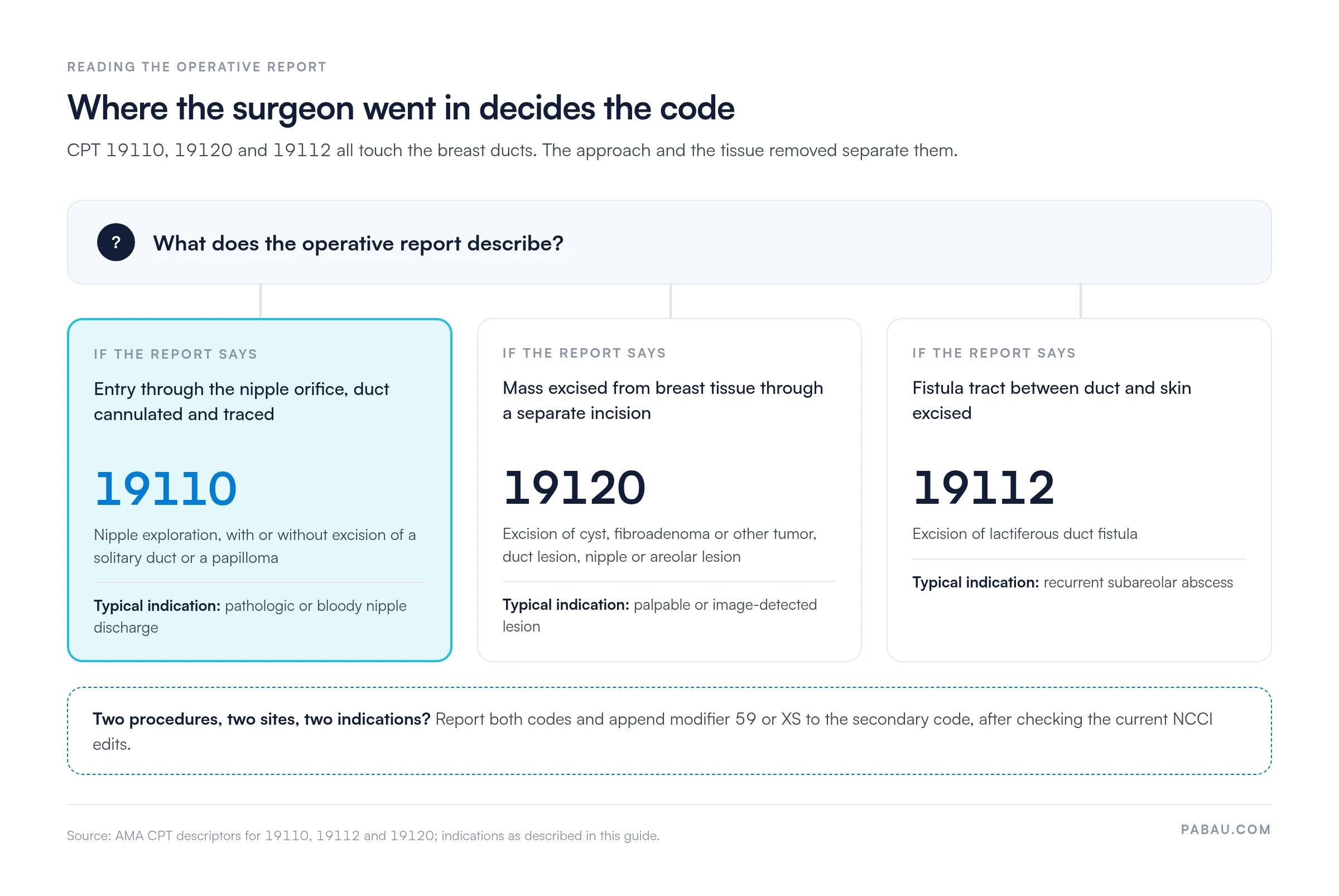
Before selecting 19110, confirm the operative report explicitly states duct cannulation from the nipple orifice. The surgeon may also remove a palpable mass through a separate breast incision. Then consider 19120 for the mass and 19110 for the exploration, with Modifier 59 and a detailed operative note supporting both.
Payers require a diagnosis code that establishes medical necessity for nipple exploration. The table below lists the ICD-10-CM codes most commonly paired with CPT code 19110. Verify all codes remain active in the current fiscal year release via the CDC/NCHS ICD-10-CM web tool.
Laterality note: Always use the laterality-specific D24 subcodes (D24.1 right, D24.2 left) rather than D24.9 unspecified. Payers increasingly flag unspecified laterality as insufficient for medical necessity, particularly when imaging reports document a lateralized finding.
Medicare payment for CPT code 19110 varies by place of service. The amounts below are 2026 national figures: total RVUs multiplied by the $33.4009 conversion factor, before geographic adjustment. Qualifying APM participants are paid at the $33.5675 factor, which lifts the non-facility amount to about $537. Confirm current figures in the CMS Physician Fee Schedule search tool, because rates change each January and vary by locality.
The RVU values below come from the 2026 CMS Physician Fee Schedule relative value file:
Important: RVU values change with each annual CMS Physician Fee Schedule update. Pull current-year figures from the CMS lookup or a tool like FastRVU before using them for productivity calculations or contract negotiations.
Medicare does not typically require prior authorization for CPT code 19110. Commercial payers vary more. Many require pre-authorization for breast surgery, particularly in an ambulatory surgical center. Verify requirements with each payer, because no universal rule applies.
When a commercial payer does require prior authorization, the documentation package typically includes:
Submit the prior auth request with the correct CPT code (19110) and ICD-10 diagnosis code (most commonly N64.52 or D24.1/D24.2). A mismatch between the authorized code and the billed code at claim time triggers an automatic denial, even when medical necessity is otherwise well supported.
An operative report that cannot be tied directly to duct-based nipple exploration is the fastest route to a denial or audit finding. A clean claim submission for 19110 requires the operative report to contain all of the following elements.
The superbill for the encounter should match the operative report findings. Payers that receive a CMS-1500 or 837P claim for 19110 may request the operative report on first submission or as part of a post-payment audit. If the report is unavailable or does not describe duct-based exploration, the claim will be denied or recouped.
CPT code 19110 denial patterns cluster around five root causes. Our denial management guide explains how to track and resolve each type. The denial codes in billing reference decodes the remark codes on a payer’s explanation of benefits.
Yes, CPT 19110 and 19112 can be billed together when both procedures are performed in the same session for separate clinical problems. CPT 19112 (excision of lactiferous duct fistula) and CPT code 19110 (nipple exploration) have different clinical indications.
19110 addresses pathologic nipple discharge or an intraductal papilloma. 19112 addresses a subareolar fistula tract, typically the sequela of a recurrent subareolar abscess. A patient with both a discharging nipple and a fistula tract could require both procedures. NCCI edits may still bundle the pair depending on the quarter, so check the current CMS NCCI edit tables before billing both.
To defend an unbundled 19110 + 19112 claim, submit it with the correct modifier stack and an operative report that documents:
If the payer bundles the codes on first submission, appeal with the annotated operative report and the modifier rationale. NCCI companion edits allow override with the appropriate modifier when clinical documentation supports it.
Run a quarterly NCCI edit check on your most-billed breast surgery code combinations. NCCI edits update quarterly, so a 19110 + 19112 combination that was payable in Q1 may become bundled in Q3. Build the NCCI check into your charge capture workflow rather than relying on the clearinghouse to catch it.
Most 19110 denials start before the claim leaves the building. A prior auth number gets lost between the scheduler and the biller. Or the claim goes out with D24.9 while the operative report names the left breast.
Pabau, a practice management platform, keeps those steps on one patient record. The prior auth code, dates and sessions sit on the patient’s case, with a warning when one is missing. Pabau’s claims management software then sends CMS-1500/837P claims through Claim.MD, with eligibility checks and ERA remittances.
Your billers see the authorization, the codes and the remittance in one place. A 19110 claim that would have gone out without its auth number gets caught at the front desk instead.

Pabau tracks prior authorizations on the patient’s case and sends CPT and ICD-10 coded claims electronically through Claim.MD. Your team catches a missing auth number before the claim goes out.

CPT code 19110 is narrow by design, and the operative report decides it. Before a claim goes out, check three things in the note: cannulation from the nipple orifice, the side, and any second incision for a mass. Those answers settle 19110 against 19120 and tell you whether modifier 59 belongs on the claim.
Treat the 2026 rates as a benchmark rather than a quote, since locality and the 90-day global both shape what you collect. Pabau supports insurance billing, including electronic claims through Claim.MD with eligibility checks and ERA remittances. Book a demo to see how your team can send 19110 claims with the prior auth already on file.

Billing a breast mass excision instead? CPT code 19120 covers the descriptor, documentation and denial risks for open excision of a breast lesion.
Want to understand the full claims lifecycle? Medical claims clearinghouse guide covers how clearinghouses validate, route, and report on claim status from submission to payment posting.
New to the billing side of surgery? What is medical billing walks through the claim cycle from charge capture to payment.
Looking to benchmark your billing operation? Best medical billing software (US) compares platforms on clean claim rates, denial management, and CPT/ICD-10 code support.
CPT code 19110 covers nipple exploration with or without excision of a solitary lactiferous duct or a papilloma lactiferous duct. It applies to duct-based procedures performed from the nipple orifice, typically for pathologic or bloody nipple discharge. Excision of a breast mass or cyst requires CPT 19120 instead.
Under the 2026 CMS Physician Fee Schedule, Medicare pays about $356 for CPT 19110 in a facility and $534 in a non-facility (office) setting. These national figures come before geographic adjustment, and rates update annually. Confirm current figures using the CMS Physician Fee Schedule lookup tool.
The most common ICD-10-CM pairing is N64.52 (nipple discharge) for discharge-driven procedures. D24.1 or D24.2 (benign neoplasm of right or left breast) applies when an intraductal papilloma is confirmed or suspected. Always use the laterality-specific D24 subcode, because D24.9 (unspecified) triggers denials.
CPT 19110 is for duct-based nipple exploration entered through the nipple orifice. CPT 19120 is for excision of a breast mass, cyst, or fibroadenoma accessed through a breast incision. The anatomic target and surgical approach are fundamentally different. Using 19120 for a duct papilloma excision performed through the nipple is a coding error that may result in denial or audit.
Medicare generally does not require prior authorization for CPT 19110. Many commercial payers do require pre-authorization for breast surgery procedures. Always verify with the individual payer and plan before scheduling. Submit the auth request with the correct CPT code and ICD-10 pairing to avoid a code-mismatch denial at claim time.