

CCSD code XR940: Foreign body retrieval billing guide
CCSD code XR940 is the UK private healthcare code for retrieval of a foreign bod...

Last Updated: Nov 26, 2026
25210 is the CPT code for carpectomy of one bone, the surgical excision of a single carpal bone from the wrist. The lunate, removed for Kienböck's disease, is the most common example. Removing every bone of the proximal row is a different procedure, reported with CPT 25215.
The code sits in the Forearm and Wrist range (25000-25999) of the CPT Musculoskeletal System. CMS assigns it a 90-day global period. The operative note must name the bone removed and the side.
Let Pabau's smart automation suggest the right codes, reduce claim denials, and keep your practice compliant—effortlessly.
Automate repetitive tasks and focus on what matters most—your patients.
Reduce coding errors and ensure compliance with the latest regulations.
Clean claims, fewer denials, and faster reimbursements.
Powerful insights and reporting to help your practice thrive.
HIPAA compliant SOC 2 certified GDPR-compliant Trusted by 4,000+ clinics worldwide

CPT Code 25210 covers excision of exactly one carpal bone. CPT 25215 covers removal of every bone in the proximal row, and no CPT code covers a full distal-row carpectomy.
Kienböck’s disease (lunate avascular necrosis) is the most common indication, coded M93.1. Osteomyelitis, a benign bone tumor and post-traumatic arthritis also qualify.
Laterality modifiers LT or RT are required by most payers, and omitting them is one of the leading denial causes for this code.
CMS pays 25210 at the facility rate only, about $467 nationally in 2026 before geographic adjustment, with a 90-day global period.
Pabau’s claims management software keeps the operative note, prior authorization and claim in one patient record, so billing staff check all three before submission.
CPT Code 25210 reports carpectomy of one bone, the surgical excision of a single carpal bone from the wrist. The 2026 CMS relative value file lists 25210 as an active, payable code with a 90-day global period.
The AMA places it in the Surgery section, under Musculoskeletal System and the Forearm and Wrist range (25000-25999). Hand and finger procedures use a separate range, 26010-26989.
A CPT 25210 carpectomy removes exactly one carpal bone from the wrist, most often through an open dorsal or volar approach. The eight carpal bones that may be excised under this code are the scaphoid, lunate, triquetrum, pisiform, trapezium, trapezoid, capitate, and hamate.
The procedure typically follows this sequence:
Most cases are performed in an ambulatory surgery center (ASC) or outpatient hospital setting. Some complex revisions may require inpatient admission. The operative note must document the specific bone removed, the surgical approach, and the pathological findings that support medical necessity.
CPT Code 25210 is indicated when a single carpal bone is too damaged to save and conservative management has failed. Surgical excision is then the least invasive option left. Orthopedic and hand surgery practices bill this code most often for the following diagnoses:
Payers require documentation of failed conservative treatment (splinting, physical therapy, corticosteroid injection) before authorizing surgical excision. Kienböck’s disease has its own code, M93.1, with no right or left variant. The RT or LT modifier on the 25210 line carries the side instead. Verify all ICD-10-CM codes against the current fiscal year’s code set before submission.
CPT Code 25210 covers removal of one carpal bone. CPT 25215 covers removal of all three bones of the proximal row: the scaphoid, lunate, and triquetrum. CPT has no dedicated code for removing the entire distal row. Selecting the wrong code is an upcoding risk and a frequent denial trigger.
If the operative report describes lunate excision only, bill CPT Code 25210. If the report confirms scaphoid, lunate, and triquetrum were all removed as part of a proximal row carpectomy, bill 25215. Never allow the reimbursement difference to influence code selection.
CPT Code 25210 is a unilateral procedure on a paired structure, so modifier selection directly affects whether the claim pays. The 2026 CMS relative value file gives 25210 a bilateral surgery indicator of 0, so modifier 50 does not apply. When both wrists are operated on, report each side on its own line with RT or LT.
Confirm modifier 59 usage against the current National Correct Coding Initiative (NCCI) edits for the specific code pair before submission. NCCI edit tables are updated quarterly, and a modifier that was correct last quarter may no longer be appropriate.
The CMS Physician Fee Schedule (PFS) Lookup Tool is the definitive source for current payment rates. In 2026, 25210 carries 13.99 total facility RVUs, and CMS lists no non-facility rate for it. At the $33.4009 conversion factor, that works out to about $467 before geographic adjustment.
The 90-day global period bundles routine follow-up visits within 90 days of surgery into the surgical payment. Billing a separate E/M during this window without the correct modifier will trigger a denial or recoupment. Document clearly when a post-op visit addresses a problem unrelated to the wrist surgery.
Documentation failures cause more 25210 denials than incorrect code selection. The operative note is the foundation. It must name the bone excised, state the operative approach, and confirm the pathological findings.
Prior authorization requirements vary by payer. Medicare fee-for-service does not require prior auth for most surgical codes, but commercial plans and Medicare Advantage often do. Use this checklist before submitting a claim:
For medical billing compliance, retain all pre-operative imaging, clinical notes, and the signed operative report together in the patient record. Payers auditing 25210 claims will request the full clinical package, not just the claim form.
When a commercial payer requires prior authorization, attach the authorization number to the claim. Keep the approval letter in the patient record for at least 7 years. Many practices lose appeals simply because they cannot produce the original authorization documentation.
Most 25210 denials are preventable. The table below maps the most common denial reasons to their root causes and fixes. Reviewing the medical billing denial codes on remittance advice is the fastest way to see which category is hitting your claims.
Knowing the adjacent codes prevents mis-selection and helps coders recognize when an operative report needs more than one code.
Read as a decision, these codes split on what the surgeon did to the bone, then on how much of the wrist it involved. The chart below sets out that order.
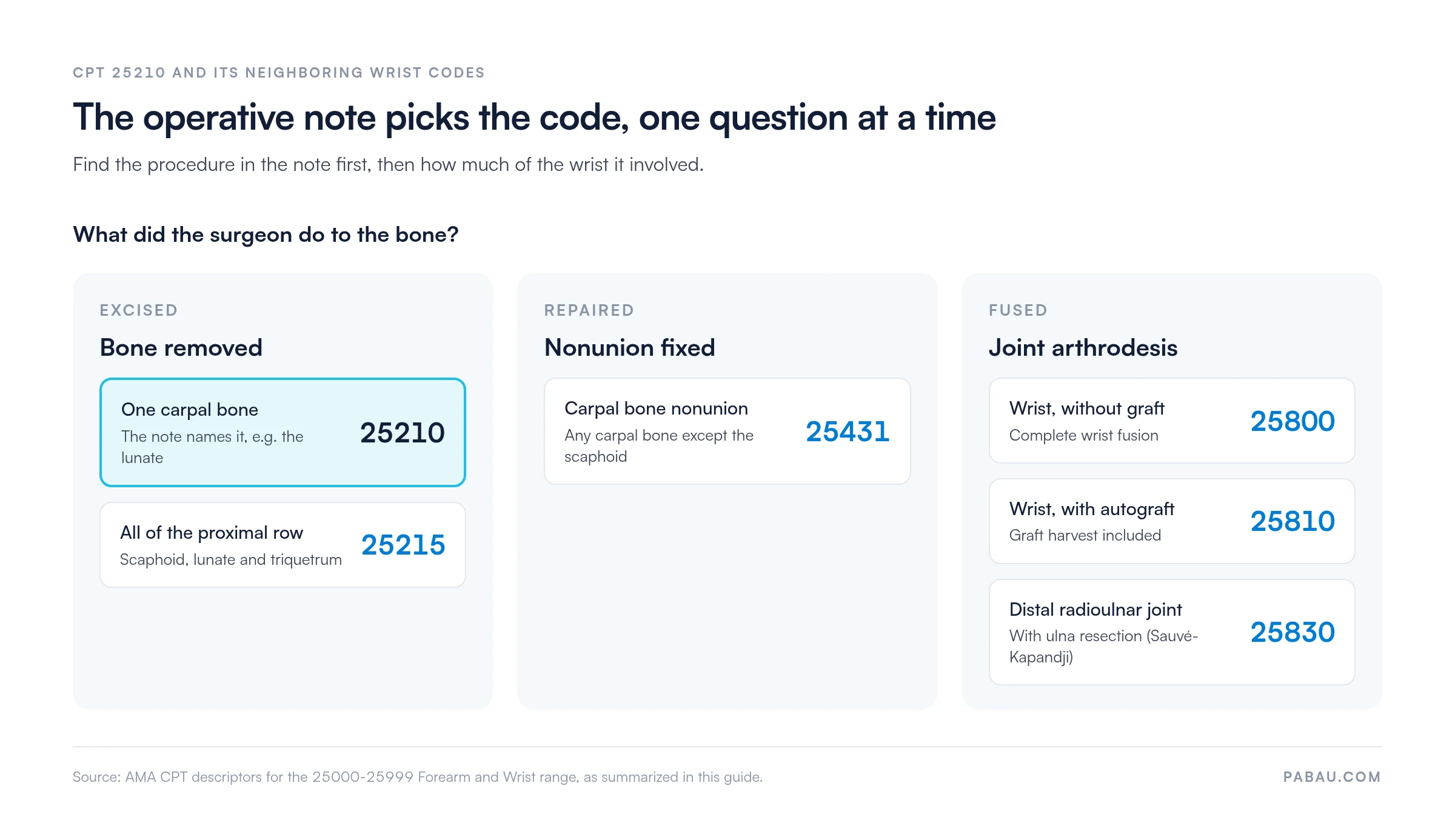
Use the AAPC Codify CPT lookup or the PGM Billing CPT search tool to check each code before you select it. Both show full descriptors, Medicare payment indicators, and applicable modifiers.
Surgical codes like CPT Code 25210 carry several requirements that depend on each other. They include laterality modifiers, specific operative documentation, payer-specific prior authorization, and 90-day global period tracking. A manual process has no checkpoint that forces the team to confirm each one before the claim goes out.
Pabau, a practice management platform with built-in insurance billing, keeps those elements in one patient record. Its claims management software lets billing staff see the operative note, the diagnosis code, and the prior authorization on the same screen.
Authorization codes, dates and sessions are tracked on the case, with a warning when one is missing. US claims go out through the Claim.MD clearinghouse, with eligibility checks and ERA remittances coming back to the same record.
Returned claims still need a process. Our guide to denial management workflows covers how to track them and spot patterns across codes. If 25210 denials keep clustering around missing laterality, one rule in the charge-entry checklist fixes the whole category.
Staff new to surgical claims can start with the fundamentals of medical billing, since the same modifier principles apply across the musculoskeletal range.

Pabau keeps the operative note, the prior authorization and the claim in one patient record. US claims go out through the Claim.MD clearinghouse, so your team checks each one before the payer does.

CPT Code 25210 is narrow by design: one bone, one wrist, and one operative note that names both. Coders rarely misread the procedure itself. Claims fail on the process around it. A missing RT or LT, an expired authorization, or a visit billed inside the global period each cost a payment.
Fix the note template and the pre-submission checklist once, and every future carpectomy claim benefits. Book a demo to see how Pabau links operative documentation to claim submission for orthopedic and hand surgery practices.

Coding a distal radius fracture instead? CPT code 25600 covers closed treatment of a distal radial fracture without manipulation.
Want to understand what happens when a claim is returned? How the Claim.MD clearinghouse works explains the ERA and denial workflow from submission to posting.
Looking for a framework to manage surgical claim denials systematically? What makes a clean claim covers the pre-submission checklist that prevents the most common rejection reasons.
CPT Code 25210 covers the surgical excision of a single carpal bone, formally described as “Carpectomy; one bone.” It applies when one of the eight carpal bones, such as the lunate, scaphoid, or trapezium, is removed. Typical causes are avascular necrosis, osteomyelitis, a benign tumor, or post-traumatic arthritis that has not responded to conservative treatment.
CPT 25210 covers removal of one carpal bone. CPT 25215 covers removal of all three proximal-row bones, the procedure known as a proximal row carpectomy. No CPT code covers a full distal-row carpectomy. Billing 25215 when only one bone was removed is upcoding, so the operative report must support the distinction.
The most critical modifier is LT or RT to indicate laterality, required by most commercial and Medicare Advantage payers. When CPT 25210 is billed alongside another procedure on the same day, Modifier 51 (multiple procedures) may apply. Modifier 59 is used when NCCI edits would otherwise bundle 25210 with a second code billed for a distinct service.
Prior authorization requirements depend on the payer. Medicare fee-for-service generally does not require prior auth for CPT 25210, but commercial insurers and Medicare Advantage plans frequently do. Check each patient’s plan before scheduling surgery, and retain the authorization number and approval letter in the patient record.
CPT 25210 carries a 90-day global surgery period as a major surgical code. Routine preoperative and postoperative visits within that window are bundled into the surgical payment. A separate E/M or procedure during the 90 days needs the right modifier: 24 for an unrelated E/M, 79 for an unrelated procedure.
The most common denial reasons are a missing LT or RT modifier and an operative note that does not name the bone excised. Others are a diagnosis that does not support medical necessity, and missing prior authorization where the payer requires it. Follow-up visits billed within the 90-day global period without the correct modifier also cause recoupments.



