HCPCS Code J1110: Dihydroergotamine mesylate injection billing guide
HCPCS Code J1110: Official descriptor and drug overview HCPCS Code J1110 is the ...

Last Updated: Oct 29, 2026
19281 is the CPT code for placement of a breast localization device in the first lesion, including mammographic guidance. The device can be a clip, metallic pellet, wire, or radioactive seed, placed through the skin so the surgeon can find a nonpalpable lesion.
Each additional lesion localized under mammographic guidance is reported with add-on code 19282. Stereotactic, ultrasound, and MRI guidance use their own code pairs within 19281-19288, and imaging guidance is never billed separately.
Let Pabau's smart automation suggest the right codes, reduce claim denials, and keep your practice compliant—effortlessly.
Automate repetitive tasks and focus on what matters most—your patients.
Reduce coding errors and ensure compliance with the latest regulations.
Clean claims, fewer denials, and faster reimbursements.
Powerful insights and reporting to help your practice thrive.
HIPAA compliant SOC 2 certified GDPR-compliant Trusted by 4,000+ clinics worldwide

CPT code 19281 reports placement of a breast localization device in the first lesion, with mammographic guidance included in the code.
Each additional lesion localized under mammographic guidance in the same session takes add-on code 19282, never 19283.
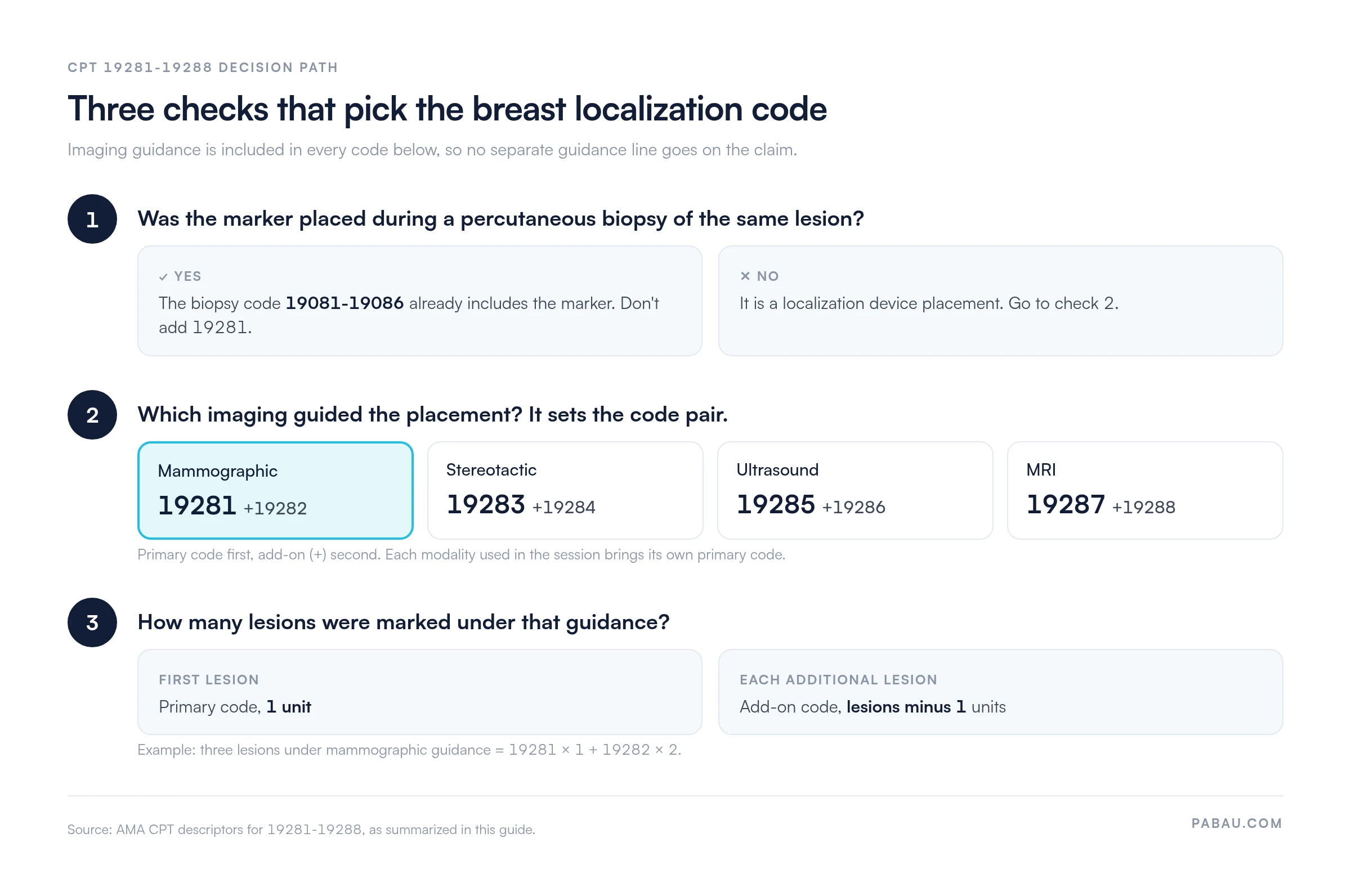
The guidance picks the code pair: 19283 and 19284 for stereotactic, 19285 and 19286 for ultrasound, and 19287 and 19288 for MRI.
Imaging guidance is part of every code in the 19281-19288 family, so no separate guidance code goes on the claim.
Pabau, the practice management platform we build, keeps lesion count, guidance, and side in one record, so coders aren’t rebuilding them from free text.
CPT code 19281 reports percutaneous placement of a breast localization device in the first lesion, with mammographic guidance included.
The American Medical Association (AMA) descriptor reads: Placement of breast localization device(s) (eg, clip, metallic pellet, wire/needle, radioactive seeds), percutaneous; first lesion, including mammographic guidance.
The 19281-19288 family has applied since 2014, replacing the needle localization wire codes 19290 and 19291. Older references may still cite those deleted codes. The family splits by imaging guidance and by first versus additional lesion.
The procedure targets nonpalpable lesions seen on imaging, such as calcifications or small masses that can’t be felt on exam. The radiologist places a marker under mammographic guidance so the surgeon can find and excise the lesion precisely.
Eight codes report percutaneous breast localization. Each one fixes two facts: the imaging that guided the placement, and whether the lesion was the first or an additional one. Pick from the wrong row and the claim contradicts the procedure note.
Some sessions mix modalities, with one lesion marked under mammographic guidance and another under ultrasound. Each modality then brings its own primary code. Don’t stretch one primary code across two guidance types. The stereotactic pair works the same way, as the guide to CPT code 19284 explains.
The flow below runs those choices in the order a coder makes them, starting with the biopsy check that rules 19281 out.
The code bundles the device placement and the mammographic imaging used to guide it. Neither the guidance nor its interpretation goes on the claim as a separate imaging line.
A common error is adding a separate imaging guidance code on top of 19281. The guidance is already part of the code, so an extra line duplicates payment and invites a denial. Biopsies follow the same logic, because the percutaneous biopsy codes 19081-19086 already include placing a marker in the biopsied lesion. The guide to CPT code 19081 walks through the stereotactic version. The AAPC CPT code reference lists the full introduction and biopsy ranges for checking each pairing.
CPT 19282 is the add-on code for each additional lesion localized under mammographic guidance in the same session. It can’t be reported without 19281 on the same claim, and it goes on once for every lesion after the first.
Example scenario: A radiologist places localization devices in two separate lesions under mammographic guidance in one session. The claim reads 19281 for the first lesion and 19282 for the second. If both placements used stereotactic guidance instead, the claim reads 19283 + 19284.
Using 19283 for a second mammographic lesion is a frequent mistake. 19283 is the primary code for stereotactic guidance, so it only belongs on the claim when a lesion was marked stereotactically. Billing 19281 twice fails too, because the second lesion belongs to the add-on.
Breast imaging and surgical billing involve several overlapping codes. Knowing the NCCI bundling status for each pairing prevents both under-billing and claim denial.
Check NCCI edit pairs quarterly. CMS updates the National Correct Coding Initiative (NCCI) tables every quarter, and bundling status between 19281 and adjacent codes can change. Pull the current CCI edit table from cms.gov before filing appeals based on older policy documents.
Modifiers carry context the base code can’t. These four come up most often with 19281, though payer policy and the current NCCI edits settle the final answer.
Laterality is the one to watch. A claim without -RT or -LT leaves the payer unable to match the procedure to the side in the diagnosis code. When lesions in both breasts are localized in one session, confirm the payer’s rule for side modifiers before you submit.
The procedure note carries the facts that pick the code, so it must address each item below to support medical necessity. Use the list as a clean claim checklist for every localization case.
A superbill for a localization case should carry the CPT code, the imaging guidance, the ICD-10-CM code with laterality, and the provider NPI. Missing laterality alone is enough for a payer to deny the claim.
The ICD-10-CM diagnosis code must justify medical necessity for the localization procedure. Payers expect specificity, particularly laterality, and will deny claims where the diagnosis code is too broad. For a finding that imaging flagged but no biopsy has confirmed, the guide to R92.8 explains when that code applies.
C50 codes run to six characters. The 4th character sets the site, such as 4 for the upper-outer quadrant. The 5th sets sex (1 female, 2 male), and the 6th sets laterality (1 right, 2 left).
D05 codes run to five characters, with the 4th setting the type of carcinoma in situ and the 5th setting laterality. N63 lumps split into N63.1x for the right breast and N63.2x for the left, with the final character naming the quadrant. Submitting an unspecified code such as C50.919 when the imaging report names a site and side will fail specificity edits at many payers.
Medicare reimburses CPT 19281 under the Physician Fee Schedule (PFS). Reimbursement varies by place of service because facility and non-facility RVU components differ. Use the CMS Physician Fee Schedule lookup tool to pull the current allowable for your locality, since published figures change with each annual PFS update.
Add-on code 19282 is paid at its own, lower rate, because the setup work is already paid through 19281. For current RVU values, the FastRVU lookup tool provides Work, PE, and MP RVUs with geographic adjustment built in.
Prior authorization: Many commercial payers require prior authorization for elective breast localization. Requirements vary by plan, so confirm them with each payer before scheduling the procedure. Don’t assume Medicare’s approach carries over to commercial plans.
CPT 19281 denials follow recognizable patterns. Effective denial management workflows map each denial reason to a specific appeal strategy rather than sending a blanket reconsideration request.
When you appeal, attach the Claim Adjustment Reason Code (CARC) from the electronic remittance advice (ERA) alongside the supporting documentation. A denial with no reason code attached is hard to fix on the first try. Our list of denial codes for billers maps each CARC to the appeal action it calls for.
Whether 19281 and a same-day lumpectomy (CPT 19301 or 19302) are separately reportable depends on who performs each service. Getting it wrong either loses the localization payment or triggers a bundling denial.
When a radiologist performs the localization and a surgeon performs the excision, both codes are separately reportable. Each provider submits their own claim with their own NPI. The global surgical package for 19301 doesn’t absorb services performed by a different provider, so no modifier is needed.
When the same surgeon places the device and performs the excision, check the current NCCI edits for the code pair first. Where an edit applies and the documentation supports a distinct service, these modifiers come up most:
The operative note must show that device placement preceded the incision as its own service. A note that folds both into one procedure description won’t support separate billing, even with a modifier attached.
CPT code 19281 is device-neutral. The descriptor names clips, metallic pellets, wires or needles, and radioactive seeds as examples, and the imaging guidance decides the code. This trips up coders because device marketing sometimes implies a proprietary billing code.
Device cost is generally bundled into the procedure payment and isn’t billed as a line on the physician claim. In hospital outpatient settings, some devices may qualify for transitional pass-through payment under a HCPCS device category code. That status changes yearly, so check the current OPPS addendum before relying on it.
When a manufacturer’s rep says a device has ‘its own billing code,’ they usually mean a HCPCS device category code. That code covers hospital outpatient pass-through payment and never replaces CPT 19281. The CPT code reports the procedure, while any HCPCS device code reports the product cost in specific facility settings. Never conflate the two on a professional claim.
Localization claims fail on small details: the guidance, the lesion count, and the side. In many practices those details live in a free-text note, and the coder rebuilds them by hand at billing time.
Pabau keeps the procedure note, the diagnosis, and the charge in one patient record. Coders read the guidance and lesion count from the note the radiologist signed. The 19281 and 19282 units then match what happened in the room.
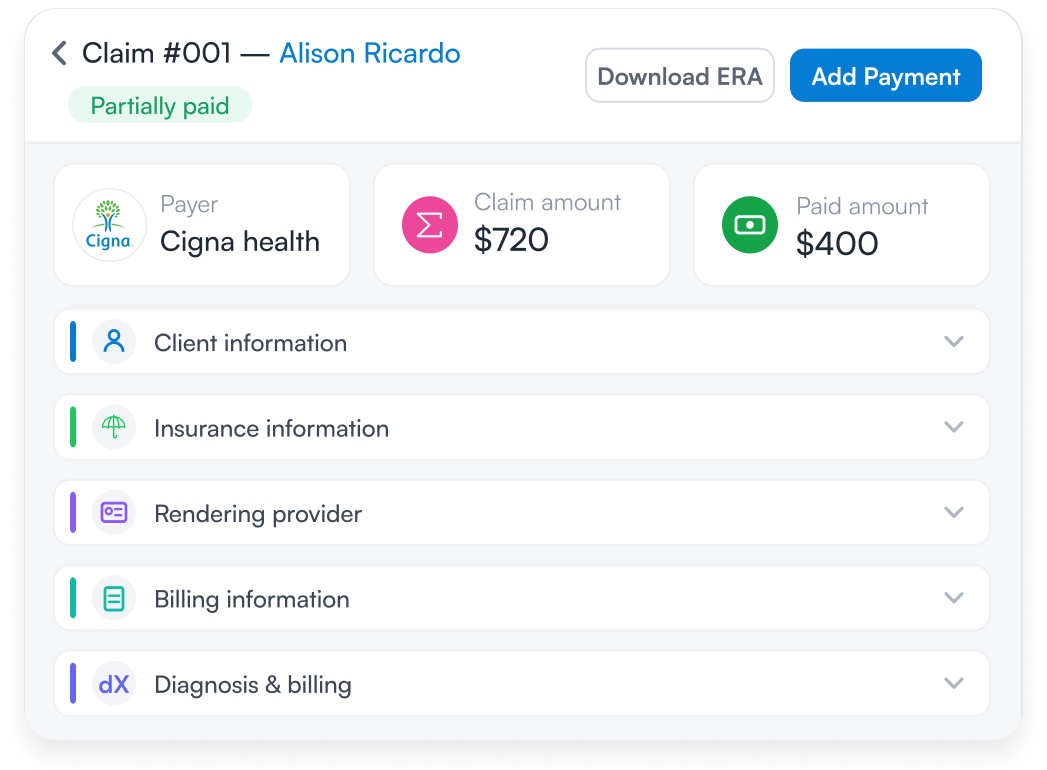
Claims go out through Pabau’s Claim.MD clearinghouse integration, which connects to thousands of US payers and supports eligibility checks before the patient arrives. Denials come back into the same claims management software, so your team can correct and resubmit without switching systems.

Pabau’s claims management tools help radiology and surgical practices track CPT 19281 claims, attach the right modifiers, and manage denials before they age. Book a demo to see the full claims workflow.

Read 19281 as one member of a modality-based family, and the claim follows from the note. That means 19281 for the first mammographic lesion, 19282 for each one after it, and no separate guidance line. The trade-off is that a careful coder can’t rescue a vague note.
The fix sits upstream of billing. A procedure note that names the guidance, numbers each lesion, and states the side gives the coder all three facts the claim depends on. Book a demo to see how Pabau keeps breast localization claims accurate from note to payment.

Billing a stereotactic localization? CPT code 19284 explains the stereotactic add-on and how it pairs with 19283.
Need to understand how the clearinghouse handles CPT claims? How Claim.MD clearinghouse works explains the 837P submission and ERA return cycle for US practices.
Want a structured denial workflow for your billing team? Denial codes in medical billing maps CARC codes to appeal actions for common procedure denials.
Need context on the full claims lifecycle? What is revenue cycle management covers how localization billing fits into the end-to-end RCM workflow.
Localized the lesion under ultrasound instead? CPT code 19285 covers the ultrasound-guided first lesion and its add-on, 19286.
CPT code 19281 reports percutaneous placement of a breast localization device, such as a clip, wire, or seed, in the first lesion. Mammographic guidance is included in the code. Each additional lesion under mammographic guidance is reported with add-on code 19282.
Report CPT 19281 for the first lesion localized under mammographic guidance. Report add-on code CPT 19282 once for each additional lesion localized the same way in the same session. CPT 19282 can’t be reported without 19281 on the same claim.
CPT 19281 requires mammographic guidance. Stereotactic placement uses 19283 and 19284, ultrasound uses 19285 and 19286, and MRI uses 19287 and 19288. The procedure note must name mammographic guidance, because “image-guided” alone is a common denial trigger.
Yes, when different providers perform the localization and the lumpectomy. When the same provider does both, check the current NCCI edits for the pair. If an edit applies and the note shows a distinct service, a modifier such as -59 or -XS may be needed.
Yes. Mammographic guidance is part of CPT 19281, so no separate imaging guidance code goes on the claim. The same applies across the 19281-19288 family. Localization also isn’t reported for a marker placed during a percutaneous biopsy, such as 19081, because the biopsy code already includes it.
There is no billing difference when both are placed under mammographic guidance. CPT 19281 is device-neutral, so wire, radioactive seed, and magnetic or radiofrequency seed placements all map to the same code. The device matters only in hospital outpatient settings, where some devices may qualify for HCPCS pass-through payment on the facility claim.