

HCPCS Code Q4185: Cellesta flowable amnion billing guide
HCPCS Code Q4185: definition and official descriptor HCPCS Code Q4185 is the Lev...

Last Updated: Nov 20, 2026
77048 is the CPT code for magnetic resonance imaging, breast, without and with contrast material(s); unilateral. It includes computer-aided detection (CAD) when performed.
Radiologists and radiology billers reach for this code most often when a patient presents with a known or suspected unilateral finding. Choosing between 77048 and its bilateral counterpart 77049 matters because laterality mismatches cost practices time and revenue.
Let Pabau's smart automation suggest the right codes, reduce claim denials, and keep your practice compliant—effortlessly.
Automate repetitive tasks and focus on what matters most—your patients.
Reduce coding errors and ensure compliance with the latest regulations.
Clean claims, fewer denials, and faster reimbursements.
Powerful insights and reporting to help your practice thrive.
HIPAA compliant SOC 2 certified GDPR-compliant Trusted by 4,000+ clinics worldwide

CPT code 77048 covers MRI of one breast without and with contrast, with computer-aided detection (CAD) included when performed.
Use 77049 when both breasts are imaged, and 77046 or 77047 when the study runs without contrast.
Most commercial payers and Medicare Advantage plans require prior authorization, while original Medicare relies on documented medical necessity.
The radiology report has to name the side and confirm both pre- and post-contrast sequences, or the claim is open to denial.
Pabau’s claims management software tracks prior-authorization status on the case and sends claims, eligibility checks and ERAs through Claim.MD.
CPT code 77048 is the code for an MRI of one breast with both pre-contrast and post-contrast sequences. CAD is bundled in when it’s used.
Medicare contractor guidance in this CMS billing and coding article allows only 77046, 77047, 77048 and 77049 for breast MRI. Picking 77048 means ruling out the other three. The American Medical Association descriptor reads: Magnetic resonance imaging, breast, without and with contrast material(s); unilateral.
The code sits in the Radiology section of the CPT codebook, in the Breast, Mammography subsection (77046-77067). Three attributes decide whether it fits.
The study covers one breast only, it includes both contrast phases, and the modality is MRI rather than mammography or ultrasound. If any of the three doesn’t match, another code applies.
A complete 77048 study needs pre-contrast and post-contrast MRI sequences of one breast, acquired in a single session and interpreted by a qualified radiologist. CAD analysis, when run, is part of the procedure and isn’t billed separately.
Included in 77048:
Not covered by 77048, so use a different code:
Billers sometimes read “without and with” contrast as two separate options. 77046 and 77047 cover breast MRI without contrast (unilateral and bilateral). Billing either when both sequences were performed understates the work. Two questions about the report settle the code, as the grid shows.
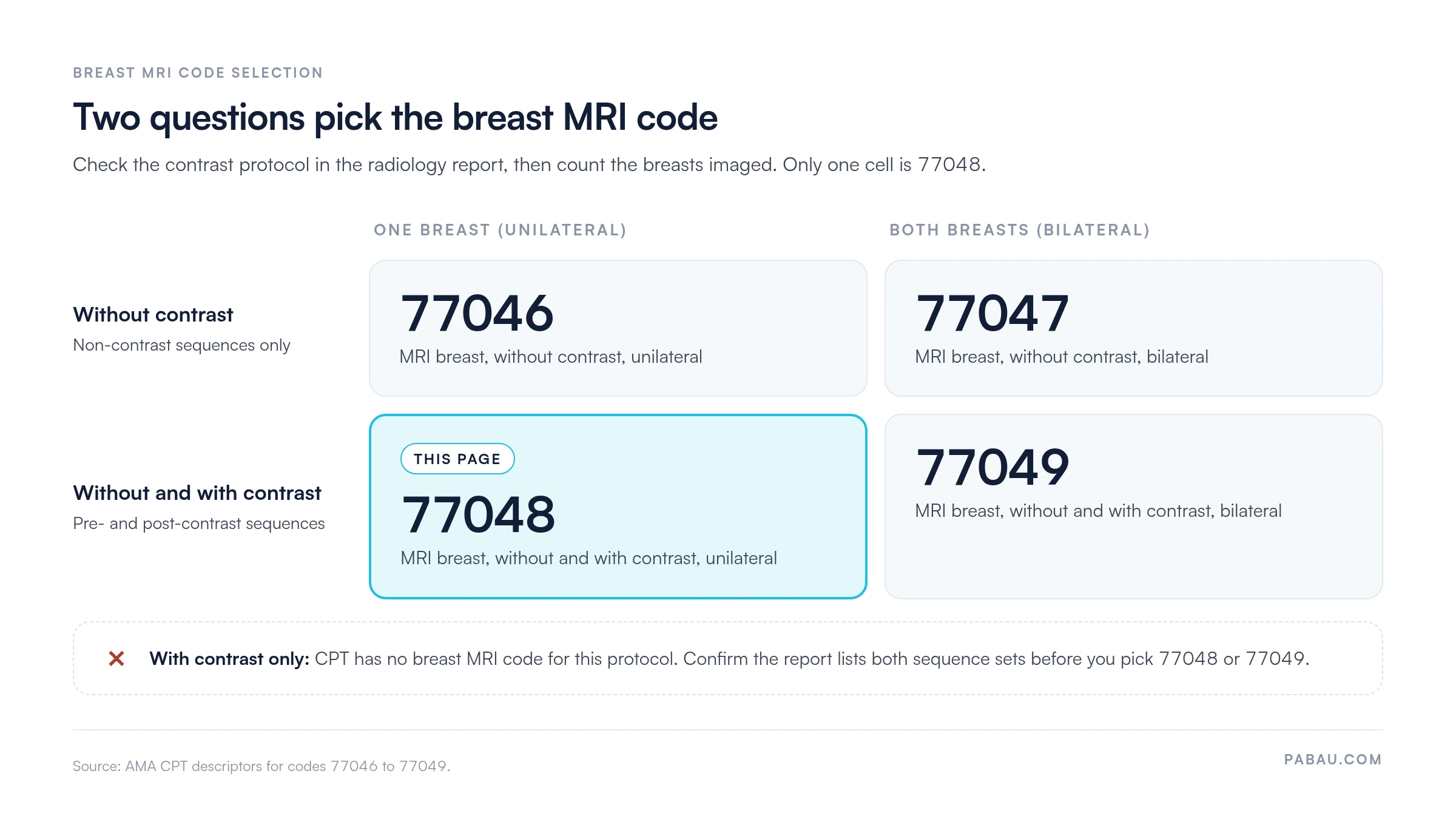
A frequent coding error on breast MRI claims is billing 77048 when both breasts were imaged, or 77049 when only one was. Settle laterality from the radiology report and the referral before anyone builds the claim. If both breasts were scanned, 77049 is the code.
When a payer requires LT or RT on a 77048 claim, the wrong modifier creates a laterality mismatch against the referral. Check the modifier against the physician order before you submit.
Seeing 77048 next to its neighbors helps coders avoid picking an adjacent code by mistake. The table covers the MRI family (77046-77049) and the mammography codes often billed on the same date of service. For descriptor text and coding notes by range, the AAPC Codify CPT lookup is a handy reference.
Every 77048 claim needs a diagnosis code that justifies imaging one breast. A bilateral high-risk screening indication, like BRCA1 carrier status, supports 77049 instead. So the diagnosis has to agree with the laterality in the report.
Surveillance of a treated breast usually rests on Z85.3, with the report naming the previously affected side. CMS Local Coverage Determinations (LCDs) for breast MRI list the covered indications by Medicare Administrative Contractor region. Check the applicable LCD before coding, because covered indications vary by jurisdiction.
Before linking a diagnosis code to a 77048 claim, verify that the ICD-10 code you are using has a laterality subcode available. Generic parent codes like N63 without the site-specific digit can trigger an edit. Use the CDC ICD-10-CM tool to confirm you have the most specific code for the site documented in the report.
Prior authorization is one of the slowest steps in breast MRI billing. Insurance eligibility verification before scheduling is your first defense against a denial that lands weeks after the scan.
Original Medicare (Parts A and B): No prior authorization for breast MRI. The claim still needs documented medical necessity, meaning a physician order and a report showing both sequences were performed.
Medicare Advantage plans: Most require prior authorization. Each plan sets its own criteria, and approval from one plan doesn’t carry over to another.
Commercial payers: Most require prior authorization for breast MRI. Rules vary by plan and by state, so verify each case rather than applying one rule.
Typical documents for a prior-auth request:
Each hand-off is a chance to lose the side or the second contrast phase. Here’s the path a clean claim takes, and the check that belongs at each stop.
Medicare pays CPT 77048 under the Medicare Physician Fee Schedule (MPFS), which the CMS fee schedule lookup tool publishes each year by locality. The 2026 rates are final.
Facility and non-facility amounts differ because hospital radiology departments and freestanding imaging centers are paid differently. For current figures by locality, use the CMS search or the FastRVU 2026 RVU lookup, which pulls from CMS data.
CMS revises the conversion factor and RVU values every year, so a dollar figure quoted elsewhere can go stale soon after a final rule. Check the current year’s MPFS before you quote a reimbursement amount to a provider or patient.
Breast MRI is a high-dollar service, and payers scrutinize it. Knowing the usual denial patterns before you submit beats appealing afterward. Denial management workflows that sort remittance codes as they arrive help you spot a repeat problem early.
A targeted appeal recovers more revenue than a generic reconsideration letter. Work through these steps in order.
A clean 77048 claim depends on paperwork that exists before the claim is built. Run through this list before release. The same principles behind submitting a clean claim apply across imaging codes.
Run a quarterly audit of your 77048 and 77049 remittance advice. If laterality mismatch denials appear more than once, the root cause is almost always at intake, not at billing. Build a laterality confirmation step into the scheduling workflow so the scan and referral agree before the patient arrives.
Many 77048 denials trace back to intake rather than coding. An auth number goes missing, a referral names the wrong side, or a report skips the contrast phases. Billing teams then spend their week cross-checking three documents by hand.
Pabau’s claims management software tracks the prior-authorization code, dates and sessions on the patient’s case, and warns you when one is missing. The diagnosis link and modifiers sit on the encounter, so the superbill and the claim draw from the same record.
US claims go out electronically through the Claim.MD clearinghouse, which also runs eligibility checks and returns ERAs. Payment posting then reflects the amount the payer allowed, not an estimate keyed in by hand.
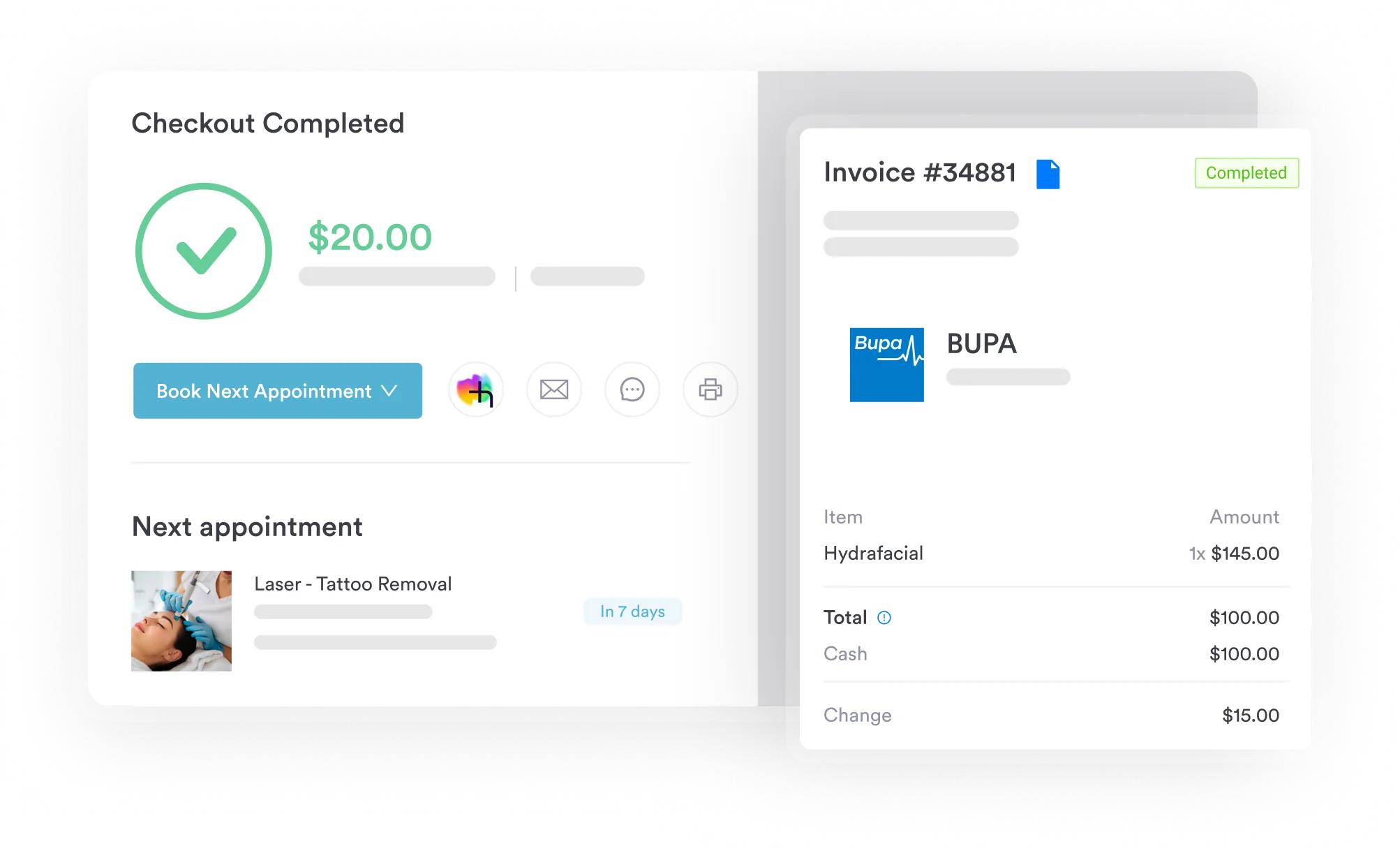

Pabau tracks prior-authorization status on the case and sends 77048 claims through Claim.MD with eligibility checks and ERAs. Your billing team spends less time chasing denials.

CPT code 77048 is a narrow code, and that works in your favor. Confirm one breast, both contrast phases and an approved authorization, and the payer has little left to dispute.
The trade-off is front-loaded work. Laterality and auth checks belong at scheduling, where a fix costs a phone call instead of an appeal. Make that check routine and your denial list shrinks to the cases that deserve a fight.
Pabau’s claims management, through Claim.MD, handles electronic claims, eligibility checks and ERAs, and tracks prior-authorization status on the case. Book a demo to see how it supports your breast imaging billing from order to payment.

Need a step-by-step guide to reducing claim rejections? Claim.MD clearinghouse overview explains how electronic claim validation catches errors before they reach the payer.
Want to understand how remittance codes map to denial patterns? Electronic remittance advice explained breaks down ERA file structure and CARC interpretation for billing teams.
Looking to benchmark your billing operation against compliance standards? Medical billing compliance guide covers documentation, audit risk, and payer-specific rules for radiology and imaging practices.
Billing a breast MRI without contrast? CPT code 77047 covers coding for the non-contrast bilateral study.
Coding the mammogram that came before the MRI? CPT code 77065 covers unilateral diagnostic mammography.
CPT 77048 arrived in 2019 and replaced 77058, the old unilateral breast MRI code. The same revision deleted 77059 for bilateral studies and the 0159T add-on for CAD, which 77048 and 77049 now include.
Implant integrity studies usually run without contrast, so they code to 77046 for one breast or 77047 for both. Use 77048 only when contrast is also given and the report documents both sequence sets.
Usually not on Part A facility claims. Medicare contractor guidance points facilities to HCPCS C-codes for contrast breast MRI, such as C8905 for one breast and C8908 for both. The radiologist’s professional claim still uses 77048 with modifier 26.
Once per session. The code already describes one breast, so a single unit covers the study. When both breasts are scanned in the same session, bill one unit of 77049 instead of two units of 77048.





