CCSD code XR940: Radiology billing guide for UK private practice
CCSD code XR940 is a UK private healthcare radiology procedure code used to bill...

Last Updated: Nov 26, 2026
96118 is the CPT code for neuropsychological testing by a psychologist or physician or other qualified health care professional, with interpretation and report, per hour.
The AMA deleted 96118 effective January 1, 2019. The evaluation is now billed with 96132 for the first hour and 96133 for each additional hour. Test administration moved to its own 30-minute codes, 96136 to 96139, so a claim carrying 96118 today is rejected.
Let Pabau's smart automation suggest the right codes, reduce claim denials, and keep your practice compliant—effortlessly.
Automate repetitive tasks and focus on what matters most—your patients.
Reduce coding errors and ensure compliance with the latest regulations.
Clean claims, fewer denials, and faster reimbursements.
Powerful insights and reporting to help your practice thrive.
HIPAA compliant SOC 2 certified GDPR-compliant Trusted by 4,000+ clinics worldwide

CPT code 96118 was deleted on January 1, 2019, and replaced by 96132 for the first hour and 96133 for each additional hour.
96130 and 96131 replaced a different deleted code, 96101, which covered psychological rather than neuropsychological testing.
Test administration now has its own 30-minute codes: 96136 and 96137 for the psychologist or QHP, and 96138 and 96139 for a technician.
Payers reject 96118 for any date of service after 2018, so remove it from your fee schedule and superbills.
Pabau’s claims management software tracks neuropsychological testing codes, links diagnosis codes, and monitors claim status in one place.
CPT code 96118 was the per-hour code for neuropsychological testing by a psychologist, physician, or other qualified health care professional (QHP), with interpretation and report.
The AMA deleted it on January 1, 2019. APA Services’ 2019 coding crosswalk maps it to 96132 and 96133 for the evaluation, and to 96136 and 96137 when the professional gives the tests.
Each unit of 96118 stood for one hour of the professional’s time. That hour covered face-to-face test administration plus the time spent interpreting results and preparing the report. If time-based units are new to you, our guide to medical billing fundamentals explains how they become a claim.
The American Medical Association maintained the official descriptor before the code’s retirement. The full descriptor read: “Neuropsychological testing by a psychologist or physician or other qualified health care professional, with interpretation and report, per hour.”
96118 applied to the neuropsychological testing portion of the evaluation. That meant hands-on administration of batteries such as the Halstead-Reitan, WAIS-IV, or WMS-IV. Interpretation and report writing counted toward the hourly units and were never billed separately.
No. CPT code 96118 is not active. The AMA deleted 96118, 96119, and 96120 effective January 1, 2019, as part of a broader restructuring of psychological and neuropsychological testing codes. Payers reject 96118 for any date of service after that, and there was no grace period.
The replacement family introduced four evaluation codes. They separate psychological from neuropsychological testing and split the first hour from each additional hour.
96132 is the direct replacement for 96118 when the psychologist performs the evaluation. The new codes explicitly require an integrated interpretation report from the performing provider. 96118’s descriptor implied that requirement without spelling it out.
The restructure also pulled test administration out of the evaluation codes and gave it 30-minute units of its own. The crosswalk below shows where each part of a legacy 96118 or 96119 claim is billed now.
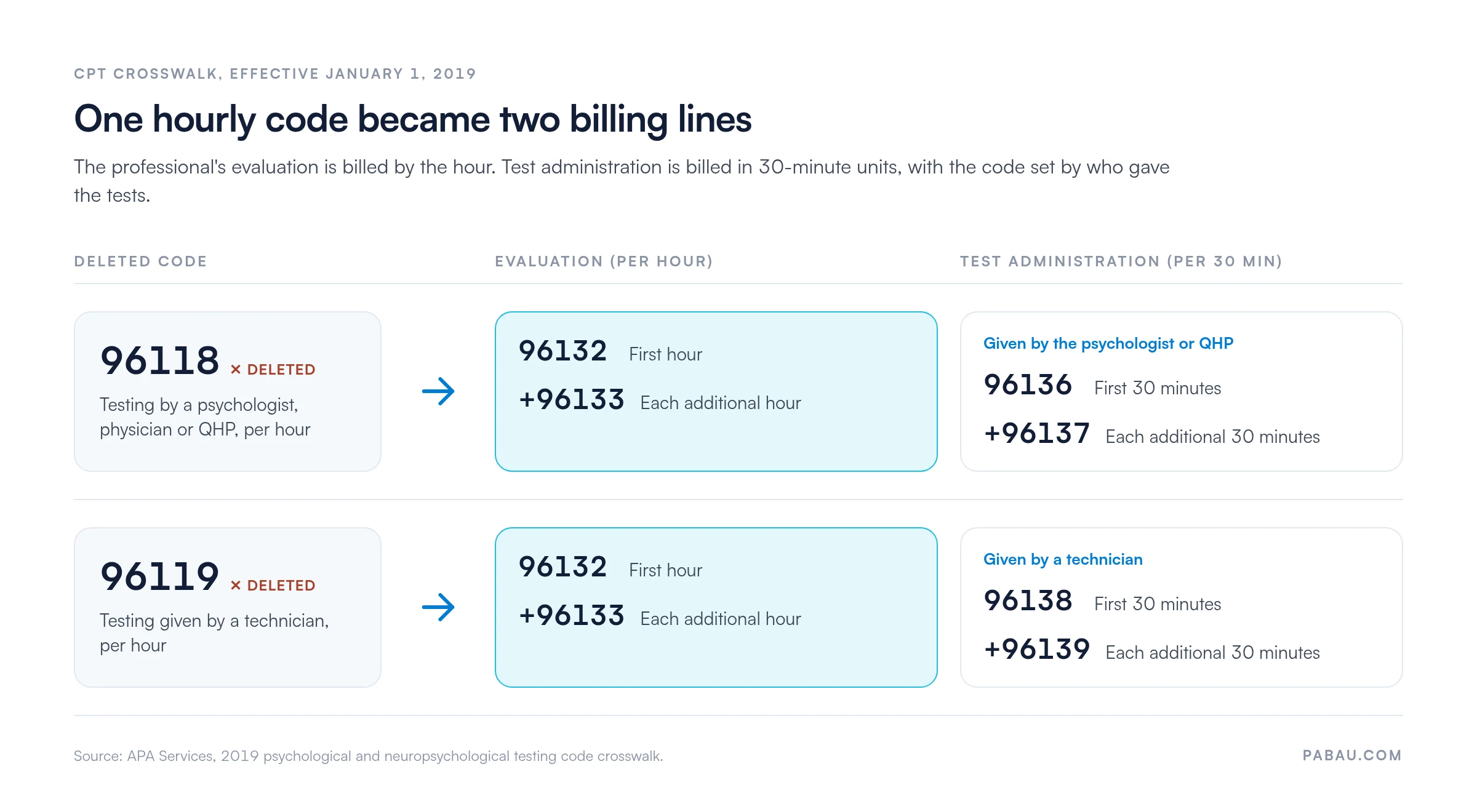
Computer-administered testing changed too. When a single automated instrument produces an automated result, the crosswalk points to 96146 instead of the deleted 96120.
96132 replaced 96118 for psychologist-performed neuropsychological testing, but the two codes are not identical in their requirements. The 2019 restructuring tightened documentation expectations and changed how technician-administered testing is billed.
One common coding mistake is billing 96133 as an add-on to 96118. That pairing was never valid, because 96133 only came into use once 96118 was deleted. Under the legacy system, 96119 and 96120 were the companion codes billed with 96118. Under the current system, 96133 is the add-on for 96132 only.
Under the legacy billing structure, 96118 was billed alongside two related codes, depending on how the testing was administered. Mixing them up was one of the most frequent denial triggers for neuropsychological testing claims before the 2019 revision.
Time rounding rules applied to 96118 and 96119, the two hourly codes. A partial hour counted as a unit only once it passed the 30-minute midpoint. Most payers followed the AMA’s general rule for time-based codes here, though some set their own threshold. Check the payer’s rounding rule before billing a partial hour as a full unit.
Under the current system, test administration is billed separately from the evaluation, in 30-minute units. 96136 and 96137 are the test administration codes when the physician or QHP gives the tests. 96138 and 96139 are the technician codes, which leaves 96133 for additional hours of the professional’s evaluation work.
If you are still seeing 96119 or 96120 on superbills or in your fee schedule, remove them. Submitting these deleted codes triggers automatic claim rejection. Audit your fee schedule annually against the current AMA CPT code set to catch retired codes before they cause billing delays.
96118 was a time-based code billed in one-hour increments. Accurate time documentation drove both correct coding and clean claims. A clearinghouse transmits the units exactly as they appear on the claim, so they have to match the hours documented in the clinical record.
The billing workflow for a 96118 claim followed these steps:
Medicare Part B covered neuropsychological testing under 96118 while the code was active, subject to Local Coverage Determinations (LCDs) from each Medicare Administrative Contractor. Testing had to be medically necessary and ordered by a physician or other qualified provider. A licensed psychologist or other eligible QHP had to perform it.
Because 96118 was deleted in 2019, its Medicare rates are historical. For current rates on the replacement codes, use the CMS Physician Fee Schedule search tool. It looks up rates by CPT code, geographic area, and payment year. Rates vary by contractor region and are updated every January 1.
Key Medicare coverage conditions that applied to 96118 and continue to apply to 96132:
Documentation for 96118 claims needed to satisfy both AMA CPT billing rules and payer LCD requirements. Claims that lacked even one of these elements risked denial or audit clawback. Following solid medical billing compliance practices means building the documentation checklist into the clinical workflow, not assembling it after the fact.
A compliant 96118 record required all of the following:
Medical necessity for CPT code 96118 required a clinical question that interview or observation alone could not answer. The test results also had to inform treatment decisions directly. Most payers rejected routine screening or testing done mainly out of the patient’s personal interest.
Diagnoses commonly supporting medical necessity for neuropsychological testing include:
Prior authorization requirements vary significantly by payer. Medicare does not require prior authorization for neuropsychological testing at the federal level, though some Medicare Advantage plans do.
Commercial payers and Medicaid programs frequently require pre-authorization, and some limit the number of hours or sessions they will cover per year. Run insurance eligibility verification and a prior authorization check before scheduling extended testing sessions. Payers almost always deny authorization requested after the fact.
Neuropsychological testing claims were among the more frequently denied in behavioral health billing, and CPT code 96118 had its own specific denial patterns. Effective denial management workflows start with knowing which denial reasons appear most often for this code family.
Neuropsychology practices bill time-based codes, so unit counts, diagnosis links, and claim tracking all have to line up. When a code is retired, every superbill and fee schedule entry that still carries it produces a rejection.
Pabau’s claims management software supports behavioral health billing workflows. Practices configure time-based codes in the fee schedule and map ICD-10 diagnosis codes to service types. Each claim is tracked from submission to payment posting in one place. Claims route through the Claim.MD clearinghouse, which reaches thousands of US payers. Eligibility checks come back before the testing session begins.
Once 96132, 96133, and the 96136 to 96139 administration codes are set up in the fee schedule, billing staff pick from a checked list. Nobody has to apply code rules from memory. That matters most when the code set changes, as it did in 2019. Retired codes come out of the fee schedule before they can reach a claim.
Run a fee schedule audit every December before the new CPT year takes effect. Pull a report of every code billed in the past 12 months and check it against the AMA’s deleted code list for the coming year. Deactivate any retired codes before January 1. This one annual task catches retired codes before they reach a claim.

Pabau tracks time-based codes, links diagnosis codes to claims, and monitors claim status. Your practice spends less time on billing admin and more on patient care.

If 96118 still appears anywhere in your billing setup, that entry is the first thing to fix. Replace it with 96132 and 96133 for the evaluation. Then add the 96136 to 96139 administration codes that match who gave the tests.
The trade-off is more lines per claim. A testing day that once billed as a few units of 96118 now splits across hourly evaluation codes and half-hour administration codes. Each line needs its own time record, so build the time fields into your clinical note template rather than reconstructing them at billing.
Book a demo to see how Pabau keeps your neuropsychological testing codes current and your claims moving.

Need a clearinghouse that handles neuropsychological testing claims? Our Claim.MD clearinghouse guide explains how the integration connects to thousands of US payers for real-time claim processing.
Looking for guidance on clean claim submission standards? Clean claim requirements covers the fields, formats, and validation checks that prevent rejections before they reach the payer.
Want to understand how remittance data feeds back into your billing workflow? Electronic remittance advice (ERA) explains how 835 transaction files map denial reason codes back to individual claims.
CPT code 96118 is a deleted neuropsychological testing code that covered testing by a psychologist or QHP per hour, including administration, scoring, and interpretation. The AMA retired it on January 1, 2019. It has been replaced by 96132 (first hour) and 96133 (each additional hour) for psychologist-performed neuropsychological evaluations.
No. CPT code 96118 was deleted effective January 1, 2019. Claims submitted with this code after that date are automatically denied by all payers. Use 96132 for the first hour of neuropsychological testing and 96133 for each additional hour instead.
96132 replaced 96118 as the primary code for psychologist-performed neuropsychological testing evaluation (first hour). 96133 is the add-on for each additional hour. For psychological (not neuropsychological) testing, 96130 and 96131 are the equivalent codes.
Prior authorization requirements vary by payer. Medicare traditional does not require prior auth for neuropsychological testing, but many commercial payers and Medicare Advantage plans do. Always verify authorization requirements with the specific payer before scheduling the testing session, as after-the-fact authorization requests are rarely approved.
One unit of 96118 for each hour of the professional’s time. Technician-administered hours were billed with 96119, and computer-administered testing took one unit of 96120 per session, whatever its length. A partial hour generally counted only once it passed the 30-minute midpoint, though this varied by plan. Under the current code set, 96132 covers the first hour of evaluation and 96133 each additional hour.
96119 (technician-administered, per hour of technician time) and 96120 (computer-administered, billed as a single unit) were the companion codes for 96118. Both were also deleted in 2019. Using 96133 as an add-on to 96118 was never a valid pairing and will generate a claim edit or denial.