



HCPCS code E0198: Water pressure pad billing guide
HCPCS code E0198 is a water pad for a standard mattress HCPCS code E0198 is the ...

Last Updated: Oct 13, 2026

CPT Code 15879 describes suction assisted lipectomy of the lower extremity, covering the thighs, knees, calves, and ankles.
Most payers, including Medicare, treat the procedure as cosmetic and non-covered unless a recorded condition such as lipedema establishes medical necessity.
US ICD-10-CM carries one lipedema code, E88.2. It has no site or stage subdivision, so the site-based E88.2x codes used in Germany are not valid here.
Missing prior authorization, using the wrong body-region code (15876-15878), or submitting without supporting records are the top denial reasons for CPT 15879 claims.
Practice management software like Pabau keeps clinical notes, before-and-after photos, and billing in one place, so the records are ready before you submit.
CPT Code 15879 is the AMA code for suction assisted lipectomy of the lower extremity, covering the thighs, knees, calves, and ankles. However, most payers read the procedure as cosmetic surgery and pay nothing for it. Coverage exists only where a recorded condition such as lipedema establishes medical necessity.
The medical billing workflow for 15879 therefore turns on records rather than on method. This reference covers the official descriptor, the 15876-15879 code family, and Medicare’s statutory exclusion. It also covers modifiers, bundling edits, the ICD-10 pairing for lipedema, records, prior authorization, and the denial patterns practices meet most often.
Official AMA descriptor: Suction assisted lipectomy; lower extremity. CPT Code 15879 sits in the integumentary system section of the AMA CPT code set, codes 10000-19999. Within that section it falls in the Other Repair (Closure) Procedures subsection, 15780-15879.
The procedure removes subcutaneous fat from the lower body using negative pressure suction through small cannulas. The scope of CPT 15879 covers the thighs, the inner and outer knees, the calves, and the ankles. Each body region in the 15876-15879 family carries its own code in the AMA CPT code set. As a result, a session that treats more than one region may need several codes, billed together with the right modifiers.
Selecting CPT Code 15879 needs confirming the operative site is the lower extremity. The 15876-15879 family assigns a distinct code to each body region. Using the wrong code from this family is among the most common coding errors in body contouring. As a result, it triggers a denial even when the rest of the claim is clean.
When a single operative session addresses multiple regions, report each applicable code separately. Other integumentary codes divide the work differently, and CPT 17110 counts lesions rather than body regions. In that case, modifier 51 applies when two or more procedures from this family are billed on the same date of service.
Medicare treats suction assisted lipectomy as cosmetic surgery, and cosmetic surgery is excluded from payment by statute. Section 1862(a)(10) of the Social Security Act bars payment for it. No Local Coverage Determination can turn CPT 15879 into a covered Medicare service, because a coverage policy cannot override a statutory exclusion. However, the narrow exception in the statute is surgery that promptly repairs an accidental injury or improves the function of a malformed body member.
Commercial plans write their own medical policies, and some of them do cover lower extremity lipectomy for lipedema. So, read the plan’s policy before you quote a patient anything. You can confirm the code’s payment status and relative values in the CMS Physician Fee Schedule lookup tool.
Medicare will not pay CPT 15879, so there is no Medicare allowable to quote for it. When a commercial plan approves the procedure, the amount comes from that plan’s own fee schedule. Six factors move the number, and each one has a source you can check rather than estimate.
Use the FastRVU lookup tool to pull current relative values and work out the locality-adjusted amount for your area. Practice management software like Pabau submits electronic claims through its Claim.MD integration. An eligibility check before surgery tells you whether the plan will process 15879 at all. If it will not, the case is cosmetic and the patient pays.
The cosmetic exclusion is the central billing challenge with CPT 15879. Most commercial payers follow Medicare and read suction assisted lipectomy as elective body contouring. As a result, submitting the code without a qualifying diagnosis and supporting records guarantees a denial.
Where coverage does exist, it rests on two things. The plan’s policy has to name the diagnosis, and the record has to show that non-surgical treatment was tried and failed.
Compression therapy and guided weight management programs are the usual first line, and both need dated records. The exact threshold differs from plan to plan, so read the policy for the patient’s own plan. Three billing paths run from that decision, and a case takes exactly one of them.
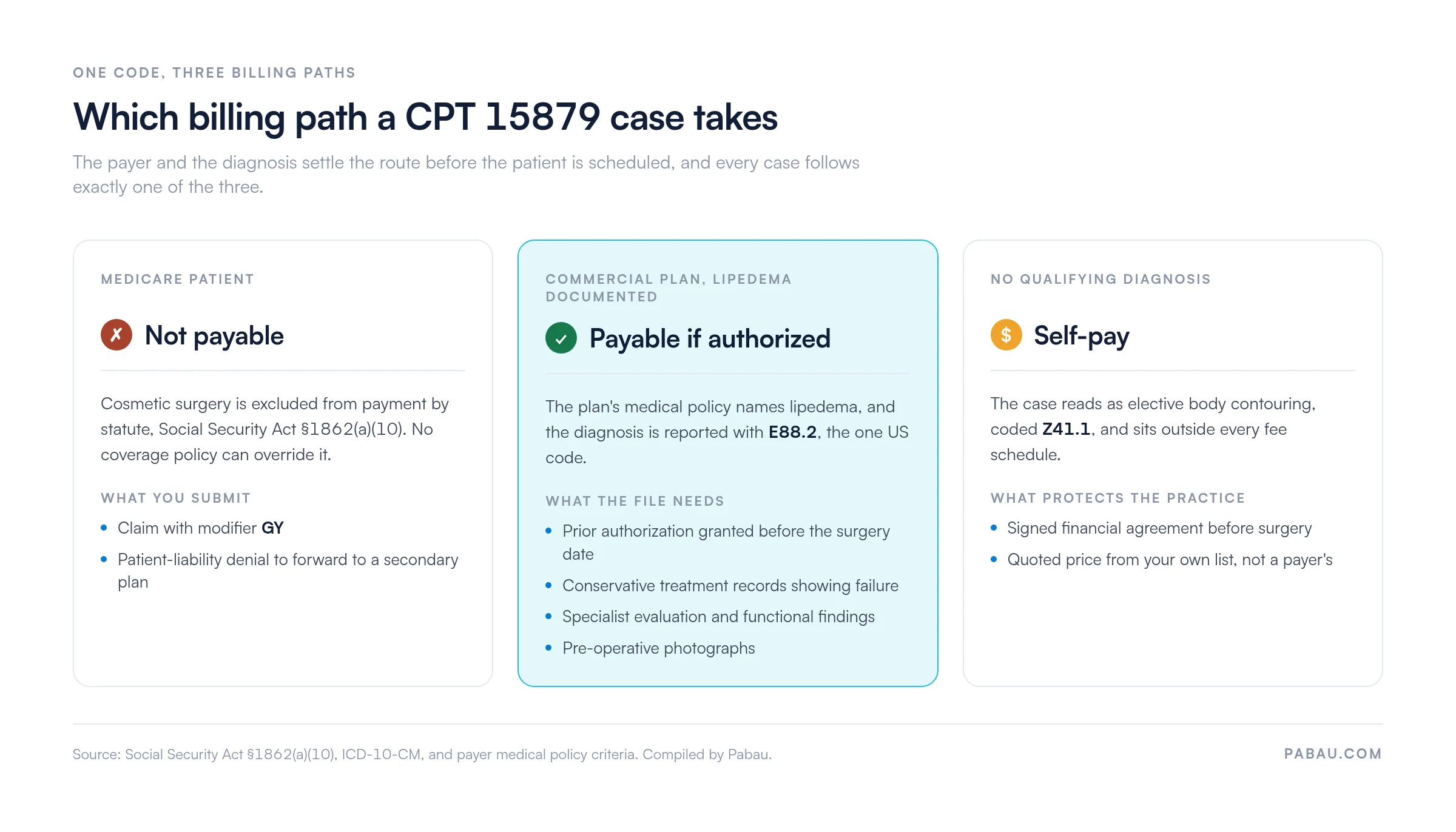
Lipedema is the diagnosis that can move CPT 15879 from a cosmetic exclusion to a potentially covered procedure. It is a chronic adipose tissue disorder that produces disproportionate fat in the lower extremities, with pain and functional limitation. Specifically, US ICD-10-CM reports it with a single code, E88.2, lipomatosis, not elsewhere classified.
This is where a lot of lipedema claims go wrong. Coders look for a code that names the legs and find the five-character E88.2x series on a reference site. They then submit a code the US code set does not contain. Those site-based and stage-based codes come from ICD-10-GM, the German modification, and no US payer can accept them.
Prior authorization is required by virtually all payers that have agreed to cover lipedema-related lipectomy. Accordingly, submit the prior authorization request with conservative treatment records, specialist evaluation notes, and functional assessment findings before scheduling the procedure.
Pairing CPT 15879 with the right diagnosis code decides how the claim is processed. The diagnosis either supports medical necessity or flags the procedure as cosmetic, and a cosmetic flag will not be paid. Therefore, verify every code against the current CMS ICD-10-CM code set, which is published each year by the CDC’s National Center for Health Statistics.
Three things drive modifier selection for CPT Code 15879. They are the number of procedures in the session, whether both sides were treated, and whether the case ran beyond usual complexity. As a result, incorrect modifier use triggers either downcoding or an outright denial. Review modifier rules annually against current AAPC CPT coding guidance since modifier requirements update with each code cycle.
Modifier choice follows the operative report, not the payment you want. Attach the modifier that describes what happened in the room, then let the payer apply its own reduction. A modifier added to clear an edit, with no note behind it, is what turns a paid claim into a repayment demand two years later.
The National Correct Coding Initiative publishes procedure-to-procedure edit tables that decide which code pairs can be billed together. CMS updates those files quarterly, so a pairing that passed last quarter can fail this one. Therefore, check the current table before you bill 15879 alongside another code from the same session.
Verify pairs against the CMS NCCI edit files rather than a coding forum, and note in the claim record which quarter you checked. That note is what makes an appeal defensible if the edit changes later.
Thin documentation is the single largest contributor to CPT 15879 denials. For an insured claim, the operative report, the medical history, and the pre-authorization records have to establish medical necessity together. For a cosmetic case, the same file has to show the patient agreed to pay. Digital forms and consent capture collect most of these documents at the point of booking.
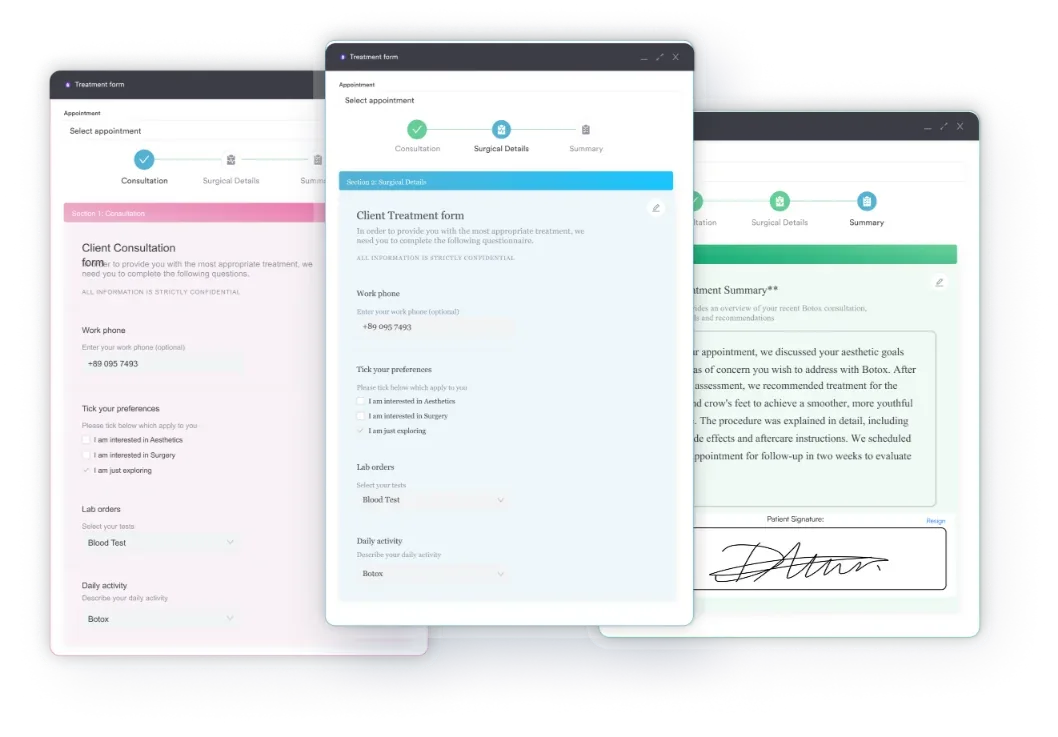
In short, documentation has to be complete before the claim goes out, not reconstructed after a denial.
Document the volume of aspirate removed per body sub-site within the lower extremity on the operative report. Some payers require this level of specificity when reviewing medical necessity claims for lipedema-related lipectomy. A single aggregate volume figure without sub-site breakdown is one of the less-obvious reasons claims come back for additional information.
Prior authorization decides whether a lipedema claim ever reaches review. Every payer that covers lower extremity lipectomy for lipedema wants approval in advance, and a request submitted after the surgery almost never succeeds. Build the authorization into scheduling, so the surgery date is set after the approval lands rather than before.
Medicare is the exception, because a statutory exclusion leaves nothing to authorize. When a Medicare patient needs a formal denial for a secondary plan, submit the claim with modifier GY and expect a patient-liability decision.
CPT 15879 claims fail in predictable ways across plastic surgery and aesthetic billing. A denial management routine catches them before submission, since denial codes on a rejected claim show which stage failed.
A pre-submission review checklist, like the one in Pabau’s claims management software, catches most of these early. Payers scrutinize these codes, so the clean claim standard matters more than on a routine visit.
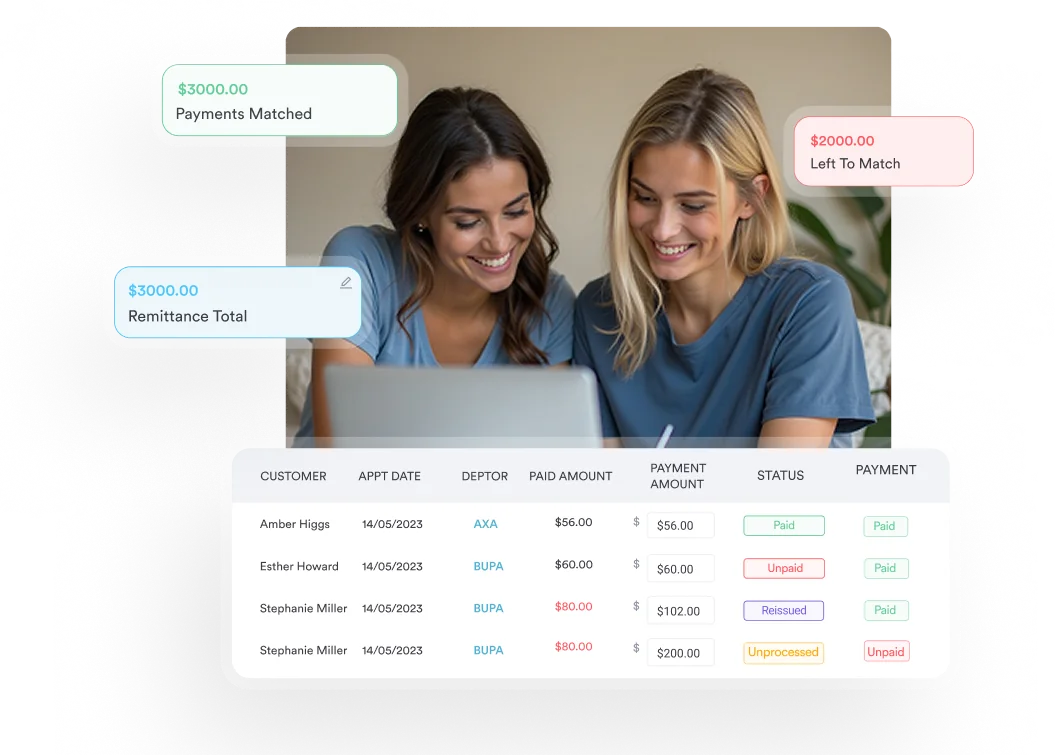
Many CPT 15879 denials trace back to where the records sit rather than to what the surgeon did. The operative note, the pre-op photos, and the signed consent all exist somewhere in the practice. Yet none of them is in front of the biller at submission. As a result, the claim goes out with less support than the chart already holds.
Pabau’s plastic surgery EMR connects the clinical encounter directly to the billing workflow. Before-and-after photos are stored against the patient record, consent forms captured digitally, and treatment notes timestamped in a single audit trail. When a payer requests supporting records for a lipedema-related 15879 claim, the information is already organized and retrievable.
Run a denial reason analysis on your last 90 days of CPT 15879 claims before building your documentation protocol. If the majority of denials cite ‘no prior authorization’ versus ‘cosmetic exclusion,’ the fix is a workflow change at scheduling, not a documentation upgrade. The denial reason tells you where in the process the breakdown is happening.

Pabau connects clinical notes, pre-op photos, consent forms, and billing in one platform. The records that support medical necessity are in place before you submit a claim.

CPT 15879 defaults to cosmetic, so every claim for it needs a decision made before surgery. Either the patient is a self-pay cosmetic case with a signed agreement, or the medical necessity package is assembled and authorized in advance. On the lipedema route, that package rests on one diagnosis code, E88.2. In turn, the operative report has to carry the specificity the code cannot.
Pabau ties the operative record to the claim, so a payer request for supporting documentation becomes a lookup instead of a search through folders. To see how that works for integumentary billing codes, book a demo.

Coding a lesion destruction in the same operative session? CPT 17271 shows how a site-specific descriptor decides the code even when the method is identical.
Billing an excision rather than a suction lipectomy? CPT 21014 covers subfascial soft tissue tumor excision and the depth documentation it depends on.
Operative reports arriving without the detail a reviewer wants? Medical transcription software compares tools that get technique and volume into the note the same day.
CPT Code 15879 is suction assisted lipectomy of the lower extremity, covering fat removal via suction cannulas from the thighs, knees, calves, and ankles. It sits in the integumentary system section of the AMA CPT code set. The 15876-15879 lipectomy family has four codes, one for each body region.
Medicare will not pay for CPT 15879, because cosmetic surgery is excluded from payment by statute rather than by a coverage policy. Some commercial plans do cover it when lipedema is recorded with ICD-10 E88.2 and prior authorization is granted. Coverage varies by payer and by plan, so read the specific medical policy before you submit.
The modifiers you will use most are 51 for multiple procedures, 22 for increased procedural services, and 59 for a distinct service. Add 50 for a bilateral procedure, or LT and RT when a payer wants each side listed separately. Modifier choice follows the clinical scenario and the payer’s rules, so verify it each year against current AMA CPT guidelines.
US ICD-10-CM carries one lipedema code. It is E88.2, lipomatosis, not elsewhere classified. E88.2 is a complete four-character code with no fifth character, so there is no separate code for the arms, the legs, or a stage. Report E88.2 and let CPT 15879 identify the operative site.
No. US ICD-10-CM has a single lipedema code, E88.2, and it does not specify a site or a stage. Codes such as E88.20, E88.21, and E88.22 come from ICD-10-GM, the German modification, and they are not valid on a US claim. Site and stage detail belongs in the operative report instead.
Each code in the 15876-15879 family covers a distinct body region. 15876 is head and neck, 15877 is trunk, 15878 is upper extremity, and 15879 is lower extremity. The procedure technique is identical across all four codes; the correct code is determined entirely by the operative site recorded in the surgical report.
Yes. CPT 15879 can be billed for lipedema-related suction assisted lipectomy of the lower extremity, and some plans will cover it once medical necessity is established. Coverage needs prior authorization, recorded conservative treatment failure, specialist evaluation notes, pre-operative photographs, and ICD-10 code E88.2. Approval is never guaranteed and varies by payer and plan.



