



CCSD code G5100: Bypass of duodenum billing guide
CCSD code G5100 bills a bypass that leaves the duodenum in place CCSD code G5100...

Last Updated: Oct 16, 2026

CPT code 11402 covers excision of a benign skin lesion, including margins, on the trunk, arms, or legs. It applies when the excised diameter is 1.1 to 2.0 cm.
The excised diameter includes the lesion plus the surrounding margin of normal skin, measured before excision, not the lesion size alone.
Skin tags are explicitly excluded from CPT 11402 unless otherwise specified in the code set; code selection depends on the exact pre-excision diameter.
Practice management software like Pabau helps dermatology and primary care practices validate claim fields and track claim status. This reduces denials on procedures like CPT code 11402.
CPT code 11402 covers excision of a benign skin lesion, including margins, on the trunk, arms, or legs. It applies when the excised diameter measures 1.1 to 2.0 cm.
This code sits in the middle of a six-code family split entirely by diameter. A 0.1 cm measurement error can shift the code, the payment, and the audit risk that follows.
According to the American Medical Association (AMA), CPT codes are maintained annually and carry specific descriptor language that defines coverage. For CPT code 11402, that descriptor language is precise and leaves little room for interpretation once you know the measurement rules.
CPT code 11402 has one exact official descriptor. It reads: “Excision, benign lesion including margins, except skin tag (unless listed elsewhere), trunk, arms or legs; excised diameter 1.1 to 2.0 cm.” That exact wording is what a payer checks against the operative note, so it is worth reading literally rather than paraphrasing.
The procedure involves surgically removing the lesion and a margin of surrounding normal skin, then closing the wound. What counts as “excision” here matters: this code requires full-thickness removal through the dermis, not a shave or destruction technique.
Two qualifiers determine whether this code applies.
Common diagnoses that pair with CPT code 11402 include sebaceous cysts, dermatofibromas, epidermoid cysts, nevi, and lipomas located on the qualifying body sites.
Skin tags are explicitly excluded from the descriptor unless otherwise specified in the code set. If the lesion turns out to be malignant on pathology, resubmit the claim with the appropriate malignant excision code.
Medicare reimbursement for CPT code 11402 varies by geographic locality and by whether the service happens in a facility or non-facility setting. The CMS Medicare Physician Fee Schedule lookup tool is the authoritative source for current-year rates.
For 2026, the national average Medicare rate for CPT code 11402 is about $171 in the non-facility (office) setting. In a facility setting, it runs $103 to $105. These figures come from national RVU and conversion-factor data, so verify against your MAC locality before billing.
Rates vary significantly by MAC locality. Alaska and California localities typically pay above the national average, while rural Midwest localities often pay below it. Always confirm against the current-year MPFS for your specific geographic payment locality.
The FastRVU 2026 lookup tool lists current work, practice expense, and malpractice RVU values by locality. The approximate national values for CPT code 11402 are shown below. Verify against the current CMS MPFS data file before using them for financial projections.
Multiply the total RVU by the CMS conversion factor: $33.40 for most clinicians, or $33.57 for those who qualify for the alternative payment model bonus. Then adjust for the geographic practice cost index in your locality. That calculation gives the payment amount.
Pull current RVU and conversion-factor data straight from the CMS file each time you estimate a payment. That way, you avoid relying on last year’s numbers.
Modifier selection for CPT code 11402 depends on the clinical scenario and payer rules. Using the wrong modifier, or omitting one when required, is one of the most common reasons for claim denial on this code.
NCCI edits govern which code combinations require modifier 59 or XS for unbundling. Cross-referencing NCCI edit tables before submitting any same-session combination reduces audit exposure. Verify modifier guidance against current AMA CPT guidelines and individual payer policies, since rules can differ.
Surgeons comparing EMR options for plastic surgery practices should check how each handles operative notes and staged procedures.
Pairing CPT code 11402 with a diagnosis code that establishes medical necessity is required on every claim. The ICD-10-CM code must describe a benign lesion of the skin at the documented body site. A crosswalk tool like CrossCoder helps verify procedure-to-diagnosis pairings against LCD policies before submission.
Practices that keep this pairing consistent across providers often rely on clinical documentation software to standardize how diagnoses get recorded.
Some MAC LCDs specify which ICD-10 codes support coverage for benign lesion removal. A seborrheic keratosis removed purely for cosmetic reasons will not meet medical necessity under most payer policies. That holds true even with the correct ICD-10 code in place. The diagnosis code must reflect the clinical indication documented in the operative note. Electronic remittance files post payments automatically, and the adjustment codes explain what was reduced and why. Downcoding is as common as upcoding, and both trace back to how the decision-making level was recorded. Electronic remittance files post payments automatically, and the adjustment codes explain what was reduced and why. Downcoding is as common as upcoding, and both trace back to how the decision-making level was recorded.
This code family covers benign lesion excision on the trunk, arms, and legs, differentiated entirely by excised diameter. Selecting the wrong code in this series is the most common upcoding audit trigger for skin lesion claims.
There is no CPT 11405 in the active code set. For lesions on the scalp, neck, hands, feet, or genitalia, use the 11420-11426 series. At the same 1.1 to 2.0 cm excised diameter, that series uses CPT 11422. For lesions on the face, ears, eyelids, nose, lips, or mucous membrane, use the 11440-11446 series. The AAPC’s CPT code range lookup shows a complete view of these parallel families alongside official descriptors.
Measure the excised diameter, including the lesion and its margins, before excision begins, not after. The AMA CPT guidelines specify that the measurement is taken prior to excision. Documenting the pre-excision measurement in the operative note protects the code selection and lowers the risk of a down-coding audit.
Medicare and most commercial payers do not cover lesion removal that is purely cosmetic. This is the single biggest coverage risk for CPT code 11402 claims. CMS Medicare Coverage Database article A57482 governs it, specifying covered and non-covered indications for benign skin lesion removal.
To establish medical necessity, the operative note must document one or more clinical reasons the lesion requires removal. Common accepted indications include:
A patient wanting a cyst removed because it is visible is not, by itself, a covered indication. Documenting only “patient preference” or “cosmetic concern” in the clinical note is the fastest route to a denied claim and a potential refund request.
Check your MAC’s Local Coverage Determination for the ICD-10 codes that support medical necessity in your jurisdiction, since covered indications vary by region.
Clean documentation for a CPT code 11402 claim needs several specific elements. Missing any one of them gives payers and auditors a reason to flag the claim. Practices that use standardized medical forms for procedures reduce that risk systematically across every provider and every patient encounter.
Practices relying on paperless documentation workflows can configure procedure-specific form fields to capture these data points automatically. The errors that most often trigger denials or audits on CPT code 11402 claims:
Running a periodic medical chart audit catches these six mistakes before a payer does.
Adopting HIPAA-compliant billing documentation means capturing every required field at the point of care, before the patient leaves.
Pabau’s digital intake forms can be customized to capture procedure-specific fields. That way, excised diameter, body site, and clinical indication get recorded the same way for every excision. One skin practice, the London Face and Skin Clinic.
Most practices still catch billing problems after a claim has already gone out. A missing modifier, an incomplete diagnosis pairing, or a field the payer needed often surfaces only after submission. By the time the denial letter arrives, the fix costs a phone call, a resubmission, and a longer wait for payment.
Pabau’s claims management software works earlier in that process. It validates the fields a submission actually needs and holds the claim back until those fields are complete. Billing staff get a status dashboard that shows where every claim sits, from submitted through to paid.
For CPT code 11402, the size bracket alone decides the code. The excised diameter, the modifier, and the diagnosis pairing all get checked before the claim leaves the practice. None of that waits for a denial to come back.
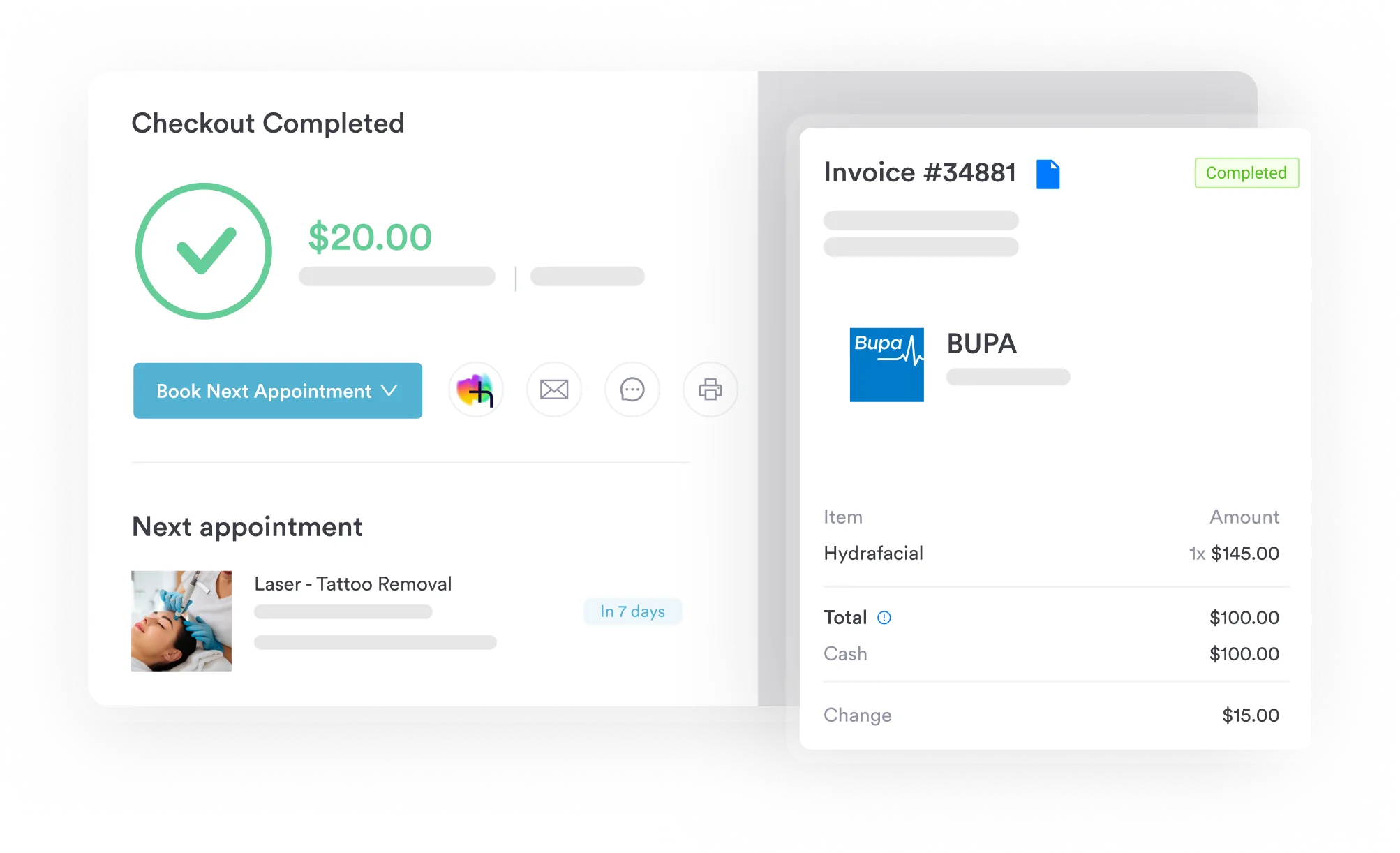

Pabau validates the fields a claim needs and holds submission until they are complete. Your team gets a live status dashboard, so errors on procedures like CPT code 11402 surface before a payer rejects them.

Getting CPT code 11402 right comes down to one habit: measure the excised diameter before you cut, not after. Record that number in the operative note the same way every time. That single habit fixes most of the denials this code generates.
The bigger risk is not the size bracket alone. It is the documentation trail behind it. That means the medical necessity statement, the modifier on a same-day E/M, and the pathology report a payer might ask for later. A claim that gets all of this right the first time avoids the slower, costlier fight of an appeal.
Pabau keeps that trail in one place. The details a claim needs get captured before it goes out, rather than chased down after a denial. Book a demo to see how Pabau supports cleaner claims for procedures like CPT code 11402.

Billing a related skin excision procedure? CPT code 15830 walks through panniculectomy billing, from documentation to reimbursement.
Coding a different excision near the eye? CPT code 15821 covers lower eyelid blepharoplasty billing rules and common denials.
Coding the anterior wall of the nasopharynx? ICD-10 code C11.3 guide covers this fourth subcode in the C11 nasopharynx malignancy family.
For 2026, the national average Medicare rate is about $171 in the non-facility setting and $103 to $105 in a facility setting. Rates vary by MAC locality, so verify current figures on the CMS MPFS lookup tool before billing.
CPT code 11402 applies when the excised diameter is 1.1 to 2.0 cm; CPT code 11403 applies from 2.1 to 3.0 cm. This split only matters above 1.1 cm. Smaller measurements use CPT code 11400 (0.5 cm or less) or CPT code 11401 (0.6 to 1.0 cm) instead.
No. CPT code 11402 covers the excision itself, and the pathology exam confirming benign status is billed separately, typically under CPT code 88305.
Simple closure is included in CPT code 11402. A flap, graft, or complex repair needs its own code, billed in addition, usually with modifier 51.
No. CPT code 11402 uses one code family for the trunk, arms, and legs together. Only the excised diameter changes which code in that family applies.



