CCSD Code D1010: Radical mastoidectomy including meatoplasty
CCSD Code D1010: Definition and clinical scope CCSD Code D1010 is the UK private...

Last Updated: Nov 25, 2026
T6460 is the CCSD code for tendon transfer of toe - unilateral. It covers moving a toe tendon to a new attachment point on one foot, most often to straighten a flexible hammertoe or claw toe.
Transfers on both feet in one sitting are billed as T6461. If a lesser-toe joint is also excised, T6462 applies instead, and the CCSD lists T6460 as an unacceptable combination with both.
Let Pabau's smart automation suggest the right codes, reduce claim denials, and keep your practice compliant—effortlessly.
Automate repetitive tasks and focus on what matters most—your patients.
Reduce coding errors and ensure compliance with the latest regulations.
Clean claims, fewer denials, and faster reimbursements.
Powerful insights and reporting to help your practice thrive.
HIPAA compliant SOC 2 certified GDPR-compliant Trusted by 4,000+ clinics worldwide

CCSD code T6460 is tendon transfer of toe, unilateral, an orthopedic procedure in Chapter 16 of the CCSD schedule.
It is most often used for a flexible hammertoe or claw toe, where moving a tendon pulls the toe straight.
Transfers on both feet in one sitting bill as T6461, not as two T6460 lines.
If a lesser-toe joint is also excised, T6462 replaces T6460, and the CCSD lists the pair as an unacceptable combination.
The operative note must name the side, the toe, the tendon moved and any implant, such as a K-wire.
CCSD code T6460 is the UK private billing code for a tendon transfer of a toe on one foot. It comes from the CCSD Group’s schedule, the standard set of procedure codes for UK private healthcare. Surgeons use it most often for a flexible hammertoe or claw toe, where moving a tendon pulls the toe back into line.
Two details decide whether the claim is paid. Which foot was operated on? And was any joint work done as well? Get either one wrong, and the insurer will query the claim.
The code sits in Chapter 16 of the schedule, which covers bones, joints and connective tissue. Within that chapter, it belongs to the toe procedures. The same chapter holds the Achilles codes, such as CCSD T6722 for a primary open lengthening. Tendon division codes sit there too, such as the percutaneous tenotomy code T7010. UK private medical insurers use the CCSD descriptors to process claims.
The descriptor ends in “unilateral”, and that word matters. It limits the code to one side. Transfers on both feet in the same sitting have their own code, which we cover below. The full CCSD codes reference explains how the chapters fit together.
A tendon transfer moves where a tendon attaches, while its muscle stays where it is. On a toe, the aim is to turn a tendon that bends the toe into one that holds it straight. In the hand, the same move made with one tendon is billed under a different code, code T6402. A primary repair of a cut flexor tendon in the hand is billed under code T6750. Secondary repair is another matter. When the surgeon uses a transfer to rebuild a tendon after a failed first repair, the claim moves to CCSD T6800. A more specific code takes priority where one exists.
The classic version is the flexor-to-extensor transfer for a lesser toe. Here’s how it usually runs:
The transfer works best when the deformity is still flexible. In other words, the toe straightens when you push up under the ball of the foot. A fixed, rigid deformity usually needs bone or joint work too. That changes the code, so the note has to say which kind of deformity the surgeon found.
Most T6460 coding errors come from three neighboring entries. Two questions sort them out, in this order. Was a toe joint excised as well as the tendon moved? And was one foot treated, or both?
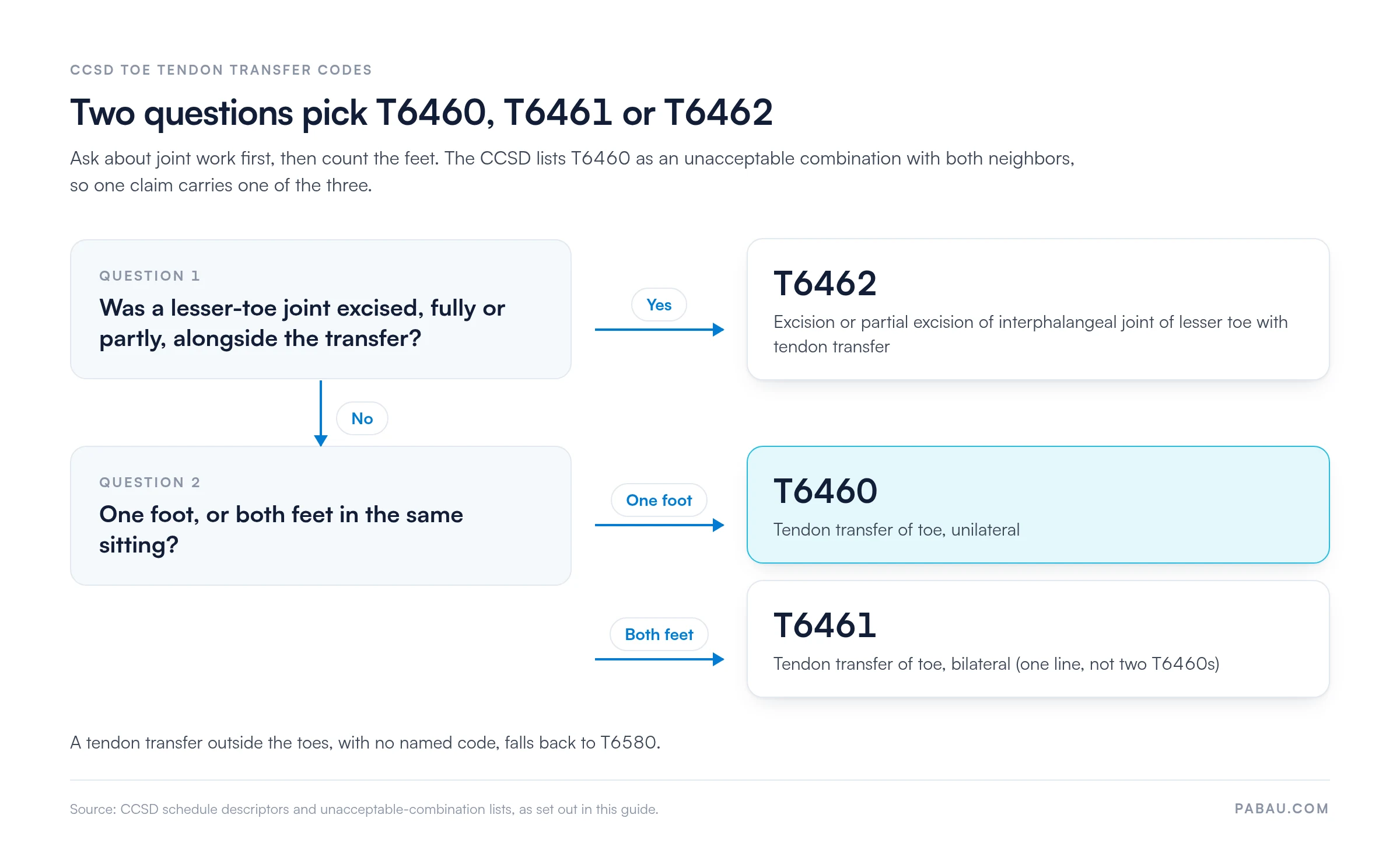
The CCSD lists T6460 as an unacceptable combination against both T6461 and T6462. Put simply, those codes should not appear together on one claim.
The CCSD technical guide adds a caveat, though. These lists are guidelines, and each insurer decides whether to apply them. Older referrals sometimes still quote T6400, a retired generic transfer code, so recode those before you request authorization.
One question the descriptor leaves open is several toes on the same foot. It doesn’t say whether each toe counts as a separate transfer. So ask the insurer before you put T6460 on a claim more than once for one foot.
A T6460 claim stands or falls on the operative note. A coder reads it to choose between three codes, and an insurer reads it to check the choice. So write it for both readers. It should record:
Most acquired toe deformities sit in the M20 category of ICD-10, which you can check in the NHS Classifications Browser. For a toe tendon transfer, two entries come up most often. M20.4 covers other hammer toes. M20.5 covers other acquired toe deformities, which is where claw toe usually sits. Make sure the diagnosis matches the toe and the side in the operative note.
Here’s an illustrative example. A patient has a painful, flexible claw deformity of the left second toe. Padding and wider shoes haven’t helped, so the consultant offers a tendon transfer.
Now change one fact. Say the surgeon finds the joint is stiffer than expected and excises part of it. The claim is now T6462, not T6460. So the practice should update the authorization before it submits, not after a rejection.
Toe surgery claims tend to trip over the same few mistakes. Each one has a simple fix.
The technical guide backs up that last point. It says no common procedure should routinely need more than one code. It also notes that each insurer sets its own rules on multiple codes. Payer-specific detail varies, and the Bupa CCSD codes guide shows how one insurer applies the schedule.
Foot and ankle billing has an awkward shape. The code depends on details that only appear in the operative note. Meanwhile, the authorization is often agreed weeks before anyone knows what the surgeon will find.
Pabau, a practice management platform, keeps the clinical record and the claim on the same episode. Its claims management software pre-fills the claim from the patient record and checks required fields before sending. Those fields include membership and authorization numbers. So a T6460 claim can’t leave without its reference, and the note is one click away when an insurer asks.
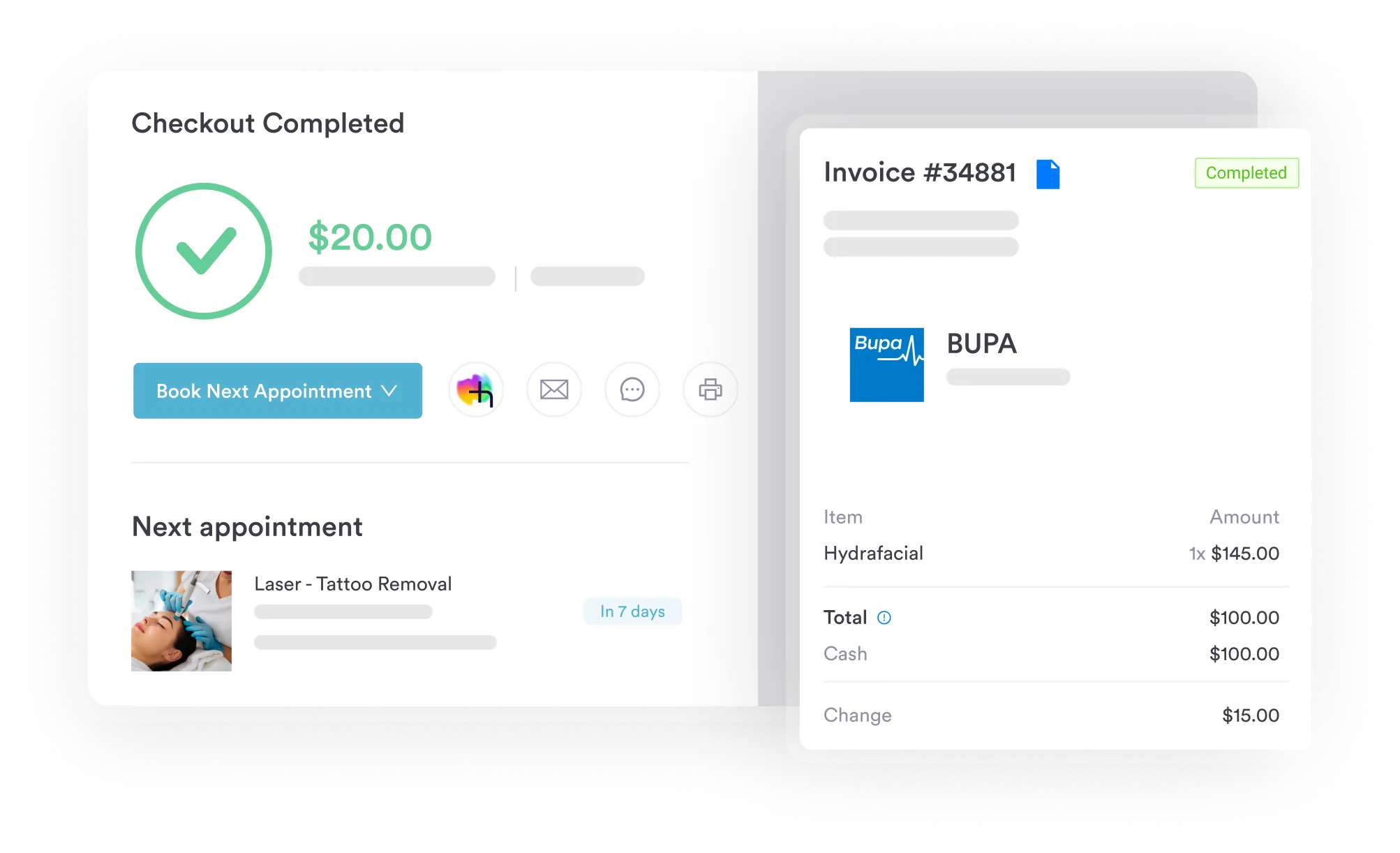

Pabau pre-fills insurer claims from the patient record and checks the authorization reference before submission. Your team spends less time rebuilding a claim after a query.

T6460 is a small code with a narrow lane. It pays for one tendon transfer on one foot. The moment the surgeon treats the other foot or excises a joint, a different code takes over.
That’s why the operative note matters more than the code itself. If the note names the side, the toe and any joint work, the coder rarely has to guess. And when surgery changes the plan, update the authorization before the claim goes out.
Book a demo to see how Pabau keeps CCSD codes, authorization references and operative notes on one patient record.

Need the wider Bupa view of the CCSD schedule? Bupa CCSD codes covers how Bupa applies the schedule, with billing rules and payer guidance.
New to the CCSD schedule? CCSD codes explains how the chapters are organized and how UK insurers use them.
Billing a tendon transfer outside the toes? CCSD code T6580 covers tendon grafts and transfers with no more specific entry.
Coding another foot and ankle tendon procedure? CCSD code T6822 sets out the rules for secondary Achilles tendon repair with a graft.
Seeing an old code on a referral? CCSD code T6400 explains the retired generic transfer code and what to bill instead.
No. T6460 belongs to the CCSD schedule, which UK private medical insurers use to process claims. OPCS-4 is the classification NHS hospitals use to record procedures. A privately funded toe tendon transfer is claimed with the CCSD code.
Often, when the toe causes pain or problems and a specialist recommends surgery. Most policies exclude treatment done only to change how the foot looks. Check the member’s cover and get authorization before booking surgery.
Most patients walk in a stiff post-operative shoe soon after surgery. If a K-wire was used, it usually comes out at a follow-up appointment after a few weeks. Swelling can take several months to settle fully.
Both, on separate claims. The surgeon claims their fee with T6460. The hospital bills its own charges, such as operating room time and implants. The anesthetist sends a third claim, and all three should quote the same authorization reference.