

CCSD Code D1010: Radical mastoidectomy including meatoplasty
CCSD Code D1010: Definition and clinical scope CCSD Code D1010 is the UK private...

Last Updated: Nov 25, 2026
CCSD code T6722 covers primary open lengthening of Achilles tendon. UK private insurers such as Bupa and AXA Health use it for surgery that lengthens a tight heel cord through an open incision. It sits in Chapter 16 of the CCSD Schedule, which covers bones, joints, connective tissue, tendon and muscle.
The Achilles codes sit close together, so the choice turns on three words: primary, open and lengthening. Percutaneous lengthening, revision surgery and tendon repair each have their own code. Insurer schedules also list some of those neighbors as unacceptable combinations with T6722. A wrong pick can hold up payment for the surgeon, the anesthetist and the hospital.
Let Pabau's smart automation suggest the right codes, reduce claim denials, and keep your practice compliant—effortlessly.
Automate repetitive tasks and focus on what matters most—your patients.
Reduce coding errors and ensure compliance with the latest regulations.
Clean claims, fewer denials, and faster reimbursements.
Powerful insights and reporting to help your practice thrive.
HIPAA compliant SOC 2 certified GDPR-compliant Trusted by 4,000+ clinics worldwide

CCSD code T6722 is the UK private-sector code for primary open lengthening of Achilles tendon, a Chapter 16 musculoskeletal procedure.
Percutaneous lengthening, revision surgery and Achilles tendon repair each carry their own CCSD code, so check all three words: primary, open, lengthening.
AXA Health’s published schedule pairs T6722 with T6723, T6822 and T7010 as unacceptable combinations, so check the current CCSD Schedule before billing them together.
Get pre-authorization for T6722 before surgery, and update it with the insurer if the procedure changes on the day.
Your operative note should show the side, the open approach, the indication and that this is the first lengthening of that tendon.
CCSD code T6722 is the code UK private insurers use for a primary, open lengthening of the Achilles tendon. It comes from the CCSD Schedule, the standard procedure code set for UK private healthcare.
UK private insurers such as Bupa and AXA Health process surgical claims against it. AXA Health’s Chapter 16 schedule lists T6722 as “Primary open lengthening of Achilles tendon”.
The surgeon opens the back of the ankle and lengthens the tendon, often with a Z-shaped cut that is then sutured in its new position. The aim is to release a tight heel cord that stops the ankle bending upward, known as equinus.
You will see it in a few typical cases:
“Primary” means this is the first lengthening of that tendon. The code sits in Chapter 16 of the schedule, which covers bones, joints, connective tissue, tendon and muscle. Other CCSD billing guides sit in our procedure code library, and our Bupa CCSD codes guide explains how the codes work across insurers.
The Achilles codes sit close together, and each one describes a different operation. T6722 fits only when the surgery was primary, open and a lengthening. If any of those words is wrong, a neighboring code is the better match.
Three questions settle it, in the order shown below.
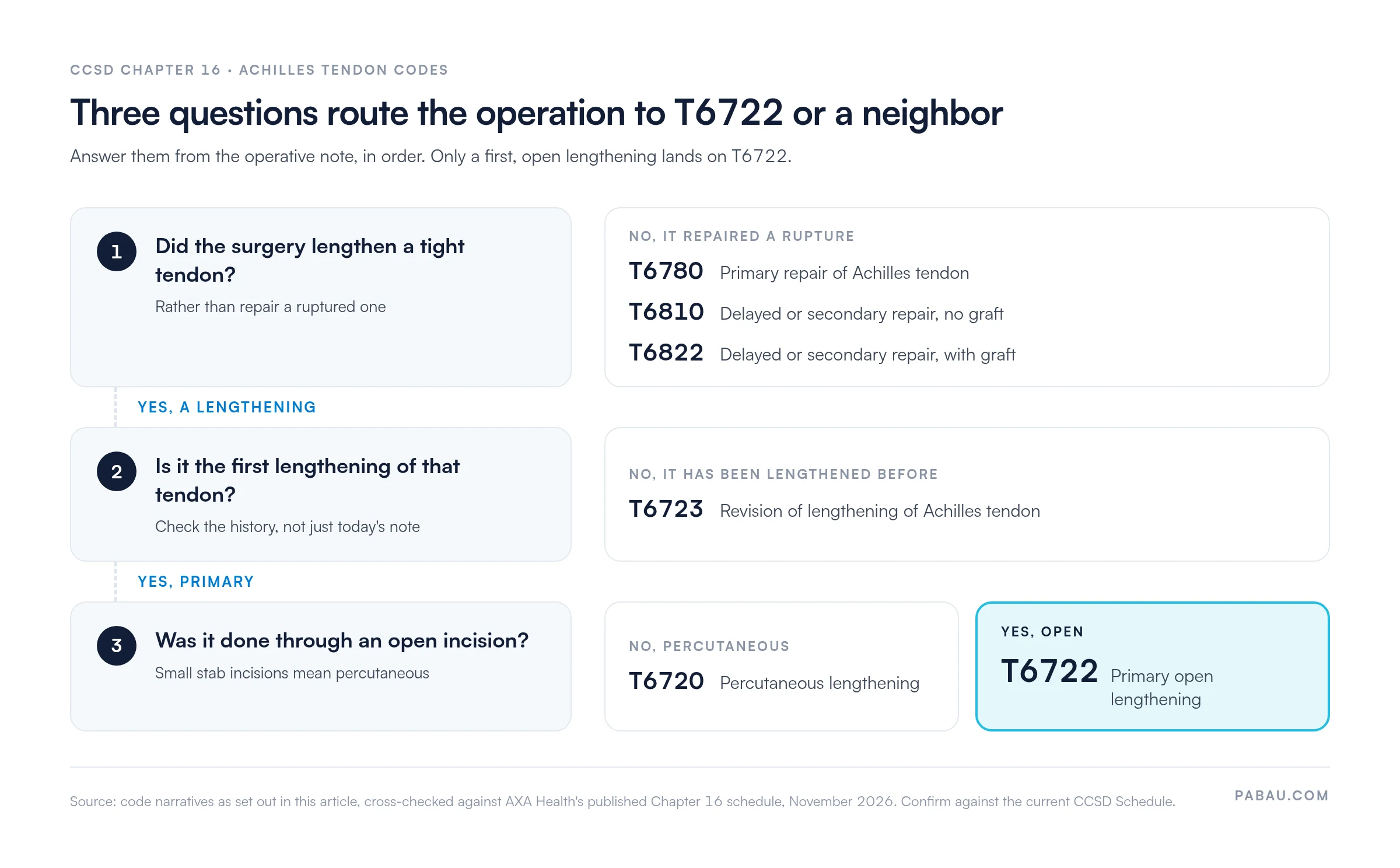
Insurer schedules sometimes word these narratives differently. AXA Health, for example, lists T6720 as “Tendo Achilles lengthening percutaneous” and T6723 as “Tendo Achilles lengthening repeat procedure”. Always match the operation to the narrative in the current CCSD Schedule, then confirm the insurer accepts it.
A gastrocnemius recession releases the calf muscle higher up the leg, so it doesn’t belong under T6722 either. Look it up separately in the schedule.
An unacceptable combination is a pair of codes that shouldn’t be billed together for the same operation. Usually, one procedure already includes the work of the other. Three pairings matter most for T6722:
These pairings come from AXA Health’s published Chapter 16 schedule. It lists T6723 and T7010 against T6722, and T6722 against T6822. It also pairs T6722 with T6800, delayed or secondary repair of tendon.
CCSD’s own code pages sit behind a login, and other insurers can add pairings of their own. Check the current CCSD Schedule and each insurer’s list before you combine codes.
The same chapter notes say every procedure code includes the first cast. Don’t bill the post-op cast separately.
If you did perform a separate procedure in the same session, such as a tendon transfer, pre-authorize both codes. Then document each with its own indication.
A private T6722 claim follows the same path at most UK insurers. The details differ, but the order rarely does.
If your fee is above the insurer’s rate, the patient may owe the shortfall. Agree that with the patient in writing before surgery, not after the remittance arrives.
Pre-authorization is the step that turns a planned operation into a payable claim. Without an authorization number, an insurer can reject the invoice outright.
At this stage, the insurer usually checks a few things:
Plans can change in the operating room. A planned percutaneous release may become an open lengthening. Equally, a lengthening may turn into a graft repair once the tendon is exposed.
Call the insurer and update the authorization to the code you performed before you invoice. A claim for a different code from the one authorized is one of the quickest routes to a query.
A reviewer should be able to read your note and land on T6722 without guessing. Include these points:
Keep the authorization number on the same record. If a query comes back months later, the whole story is in one place.
Rejected T6722 claims usually trace back to admin errors. Here is what to look for and how to fix each one.
Read the rejection reason first, because it tells you which fix applies. Resubmit through the same channel with the correction and the operative note attached. Keep a log of the date, the reason and the outcome. A pattern often shows up after a few claims.
Claim errors often creep in when details are copied between systems. Pabau, a practice management platform with built-in insurance billing, keeps the claim on the same record as the operative note. It then sends CCSD-coded claims to Healthcode straight from that record.
Before a claim goes out, Pabau’s claims management software warns when an authorization code is missing, and tracks each claim’s status. Your team sees where every T6722 claim stands without keeping a separate spreadsheet.
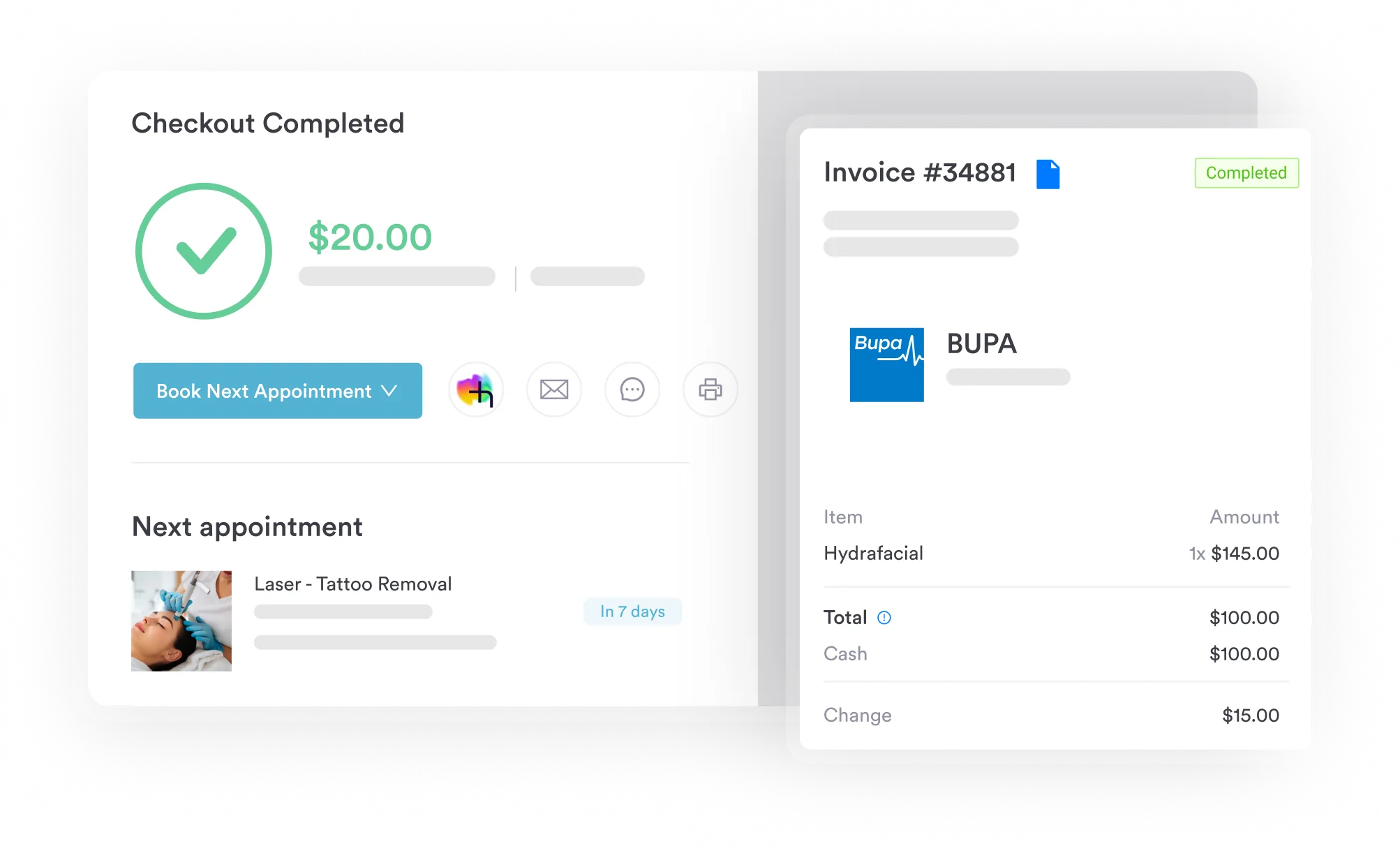

Pabau warns when an authorization code is missing, submits CCSD-coded claims through Healthcode and tracks each claim’s status.

T6722 is a narrow code. It pays for one operation, a first open lengthening of the Achilles tendon. Get the three words right, and the rest of the claim becomes routine admin.
If you change one habit, make it the call to the insurer when the plan changes in the operating room. That one step protects the claim more than any resubmission. Book a demo to see how Pabau keeps T6722 claims, notes and authorizations on one patient record.

Need the wider CCSD picture? Bupa CCSD codes explains how CCSD codes are structured and billed to Bupa.
Lengthened the tendon through stab incisions? CCSD code T6720 covers percutaneous Achilles tendon lengthening.
Repairing a ruptured tendon instead? CCSD code T6780 covers primary repair of the Achilles tendon.
Used a graft for a late repair? CCSD code T6822 covers secondary Achilles tendon repair with a graft.
Often, yes, if the policy covers planned surgery and the condition isn’t excluded. Cover depends on the individual policy, so the patient should get pre-authorization for T6722 before booking.
No. CCSD codes are for UK private healthcare claims. NHS hospitals record procedures with OPCS-4 codes instead.
It depends on the insurer. The CCSD Group sets the code and its description, while each insurer sets its own fee. Check the current fee schedule for the patient’s insurer before quoting.
Usually, yes. The anesthetist invoices separately, but against the same procedure code. The hospital sends its own invoice as well.
Most patients spend several weeks, often four to six, in a cast or boot, followed by physical therapy. Your surgeon sets the exact plan, which matters for any follow-up claims.




