HCPCS Code Q4185: Cellesta flowable amnion billing guide
HCPCS Code Q4185: definition and official descriptor HCPCS Code Q4185 is the Lev...

Last Updated: Nov 20, 2026
T6822 is the CCSD code for delayed or secondary repair of the Achilles tendon with a tendon or fascial graft. Surgeons use it to bill UK private medical insurers for a re-rupture or neglected rupture that needs a graft. Bupa’s schedule lists it in band MAJOR+ 2 at £725.
If no graft is used, the code is T6810 instead. A primary repair of a fresh rupture is T6780.
Let Pabau's smart automation suggest the right codes, reduce claim denials, and keep your practice compliant—effortlessly.
Automate repetitive tasks and focus on what matters most—your patients.
Reduce coding errors and ensure compliance with the latest regulations.
Clean claims, fewer denials, and faster reimbursements.
Powerful insights and reporting to help your practice thrive.
HIPAA compliant SOC 2 certified GDPR-compliant Trusted by 4,000+ clinics worldwide

CCSD code T6822 covers delayed or secondary repair of the Achilles tendon when a tendon or fascial graft is used.
The same repair without a graft is T6810, and a primary repair of a fresh rupture is T6780.
Bupa’s schedule places T6822 in band MAJOR+ 2 with a fee of £725. Other UK insurers publish their own fees.
The operative note must state that the repair is delayed or secondary and name the graft used and its source.
Pabau sends CCSD-coded claims to UK private medical insurers through Healthcode and tracks each one to payment.
CCSD code T6822 is the UK private healthcare code for delayed or secondary repair of the Achilles tendon with a tendon or fascial graft. It sits in the CCSD Schedule, the standard procedure codes that the Clinical Coding & Schedule Development Group maintains for UK private healthcare. Surgeons use it to bill private medical insurers such as Bupa, AXA Health, Aviva and Vitality.
Two conditions must both hold before T6822 applies. The repair is delayed or secondary, and a graft is used to bridge or reinforce the tendon. If either one is missing, a different code fits better.
“Delayed or secondary” covers a re-rupture after an earlier repair, and a neglected rupture that presents weeks or months after the injury. In both, the tendon ends have retracted or degenerated, so direct end-to-end suture is no longer enough.
Two graft types fall within the descriptor:
The descriptor does not separate autograft from allograft. The operative note should still name the graft, because insurers and hospitals treat tissue costs differently.
Secondary Achilles reconstruction with graft is a longer, more complex operation than primary repair. The surgeon works through scar tissue, retracted tendon ends and, sometimes, the remains of a failed repair.
The operation usually follows this sequence:
T6822 applies when the record confirms a graft-assisted repair in one of these situations:
In each case, the operative note and the pre-authorisation request must make the secondary nature of the repair explicit. Without it, insurers tend to query the claim or treat it as a primary repair.
The Achilles repair codes sit side by side in the foot and ankle section of the schedule. The table shows how T6822 differs from its neighbours, with Bupa’s band and fee for each. Every other code in the schedule is indexed in Pabau’s CCSD codes reference, and the Bupa CCSD codes guide explains how bands and fees work.
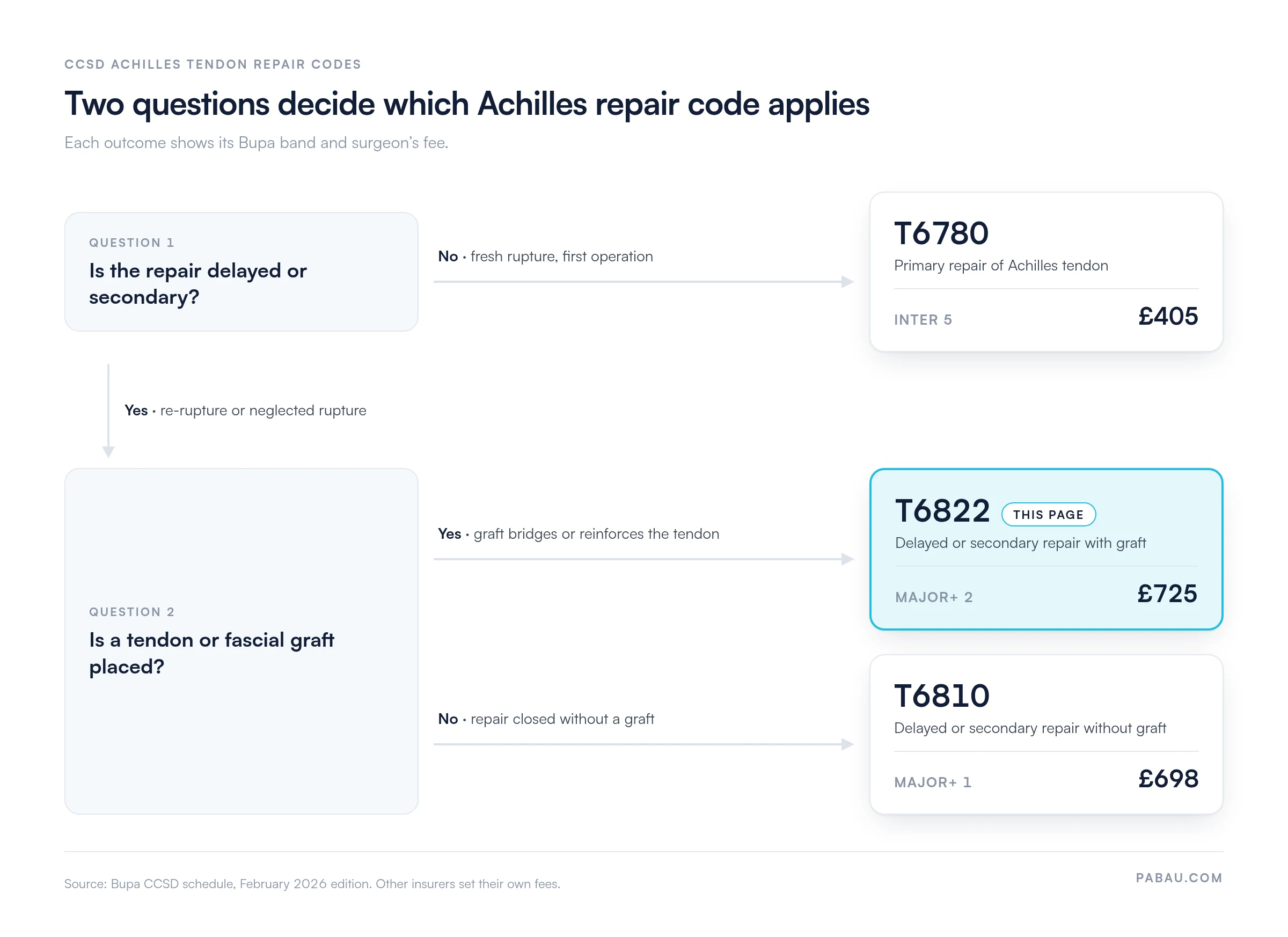
Read as a decision, the three codes turn on two questions. Was the repair delayed or secondary, and was a graft placed?
Lengthening is coded separately. T6720 and T6722 cover percutaneous and open lengthening of the Achilles tendon, and T6723 covers revision of a lengthening. None of them involves repairing a rupture.
No. T6822 is the surgeon’s code whichever graft is used. What changes is who bills for the tissue and whether the insurer covers it.
Record the graft source, the harvest site or the tissue bank batch reference in the operative note. Insurers may ask for it when they review an allograft claim, even after accepting the procedure code.
UK insurers code diagnoses with WHO ICD-10, not the US ICD-10-CM. For T6822, the diagnosis should support the secondary nature of the repair. The WHO ICD-10 browser gives the full definition for each code below.
Code from the operative findings and the clinical history, not from the referral letter alone. Where the revision follows a failed repair, pair the rupture code with T81.8 so the claim shows why a second operation was needed.
Bupa, AXA Health, Aviva, Vitality and most other UK private medical insurers expect pre-authorisation before elective surgery. The patient usually contacts the insurer, which issues an authorisation number for the agreed procedure code.
For a revision Achilles repair, the insurer may ask for more detail than for a primary repair. Have this ready:
Authorisation is not a promise of payment. If the operative note describes a different procedure from the one authorised, the insurer can still query or reduce the claim.
The operative note is the document insurers check first. It has to match the CCSD code, the ICD-10 codes and the authorisation. It should include:
Send the claim with the authorisation number, the surgeon’s insurer provider number and the ICD-10 codes. Keep copies of the note and the imaging, as revision claims are more likely to be reviewed.
Several other charges usually sit alongside the surgeon’s T6822 claim. Each one goes to the insurer separately:
Skin incision, closure, haemostasis and an autograft harvest from the same leg are part of T6822. Billing them as separate lines is a bundling error, and insurers recover the payment.
Most rejected T6822 claims fail on documentation rather than coding. The table sets out the usual reasons and how to fix each one.
Bupa’s schedule places T6822 in band MAJOR+ 2, with a surgeon’s fee of £725. That is above T6810 (MAJOR+ 1, £698) and well above primary repair under T6780 (INTER 5, £405). The figures come from the Bupa CCSD schedule, February 2026 edition.
AXA Health, Aviva, Vitality and other insurers publish their own fee schedules, and their fees for T6822 can differ from Bupa’s. Check each insurer’s current schedule before you quote the patient.
If the surgeon charges more than the insurer pays, the patient usually covers the shortfall. Tell the patient about any shortfall in writing before surgery, so the bill holds no surprises.
Load each insurer’s new fee schedule into your billing system as soon as it is published. Claims sent at last year’s fees are paid at the insurer’s rate anyway, and the shortfall often goes unnoticed until a year-end review.
Orthopaedic practices billing T6822 need the operative note, the authorisation number and the claim to agree. Pabau, a practice management platform, keeps all three in the same patient record.
With Pabau’s claims management software, your team sends CCSD-coded claims to UK insurers through Healthcode. Each claim is tracked from submission to payment, so a rejection reaches the team while there is still time to resubmit.
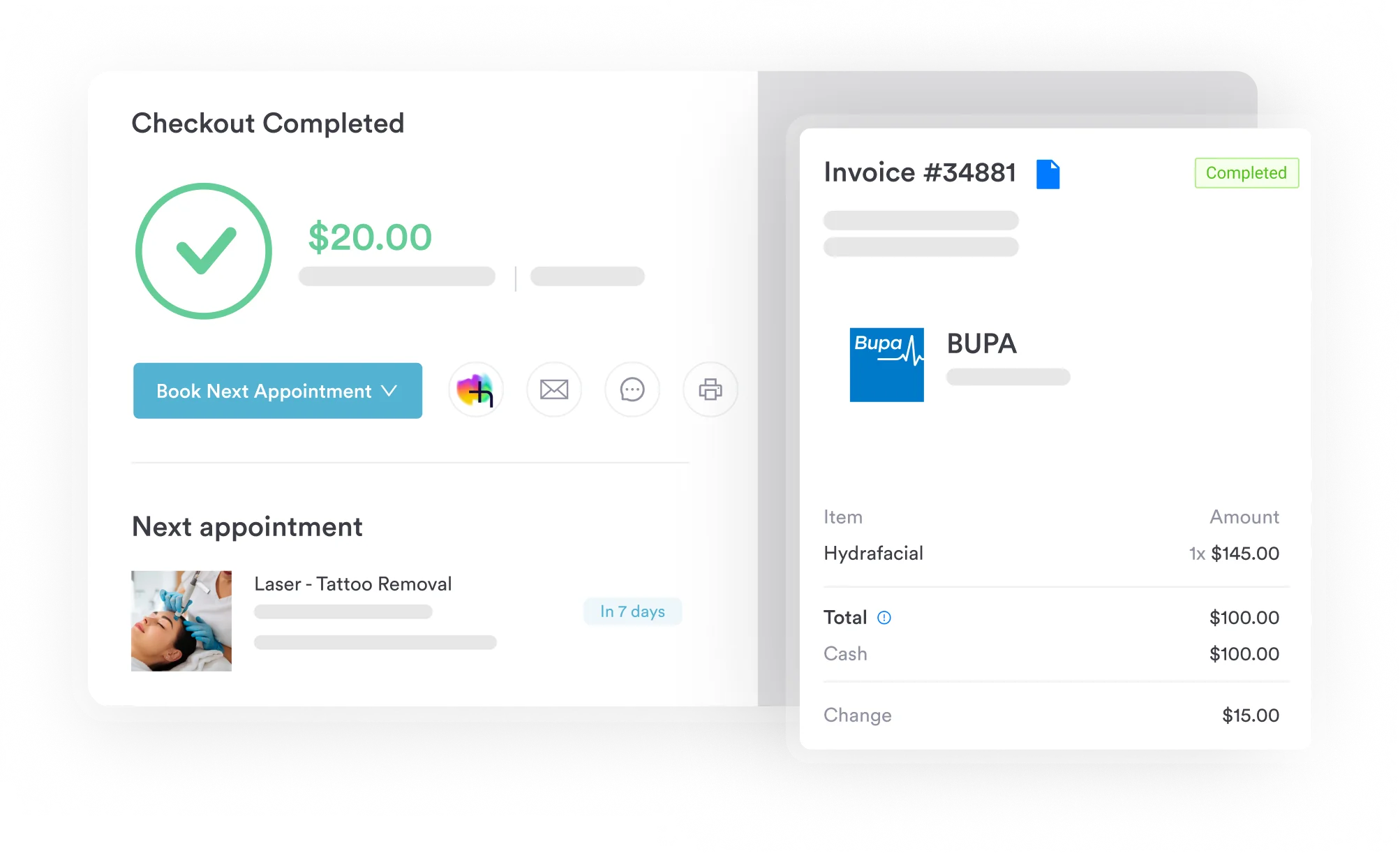
The authorisation number sits against the booked procedure and fills in on the claim. An audit trail records every code change and submission against the patient file, which helps when an insurer reviews a revision claim.

Pabau helps UK orthopaedic practices keep operative notes, authorisation numbers and ICD-10 codes together, then sends CCSD-coded claims through Healthcode.

T6822 pays for a delayed or secondary Achilles repair in which a graft is placed. Take away the graft and the code is T6810. Make it the first operation on a fresh rupture and it is T6780.
So the claim rests on two lines in the operative note: that the repair is secondary, and which graft went in. Write both plainly and match the authorisation to them. Book a demo to see how Pabau sends CCSD claims through Healthcode with the note beside each one.

Need the full Bupa schedule? Pabau’s Bupa CCSD codes guide explains code structure, bands and fees across the schedule.
Billing a revision without a graft? CCSD code T6810 covers delayed or secondary Achilles repair without a graft.
Choosing billing software for a UK practice? The best medical billing software in the UK compares the options for insurer claims.
CCSD code T6822 covers delayed or secondary repair of the Achilles tendon with a tendon or fascial graft. It is part of the UK private healthcare schedule maintained by the CCSD Group. It applies to re-ruptures and neglected ruptures where a graft is needed.
T6822 is a delayed or secondary Achilles repair with a tendon or fascial graft. T6810 is the same repair without a graft. T6780 is a primary repair of a fresh rupture at the first operation.
Bupa’s schedule places T6822 in band MAJOR+ 2 with a surgeon’s fee of £725. T6810 sits in MAJOR+ 1 at £698, and T6780 in INTER 5 at £405. AXA Health, Aviva and Vitality publish their own fees.
UK insurers use WHO ICD-10. Common pairings are S86.0 for a traumatic rupture and M66.3 for a spontaneous one. T93.5 fits a neglected rupture, and T81.8 a failed earlier repair.
Most UK private medical insurers, including Bupa, AXA Health, Aviva and Vitality, expect pre-authorisation before elective surgery. Quote T6822 and the diagnosis codes when you ask. Authorisation is not a guarantee of payment if the operative note describes a different procedure.
No. T6822 is the surgeon’s code for both autograft and allograft repairs. An autograft harvest is included in the procedure. Allograft tissue is usually charged by the hospital, so check cover with the insurer first.
Most UK practices send CCSD-coded claims to insurers electronically through Healthcode. The claim carries the CCSD code, the ICD-10 codes, the authorisation number and the surgeon’s insurer provider number.