CCSD Code D1010: Radical mastoidectomy including meatoplasty
CCSD Code D1010: Definition and clinical scope CCSD Code D1010 is the UK private...

Last Updated: Nov 25, 2026
T6800 is the CCSD code for delayed or secondary repair of a tendon, including graft, transfer or prosthesis, when no more specific code fits. UK private insurers use it when a tendon is repaired after the acute stage of an injury, or after an earlier repair has failed.
T6800 sits in sub-chapter 16.1.0 Connective Tissue/Tendon Muscle of the CCSD schedule, under CCSD reference Fp.009. Hand flexor, hand and forearm extensor, and Achilles tendon repairs have their own codes.
Let Pabau's smart automation suggest the right codes, reduce claim denials, and keep your practice compliant—effortlessly.
Automate repetitive tasks and focus on what matters most—your patients.
Reduce coding errors and ensure compliance with the latest regulations.
Clean claims, fewer denials, and faster reimbursements.
Powerful insights and reporting to help your practice thrive.
HIPAA compliant SOC 2 certified GDPR-compliant Trusted by 4,000+ clinics worldwide

CCSD code T6800 covers delayed or secondary repair of a tendon, including graft, transfer or prosthesis, where no more specific code applies.
It sits in CCSD chapter 16, sub-chapter 16.1.0 Connective Tissue/Tendon Muscle, under reference Fp.009, and it is an active code.
Hand flexor, hand and forearm extensor, and Achilles repairs have their own codes, such as T6830, T6820 and T6822, which come first.
A graft or transfer done as the whole operation, without repairing an earlier tendon injury, fits the narrative of T6580 instead.
Get the insurer’s pre-authorization before the operation, then submit the claim electronically via Healthcode or direct to the insurer.
UK private insurers use CCSD code T6800 for a delayed or secondary repair of a tendon when no site-specific code fits. National Friendly’s CCSD-based schedule of fees lists it in the Major band.
The surgeon may join the tendon ends directly, or bridge them with a graft, a transfer or a prosthesis. The narrative includes each of these, and it names no tendon and no body site.
Examples include a tendon injury that was missed at the first visit, a repair that has ruptured, or a tendon whose ends have pulled back. T6800 is the code when the schedule has nothing more specific for the tendon involved.
The CCSD schedule holds the standard procedure codes for the UK private healthcare sector. Each insurer sets its own band and fee, so check the paying insurer’s schedule before you invoice. For the other procedure codes, browse our CCSD code library.
Two phrases in the narrative decide when T6800 is the right code. Both should be easy to find in the operation note before the claim goes out.
The tendon is repaired after the acute stage of the injury, or after an earlier repair has failed. The narrative sets no time limit for “delayed”, so the note has to carry the history instead.
Record the date of the injury, any earlier repair, and the reason the tendon is being repaired now. Without that history, the insurer can’t tell a secondary repair from a primary one.
The code names no tendon and no site, so it is a fallback. Where the schedule has a code for the tendon involved, that code is the one to use.
The narrative names no surgical approach either. The CCSD technical guide says a code that doesn’t state an approach is assumed to be open. The guide also keeps brand names out of narratives, so describe an implant in generic terms, such as a silicone tendon rod.
Copy the CCSD narrative word for word into the pre-authorization request. If your code library shows “Secondary repair of tendon” without “Delayed or” at the start, it predates the July 2014 change.
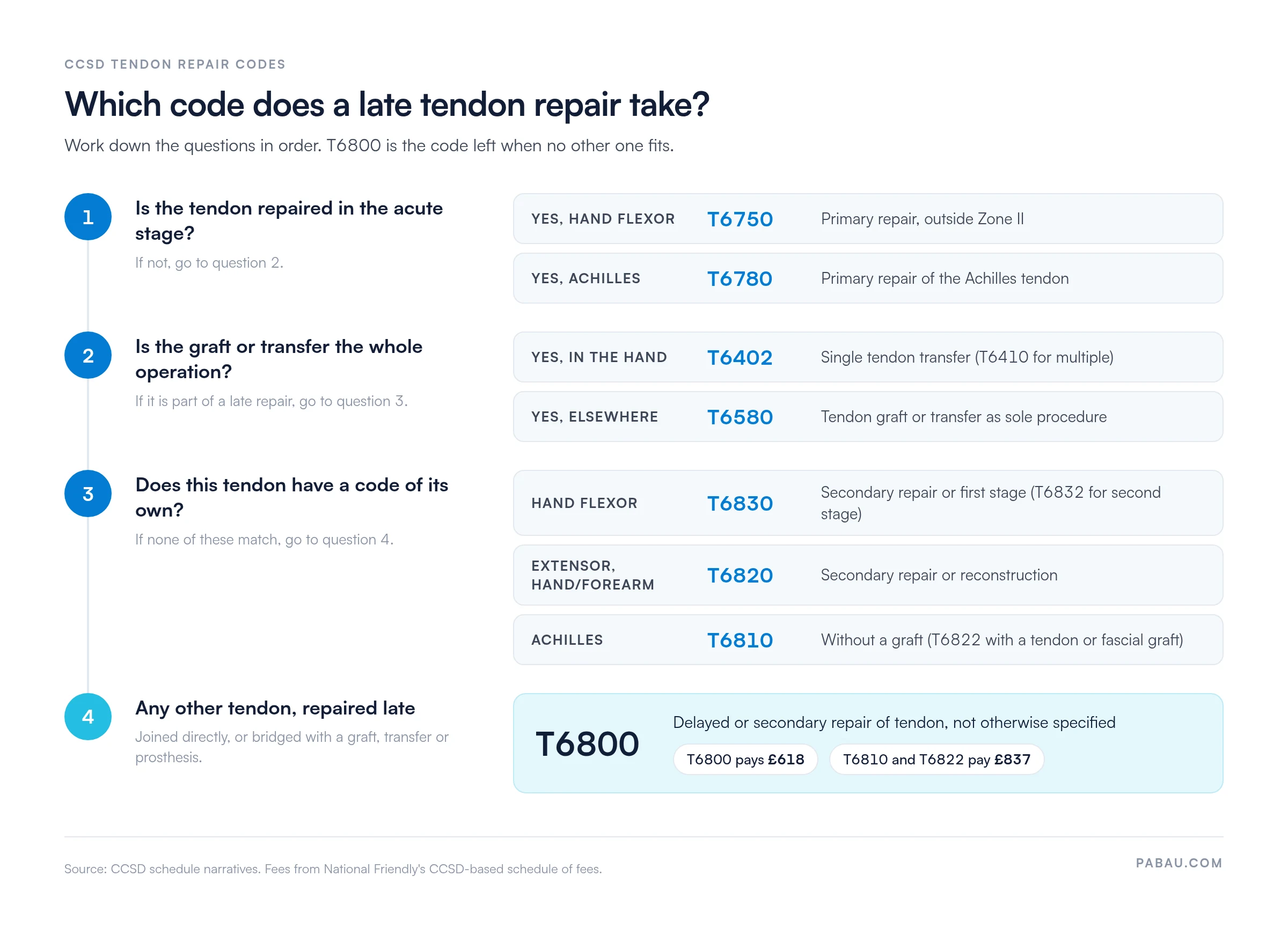
Several tendons have their own CCSD codes, filed by body area rather than in sub-chapter 16.1.0. The table lists the ones most likely to be confused with T6800. Narratives come from the CCSD schedule. A late repair of an extensor tendon in the hand or forearm, for example, is billed as CCSD code T6820.
The band matters as much as the narrative. National Friendly’s schedule pays £618 for T6800 and £837 for both T6810 and T6822. Coded as T6800, a late Achilles repair there would be paid at the lower fee.
Primary repairs have codes of their own too, such as T6750 for a hand flexor outside Zone II and T6780 for the Achilles tendon. Use those when the tendon is repaired in the acute stage. An open operation that lengthens a tight Achilles tendon, rather than repairing it, is billed as CCSD code T6722.
Put together, coding a tendon repair comes down to four questions asked in order. T6800 is the code left at the end.
Insurers want to know which condition is being treated before they authorize surgery. Use the same diagnosis in the referral, the pre-authorization request and the operation note. The WHO ICD-10 browser holds the codes below.
When an earlier repair has failed, describe the current problem in the diagnosis and the history in the note. Confirm the choice with the treating surgeon before the request goes in.
A T6800 claim is only as strong as the operation note behind it. A note that only says “tendon repair” leaves the coder choosing between primary, secondary and site-specific codes.
The work starts before the operation. UK insurers such as Bupa, AXA Health, Aviva and Vitality generally ask for planned surgery to be approved in advance. The patient’s policy decides what is covered. Our guide to Bupa CCSD codes covers how Bupa handles CCSD claims.
The anesthetist usually bills separately for the same operation. Check whether the insurer wants both claims to carry the same authorization code.
Each of these slips gives the insurer a reason to query a T6800 claim, and each one has a fix.
If a claim is still refused, check the insurer’s current provider manual for its appeal process. Only commit to a deadline you have confirmed there.
Review your T6800 claims every quarter against the operation notes. If several name a hand or Achilles tendon, your team may be defaulting to the fallback code.
In many hand and orthopedic practices, the authorization sits in an email and the operation note in another system. Then the claim is keyed in by hand. Each handoff is a chance to lose the authorization code or send the wrong tendon code.
Pabau, a practice management platform, keeps those steps on the patient record. Its claims management software sends claims electronically through Healthcode and to Bupa. The authorization code sits on the patient’s case, with a warning when it is missing.
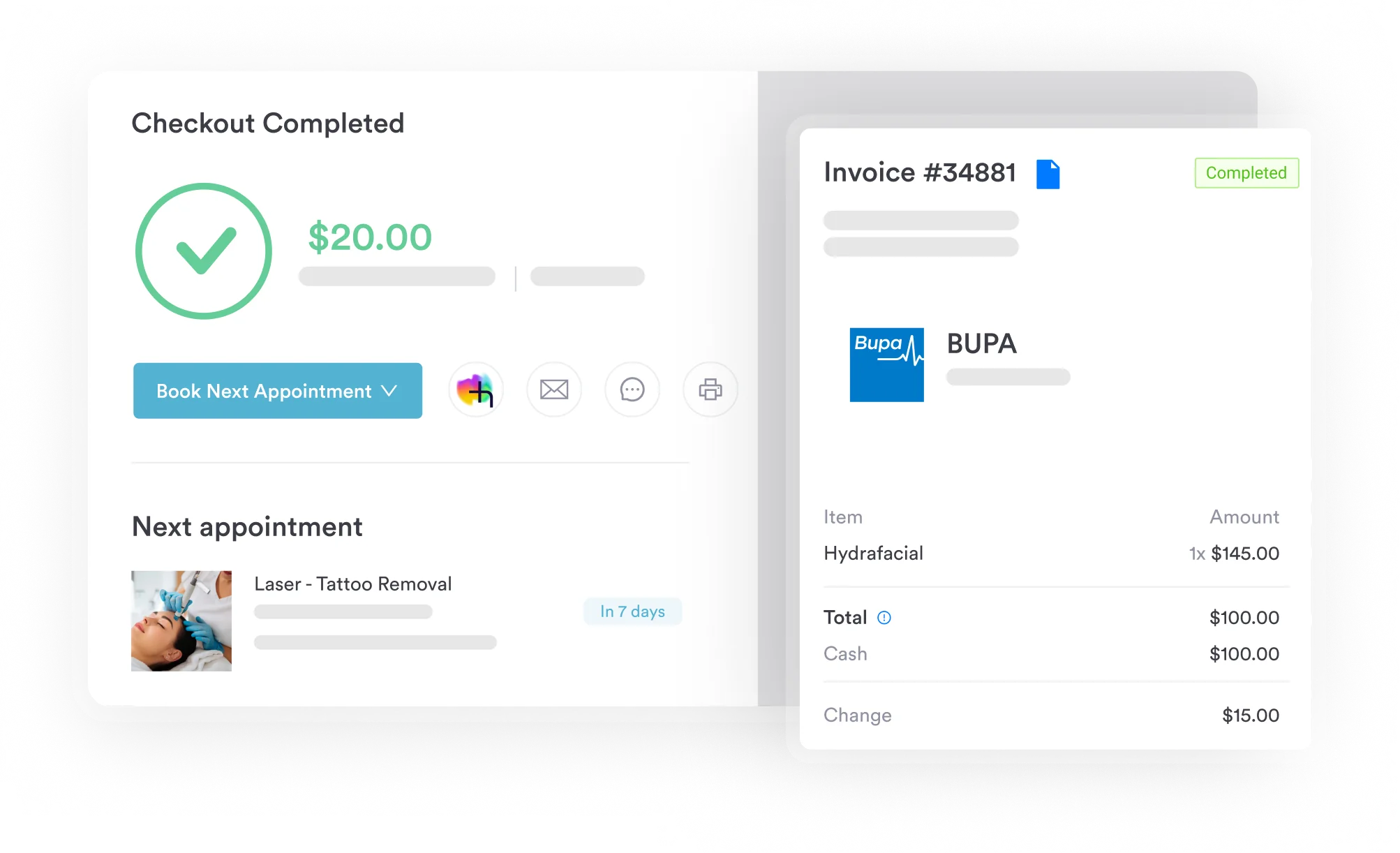
The result is fewer claims queried for a missing authorization code. Your team spends less time chasing insurers and more time with patients.

Pabau keeps the authorization code on the patient’s case and warns you when it is missing. Claims go electronically through Healthcode and to Bupa.

T6800 is a fallback code, and that decides how it should be used. It fits a delayed or secondary tendon repair only when no hand, forearm or Achilles code describes the operation better. Most queries trace back to a note that hides the history or the tendon involved.
Build a note template that records the injury date, the tendon and the technique, and check each insurer’s current schedule before you invoice. Book a demo to see how Pabau tracks authorization codes and sends your Healthcode claims from one patient record.

Looking for another CCSD procedure code? CCSD codes lists the procedure codes Pabau covers, chapter by chapter.
Need a full Bupa CCSD billing reference? Bupa CCSD codes covers Bupa’s procedure list and how its claims work.
Coding a staged hand flexor reconstruction? CCSD code T6830 covers secondary repair or first stage reconstruction of a hand flexor tendon.
Repairing an Achilles tendon late? CCSD code T6822 covers delayed or secondary Achilles repair with a tendon or fascial graft.
CCSD code T6800 covers delayed or secondary repair of a tendon, including repair by graft, transfer or prosthesis. UK private insurers use it when no site-specific code fits the tendon involved. It is the fallback code for late tendon repairs.
T6800 sits in chapter 16.0.0 Bones, Joints & Connective Tissue/Tendon Muscle, sub-chapter 16.1.0 Connective Tissue/Tendon Muscle. Its CCSD reference is Fp.009, and the code is active.
Use a site-specific code whenever the schedule has one for the tendon repaired. Late hand extensor or forearm extensor repairs take T6820, and hand flexors take T6830 or T6832. Late Achilles repairs take T6810 or T6822.
Not for a hand flexor. CCSD codes that as T6830 for the first stage and T6832 for the second. For a staged reconstruction elsewhere, ask the insurer how it wants each stage coded before the first operation.
Yes. In July 2014 the narrative changed from “Secondary repair of tendon” to “Delayed or secondary repair of tendon”, with the rest unchanged. A code library showing the older wording needs updating.
Most UK insurers expect planned surgery to be pre-authorized, and the patient’s policy decides what is covered. Confirm with the insurer before the operation date and put the authorization code on the claim.
Submit it electronically via Healthcode or direct to the insurer, with the authorization code and a fee that matches the insurer’s current schedule. Keep the operation note ready in case the insurer asks for it.