

CCSD Code D1010: Radical mastoidectomy including meatoplasty
CCSD Code D1010: Definition and clinical scope CCSD Code D1010 is the UK private...

Last Updated: Nov 25, 2026
T6462 is the CCSD code for excision or partial excision of interphalangeal joint of lesser toe with tendon transfer. It covers one operation on the second to fifth toe. The surgeon removes all or part of a toe joint and moves a tendon in the same sitting.
The code sits in sub-chapter 16.11.5 Toes of the CCSD schedule. UK private medical insurers use it to authorize and pay for the procedure. CCSD lists the separate toe tendon transfer codes as unacceptable alongside it.
Let Pabau's smart automation suggest the right codes, reduce claim denials, and keep your practice compliant—effortlessly.
Automate repetitive tasks and focus on what matters most—your patients.
Reduce coding errors and ensure compliance with the latest regulations.
Clean claims, fewer denials, and faster reimbursements.
Powerful insights and reporting to help your practice thrive.
HIPAA compliant SOC 2 certified GDPR-compliant Trusted by 4,000+ clinics worldwide

CCSD code T6462 covers excision or partial excision of a lesser toe interphalangeal joint with tendon transfer, in one operation.
It sits in Chapter 16 of the CCSD schedule, sub-chapter 16.11.5 Toes, and applies to the second to fifth toes only.
The tendon transfer is part of T6462, so billing T6460 or T6461 for the same toe is an unacceptable combination.
The operation note should name the toe, the side, the joint excised and the tendon moved. That detail separates T6462 from its neighbors.
UK private medical insurers usually want pre-authorization before an elective toe operation, and each insurer sets its own fee.
CCSD code T6462 covers excision or partial excision of an interphalangeal joint of a lesser toe with tendon transfer.
That wording comes from the CCSD entry for T6462 (CCSD login required), which also lists its unacceptable combinations. In plain terms, the surgeon removes all or part of a small toe joint and moves a tendon in the same sitting. Surgeons usually do this to correct a fixed hammer toe or claw toe.
The code belongs to Chapter 16 of the schedule, in sub-chapter 16.11.5 Toes. UK private medical insurers use CCSD codes to authorize and pay for treatment, so the right code decides whether the claim moves or stalls. Our CCSD codes reference lists the neighboring toe and forefoot codes.
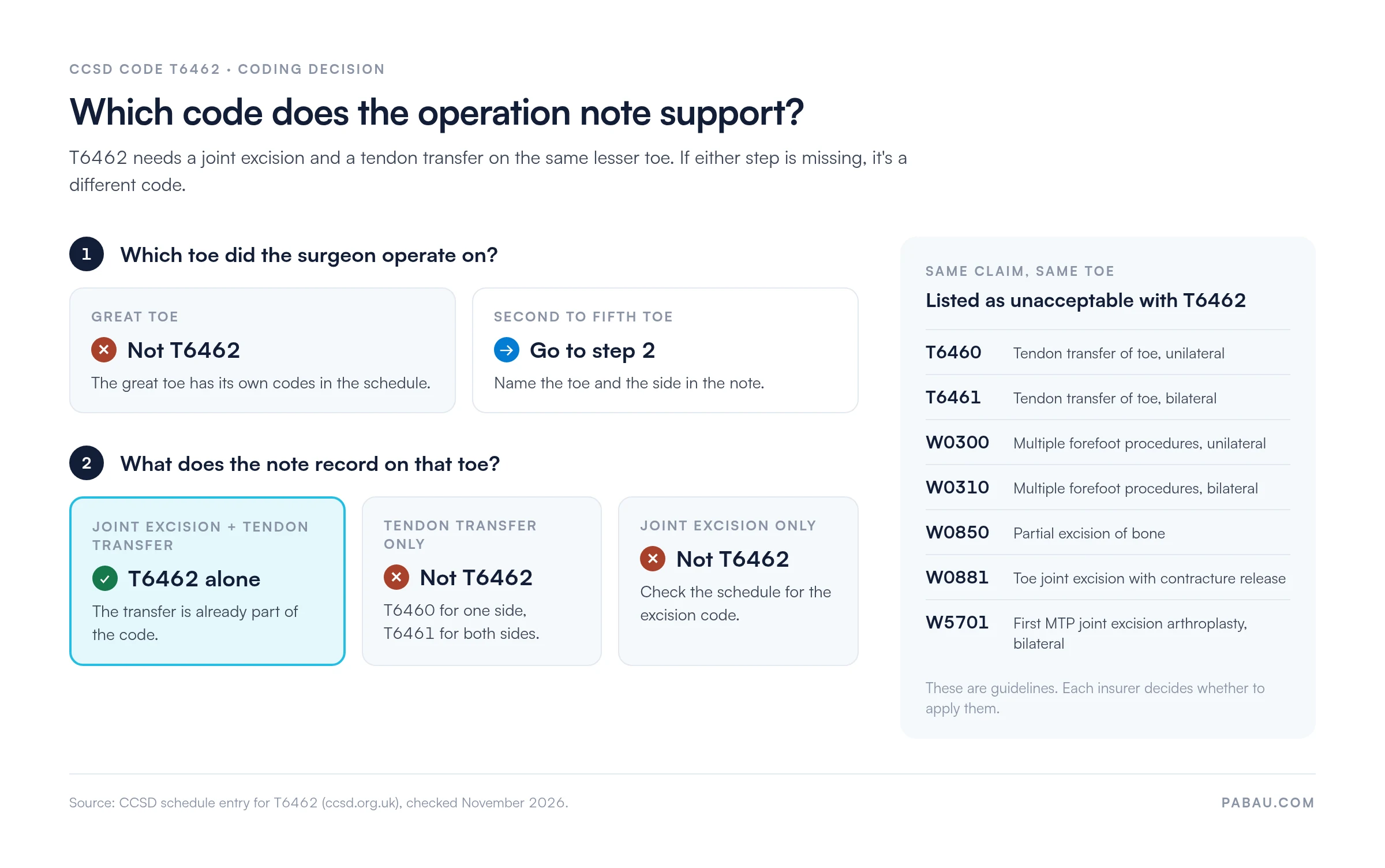
T6462 bundles two steps. If both happen on the same lesser toe, one code covers them.
Included in T6462:
Not covered by T6462:
So check the note against both halves of the descriptor. If either step is missing, T6462 is the wrong code. It is also wrong when a tendon is moved to rebuild one whose earlier repair failed. That operation is a secondary tendon repair, which falls to code T6800 when no site-specific code fits. The chart below runs that check in two questions and lists the codes CCSD won’t accept beside it.
Knowing the steps helps you read the operation note and spot a mismatch early. Techniques vary by surgeon, but the shape is usually the same.
Coders don’t need to judge the surgery. However, they do need the note to confirm that both the excision and the transfer took place.
A clear note is the best defense when an insurer queries a T6462 claim. Check that it records these points before you code:
If two toes were treated, record each one separately. Then check with the insurer how it wants more than one toe reported.
CCSD lists these as unacceptable combinations with T6462. They are guidelines, and each insurer decides whether to apply them.
The full schedule sits behind a CCSD login, so confirm the current list there before you submit. Then check the insurer’s own rules for any combination it treats differently.
Here’s how an illustrative case might look. A patient has a painful, fixed claw deformity of the right second toe.
The surgeon excises part of the proximal interphalangeal joint. Then the long flexor tendon is moved to the top of the toe, and a wire holds the position.
The coder reads the note and finds both steps on one lesser toe. So the claim carries T6462 alone, with the right second toe named. T6460 is a listed unacceptable combination with T6462, so adding it for the tendon transfer would invite a query.
Most UK private medical insurers expect pre-authorization for elective surgery. Toe surgery is usually planned, so build this step into booking.
Policies differ. Some exclude certain foot procedures, and cover for podiatric surgeons varies by insurer. So confirm cover for this patient, not just for the code.
Most of these are fixed before submission, not after. A two-minute check against the note saves weeks of back-and-forth.
In many practices, the authorization number lives in an email, the note in a separate system and the claim in a third. That split is where mismatches start.
Pabau, a practice management platform for private practices, keeps those parts on one patient record. Its medical billing software tracks the authorization code, dates and sessions on each case, with a warning when one is missing. Through its Healthcode integration, UK practices then submit insurance claims from that same record.
So when an insurer queries a T6462 claim, the note, the authorization and the claim are already in one place.

Pabau tracks authorization codes on each case and lets UK practices submit insurance claims through Healthcode from the patient record. When an insurer queries a toe surgery claim, the details are already in one place.

T6462 is narrow by design. It fits only when one lesser toe has both a joint excision and a tendon transfer in the same operation.
So let the operation note decide the code. Name the toe and the side, confirm both steps, and leave T6460 and T6461 off the claim. Get the authorization in place before the surgery date, and most queries never arrive.
Book a demo to see how Pabau keeps the note, the authorization and the Healthcode claim for each toe operation on one record.

Need the wider picture of the CCSD schedule? CCSD codes explains how the schedule works and how UK insurers use it.
Billing a Bupa patient? Bupa CCSD codes covers how Bupa applies the schedule to claims.
Coding another forefoot operation? CCSD code W7900 walks through bunionectomy billing for UK practices.
Coding a ganglion excision? CCSD code T6000 covers repeat excision of a ganglion.
Billing the tendon transfer on its own? CCSD code T6460 covers a toe tendon transfer done without the joint excision.
No. T6462 applies to the lesser toes, the second to the fifth. Surgery on the great toe uses other codes in the schedule.
Each insurer sets its own fee. The CCSD Group maintains codes and descriptors, but it doesn’t decide reimbursement or fees.
Often, when it’s medically necessary and the policy includes it. Cover varies by policy, so the patient should get pre-authorization first.
It depends on the diagnosis. In ICD-10-CM, acquired hammer toe is coded M20.4- (M20.41 right foot, M20.42 left foot). Other acquired toe deformities, such as mallet toe, fall under M20.5X-. Congenital deformities use Q66- codes instead. CCSD codes describe the procedure, so the insurer may also want the diagnosis code.
Not always. The CCSD Group is made up of UK private medical insurers, but each applies its own policy rules.




