HCPCS Code Q4185: Cellesta flowable amnion billing guide
HCPCS Code Q4185: definition and official descriptor HCPCS Code Q4185 is the Lev...

Last Updated: Nov 20, 2026
T6400 is a retired CCSD code for transfer of tendon (not otherwise specified). Bupa, AXA Health, Vitality and WPA no longer list it, so do not use it on a current claim.
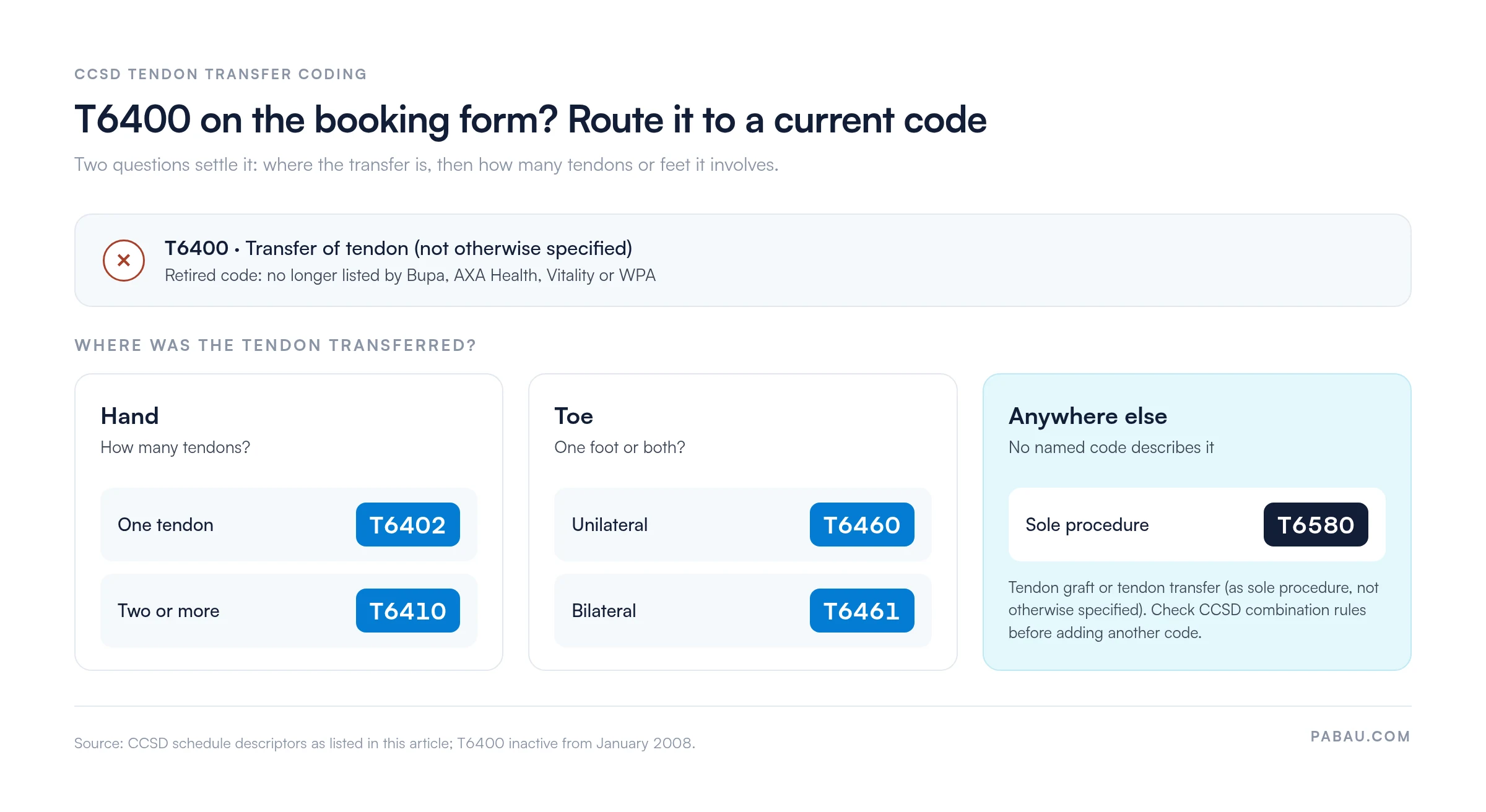
Bill an unspecified tendon transfer under T6580, tendon graft or tendon transfer (as sole procedure, not otherwise specified). Use T6402 or T6410 for the hand, and T6460 or T6461 for the toe.
Let Pabau's smart automation suggest the right codes, reduce claim denials, and keep your practice compliant—effortlessly.
Automate repetitive tasks and focus on what matters most—your patients.
Reduce coding errors and ensure compliance with the latest regulations.
Clean claims, fewer denials, and faster reimbursements.
Powerful insights and reporting to help your practice thrive.
HIPAA compliant SOC 2 certified GDPR-compliant Trusted by 4,000+ clinics worldwide

CCSD code T6400, transfer of tendon (not otherwise specified), is a retired code. Do not use it on a current claim.
Bupa, AXA Health, Vitality and WPA no longer list T6400, so a claim or pre-authorisation request quoting it will not match their schedules.
Bill an unspecified tendon transfer under T6580, tendon graft or tendon transfer (as sole procedure, not otherwise specified).
Use a named code when one fits: T6402 or T6410 for the hand, and T6460 or T6461 for the toe.
The pre-authorisation, the operative note and the invoice should all carry the same current code.
CCSD code T6400 is the retired code for transfer of tendon, not otherwise specified. It sits in the tendon section of the CCSD (Clinical Coding & Schedule Development) schedule, which UK private medical insurers use to code procedures. The schedule data lists T6400 as inactive from January 2008.
Bupa, AXA Health, Vitality and WPA no longer list T6400 on their procedure schedules. A claim or pre-authorisation request that quotes it will not match a current code. For an unspecified tendon transfer, bill T6580, tendon graft or tendon transfer (as sole procedure, not otherwise specified), which all four insurers list.
T6400 still turns up in old fee lists, templates and coding notes. Recognise it there, then move the claim to the right current code. Retired soft tissue tumour excisions under T7790 need the same check, since S0653 or a skin lesion code now replaces it.
The tendon transfer family now has one generic code and four named ones. Pick the named code whenever the operative note describes a hand or toe transfer that it covers.
Confirm each code against the insurer’s current schedule before you submit. Bupa’s code search shows whether a code is listed, and other insurers publish their own schedules. For neighbouring procedures, our UK private billing reference lists more CCSD codes.
Tendon transfer surgery re-routes a working donor tendon from its original attachment to a new insertion point. It restores movement lost to nerve damage, tendon rupture or a biomechanical imbalance. The donor tendon must be expendable at its original site, keep active motor function, and reach the new insertion under the right tension.
Common indications include radial nerve palsy, where flexor tendons are transferred to restore wrist and finger extension. Others are ulnar nerve palsy with clawing, foot drop after peroneal nerve injury, and tibialis posterior dysfunction causing adult acquired flatfoot.
These are separate procedure groups in the CCSD schedule, and the operative note decides which one applies.
Coding a transfer as a repair is the most frequent error in this group. Insurers compare the operative note with the code submitted. A repair code on a note that describes detachment and re-insertion is likely to be queried. The reverse holds too: a secondary repair of a flexor tendon in the hand codes to T6830, never to a transfer code. Likewise, a delayed Achilles repair with a tendon or fascial graft has a named listing, code T6822, so it is not billed as a transfer. Relocating dislocated peroneal tendons into a reconstructed groove is not a transfer either, and it codes to code T6770. The same goes for a tendon lengthened in place or divided through an open incision, which codes to CCSD T7050.
T6580 is a “not otherwise specified” code, like T6400 was. It is correct only when no named code describes the transfer performed. Using it for a hand or toe transfer that T6402, T6410, T6460 or T6461 covers is a coding error, and insurers query it.
In practice, two questions settle the choice. Where was the transfer done, and how many tendons or feet did it involve?
Its descriptor also says “as sole procedure”. T6580 is meant for a graft or transfer done on its own. The CCSD schedule lists combinations it will not accept with T6580, so check them before you add another procedure code to the same episode.
When you use T6580, the operative note has to justify the choice. Detailed notes make up for the code’s broad wording.
An operative note that supports a tendon transfer claim needs a few specific elements. If one is missing, the insurer’s clinical reviewer has grounds to query the claim. Teams working to Bupa CCSD codes and other insurers’ schedules can use this checklist:
The record must let a reviewer who was not in theatre check what was done and why.
Check the code before the documentation. Search the insurer’s schedule for the code on the booking form, and replace T6400 with T6580 or the named code before you request pre-authorisation.
Most UK private medical insurers require pre-authorisation for elective tendon surgery. It confirms the insurer has reviewed the case and that the procedure sits within the patient’s cover. It does not guarantee payment, because settlement depends on what was performed and whether it matches the authorisation.
Request the authorisation under the current code. An authorisation granted under T6400, or under a different code from the one on the claim, leaves the claim and the authorisation out of step. Insurers usually ask for a consultant’s referral letter, relevant imaging, evidence of failed conservative care and an operative plan naming the code.
Going ahead without pre-authorisation, where the policy needs it, usually ends in the claim being refused. Practices that keep booking, authorisation and billing in one system can attach the authorisation reference to the episode from the start.
Most rejections in this group trace back to the code itself. The rest usually come from a code that differs between the authorisation, the operative note and the claim.
The retired code is the easiest of these to prevent. Older fee lists and practice templates still carry T6400, so remove it from your code library and booking forms.
Tendon transfer surgery is rarely a single-code episode. These are the usual companions to T6580 or a named transfer code:
Unbundling rules differ between insurers. The Vitality fee finder and the Aviva fee schedule show what may be charged separately. Check them before you add companion codes to the claim.
These steps take a tendon transfer from booking to submission without T6400 reaching the insurer. They apply to any UK private practice billing system with CCSD code support.
Orthopaedic and hand surgery practices need the code, the authorisation and the operative note to agree before a claim goes out. Pabau, a practice management platform, keeps all three in one patient record.
With Pabau’s claims management software, your team submits CCSD-coded claims through Healthcode and tracks each one to payment. The authorisation reference and the operative note sit on the same episode as the invoice, so nobody retypes them.

Pabau keeps the operative note, the authorisation reference and the CCSD code in one patient record, then submits the claim through Healthcode.

A claim that still carries T6400 fails on the code before anyone reads the operative note. Check the code at booking, choose T6580 or the named hand or toe code, and keep the authorisation under that same code.
Once the code library is clean, the old error stops coming back through templates and copied fee lists. Book a demo to see how Pabau keeps CCSD codes, authorisations and claims in one workflow.

Coding Achilles tendon surgery instead? CCSD code T6810 covers secondary repair of the Achilles tendon, the code to check when the note describes a repair.
No. T6400, transfer of tendon (not otherwise specified), is a retired CCSD code. Bupa, AXA Health, Vitality and WPA do not list it. Code a tendon transfer under T6580 or under a named transfer code instead.
The current generic code is T6580, tendon graft or tendon transfer (as sole procedure, not otherwise specified). Bupa, AXA Health, Vitality and WPA all list it. Where the transfer is of the hand or toe, a named code fits better.
Use T6402 for a single tendon transfer of the hand and T6410 for multiple transfers of the hand. Use T6460 for a unilateral tendon transfer of a toe and T6461 for a bilateral one. T6580 is for a transfer that no named code describes.
A repair sutures a divided or ruptured tendon at its original site. A transfer detaches a working donor tendon and fixes it at a new insertion point. The operative note decides which code family applies, so it must say which was done.
CCSD stands for Clinical Coding & Schedule Development. The CCSD group maintains the procedure code schedule that UK private medical insurers use for claims.
Expect the insurer to query or return it, because T6400 is not on their current schedules. Recode it under T6580 or the right named code. Check the pre-authorisation was granted under that code before you resubmit.
Usually, yes. Most UK private medical insurers ask for pre-authorisation before elective tendon surgery, and the terms depend on each patient’s policy. Request it under the current code, never under T6400.