

HCPCS Code Q4185: Cellesta flowable amnion billing guide
HCPCS Code Q4185: definition and official descriptor HCPCS Code Q4185 is the Lev...

Last Updated: Nov 20, 2026
T6580 is the CCSD code for tendon graft, or tendon transfer, as sole procedure (not otherwise specified). It applies when a graft bridges a tendon defect, or a working tendon moves to a new insertion, as the whole operation.
T6580 is the residual code in chapter 16 of the CCSD Schedule. Use it only when no site-specific CCSD code covers the tendon and no encompassing reconstruction code is billed for the same operation.
Let Pabau's smart automation suggest the right codes, reduce claim denials, and keep your practice compliant—effortlessly.
Automate repetitive tasks and focus on what matters most—your patients.
Reduce coding errors and ensure compliance with the latest regulations.
Clean claims, fewer denials, and faster reimbursements.
Powerful insights and reporting to help your practice thrive.
HIPAA compliant SOC 2 certified GDPR-compliant Trusted by 4,000+ clinics worldwide

CCSD Code T6580 covers a tendon graft or a tendon transfer performed as the sole procedure. It is the residual code for sites with no more specific CCSD code.
The ‘as sole procedure’ qualifier is binding. T6580 is not billed when the graft or transfer forms part of a larger reconstruction under an encompassing code, such as T6770 or T6780.
‘Not otherwise specified’ means the schedule holds no site-specific code for the case. The operative note must still name the tendon, the graft or transfer type, and the clinical indication.
Most major UK PMI providers require pre-authorisation for elective tendon surgery. A missing or mismatched authorisation reference is a common cause of non-payment on T6580 claims.
Pabau’s claims management software supports CCSD code entry and Healthcode submission, which cuts manual coding errors at the point of claim.
CCSD Code T6580 covers a tendon graft or tendon transfer performed as the sole procedure, at a site no more specific code covers. It belongs to the CCSD Schedule, the standard set of procedure codes for the UK private healthcare sector.
The CCSD Board maintains the schedule. Its voting members are Aviva, AXA Health, Bupa and VitalityHealth, plus two rotating private hospital representatives. T6580 sits in chapter 16, Bones, Joints & Connective Tissue/Tendon Muscle, alongside tendon repair and reconstruction codes. The Bupa CCSD procedure codes reference lists the codes Bupa accepts.
The official descriptor covers two techniques and carries two qualifiers, and each has billing implications:
The table below summarises the code’s key attributes as defined by the CCSD schedule.
A tendon graft uses a harvested or donor segment of tendon to bridge a defect in a damaged or absent native tendon. It differs from tendon repair, where the surgeon sutures the torn ends together without adding material. A tendon transfer instead detaches a working tendon and reattaches it elsewhere to restore a lost movement. T6580 covers either technique when it is the entire operative purpose. A major release of a contracted muscle around a large joint, such as the quadriceps, is a separate operation billed under CCSD code T8003.
A graft procedure typically runs in three stages:
The “sole procedure” qualifier means the whole operative session is dedicated to this reconstruction. The surgeon may also perform a ligament reconstruction, joint replacement or other distinct procedure under a separate CCSD code. T6580 may then not be the principal code. Unbundling rules then apply.
Transfers once coded under T6400 now go to T6580 or a site-specific transfer code, because T6400 is no longer in the current schedule.
T6580 applies when primary end-to-end tendon repair is not viable and a graft or transfer is the principal surgical solution. The most common clinical scenarios include:
The clinical indication must appear explicitly in the operative note. A note that records the procedure but not why primary repair was impossible is a frequent cause of insurer queries. In sports medicine, graft indications often follow high-energy acute injuries, so record the intra-operative findings in full.
Before closing the operative note, confirm it states why end-to-end repair was not possible. An insurer’s clinical reviewer needs a line such as ‘Direct repair not possible due to 4 cm gap with retracted and fibrosed ends’. That line lets them approve the claim without a query.
The most consequential coding decision for orthopaedic tendon procedures is whether to apply T6580 or a more specific code. Most PMI providers treat T6580 as miscoding when a site-specific code exists. Using a tendon repair code when a graft or transfer was performed is downcoding. Both generate rejections.
When unsure whether a site-specific code exists, check the current CCSD schedule at ccsd.org.uk before submitting. Codes are updated each year, and a case that was NOS in a prior year may have gained a site-specific entry. Secondary repair or first-stage reconstruction of a hand flexor tendon, for example, has its own code in T6830. A tendon that is lengthened or divided through an open incision, rather than grafted or transferred, is billed as CCSD code T7050. Percutaneous lengthening of the Achilles tendon is billed under code T6720.
Read in order, the table reduces to three questions, and only a case that clears all three lands on T6580.
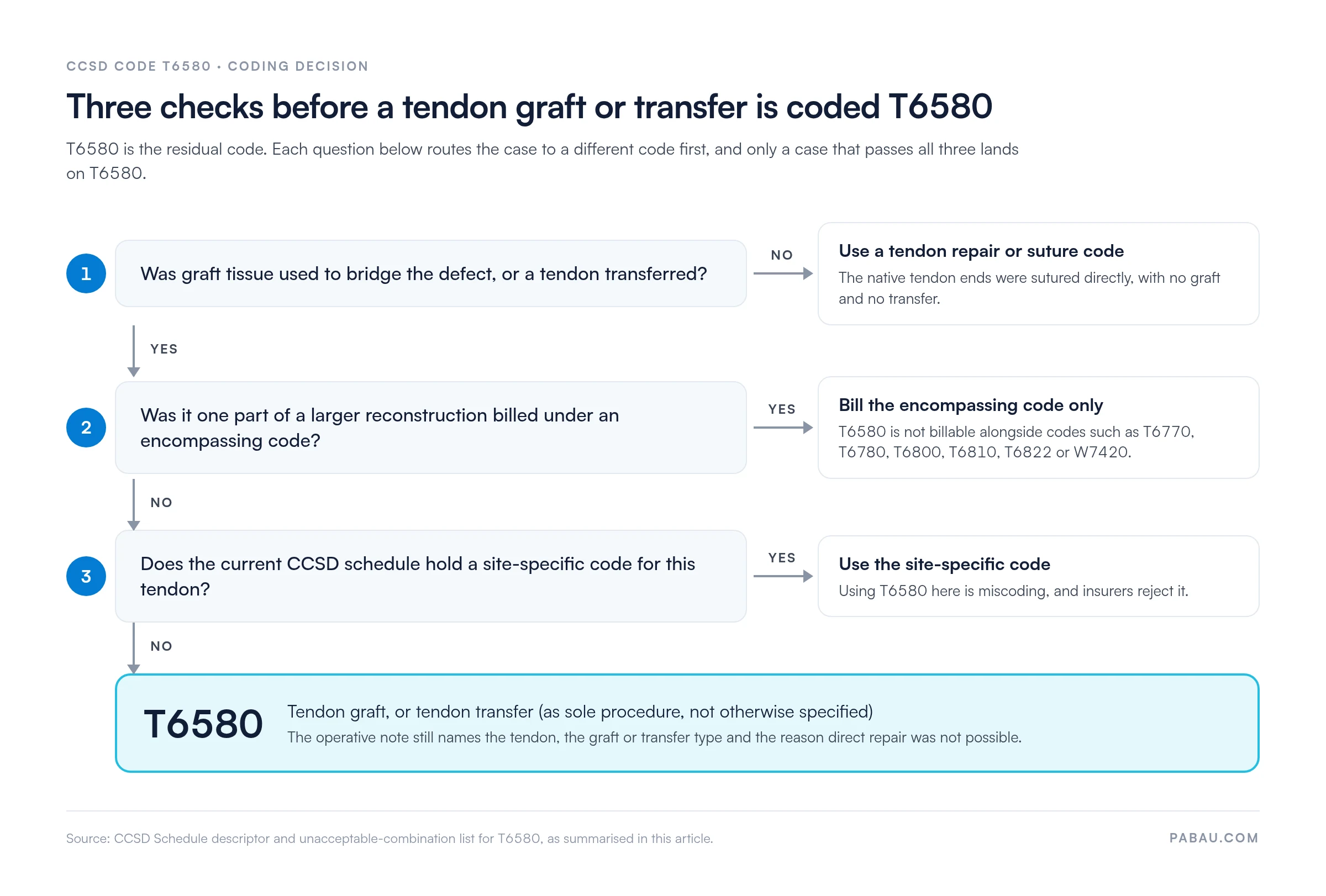
The encompassing codes on T6580’s unacceptable-combination list include T6770, T6780, T6800, T6810, T6822 and W7420. When one of them is billed for the operation, the graft or transfer is part of it.
The NOS label in T6580 describes how far the CCSD schedule’s coverage reaches, and says nothing about how precise the surgery was. The schedule simply has no dedicated code for this site and technique combination. The procedure itself may be precisely defined, with a named tendon, a specific graft source and a documented technique. The NOS label still applies if no matching site-specific code exists.
Some PMI clinical reviewers query NOS-coded claims more often than site-specific ones, to confirm the residual code is appropriate. The remedy is a specific operative note, and the code itself stays the same. Where the schedule lacks a code for the exact site, T6580 is correct. A note showing that the coder checked for a more specific code and found none is the strongest defence against a query.
Coders should not read the NOS designation as a signal to borrow a more specific code from another system, such as a CPT equivalent. CCSD is a closed system for UK private healthcare, and UK PMI providers do not accept codes from other systems. The CCSD codes reference covers the alternatives within the schedule.
A T6580 claim requires the operative note to establish five categories of information clearly. Missing any one of them is the most common cause of insurer queries and payment delays.
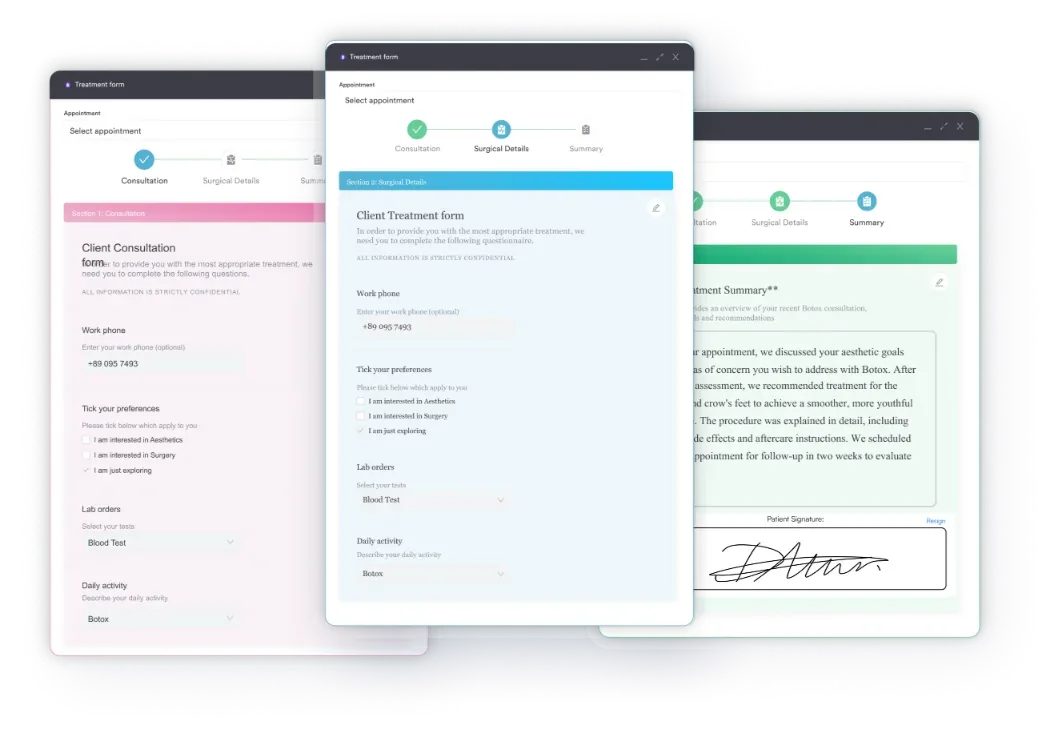
In Pabau’s practice management software, digital consent and operative forms let private practice teams build structured operative note templates. Each template prompts for these fields before the claim is generated.
Most major UK PMI providers require pre-authorisation for elective tendon graft or transfer surgery. This applies across Bupa, AXA Health, Aviva and Vitality for most elective orthopaedic procedures. Policy terms vary by plan and change periodically, so confirm with the specific insurer before listing the procedure.
At the authorisation stage, the insurer typically requires:
The authorisation reference number issued by the insurer must be entered on the Healthcode claim submission and must match the procedure coded. A T6580 claim submitted against an authorisation issued for a different procedure code will typically be rejected. If the clinical need changes between authorisation and surgery, the insurer must be notified and the authorisation amended before the procedure proceeds.
Procedures performed without a required pre-authorisation are generally treated as non-authorised claims. Most PMI policies do not reimburse these, regardless of clinical necessity, unless the procedure was an emergency.
T6580 claims are rejected for a predictable set of reasons. Each has a direct remedy.
CCSD Code T6580 is source-neutral in its descriptor. It does not differentiate between autograft, allograft, or synthetic graft material. The same code applies regardless of where the graft tissue originates.
The graft source still matters for the claim in two ways. First, PMI clinical reviewers expect the operative note to specify the graft type for audit. Leaving it out is a documentation failure, even though the code stays the same.
Second, some PMI policies reimburse allograft tissue costs separately from the T6580 procedure fee, under a supplementary cost or implant provision. This is not universal. Confirm it with the insurer before the procedure instead of assuming separate reimbursement applies.
An autograft may come from a separate anatomical site, such as hamstrings for an upper-limb reconstruction. Then check the current CCSD schedule for a supplementary harvest code. Check it against the insurer’s unbundling rules before submitting both codes on the same claim.
The CCSD Schedule defines the code and its narrative but sets no fee. Each PMI provider publishes its own fee schedule for recognised consultants, and the figures change from year to year. Verify the amount against the current schedule rather than a prior-year document.
When T6580 is the principal surgical code on a claim, the following additional fees are conventionally billed alongside it:
For current fee schedule amounts, verify directly with the treating insurer’s portal. The Aviva fee schedule, Healix fee schedule, and Vitality fee finder each publish CCSD-coded fee amounts for recognised providers. Pabau’s private practice claims management tools map CCSD fees against each insurer’s schedule within the billing workflow.
Healthcode is the principal electronic billing clearinghouse for UK private healthcare claims. Most major PMI providers accept CCSD-coded electronic claims through it.
A T6580 submission via Healthcode follows these steps:
Save a copy of the Healthcode submission confirmation and the insurer’s authorisation letter in the patient record at the time of claim. If the claim is subsequently queried or rejected, having both documents immediately accessible cuts the resolution time significantly.
Most T6580 rejections start at a handoff. The surgeon writes the operative note, the secretary chases the authorisation, and the billing team keys the code into Healthcode. When those three records sit in different places, the narrative, the code and the authorisation reference drift apart.
Pabau keeps the operative note, the authorisation details and the claim in the same patient record. Structured note templates prompt for the tendon, the graft or transfer type and the indication. The billing team then enters T6580 and submits through Healthcode without retyping the clinical detail.
The claim that leaves the practice carries a code, a narrative and an authorisation that agree. That agreement is what an insurer’s validation and clinical review check.

Pabau supports CCSD code entry, Healthcode claim submission, and digital operative documentation for UK private practices. See how it works for your orthopaedic or musculoskeletal team.

Reach for T6580 last. Rule out a repair code, an encompassing reconstruction code and a site-specific code, and T6580 is what remains for a sole tendon graft or transfer.
Choosing the code is the quick part. What gets a T6580 claim paid is the operative note. It names the tendon and the technique, explains why direct repair was not possible, and matches the insurer’s authorisation. Book a demo to see how Pabau keeps the note, the authorisation and the Healthcode claim together for orthopaedic practices.

Need a full reference for Bupa CCSD codes? Bupa CCSD procedure codes covers the full schedule of codes accepted by Bupa with guidance on submission and documentation.
Coding a secondary Achilles reconstruction? CCSD code T6810 covers secondary repair of the Achilles tendon, one of the codes T6580 is never billed alongside.
Managing a multi-insurer private orthopaedic practice? Private practice claims management in Pabau maps CCSD fees against insurer schedules and tracks submission status across Bupa, AXA Health, Aviva, and others.
CCSD Code T6580 is the UK private healthcare code for a tendon graft or tendon transfer performed as the sole procedure. It applies when no more specific CCSD code exists for that site. It sits in chapter 16 of the CCSD Schedule, Bones, Joints & Connective Tissue/Tendon Muscle. Recognised consultants submit it to PMI providers through Healthcode.
NOS means the CCSD schedule has no site-specific code for this anatomical location or technique. The label is about the schedule’s coverage, and the surgery itself may be precisely defined. The operative note should still document the specific tendon, the graft or transfer type, and the indication in full.
Most major UK PMI providers require pre-authorisation for elective tendon graft procedures. The authorisation reference must be recorded on the Healthcode claim and must correspond to T6580 as the coded procedure. Proceeding without authorisation where it is required typically results in non-payment regardless of clinical necessity.
T6580 applies when graft tissue bridges a tendon defect, or when a working tendon is transferred to a new insertion. Tendon repair codes apply when the surgeon sutures the native tendon ends directly, with no added material. If the operative note documents harvested, donor or synthetic graft material, or a tendon transfer, T6580 is the appropriate code.
No. T6580 is source-neutral and applies whether the graft is autologous, allograft or synthetic. The graft source must still be documented in the operative note. Some PMI policies reimburse allograft tissue costs outside the T6580 procedure fee, so confirm this with the insurer before the procedure.
The most common causes are a missing or mismatched pre-authorisation reference and an NOS code without a supporting operative note. Close behind are an undocumented graft type, T6580 used where a site-specific code exists, and T6580 billed alongside an encompassing reconstruction code.





