CPT Code 52352: Ureteroscopic stone removal billing guide
CPT Code 52352: Official descriptor and procedure overview CPT Code 52352 descri...

Last Updated: Oct 30, 2026
M0800 is the CCSD code for other open operations on kidney. It covers open surgery on the kidney or renal pelvis that no more specific CCSD code describes. One example is an open exploration of a native kidney.
The code sits in Chapter 12 of the CCSD schedule, Urinary system and male reproductive organs, under Kidney / Renal Pelvic, with a Major complexity rating. Bupa ranks it MAJOR 3 with a £575 surgeon fee. Laparoscopic, robotic and percutaneous kidney operations carry their own codes.
Let Pabau's smart automation suggest the right codes, reduce claim denials, and keep your practice compliant—effortlessly.
Automate repetitive tasks and focus on what matters most—your patients.
Reduce coding errors and ensure compliance with the latest regulations.
Clean claims, fewer denials, and faster reimbursements.
Powerful insights and reporting to help your practice thrive.
HIPAA compliant SOC 2 certified GDPR-compliant Trusted by 4,000+ clinics worldwide

CCSD Code M0800 is the residual code for open kidney and renal pelvis operations that no more specific CCSD code describes.
Open nephrectomy, open pyeloplasty, open stone removal and open renal biopsy each have their own codes, so check those first.
Bupa ranks M0800 as MAJOR 3 with a £575 surgeon fee, and other UK insurers publish their own fees for the code.
UK private medical insurers expect pre-authorisation before surgery and an operative note that confirms the open approach.
CCSD Code M0800 is the UK private insurance procedure code for “Other open operations on kidney”. It covers open surgery on the kidney or renal pelvis that no more specific code in chapter 12.1 of the schedule describes.
The word “open” is the qualifier that matters. Laparoscopic, robotic, percutaneous and endoscopic kidney procedures all carry their own codes. If the operative note records any approach other than an open incision, M0800 does not apply.
The CCSD schedule is a UK-only coding schedule. Clinical Coding & Schedule Development is run jointly by four UK private medical insurers: Bupa, AXA Health, Aviva and Vitality.
Other UK insurers, such as Freedom Health Insurance and National Friendly, publish fees against the same codes. Our CCSD code library collects guides to the other codes in the schedule.
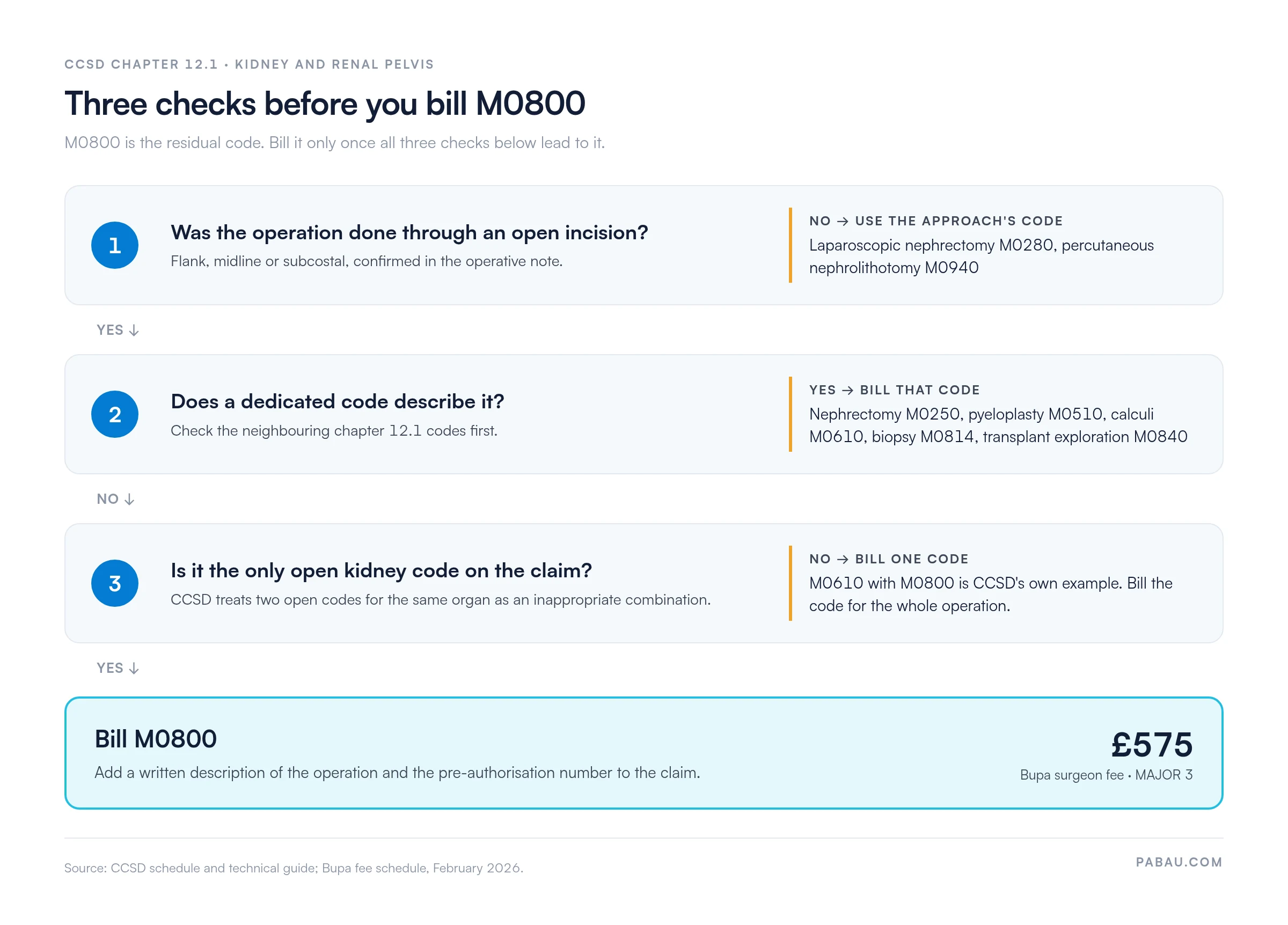
M0800 is a residual code. It applies only when the operation is open, is on the kidney or renal pelvis, and has no dedicated code of its own.
That leaves a short list. One example is an open exploration of a native kidney. The surgeon assesses trauma or an unclear finding, and no repair, removal or drainage follows. Rarer open reconstructive or revision operations that the schedule does not name also fall here.
Exploration of a renal transplant for bleeding is not one of them, because it has its own code, M0840. Removing a failed graft is coded M0260 instead. Add a clear description of the procedure to every M0800 claim, because the code alone does not tell the insurer what was done.
Three checks, in this order, settle whether an operation belongs under M0800.
Most open kidney operations have a dedicated code. The table lists the common ones in chapter 12.1, with the complexity category Bupa gives each code in its February 2026 schedule.
The “other” in the descriptor is a signal to check this list first. Billing M0800 when a dedicated code exists is a miscoding error, and the insurer can reject or recode the claim. A nephrectomy that also removes the perirenal tissue, for example, is billed as M0210.
Search the procedure on the Bupa code search, or on your insurer’s own code finder, before you submit an M0800 claim. If the search returns a dedicated code for the operation performed, use that code instead.
The surgeon fee depends on the patient’s insurer. Bupa ranks M0800 as MAJOR 3, with a published fee of £575 in its February 2026 schedule.
Freedom Health Insurance lists £550 for the specialist and £285 for the anaesthetist, and National Friendly lists £663. Each insurer sets its own fee, so the same code can pay differently from one policy to the next.
Here’s a worked example. A consultant charges £800 for an open renal exploration, and the Bupa fee for M0800 is £575. That leaves a £225 shortfall, which the patient pays unless the consultant works within Bupa’s fees.
Agree any shortfall with the patient in writing before surgery. Fees change, so check the live figure on the Bupa code search. Our Bupa fee schedule guide explains how complexity bands shape what each code pays.
The operative note is the part of an M0800 claim that the practice controls most. Insurers reviewing open renal surgery look for specific elements in it. A note that skips them invites a rejection or a request for more information.
The note must confirm the open surgical approach, because the CCSD code alone cannot show it. Use an operative note template that prompts surgeons to record each required element at the time of the procedure, not afterwards.
Record an ICD-10 diagnosis code with every M0800 claim. It must match the indication in the operative note, not the procedure. These pairings fit the operations M0800 typically covers.
UK insurers work with the WHO version of ICD-10, not the US ICD-10-CM. WHO codes carry no laterality digit, so state the side in the operative note.
A mismatch between the ICD-10 code and the operative note is a common reason UK insurers ask for more information before paying. Compare the diagnosis code with the indication in the note before the claim leaves the practice.
UK private medical insurers expect pre-authorisation before planned open kidney surgery. A claim with no authorisation number is one of the simplest rejections to avoid.
Requirements vary by insurer and policy, so confirm them with the insurer before you schedule the operation.
Most UK private medical insurance does not cover emergency treatment, which the NHS usually provides. If an urgent case is admitted privately, contact the insurer straight away and confirm cover before billing.
Most M0800 rejections share the same root causes, and nearly all of them can be prevented before the claim is submitted. The table maps the most frequent triggers to their corrective action.
Practices with a high volume of urology work benefit from claims management software that flags incomplete documentation and code-pairing errors before submission. That cuts the correction cycle that costs billing teams time on every rejected claim.
When a resubmission won’t fix the rejection, use the insurer’s own appeals process.
Three rules decide what else can go on the same claim as M0800: code combinations, bilateral surgery and the anaesthetist’s fee.
The CCSD technical guide treats two codes with the same approach to the same organ as an inappropriate combination. Its own example is M0610 Open removal of calculi from kidney billed with M0800.
Open, endoscopic and percutaneous codes for the same organ are not combined either. Bill the single code that describes the whole operation, and record any extra steps in the operative note.
A separate procedure on a different organ in the same session can carry its own code. Check the insurer’s combination rules on the Bupa code search or its own schedule before you add a second code.
CCSD handles laterality through separate unilateral and bilateral codes where a procedure needs them. M0800 has no bilateral version, so ask the insurer how to bill open surgery on both kidneys in one session before you submit.
Whatever the insurer advises, state both sides clearly in the operative note.
The anaesthetist bills separately from the surgeon, on their own invoice, against the same CCSD code. Insurers publish a separate anaesthetist fee for each code, such as the £285 Freedom Health Insurance lists for M0800.
Check each insurer’s schedule for the anaesthetist fee before billing, including the Aviva fee schedule.
Billing teams that handle both claims should keep the surgeon’s operative note and the anaesthetic record in the same patient record. If the surgeon’s note says open approach and the anaesthetic record describes a laparoscopic set-up, both claims are at risk.
Check the anaesthetist fee for M0800 on each insurer’s schedule before you bill. Bupa, AXA Health, Aviva and Vitality publish their own figures, and using the wrong one leads to an underpayment or a claim query.
In many private practices, an M0800 claim passes through three pairs of hands. The surgeon writes the note, the secretary chases the authorisation, and the billing team re-keys it into Healthcode.
Pabau, the practice management software we build for private practices, assembles the claim from the patient record instead. Its Healthcode integration carries the CCSD code, membership number and authorisation reference across.
M0800 needs a clear description of the operation, so the operative note and the claim belong in one record. Remittances come back to the same place, and your team can see which claims are paid, short or still waiting.

Pabau builds CCSD claims like M0800 from the patient record and checks required fields before submission. Then you can track each claim’s status in one place.

M0800 is the last stop in chapter 12.1, and most of its rejections start with a dedicated code that was missed. Open nephrectomy, pyeloplasty, stone removal and biopsy each have their own codes.
Make the operative note do the work. When it confirms the open approach, names the operation and explains why no specific code fits, the claim stands on its own. Add the authorisation number and agree any shortfall with the patient before surgery.
Book a demo to see how Pabau turns an M0800 operative note into a Healthcode claim with the authorisation reference attached.

Need a broader CCSD billing reference? Pabau’s Bupa CCSD billing guide covers the full private insurer code schedule used across UK urology and surgical billing.
Working out a patient’s shortfall? Our Bupa fee schedule guide explains how complexity bands such as MAJOR 3 set what each CCSD code pays.
CCSD Code M0800 covers other open operations on the kidney. It applies to open surgery on the kidney or renal pelvis that no more specific CCSD code describes. One example is an open exploration of a native kidney.
No. Open pyeloplasty has its own CCSD code, M0510, which Bupa ranks as MAJOR 4. Use M0800 only when no dedicated code describes the open operation performed.
M0800 applies only to open surgery. Laparoscopic, robotic and percutaneous kidney procedures carry their own CCSD codes, such as M0280 for laparoscopic nephrectomy. If the operative note records a minimally invasive approach, M0800 is the wrong code.
Get pre-authorisation before surgery and put the authorisation number on the invoice. Pair M0800 with the ICD-10 code from the operative note, and add a clear description of the procedure. Then submit the claim through Healthcode or the insurer’s own portal.
The most frequent triggers are a missing authorisation number and an operative note that does not confirm the open approach. Others include an ICD-10 code that does not match the indication, and M0800 billed when a dedicated code exists.
Usually not. Open removal of calculi from the kidney has its own code, M0610, and percutaneous nephrolithotomy is M0940. CCSD treats M0610 billed with M0800 as an inappropriate combination.
Bupa ranks M0800 as MAJOR 3, with a published surgeon fee of £575 in its February 2026 schedule. Other insurers set their own fees, such as £663 at National Friendly, so check the patient’s policy.