CPT Code 25210: Excision of a single carpal bone
CPT Code 25210: Official descriptor and quick-reference data CPT Code 25210 is a...

Last Updated: Nov 26, 2026
86160 is the CPT code for complement; antigen, each component. It covers the quantitative measurement of a single complement protein, such as C3, C4 or C1q. Each component tested is billed as one unit, so a C3 and C4 order is two units.
Denials for 86160 usually trace back to an ICD-10 code the payer's LCD doesn't cover. The other common cause is a note that never says why complement levels matter to the patient's management.
Let Pabau's smart automation suggest the right codes, reduce claim denials, and keep your practice compliant—effortlessly.
Automate repetitive tasks and focus on what matters most—your patients.
Reduce coding errors and ensure compliance with the latest regulations.
Clean claims, fewer denials, and faster reimbursements.
Powerful insights and reporting to help your practice thrive.
HIPAA compliant SOC 2 certified GDPR-compliant Trusted by 4,000+ clinics worldwide

CPT code 86160 covers antigen measurement of one complement component, such as C3, C4, C1q or Factor B. Bill one unit per component tested.
86160 measures how much of a complement protein is present by immunochemistry, while 86161 measures the component’s functional activity.
SLE (M32.x), hereditary angioedema (D84.1) and membranoproliferative glomerulonephritis (N00-N08) are the strongest ICD-10 codes for payer medical necessity.
Pabau’s claims management software records insurance policies, cases and claims in one place, and sends US claims through Claim.MD.
CPT code 86160 is the code for measuring a single complement protein, with the official descriptor Complement; antigen, each component. The descriptor comes from the AMA’s CPT code set, which the AMA’s CPT Editorial Panel maintains and updates. The phrase “each component” is the key billing detail. Every complement protein ordered and measured on the same date of service is a separate billable unit.
The test itself is a quantitative immunochemical assay. The laboratory measures the serum concentration of a specific complement protein using nephelometry, radial immunodiffusion, or ELISA. The result is a concentration value (typically mg/dL) that tells the ordering clinician whether that protein is depleted, elevated, or within reference range.
86160 sits in the Immunology section of the CPT codebook (codes 86000-86849). It is a clinical laboratory code, so it is reimbursed under the Medicare Clinical Laboratory Fee Schedule (CLFS), not the Physician Fee Schedule.
CPT 86160 covers the antigen quantification of any individual complement component. The table below lists the components most commonly ordered, their clinical relevance, and how they map to billing units.
The most common order is C3 and C4 together, which is two units of 86160 on the same claim. When additional components such as C1q or Factor B are added to the workup, each is billed as an additional unit. The standard CMS NCCI edit tables don’t bundle separate complement antigens into a single unit. Individual payer contracts may still add restrictions.
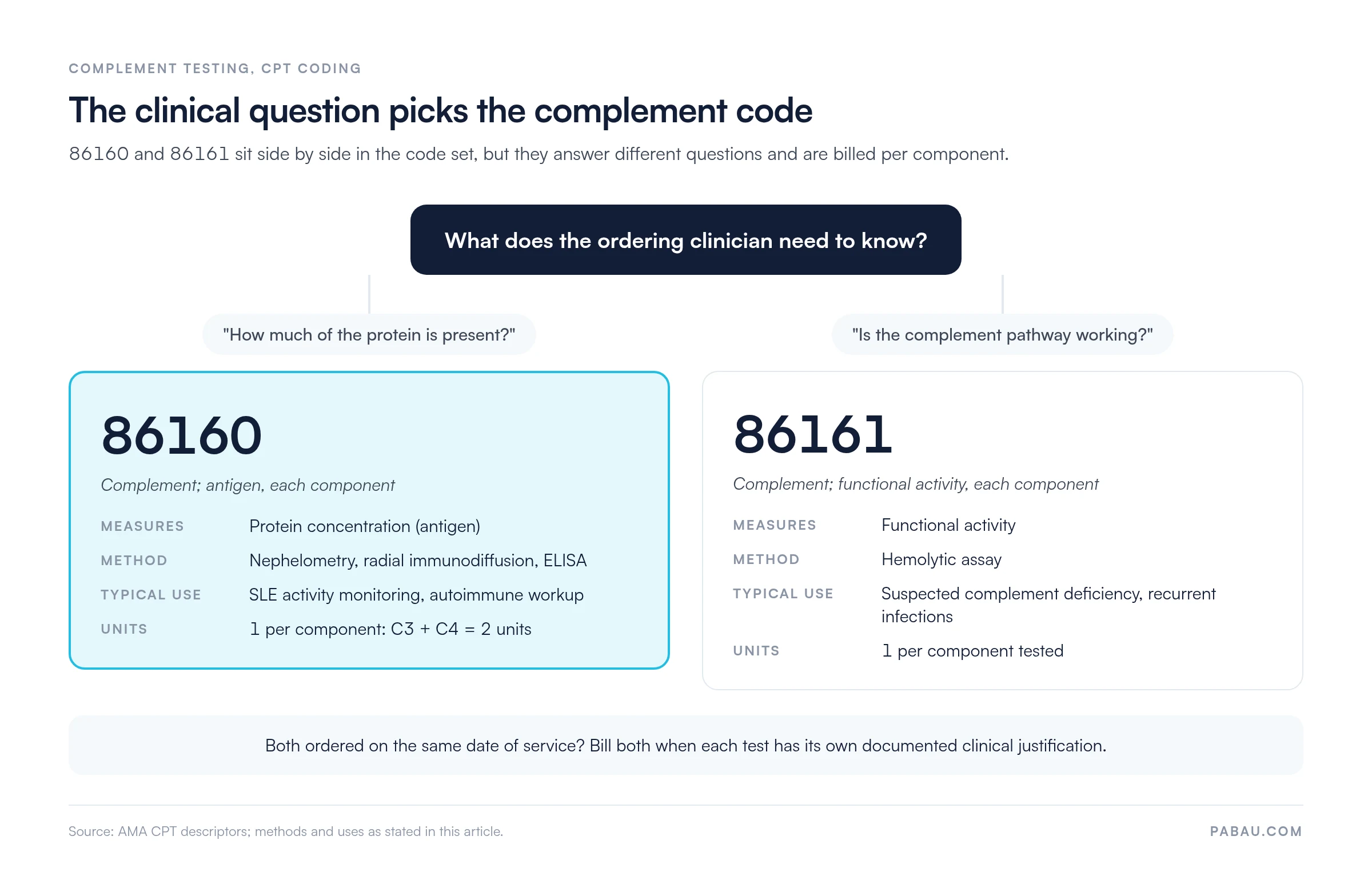
86160 and 86161 are neighboring codes that measure different things. Confusing them is the most common coding error in complement testing.
Use 86160 when the clinical question is quantitative, such as whether a low C3 level shows active complement consumption. Use 86161 when the question is functional, such as whether the patient’s complement system can lyse target cells. The diagram below shows how that question routes the code. Both can appear on the same claim when each is independently medically necessary.
Payer coverage for CPT code 86160 is governed by Medicare Administrative Contractor (MAC) Local Coverage Determinations (LCDs). Covered indications vary by region, but the diagnoses below appear consistently across major MAC LCDs. Always verify your MAC’s current LCD before submitting.
Meeting billing compliance requirements means documenting the clinical question the complement test answers, beyond listing the diagnosis code on the lab order. When the note names SLE without any organ involvement, the diagnosis codes to M32.9. Documenting the organ involved supports a more specific M32.1x code.
Before ordering C3/C4 for SLE monitoring, confirm the patient’s MAC LCD. Palmetto GBA, Novitas, and CGS each publish complement testing LCDs with different frequency limitations. Testing more often than the LCD allows is the leading cause of medical necessity denials for 86160, even with a correct ICD-10 code.
CPT code 86160 is reimbursed under the CMS Clinical Laboratory Fee Schedule (CLFS), not the Physician Fee Schedule. CMS bases CLFS rates on private payer data and recalculates them on a three-year cycle. The 2025 Medicare national limitation amount for 86160 is approximately $12.14 per unit. Check the CLFS file for your billing year before you quote a rate.
Because 86160 is billed per component, a standard C3 + C4 order generates two units and approximately $24.28 in Medicare reimbursement. Private payer rates vary substantially by contract and are almost always higher than the Medicare allowable.
Practice management systems that submit claims through a clearinghouse can check unit counts before claims leave the practice. Pabau, a practice management platform with insurance billing, connects practices to thousands of US payers through Claim.MD.
Accurate billing for CPT code 86160 depends on three details. They are the unit count, any applicable modifier, and the place of service code.
Understanding medical billing fundamentals like who bills for referred lab work prevents a common error. That error is billing the complement test twice, once by the ordering practice and once by the reference lab.
For practices performing in-house immunology testing, claims management software helps catch coding errors before submission. Submitting a clean claim the first time is faster and cheaper than filing a corrected claim after a denial.
Most payers do not require prior authorization for CPT code 86160. It is a low-cost laboratory test, and on a $12-24 claim the administrative burden of prior auth outweighs the payer’s risk of overutilization.
Three situations where prior authorization may apply:
Always verify PA requirements directly with the individual payer before ordering. Payer policies change with plan year, and no general statement about PA requirements should be treated as universal.
The five denial patterns below account for most rejected 86160 claims, and each has a specific corrective action.
Structured denial management workflows that track denial codes by CPT code let practices spot patterns. If CO-50 denials cluster around 86160 claims, the lab order template almost certainly lacks the covered ICD-10. Fix the template once instead of appealing case by case. For a full reference of denial codes and their meanings, see the guide to medical billing denial codes.
A lab order alone is not sufficient documentation for CPT code 86160. The payer’s medical necessity review looks at the clinical note, not the lab requisition.
Documentation checklist for complement testing claims:
CPT code 86160 is one of several immunology laboratory codes that may appear in an autoimmune workup. The table below identifies the most commonly co-ordered or confused codes, with guidance on when each is appropriate.
Use the AAPC Codify CPT lookup to verify descriptor language and check for any NCCI edit relationships between 86160 and codes being co-billed. For ICD-10 to CPT crosswalk validation, CrossCoder provides LCD and coverage policy data alongside the crosswalk results.
Run a quarterly audit of all 86160 claims submitted in the past 90 days. Filter by denial rate and ICD-10 code. If a specific diagnosis code is driving denials, check that MAC’s current LCD to confirm the code is still on the covered list. LCD updates happen mid-year and are rarely announced proactively to ordering practices.
Many practices still track complement testing claims across a lab requisition, a payer portal and a denial spreadsheet. The unit count, the ICD-10 code and the remittance end up in three places, so a CO-50 pattern takes weeks to notice.
Pabau keeps the patient’s insurance policy, case and claim in one record. US claims go out through Claim.MD as CMS-1500 or 837P claims, with eligibility checks before the visit. ERA remittances come back to the same system, so the billing team sees an 86160 denial next to the claim it belongs to.

Pabau records insurance policies, cases and claims together, then sends US claims through Claim.MD with eligibility checks and ERA remittances built in.

Start with the lab order template. Build in a covered ICD-10 code from your MAC’s current LCD and a line stating why complement levels matter to this patient’s management. With those two fields in place, most 86160 denials stop before they start.
Per-unit billing and the split from 86161 still need a coder’s eye on each claim. Those checks take seconds once the order itself carries the clinical question.
Pabau’s claims management software records insurance policies, cases and claims in one place. If your complement testing denial rate stays above 5%, book a demo to see how Pabau handles insurance billing.

Sending US claims through a clearinghouse? Claim.MD clearinghouse integration with Pabau explains how claims, eligibility checks and remittances move between Pabau and Claim.MD.
Seeing recurring claim denials across your lab billing? Electronic remittance advice (ERA) processing shows how 835 remittance data can be used to identify denial patterns by CPT code.
Want to understand how the claims process works end to end? Revenue cycle management fundamentals covers how lab claims move from order to payment posting.
CPT code 86160 covers the quantitative immunochemical measurement of a single complement component antigen, such as C3, C4 or C1q. Each component tested on a given date of service is billed as a separate unit under 86160.
86160 measures the protein concentration of a complement component using immunochemistry, such as nephelometry or ELISA. 86161 measures the functional activity of a complement component using a hemolytic assay. Use 86160 when asking “how much protein is present?” and 86161 when asking “is the pathway working?”
The strongest ICD-10 codes for payer medical necessity are M32.x for lupus, D84.1 for hereditary angioedema and N00-N08 for nephritis syndromes. M05.x (seropositive rheumatoid arthritis) and M31.x (vasculitis) also qualify. The specific covered codes vary by MAC LCD, so verify your regional LCD before submitting.
There is no universal cap on units per date of service for 86160, since each complement component tested is a separate billable unit. A standard C3 + C4 order generates 2 units. Payer frequency policies limit how often testing can occur per episode, not how many components can be tested in a single order.
Yes, Medicare covers CPT code 86160 under the Clinical Laboratory Fee Schedule. Medical necessity must be shown with an ICD-10 code covered by the applicable MAC LCD. The 2025 national limitation amount is approximately $12.14 per unit. Verify your MAC’s current LCD for covered indications and frequency limitations.
The most common reason is an ICD-10 code missing from the MAC’s LCD covered list. Next come testing more often than the payer allows and an unbundling conflict with a panel code. A same-day repeat billed without modifier 91 and a claim from the ordering physician instead of the performing lab complete the list.