ICD-10 Code Y76.0: Diagnostic obstetric and gynecological devices
ICD-10 Code Y76.0: Definition and billable status ICD-10 Code Y76.0 is a valid, ...

Last Updated: Oct 23, 2026
Billable Code Specific Code
T86.820 is a billable ICD-10-CM code that describes skin graft (allograft) rejection. This is an immune-mediated response in which the recipient's immune system attacks transplanted donor skin, and it differs from graft failure (T86.821), which follows ischemia, infection, or another non-immune cause.
Let Pabau's smart automation suggest the right codes, reduce claim denials, and keep your practice compliant—effortlessly.
Automate repetitive tasks and focus on what matters most—your patients.
Reduce coding errors and ensure compliance with the latest regulations.
Clean claims, fewer denials, and faster reimbursements.
Powerful insights and reporting to help your practice thrive.
HIPAA compliant SOC 2 certified GDPR-compliant Trusted by 4,000+ clinics worldwide

ICD-10 Code T86.820 is a billable ICD-10-CM code for skin graft (allograft) rejection, and it sits under the broader T86.82 subcategory.
T86.820 covers immune-mediated rejection only, while T86.821 covers skin graft loss from non-immune causes such as ischemia or shear.
The T86.82 family carries five billable codes: T86.820, T86.821, T86.822, T86.828 and T86.829.
Documentation must show an immune mechanism through biopsy findings, immune workup results, or a clear physician attestation of rejection.
Pabau’s claims management software submits T86.820 diagnoses through Claim.MD, validates them against 4,000+ payer rules, and tracks ERA remittances.
Billable means the code is specific enough for a claim without a more granular sub-code. Coders assign T86.820 directly to a diagnosis field on a CMS-1500 form or an 837P electronic claim. The descriptor and effective date below come from the CMS ICD-10-CM FY2026 code set.
Despite the parenthetical “(allograft)(autograft)” on the parent code T86.82, T86.820 describes allograft rejection only. The sibling codes T86.821 and T86.822 carry both parentheticals in their descriptors, so the narrower wording of T86.820 is deliberate.
Autograft rejection is immunologically rare, and a record that documents it should go back to the treating physician for clarification. The WHO ICD-10 classification framework is the base that CMS extends when it builds out these transplant complication codes.
T86.820 sits five levels deep in the ICD-10-CM Tabular List, from chapter down to the specific code. The ICD-10-CM code library holds the other diagnosis codes a graft case tends to need alongside it.
The parent subcategory T86.82 is itself non-billable. Coders must assign one of the five specific T86.82x codes instead. Never report T86.82 alone on a claim, because payers reject it as insufficiently specified. Use the CDC/NCHS ICD-10-CM web tool to confirm billable status for the date of service.
Allograft rejection is an immune-mediated process. The host’s T-lymphocytes recognize donor skin antigens as foreign and mount a response that damages the grafted tissue. Graft loss from ischemia or infection carries no immune component, which is why it takes a different code.
Corneal transplants split along the same line. T86.840 covers immune rejection of the donor cornea, while T86.841 records permanent loss of graft function.
Clinically, rejection presents with erythema, edema, blistering, or loss of graft adherence at the recipient site. Biopsy findings showing lymphocytic infiltration support the diagnosis. The treating physician’s documentation must name rejection rather than failure as the mechanism.
The medical record must demonstrate an immune-mediated rejection event rather than another form of graft complication. Records that already carry that evidence at the point of coding move through adjudication with fewer document requests.
The following elements support T86.820 when present in the clinical record:
The graft procedure itself is billed separately from the complication. A skin substitute graft applied to the trunk, arms or legs is reported with CPT 15271. The two encounter dates should line up in the record.
A record that documents only “graft complication” without naming rejection as the mechanism does not support this code. T86.829 is the more defensible assignment in that situation, though a physician query to clarify is always preferable.
Run a physician query before assigning T86.820 when the record describes graft loss without naming the mechanism. A structured query asking whether the complication is rejection (immune-mediated) or failure (non-immune) takes minutes and protects the claim against a medical necessity denial.
T86.820 belongs to the T86.82x family, which covers complications of skin graft (allograft)(autograft). The family carries five billable codes, and each one captures a distinct complication type. Selecting the wrong sibling is the most common error in this subcategory.
The diagram below condenses the family into the one question a coder puts to the record: what does the note say happened to the graft?
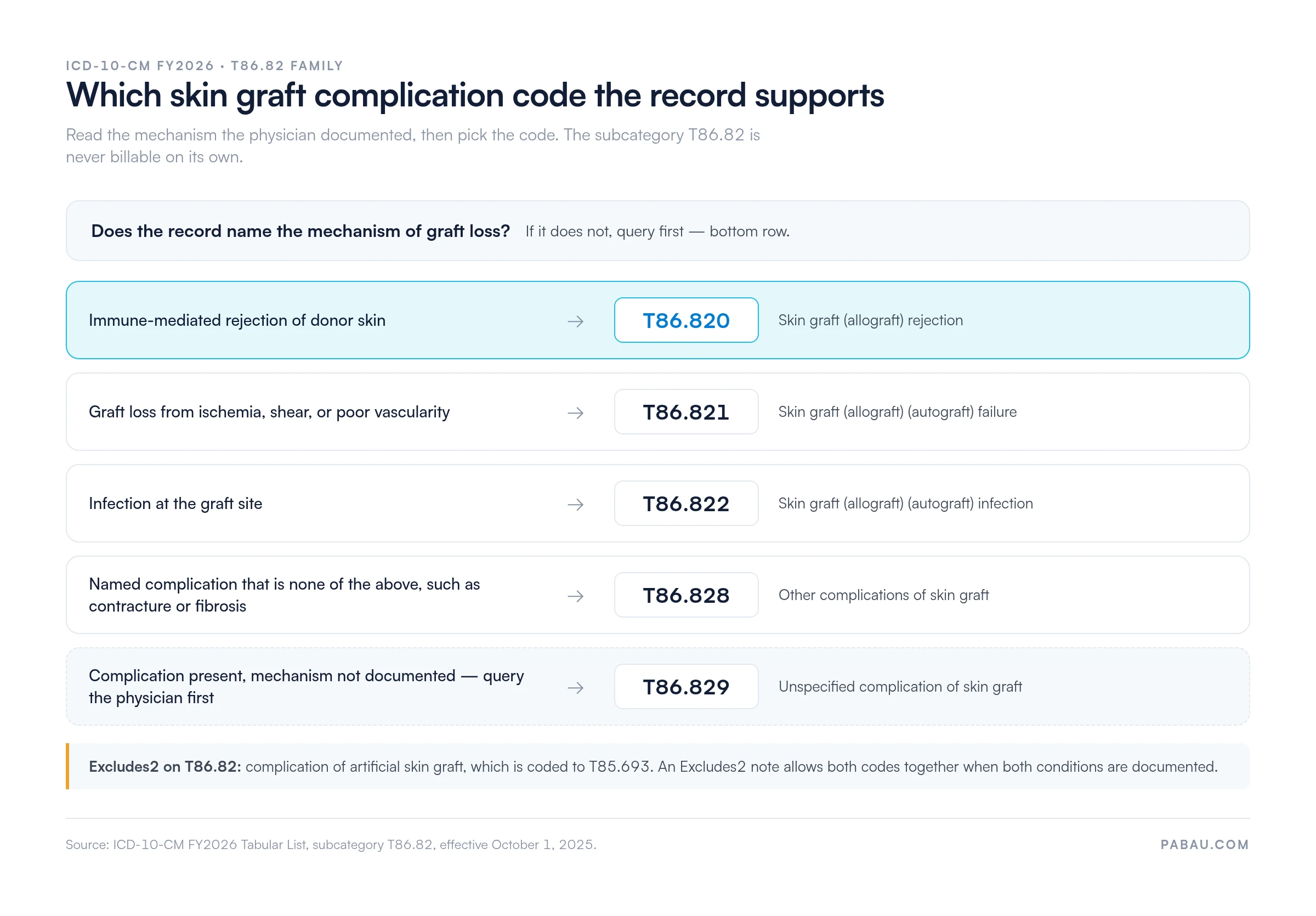
T86.821 codes for skin graft failure, a clinically distinct outcome from rejection. Failure occurs when the graft never establishes a viable blood supply, or when infection, mechanical disruption or metabolic factors cause graft loss.
The documentation signal is the absence of immune-mechanism language. A note reading “graft failed to take” or “graft necrosis secondary to infection” supports T86.821.
T86.822 covers infection of a skin graft, and its descriptor spans both allografts and autografts. Use it when the physician documents infection at the graft site as the complication being treated.
Infection can also precipitate graft loss, so read the note for the mechanism the physician treats as primary. Where infection and rejection are both documented, a query settles which one the claim leads with.
T86.828 is the residual category within the T86.82x family. Use it when the documented complication is specific but falls outside rejection, failure and infection.
Contracture formation, graft-site fibrosis and pigmentation changes recorded by the physician may map here. T86.828 should never serve as a default when the complication type is unknown, because T86.829 is the accurate choice there.
T86.829 applies when the record confirms a graft complication but names no mechanism. It is the defensible assignment once a physician query goes unanswered.
Reaching for it before the query turns a specific case into an unspecified one on the claim. Query first, and assign T86.829 only when the answer does not arrive.
The ICD-10-CM Tabular List includes official notes that govern how T86.820 is used. Verify them against the AAPC ICD-10-CM lookup or the CDC/NCHS tool for the applicable fiscal year, since notes are revised annually.
These are the notes that apply to T86.820 and to the broader T86 category:
The most common decision point for T86.820 is telling it apart from adjacent codes in the T86 transplant complication family. Plastic surgery, burn and wound care records often describe a graft complication without naming the mechanism at all.
A structured query does not need to be complex. Ask the physician to confirm whether the complication is rejection, failure, infection, or another type. AHIMA’s query guidelines support this approach, and most EHR systems allow templated queries to be attached to the encounter note.
Flag T86.820 claims for documentation review before submission whenever the record carries no biopsy report and no explicit physician statement about the rejection mechanism. Catching that before the claim leaves the practice is faster than working a denial afterward.
The ICD-10-CM Alphabetic Index offers several pathways to T86.820. Coders who start in the Index and then verify in the Tabular List follow the sequencing process the official guidelines set out.
Common Alphabetic Index pathways to T86.820 include:
Always verify the index-derived code against the Tabular List before assigning. The Tabular List is the final authority and may carry notes, exclusions or instructions the Alphabetic Index does not show.
Plenty of practices settle the rejection-versus-failure question in the chart, then rekey the diagnosis into a separate billing tool or a clearinghouse portal. The decision effectively gets made twice, and the two records can drift apart before the claim is transmitted.
Practice management software like Pabau keeps the diagnosis attached to the encounter it came from. Pabau’s claims software for practices submits T86.820 electronically through Claim.MD, our US clearinghouse partner. Claims are validated against rules from 4,000+ US payers, including Medicare and Medicaid, before they leave the practice.
Electronic remittance advice returns in the standard 835 format and posts against the original claim. A coder can see how each T86.820 line was adjudicated without opening a payer portal. Where denials repeat, the cause is usually thin documentation of the immune mechanism. That pattern shows up in the same record the note was written in.

Pabau integrates with Claim.MD to submit T86.820 diagnoses electronically, validate claims against 4,000+ US payer rules, and receive ERA remittances in your workflow. See how plastic surgery and wound care practices handle graft complication billing.

T86.820 turns on one word in the note. Where the physician names an immune mechanism, the code holds up under review. Where the note says only that the graft was lost, a query is the cheaper move.
The five T86.82x codes leave little room for a judgment call, so the work sits upstream of coding. Build the rejection-versus-failure question into the post-operative follow-up template and the claim writes itself. Skip it, and the answer has to be chased weeks later from a physician who has moved on.
Book a demo to see how Pabau keeps the diagnosis, the supporting documentation and the claim for a graft complication in one record.

Want the compliance checks behind a clean diagnosis code? Medical billing compliance sets out the documentation standards that keep coded claims defensible under audit.
Want to understand how medical claims clearinghouses work? Medical claims clearinghouse explains how clearinghouse validation catches coding errors before payer submission.
Looking to reduce denial rates on complication codes? Denial management in healthcare outlines the most common denial triggers and how to address them in the revenue cycle.
ICD-10 Code T86.820 is the billable ICD-10-CM diagnosis code for skin graft (allograft) rejection. It describes an immune-mediated complication in which the host’s immune system attacks a transplanted donor skin graft. It sits under subcategory T86.82 and is valid for FY2026.
Yes, T86.820 is a billable and specific ICD-10-CM code that can be used directly on a claim without a more granular sub-code. It is valid for encounters with dates of service on or after October 1, 2025 (FY2026).
Skin graft rejection (T86.820) is immune-mediated, so the host’s immune system targets the donor tissue. Skin graft failure (T86.821) results from non-immune causes such as ischemia, poor vascularity, infection or mechanical disruption. The physician’s documentation must specify the mechanism, and a query is required when it does not.
The T86.82x family holds five billable codes. T86.820 covers skin graft rejection, T86.821 covers failure, and T86.822 covers infection. T86.828 covers other named complications such as contracture, and T86.829 covers an unspecified complication. The parent subcategory T86.82 is not billable on its own.
The medical record must demonstrate immune-mediated rejection. A physician attestation naming rejection as the mechanism will do it, as will biopsy findings showing lymphocytic infiltration or documented immune workup results. The record should also confirm the graft was an allograft and give a timeline linking the procedure to the onset of symptoms.
Yes. T86.82 carries an Excludes2 note for complication of artificial skin graft, which is coded to T85.693. An Excludes2 note means the two conditions are distinct, so both codes may be reported together when the record documents both.
No. T86.820 specifically describes allograft (donor) rejection. Autograft rejection is immunologically rare because the tissue is the patient’s own. If a physician documents rejection of an autograft, a query is warranted to confirm the mechanism and identify the right code in the T86.82x family.